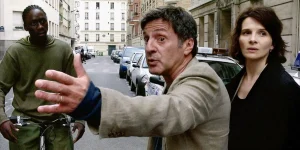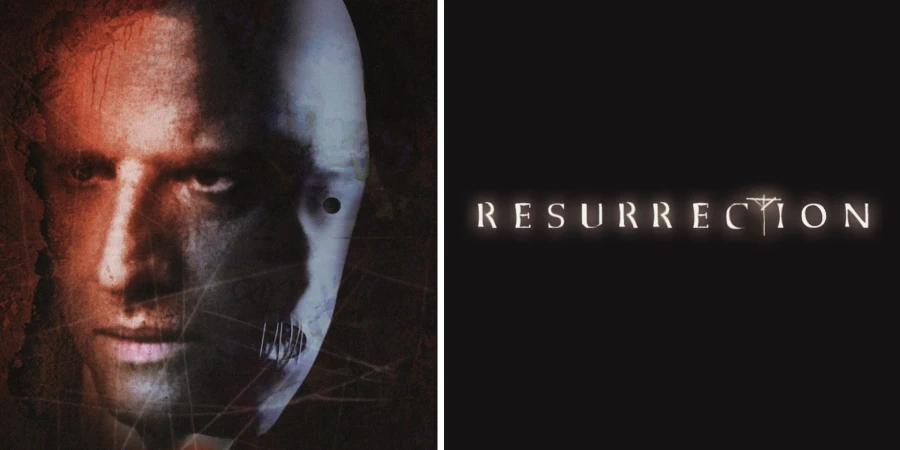
Russell Crowe plays a Chicago detective hunting a serial killer who collects body parts to reassemble a crucified Christ, and somehow that premise lands with genuine dread rather than camp. Resurrection (1999) arrived quietly, bypassed theaters for a cable premiere on Showtime, and has spent decades collecting dust despite delivering a tightly wound procedural with a genuinely unsettling villain. Director Russell Mulcahy strips the film of glamour and lets the ugliness sit on screen. This is a grimy, cold, serious piece of work.
Detailed Summary
Opening: A Body on Easter Sunday
Chicago detective John Prudhomme, played by Russell Crowe, catches a case on Easter Sunday. A body turns up missing its left arm, removed with surgical precision. Prudhomme and his partner Andrew Hollingsworth, played by Robert Joy, notice a message left at the scene referencing resurrection and the body of Christ.
Prudhomme is already a man under pressure. His marriage has collapsed, he drinks too much, and his estranged son barely knows him. Crowe plays this exhaustion physically: slumped posture, slow eyes, a man going through the motions before the case forces him awake.
The Pattern Emerges
A second murder follows. Another body, another limb removed, another biblical reference left behind. Prudhomme and Hollingsworth bring in FBI profiler Andrew Stuyvesant, played by David Cronenberg, yes, that David Cronenberg, in a quietly effective supporting performance.
Stuyvesant helps the detectives piece together the killer’s logic. Someone is collecting specific body parts, one from each victim, to construct a physical recreation of the crucified Christ in time for Easter. Each victim corresponds to a body part mentioned in the Passion narrative.
Prudhomme starts receiving personal letters from the killer. Handwritten, intimate, and theologically literate. Whoever this is, they have fixated on Prudhomme specifically.
Closing In and the Cost of Attention
Prudhomme digs into the theology with help from a local priest. He walks through the logic of the wounds of Christ, cross-referencing the missing limbs against scripture. It is procedural detective work done with unusual patience, and Mulcahy lets those scenes breathe.
Suspect leads multiply and dry up. Prudhomme becomes consumed, sleeping at the office, letting his personal life further deteriorate. Crowe never overplays this obsession; he just looks increasingly hollow, like a man burning from the inside.
The killer, eventually revealed as a man named Bard, played by David Palffy, begins to taunt Prudhomme more directly. Bard is soft-spoken, educated, and absolutely convinced that what he is doing is sacred work rather than murder.
Hollingsworth Dies
Bard kills Hollingsworth. This is the film’s gut-punch moment, arriving without the usual telegraphing of a partner death. Robert Joy had made Hollingsworth warm and specific, a family man with a dry sense of humor, which makes his absence in the film’s final act feel genuinely heavy.
Prudhomme takes the death personally in the way only a grieving, self-punishing detective can. He pushes harder, cuts corners, and starts operating in ways that put him outside official channels.
The Trap Closes
With Easter approaching, Prudhomme works out that Bard needs one final body part to complete his construction. He sets a trap, using himself as bait. Bard has been circling Prudhomme throughout, drawn to him as a worthy witness to his work.
Bard walks into the trap but nearly turns it around. A brutal confrontation follows in a cold, spare interior space that Mulcahy shoots with very little light and almost no music. Crowe and Palffy play the scene as two men locked in a horrible intimacy, the detective and the killer who chose each other.
Movie Ending
Prudhomme survives. Bard does not. But the film earns its ending by refusing to make it triumphant. Prudhomme sits in the aftermath of the confrontation looking like a man who won nothing. He stopped the killings, yes, but Hollingsworth is still dead, his marriage is still rubble, and whatever Bard wanted to prove about faith and flesh hangs in the air unanswered.
The film’s final image pulls back from Prudhomme alone, framed small against a large, indifferent city. Mulcahy does not offer a sunrise or a reconciliation phone call to his son. He just lets the character exist in his damage.
What audiences often want to know is whether Bard actually completes his grotesque construction. He does not. Prudhomme stops him before the final piece is in place. The incomplete figure is discovered and photographed by investigators, and the film lingers on that image briefly: something almost finished, almost coherent, denied completion. It reads as the film’s thesis made visual. Bard’s theology, like all violent certainty, falls apart before it can prove anything.
Crowe’s performance in the closing minutes is his best work in the film. He barely speaks. He sits in a hallway outside the crime scene, forearms on his knees, staring at nothing. No catharsis. Just aftermath.
Are There Post-Credits Scenes?
Resurrection has no post-credits scenes. It was a television movie produced for Showtime, and it ends when it ends. No teases, no sequels were planned, no stingers.
Type of Movie
Resurrection is a psychological crime thriller with strong elements of religious horror. In tone it sits close to David Fincher’s Se7en, which almost certainly influenced it: a grimy urban setting, a theologically motivated serial killer, and a detective whose personal life mirrors the darkness of his cases.
It is not a supernatural film. Every element has a rational explanation. But it carries a genuinely unsettling atmosphere that pushes it past standard procedural territory.
Cast
- Russell Crowe – Detective John Prudhomme
- Robert Joy – Detective Andrew Hollingsworth
- David Palffy – Bard, the killer
- David Cronenberg – FBI Profiler Andrew Stuyvesant
- Barbara Tyson – Prudhomme’s estranged wife
- Richard Donat – Father Nolan
Film Music and Composer
The score was composed by Jim McGrath. Rather than leaning on big melodic themes, the music works mostly as atmosphere, supporting the film’s dark, rain-soaked Chicago setting and its grim procedural tone.
It suits the film. The music rarely tells you how to feel, and it avoids turning the killer’s scenes into operatic spectacle, which is the right call given how quietly and unsettlingly Robert Joy plays Gerald Demus.
Filming Locations
Resurrection was filmed primarily in Montreal, Quebec, Canada, doubling for Chicago. This was a budget and logistics decision common to Canadian-American television productions of the era.
Montreal’s older industrial and ecclesiastical architecture actually serves the film well. The stone churches and wet winter streets give the film a European griminess that makes Chicago feel less like a tourist-poster city and more like a place where this kind of darkness could fester unseen.
Awards and Nominations
Resurrection did not receive significant awards attention. As a Showtime television movie, it fell outside the theatrical release circuit where major critical prizes accumulate. It was not widely reviewed at the time of its premiere.
Behind the Scenes Insights
- David Cronenberg, one of cinema’s most celebrated horror directors, took the role of the FBI profiler in what amounts to a small but memorable piece of casting. Cronenberg has occasionally acted in other directors’ films throughout his career.
- Russell Crowe shot Resurrection during a period when he was building his Hollywood profile after L.A. Confidential (1997) but before Gladiator (2000) made him a global star. His commitment to the role feels like someone still proving himself rather than coasting.
- Director Russell Mulcahy came to the film with a background in music videos and genre pictures, including the Highlander franchise. Resurrection represents one of the more grounded and restrained entries in his career.
- The production leaned into practical effects for the crime scenes rather than relying heavily on digital work, which gives the disturbing imagery a tactile weight.
Inspirations and References
The most obvious touchstone is David Fincher’s Se7en (1995). Both films feature a serial killer organized around a theological framework, a weary detective with a crumbling personal life, and a rain-soaked urban environment that feels spiritually exhausted.
Beyond that direct influence, the film draws from a long tradition of procedural crime fiction that treats religious obsession as the ultimate engine of violence, from Thomas Harris’s Hannibal Lecter novels to the works of James Ellroy.
The specific Catholic theology at the film’s center, the wounds of Christ, the Passion narrative as a blueprint, reflects a broader cultural fascination in American crime storytelling with Catholicism as a space where devotion and violence share a very thin wall.
Alternate Endings and Deleted Scenes
No officially documented alternate endings or significant deleted scenes have been made public for Resurrection. Given its television origins, the production did not receive the kind of DVD special-edition treatment that might have surfaced cut material.
If alternate material exists, it has not entered public record. Nothing in this section should be fabricated, so this is simply an area where hard information is absent.
Book Adaptations and Differences
Resurrection is not based on a novel or any other pre-existing source material. It was written directly for the screen by Brad Mirman. There is no source text to compare it against.
Memorable Scenes and Quotes
Key Scenes
- The discovery of the first body on Easter Sunday, shot in flat grey morning light with no dramatic music, just ambient street noise and the sound of investigators’ shoes on wet pavement.
- Prudhomme laying out the biblical correspondence on a table: photographs, scripture printouts, a diagram of the crucified body. Crowe plays the moment of realization quietly, sitting back in his chair and rubbing his face rather than announcing his discovery.
- Hollingsworth’s death, which happens with jarring speed and no buildup. One scene he is alive and making a dry observation; the next he is gone. The film does not soften it.
- The final confrontation between Prudhomme and Bard, lit almost entirely by a single overhead source, two faces in shadow talking with terrible calm before violence erupts.
- The closing shot of Prudhomme alone in a hallway, made small by the frame, not victorious, just still alive.
Iconic Quotes
- “I am not a murderer. I am a builder.” Bard, explaining his work to Prudhomme in one of the film’s key exchanges.
- “You were supposed to witness this.” Bard, near the end, revealing why he fixated on Prudhomme specifically.
Easter Eggs and Hidden Details
- Each murder scene contains a small visual reference to a specific passage from the Gospel accounts of the crucifixion. Viewers familiar with the texts will recognize the correspondence before Prudhomme does.
- Bard’s apartment, seen briefly, contains religious imagery that is conspicuously incomplete: icons missing faces, a crucifix with no figure on it. These details quietly establish his obsession before it is articulated.
- Prudhomme’s apartment has a child’s drawing pinned to a nearly empty refrigerator. It is the only personal item visible in his living space, which economically communicates everything about his relationship with his son without a single line of dialogue.
- The film’s color palette shifts subtly as Easter approaches. Early scenes are blue-grey. By the final act, warmer but sickly amber tones begin to appear, suggesting corrupted religiosity rather than redemption.
Trivia
- Resurrection premiered on Showtime in 1999, which meant it largely bypassed the theatrical critical machinery and slipped under the radar despite a strong lead performance from a soon-to-be A-list actor.
- David Cronenberg, who plays the FBI profiler, has been a working actor in other directors’ films for decades alongside his career as a filmmaker. His casting here adds an intertextual layer for genre fans: the director of body-horror films appearing in a film built around corporeal violation.
- Russell Crowe’s performance was praised by some critics who caught the film, with several noting it as evidence that his range extended well beyond the action-adjacent roles he was then becoming known for.
- The film’s title operates on two levels: the literal resurrection Bard is attempting to construct, and the implicit question of whether Prudhomme himself can be resurrected from his personal dissolution.
- Brad Mirman, the screenwriter, had previously written the crime thriller Knight Moves (1992), another serial killer procedural, which suggests a sustained interest in the genre.
Why Watch?
Crowe gives a performance here that most people have never seen, a physically deflated, emotionally wrecked detective who never once tips into self-pity, and it is a sharper piece of acting than several of his more celebrated roles. Palffy’s killer is the most underrated element: soft where he should be monstrous, which is far more disturbing. Watch it as a corrective to the polished serial-killer procedurals that have crowded streaming platforms since.
Director’s Other Movies
- Highlander (1986)
- Razorback (1984)
- Ricochet (1991)
- The Shadow (1994)
- Highlander II: The Quickening (1991)
Recommended Films for Fans
- Se7en (1995)
- Copycat (1995)
- Fallen (1998)
- The Pledge (2001)
- Manhunter (1986)
- The Bone Collector (1999)