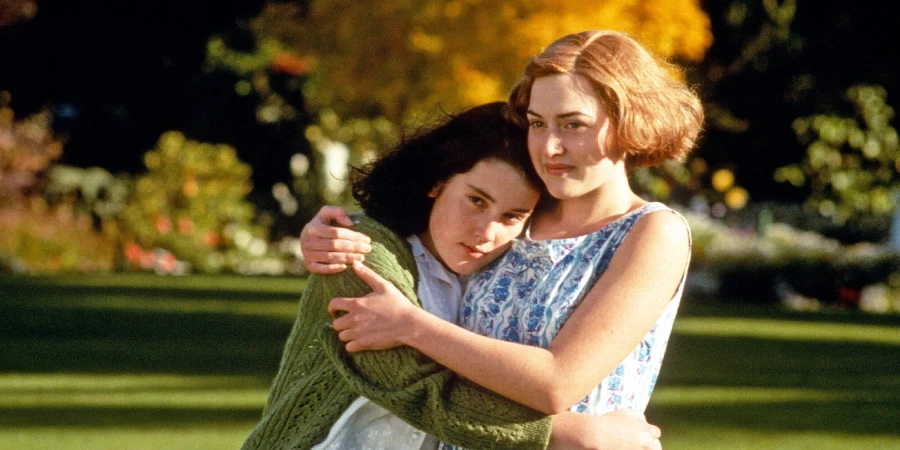

Two teenage girls in 1950s New Zealand bludgeoned a woman to death with a brick inside a stocking, and Peter Jackson turned that true crime into one of the most visually audacious films of the decade. Heavenly Creatures refuses to let you watch from a safe distance. It pulls you into Pauline Parker and Juliet Hulme’s fantasy world with such seductive color and warmth that when the murder arrives, it hits like a physical blow.
Detailed Summary
Arrival and First Meeting
The film opens in 1952 Christchurch, New Zealand, with Pauline Parker (Melanie Lynskey) narrating from her diary. She is bookish, awkward, and simmering with barely concealed contempt for her working-class family. Then Juliet Hulme (Kate Winslet) walks into her school, and everything changes.
Juliet is the daughter of a prominent academic, confident to the point of arrogance, and she carries herself like she owns every room she enters. Pauline is immediately drawn to her. Their friendship ignites fast, fueled by a shared disdain for ordinary people, whom they privately label “morons.”
The Birth of Borovnia
As the girls grow closer, they construct an elaborate shared fantasy world called Borovnia. Jackson visualizes this place with lush, hyper-saturated colors, giant clay figures, and operatic melodrama. It feels genuinely alive on screen, which is exactly the point.
Borovnia is populated by royal characters the girls invent and act out obsessively. Their favorite is Charles, a dashing prince they both adore. The fantasy becomes a private religion, a shared delusion that binds them tighter than any ordinary friendship.
The Friendship Deepens Into Obsession
Pauline’s diary entries grow more fervent. She and Juliet skip school together, lose themselves in music, and declare themselves geniuses unappreciated by their small-minded world. Their parents begin to notice, and alarm sets in on both sides.
Jackson frames their bond with a romantic charge that he never tries to explain away. Whether their relationship is sexual or intensely spiritual is left deliberately open, but their emotional dependency is absolute. One scene shows them lying on grass, whispering about their royal characters, their faces inches apart, while the world outside their bubble simply ceases to matter.
Illness, Separation, and Growing Dread
Juliet contracts tuberculosis and spends months in a sanitarium. Pauline, left behind, becomes withdrawn and angry. Her diary turns darker. When Juliet returns, their reunion is explosive with joy, and the fantasy world roars back to life with even greater intensity.
Both sets of parents now see the friendship as pathological. Juliet’s father, Dr. Henry Hulme (Clive Merrison), has his own crisis: he is losing his academic post, his marriage is collapsing, and his wife Hilda (Diana Kent) is having an affair with a lodger. Juliet discovers all of this and is shattered.
The Plan Takes Shape
Dr. Hulme announces the family will leave New Zealand permanently. Juliet will not stay behind, and Pauline cannot come with them. The girls fixate on one solution: Pauline must go to South Africa with Juliet. For that to happen, they need Pauline’s mother, Honora Parker (Sarah Peirse), to agree.
Honora refuses. She will not give permission, and she actively opposes the plan. In the girls’ diary logic, Honora becomes the obstacle, and then something more sinister: she becomes the enemy. Pauline begins writing coldly about her mother, stripping her of humanity in the pages of her journal.
Their plan shifts from persuasion to murder. Pauline records the decision in her diary with chilling matter-of-factness, referring to the killing as “the happy event.” Jackson shows us the girls wrapping a half-brick in a stocking, practicing their story, and walking Honora toward her fate.
Movie Ending
On June 22, 1954, Pauline and Juliet take Honora for a walk through Victoria Park in Christchurch. Jackson films the approach in wide, almost peaceful shots. Then Juliet drops a pink carnelian stone on the path so that Honora bends down to pick it up.
Pauline strikes first. What follows is brutal and extended, not stylized, not quick. Honora does not die easily, and the film makes sure you feel every second of it. She screams, she struggles, and both girls take turns with the brick. By the end, their clothes and hands are covered in blood.
They walk to the tearoom at the park and tell staff that Honora has fallen and hit her head. Nobody believes them. Police arrive. The girls are arrested separately, and the investigation quickly uncovers Pauline’s diary, which lays out the motive and the premeditation in Pauline’s own handwriting.
Both girls are tried and convicted of murder in 1954. Because they are under eighteen, they are sentenced to be detained “at Her Majesty’s pleasure” rather than executed. New Zealand law at the time specified they could not be imprisoned together, which was the point: their bond was considered the source of the danger.
Jackson ends the film with text cards rather than dramatized aftermath. We learn that both girls were released after roughly five years. They were forbidden from ever contacting each other again. The final revelation is the one that sent genuine shockwaves through audiences: Juliet Hulme later became the crime novelist Anne Perry, a fact that had been a secret for decades before the film’s release forced it into public view.
That ending lands harder than any fictional twist could. You have just watched Kate Winslet play a real woman who built a celebrated literary career while her crime remained unknown to most of her readers. There is no redemption arc, no apology, just the strange, mundane persistence of life after catastrophe.
Are There Post-Credits Scenes?
No. Heavenly Creatures has no post-credits scene of any kind. Once the closing text cards appear, the film is finished. You can leave when the credits start rolling.
Type of Movie
Heavenly Creatures is a psychological drama with strong elements of true crime and dark fantasy. It sits in unusual territory: part coming-of-age story, part horror film about the logic of shared delusion. The tone shifts constantly, from euphoric to suffocating to genuinely violent.
Peter Jackson made this before his Lord of the Rings years, and it shows his ability to make fantasy feel physically real long before he had a massive budget to do it with. Genre-resistant viewers should know this film is more intense drama than thriller.
Cast
- Melanie Lynskey – Pauline Parker
- Kate Winslet – Juliet Hulme
- Sarah Peirse – Honora Parker
- Diana Kent – Hilda Hulme
- Clive Merrison – Dr. Henry Hulme
- Simon O’Connor – Herbert Rieper (Pauline’s father)
- Jed Brophy – Nicholas
- Peter Elliott – Bill Perry
Film Music and Composer
Peter Jackson and co-writer Fran Walsh made the deliberate choice to build much of the film’s emotional architecture around Mario Lanza‘s recordings rather than a conventional orchestral score. Pauline and Juliet are both obsessed with Lanza in real life, so his voice functions as both period detail and dramatic fuel.
Lanza’s sweeping, romantic tenor floods the Borovnia sequences with almost deranged grandeur. It makes you feel the girls’ intensity from the inside rather than watching it from the outside. That is a smart compositional decision, and it pays off consistently.
The original score was composed by Peter Dasent, a New Zealand composer who worked with Jackson on several earlier projects. Dasent’s contributions support the quieter, domestic scenes, leaving the big emotional moments to Lanza’s pre-existing recordings.


Filming Locations
Almost all of Heavenly Creatures was shot on location in Christchurch, New Zealand, the actual city where the Parker-Hulme murder took place. Shooting in the real environment gives the film a documentary undercurrent that no studio set could replicate.
Victoria Park in Christchurch is the genuine location of the murder, and Jackson filmed there. Walking audiences through that actual terrain makes the final sequence carry weight that would otherwise require far more cinematic artifice to achieve.
The Borovnia fantasy sequences required constructed sets to contrast sharply with the naturalistic location work. That visual contrast, grimy domestic reality versus lush painted fantasy, is one of the film’s most effective structural choices.
Awards and Nominations
Peter Jackson received an Academy Award nomination for Best Original Screenplay (shared with Fran Walsh) for this film. Both Melanie Lynskey and Kate Winslet received substantial critical attention, with Winslet’s debut performance earning her a BAFTA nomination for Best Supporting Actress.
Jackson also won the Silver Lion for Best Direction at the Venice Film Festival for this film. For a New Zealand production with a modest budget, the international recognition was significant.
Behind the Scenes Insights
- Melanie Lynskey had never acted in a film before this. Jackson spotted her in a school production and cast her as Pauline. Her performance feels lived-in because, in many ways, she was processing real emotions rather than drawing on technical training.
- Kate Winslet was barely eighteen when production began. This was her feature film debut, and she secured the role of Rose in Titanic just a few years later partly on the strength of what she did here.
- Peter Jackson and co-writer Fran Walsh reportedly read Pauline Parker’s actual diaries extensively during research. The diary entries heard in voiceover are drawn directly from the real documents, not invented.
- Jackson used early digital effects technology to bring the Borovnia sequences to life, particularly the giant clay figures. For 1994, the integration of those effects with live action was ambitious and mostly convincing.
- The production team deliberately kept the identity of Juliet Hulme’s adult alias under wraps during filming and marketing. When the film released and it became public that Anne Perry was Juliet Hulme, it was a genuine news event.
- Juliet Hulme, by then Anne Perry, was reportedly not consulted during the making of the film and had mixed feelings about it publicly confronting a secret she had kept for decades.
Inspirations and References
The film draws directly from the real Parker-Hulme murder case of 1954, one of New Zealand’s most notorious crimes. Pauline Parker’s actual diaries, preserved as evidence from the trial, provided Jackson and Walsh with primary source material of extraordinary intimacy.
The girls’ shared obsession with Mario Lanza and their fantasy world were documented facts from the investigation, not inventions. Jackson was faithful to those details because they were stranger and more useful than anything a screenwriter could fabricate.
The film also reflects a clear awareness of the Romantic literary tradition: the girls model their inner world on grand, doomed passions. Their fantasy is partly constructed from the novels and poetry they consumed voraciously, and Jackson embeds that literary fever into the Borovnia sequences visually.
Alternate Endings and Deleted Scenes
No officially documented alternate ending for Heavenly Creatures has been released or confirmed. The film’s conclusion mirrors the historical record closely, which left Jackson little room to deviate even if he had wanted to.
Jackson has spoken in interviews about the challenge of pacing the final act, but no specific deleted scenes have been widely documented or included in home video releases. No extended cut or director’s cut has been released.
Book Adaptations and Differences
Heavenly Creatures is not based on a novel. It is an original screenplay by Peter Jackson and Fran Walsh, drawn from historical records, trial documents, and Pauline Parker’s real diaries. Several books about the Parker-Hulme case existed before the film, most notably Peter Graham’s research into the case, but none of them served as a direct source text for the screenplay.
Memorable Scenes and Quotes
Key Scenes
- Pauline and Juliet’s first meeting at school, where Juliet coughs dramatically and then grins as if daring anyone to pity her: Winslet plays it with such precise, controlled charisma that you understand immediately why Pauline is hooked.
- The first entry into Borovnia, where the screen floods with emerald green and the clay figures move through a landscape that looks like a fever dream painted by a teenager who has read too much Byron.
- Juliet’s breakdown when she discovers her parents’ marriage is destroyed, with Winslet dropping every ounce of bravado and shaking on the floor of her bedroom. It is the best single moment in her performance.
- The murder sequence in Victoria Park, filmed in long, unrelenting takes that refuse to let the camera look away. Jackson gives you no musical swell, no stylistic softening. Just grass, blood, and screaming.
- Pauline writing the words “the happy event” in her diary, her handwriting calm and neat, while the film holds on the page long enough for the horror to fully register.
Iconic Quotes
- “The next time I write in this diary, Mother will be dead. How odd, yet how pleasing.” (Pauline, diary voiceover)
- “We have decided how sad it is for other people that they cannot appreciate our genius.” (Pauline, diary voiceover)
- “We are indeed the two most fortunate and wonderful people in the world.” (Pauline, diary voiceover)
Easter Eggs and Hidden Details
- Jackson cast himself in a brief cameo as a pedestrian near the park. Spotting him is a small reward for attentive viewers who know his face from his other films.
- The specific color palette of the Borovnia sequences is calibrated to mirror the oversaturated look of 1950s hand-tinted postcards and amateur film stock, tying the fantasy visually to the era rather than making it feel generic.
- Pauline’s bedroom is deliberately cluttered with Mario Lanza ephemera, mirroring details documented in the real investigation and giving the set design evidentiary weight beyond mere decoration.
- Some of the dialogue spoken in the Borovnia sequences mirrors language found in Pauline’s actual diary entries, blurring the line between documented history and dramatic invention in ways that reward close attention.
Trivia
- This was both Melanie Lynskey’s and Kate Winslet’s feature film debut.
- Juliet Hulme had been living as crime novelist Anne Perry for decades before the film’s release exposed her identity. The revelation caused significant controversy in the literary world.
- Peter Jackson made this film between his low-budget horror comedies and his eventual blockbuster work, and it remains the clearest signal that he could handle serious dramatic material.
- The real Pauline Parker changed her name after her release and has lived in deliberate obscurity. Her identity and location have generally been protected, and she has never publicly discussed the case.
- Jackson and Walsh’s screenplay was written partly as a counter-argument to the popular theory that the girls’ relationship was purely a folie a deux caused by mental illness, suggesting instead that their bond had its own internal logic.
- The film’s New Zealand release stirred considerable national debate about whether dramatizing the country’s most infamous murder case was appropriate, particularly so soon after some surviving family members were still alive.
Why Watch?
Kate Winslet’s debut performance alone justifies the two hours: watch the exact moment her composure cracks after she discovers her father’s betrayal, and you will see a fully formed actress working at a level most professionals take decades to reach. Lynskey matches her beat for beat, and together they make you complicit in a murder you see coming from thirty minutes out.
Director’s Other Movies
- Bad Taste (1987)
- Meet the Feebles (1989)
- Braindead (1992)
- The Frighteners (1996)
- The Lord of the Rings: The Fellowship of the Ring (2001)
- The Lord of the Rings: The Two Towers (2002)
- The Lord of the Rings: The Return of the King (2003)
- King Kong (2005)
- The Lovely Bones (2009)
- The Hobbit: An Unexpected Journey (2012)
- They Shall Not Grow Old (2018)