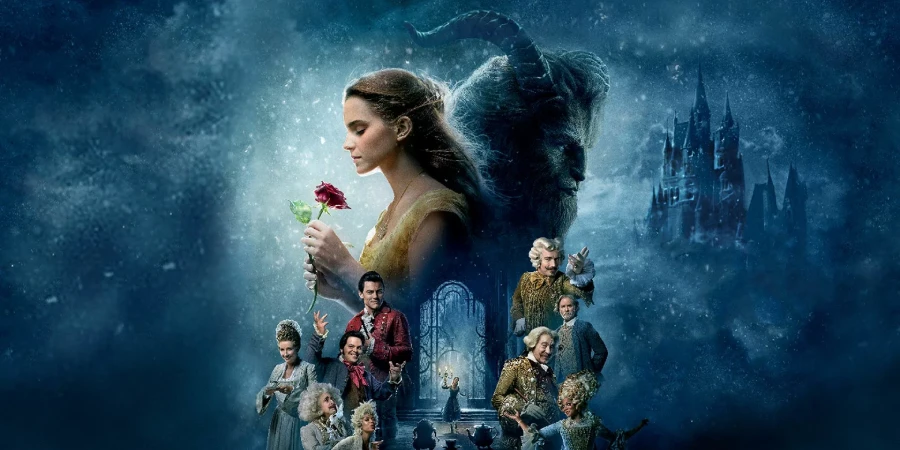

Disney’s 2017 live-action retelling of Beauty and the Beast opens with a decision that tells you everything: the camera pushes through a stained-glass window into a candlelit ballroom, and a narrator immediately reminds you how well you already know this story. Bill Condon is betting on nostalgia as a feature, not a bug. Emma Watson carries the film on sheer screen presence, even when the screenplay hands her clunky expository dialogue. Whether that bet pays off depends entirely on how much you love the 1991 original, and how patient you are with a film that occasionally forgets to earn its runtime.
Detailed Summary
The Prince’s Curse
A selfish young prince rules his castle in 18th-century France. An enchantress arrives disguised as an old beggar woman, and he turns her away. She punishes him by turning him into a hideous beast, transforming his servants into household objects, and wiping all memory of the castle from the surrounding villagers.
One enchanted rose holds the timeline. If the Beast falls in love and earns love in return before the last petal falls, the curse breaks. If not, he stays a beast forever, and his servants remain trapped as objects permanently.
Belle in Villeneuve
Belle lives in the small provincial town of Villeneuve with her father Maurice. She reads constantly, tinkers with inventions, and feels suffocated by the town’s small ambitions. The 2017 film adds a detail the original skipped: Belle actually teaches a young girl to read, which immediately draws the disapproval of the village men.
Gaston swaggers through town pursuing Belle, convinced she would make a perfect wife. He is charming on the surface and genuinely frightening underneath, and Luke Evans plays that duality with obvious relish. Gaston’s sidekick LeFou trails behind him, admiring him with an affection the film nudges toward something romantic.
Maurice Rides Into the Beast’s Domain
Maurice sets off to sell his music boxes at a market. He takes a wrong turn through a dark forest and stumbles onto the Beast’s enchanted castle. He briefly admires the grounds and picks a rose for Belle, which triggers the Beast’s fury. Maurice becomes a prisoner.
A horse named Phillippe returns to Villeneuve alone, and Belle follows him directly to the castle. She finds her father locked in a dungeon tower. Belle offers herself as prisoner in his place, and the Beast accepts without hesitation.
Life Inside the Castle
Belle refuses to dine with the Beast on her first night and ends up in the forbidden West Wing anyway. She sees the enchanted rose and the Beast’s torn portrait. He arrives furious, and she flees into the night forest, nearly killed by wolves before the Beast saves her. That rescue is the film’s first real turning point.
Back inside, the enchanted servants work hard to soften relations between the two. Lumiere, the candelabra voiced by Ewan McGregor, orchestrates the “Be Our Guest” number with theatrical glee. Cogsworth, Mrs. Potts, and the others have obvious personal stakes in this romance working out.
Forbidden Rooms and Growing Feelings
The Beast shows Belle the castle’s massive library, and for her that is the moment everything shifts. He gives it to her outright. That gesture does more for their developing connection than any scripted romantic scene in the film.
A new subplot here involves an enchanted book that lets them travel anywhere in the world. They use it to visit Paris, where Belle learns that her mother died of plague and her father fled to protect her from the grief. It adds emotional backstory the original never bothered with, though it sits a little awkwardly in the pacing.
Gaston’s Scheme
Gaston grows impatient after Belle repeatedly rejects him. He hatches a plan with the scheming Monsieur D’Arque to have Maurice committed to an asylum, using Maurice’s wild stories about a Beast as evidence of madness. His calculation is cold and practical: remove the father, isolate Belle, and she will have no choice but to accept him.
LeFou watches Gaston slide deeper into cruelty and grows visibly uncomfortable. His loyalty starts to waver. Josh Gad gives LeFou more interior life than the character has ever had on screen before.
Belle Leaves, Maurice Suffers
The Beast, sensing Belle’s longing for her father, lets her go. He uses the enchanted mirror to show her that Maurice is in trouble. She races back to Villeneuve and uses the mirror to prove the Beast exists, hoping to defend her father’s sanity.
Gaston turns that proof against her. He convinces the crowd that the Beast is a threat, locks both Belle and Maurice in the wagon, and leads an angry mob to the castle. His manipulation of public fear plays out quickly but effectively.
The Battle at the Castle
Gaston leads the villagers through the castle. Mrs. Potts, the wardrobe, and the other enchanted objects fight back with surprising ferocity. LeFou defects mid-battle, switching sides when a wardrobe dresses him in women’s clothes and he seems briefly and delightedly fine with it.
Gaston corners the Beast on the castle’s rooftops. The Beast, having given up on life after Belle left, barely fights back. Seeing Belle return gives him something to live for, and he rallies. He defeats Gaston and shows mercy, telling him to leave.
Movie Ending
Gaston, shown no mercy in return, shoots the Beast from a crumbling bridge. He fires three times. The Beast collapses on the balcony as Gaston falls to his death below. Belle reaches the Beast just as the last petal drops from the enchanted rose.
She tells him she loves him. He dies anyway, which is the film’s bravest beat, refusing to cut away before the grief lands. One by one, the enchanted servants go still and silent. Lumiere’s flame goes out. Cogsworth stops ticking. Mrs. Potts becomes just a teapot.
Then the enchantress appears and breaks the curse. The Beast revives, rises, and physically transforms back into Prince Adam in a swirl of golden light and petals. Emma Watson’s face does the work here: she watches the transformation with wariness rather than immediate joy, and only recognizes him when she looks into his eyes.
Every servant returns to human form. The villagers who had forgotten the castle suddenly remember everything. A grand ballroom scene follows, scored by the film’s signature waltz. Maurice and Belle reunite. LeFou dances with a male villager in a brief but deliberate moment. Prince Adam and Belle dance, and the camera pulls back through the same stained-glass window that opened the film.
What the ending gets right is restraint in the final moments between Belle and Adam. She chooses him after seeing who he is without the curse’s pressure. That choice feels earned because the film spent real time on their shared love of books and ideas, not just their shared trauma.
Are There Post-Credits Scenes?
Beauty and the Beast (2017) has no post-credits scene. You can leave when the ballroom fades to black. Disney’s live-action remakes have generally skipped the Marvel-style tag, and this one is no different.
Type of Movie
This is a live-action fantasy musical romance. It operates with the tone of a traditional Broadway-style spectacle, leaning into theatrical staging and musical numbers over naturalistic drama. Lighthearted for most of its runtime, it darkens noticeably in the third act.
Younger viewers will enjoy the spectacle. Adults familiar with the original will spend most of the runtime running internal comparisons, which is honestly part of the experience the film is designed for.
Cast
- Emma Watson – Belle
- Dan Stevens – The Beast / Prince Adam
- Luke Evans – Gaston
- Josh Gad – LeFou
- Kevin Kline – Maurice
- Ewan McGregor – Lumiere (voice)
- Ian McKellen – Cogsworth (voice)
- Emma Thompson – Mrs. Potts (voice)
- Audra McDonald – Madame Garderobe (voice)
- Stanley Tucci – Maestro Cadenza (voice)
- Gugu Mbatha-Raw – Plumette (voice)
- Nathan Mack – Chip
Film Music and Composer
Alan Menken returned to score the film, decades after writing the original 1991 soundtrack with Howard Ashman. His presence ensures tonal consistency across both versions. New lyrics were written by Tim Rice, who stepped in to replace the late Ashman.
Three new original songs were added: “How Does a Moment Last Forever,” “Days in the Sun,” and “Evermore.” “Evermore” is the clear standout, sung by Dan Stevens as the Beast watches Belle leave. Stevens performs it with genuine anguish, and it became the most commercially discussed new addition to the score.
Emma Thompson’s version of the title song carries enormous pressure given Angela Lansbury’s original. Thompson handles it warmly, though her vocal performance invites constant comparison, which is a structural problem the film never quite solves.
Filming Locations
Principal photography took place at Shepperton Studios in Surrey, England. Nearly everything inside the castle was built as a practical set, which gives the interiors a physical weight that pure CGI environments rarely achieve.
Exterior village scenes drew on a mix of studio construction and location dressing. The production design team, led by Sarah Greenwood, built Villeneuve as a coherent physical space rather than a series of disconnected sets. That attention to geography makes the village feel lived-in.
France itself does not appear in the film in any significant on-location capacity. The decision to keep production in England kept scheduling tight and gave the designers full control over every frame of the environment.
Awards and Nominations
The film received Academy Award nominations for Best Costume Design and Best Production Design. It did not win in either category. Jacqueline Durran’s costume work, particularly Belle’s gold gown, generated significant awards attention.
The film won a Grammy Award for Best Compilation Soundtrack for Visual Media. It also received nominations from the Critics’ Choice Movie Awards and the Saturn Awards, among others.
Behind the Scenes Insights
- Dan Stevens wore a performance capture suit with a camera rig attached to his head throughout Beast scenes, allowing his facial expressions to drive the CGI character directly.
- Emma Watson reportedly wore a custom corset-free version of Belle’s iconic yellow gown to reflect the character’s practical nature.
- Director Bill Condon previously directed the final two Twilight films, making this his highest-profile musical project.
- The “Be Our Guest” sequence reportedly took over a year to animate and design.
- Luke Evans and Josh Gad actually performed their musical numbers live on set rather than recording them separately and lip-syncing.
- Alan Menken composed a full underscore alongside the vocal songs, which runs nearly continuously under dialogue scenes to maintain the theatrical feel.
- The production used 750 crew members at peak shooting periods at Shepperton.
- Watson did her own stunts on the horse Phillippe, which required significant time in equestrian training before shooting began.
Inspirations and References
The primary source is the 1991 Disney animated film of the same name, with the 2017 version functioning largely as a scene-by-scene expansion rather than a reimagining. The animated film itself drew from the French fairy tale La Belle et la Bête, most famously the 1740 version by Gabrielle-Suzanne Barbot de Villeneuve, later condensed by Jeanne-Marie Leprince de Beaumont in 1756.
Jean Cocteau’s 1946 film adaptation, also titled La Belle et la Bête, influenced the visual atmosphere of several castle scenes, particularly the use of candlelit corridors and living architecture.
The Broadway musical adaptation of the 1991 film, which ran for years on the Great White Way, also informed how Condon staged several of the theatrical numbers.
Alternate Endings and Deleted Scenes
No dramatically different alternate ending has been officially released. The home video release included several deleted and extended scenes, most notably an extended version of the enchanted book travel sequence with more dialogue between Belle and the Beast in Paris.
An early version of the script reportedly placed more emphasis on the backstory of the enchantress and her reasons for cursing the prince. That material was scaled back considerably in the final cut, leaving the enchantress as a near-silent presence who mostly just shows up to reverse the spell at the end. Honestly, that was the right call.
Book Adaptations and Differences
This film is not a direct book adaptation. It adapts the 1991 Disney animated film, which itself drew from the Villeneuve and Leprince de Beaumont fairy tales. Several changes from the animated source are worth noting.
Belle’s backstory receives a significant expansion: her mother’s death and Maurice’s protective secrecy add emotional context that the 1991 film omitted entirely. The enchanted book device is also new. Gaston’s arc runs slightly darker, with his willingness to leave Maurice to die in the forest adding a premeditated cruelty that the animated version only implied.
LeFou’s characterization shifts most dramatically. His comic-relief role gets layered with genuine moral conflict and a subtle romantic orientation that the original character never had.
Memorable Scenes and Quotes
Key Scenes
- The “Be Our Guest” number: Lumiere launches into the full production number at the dinner table. Dishes spin, food erupts into choreographed spectacle, and the camera swings from overhead crane shots to tight close-ups of individual performers. It is deliberately excessive in exactly the right way.
- The Beast gives Belle the library: He leads her to a two-story room packed floor-to-ceiling with books, watches her face as she takes it in, and simply says she can have it. No grand speech. Watson’s reaction, a sharp intake of breath and a slow smile, sells the entire romance in about four seconds.
- The ballroom waltz: Belle descends in a gold gown, the camera cranes up and away, and the two of them dance in a room decorated to look like a night sky. Visually it is the film’s most complete image.
- “Evermore” on the balcony: The Beast watches Belle ride away through the enchanted mirror, then turns to the snowblown balcony and sings. Stevens performs with his actual voice, face visible in the motion-capture data driving the CGI, and the isolation in the shot earns the emotion.
- LeFou’s defection during the battle: Mid-combat, a wardrobe dresses him in women’s clothes, Gaston abandons him without a second thought, and LeFou simply switches sides. It is played for laughs but it actually lands as a small character beat about loyalty.
- The Beast’s death scene: Gaston shoots him three times and the Beast collapses. Belle reaches him while he is still alive, and the camera stays on both of them as he dies. It refuses to rush past the grief, which is the most mature choice the film makes.
Iconic Quotes
- “I am not a Beast.” (Prince Adam, during the transformation)
- “She warned him not to be deceived by appearances, for beauty is found within.” (Narration, opening sequence)
- “I am not a princess.” (Belle, pushing back against the village’s expectations of her)
- “There’s something there that wasn’t there before.” (Mrs. Potts, observing the developing bond)
- “How in the midst of all this sorrow can so much hope and love endure?” (From the song “Days in the Sun”)
- “I want adventure in the great wide somewhere.” (Belle, singing about her desire for more than provincial life)
Easter Eggs and Hidden Details
- The stained-glass windows in the opening sequence illustrate the story of the curse in images that mirror the style of the 1991 animated film’s opening narration panels.
- When the servants return to human form at the end, the camera lingers on Lumiere and Plumette’s reunion, and the arrangement of their embrace mirrors a famous moment from the animated film almost exactly.
- The enchantress who cast the spell appears several times in Villeneuve in disguise before the climax, watching events unfold. Most viewers miss her entirely on first viewing.
- Gaston’s tavern features animal trophies and hunting memorabilia that foreshadow his willingness to hunt the Beast as though he were prey.
- The torn portrait of the prince in the West Wing shows the eyes intact, which the 2017 film uses to connect to Belle recognizing Adam by his eyes during the transformation scene.
- The color scheme of Belle’s everyday blue dress directly mirrors the 1991 animated film’s palette, a deliberate visual callback to the source.
- During “Be Our Guest,” there is a brief visual nod to Busby Berkeley-style overhead choreography, with dishes arranging themselves into geometric patterns when viewed from above.
Trivia
- The film grossed over 1.2 billion dollars worldwide, making it one of the highest-grossing musical films ever released.
- Dan Stevens lost a significant amount of weight to play the Beast, since a leaner frame worked better with the motion-capture suit and the CGI proportions of the character.
- Emma Watson turned down the role of Cinderella before accepting Belle.
- The film was Bill Condon’s first musical since Dreamgirls in 2006.
- LeFou became one of Disney’s first explicitly gay characters, which caused the film to be briefly banned or restricted in several countries.
- Alan Menken and Howard Ashman originally wrote additional songs for the 1991 film that were cut; one of those songs, “Human Again,” was later used in the Broadway production and appears in an extended cut of the animated film but not in the 2017 version.
- The production design team built over sixty individual sets at Shepperton Studios for the shoot.
- Kevin Kline was Condon’s first and only choice for Maurice, partly because of his background in musical theater.
Why Watch?
Luke Evans delivers a Gaston who is genuinely frightening rather than just comic, and that single casting success gives the film a tension the 1991 original never quite had. Watch it for Evans making a cartoon villain feel like a real threat, for Dan Stevens performing “Evermore” with visible heartbreak, and for a ballroom sequence that uses scale and color in ways that justify a big screen.
Director’s Other Movies
- Gods and Monsters (1998)
- Kinsey (2004)
- Dreamgirls (2006)
- The Twilight Saga: Breaking Dawn Part 1 (2011)
- The Twilight Saga: Breaking Dawn Part 2 (2012)
- Mr. Holmes (2015)
Recommended Films for Fans
- Beauty and the Beast (1991)
- Cinderella (2015)
- Beauty and the Beast (1946)
- Enchanted (2007)
- Into the Woods (2014)
- The Phantom of the Opera (2004)
- Maleficent (2014)
- Moulin Rouge! (2001)