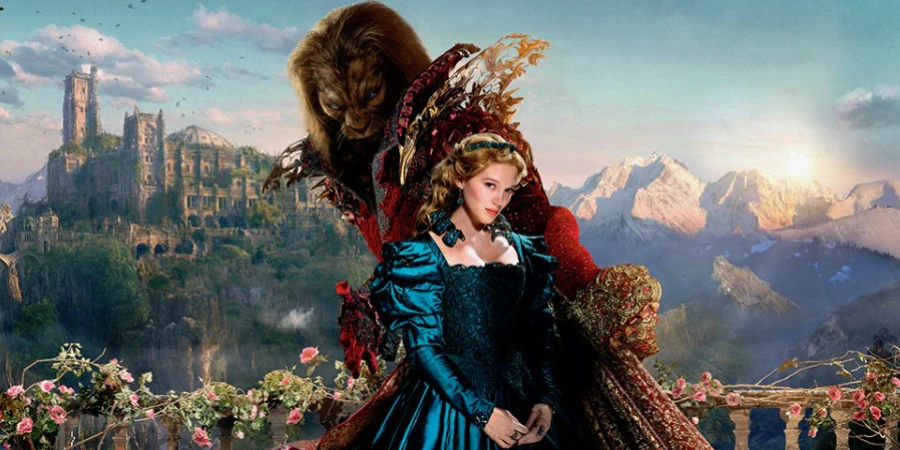
Christophe Gans returned to French fairy tale territory with his 2014 adaptation of Beauty and the Beast, and the result is a film that commits fully to spectacle, sometimes at the expense of emotional weight. Shot with a painterly obsession for gold light and baroque excess, it looks like a Versailles fever dream stretched across two hours. Vincent Cassel plays the Beast with a coiled intensity that the script never quite deserves, and Léa Seydoux brings a sharp, watchful quality to Belle that keeps the film honest even when the CGI threatens to swallow everything whole.
Detailed Summary
A Merchant’s Ruin and a Desperate Promise
A once-wealthy merchant loses his fortune when his trading ships sink. He has six children: three vain, materialistic sons and daughters, and one daughter, Belle, who asks only for a single rose when her father mentions he may travel to reclaim some goods.
On his journey, the merchant stumbles into an enchanted castle buried in a forest. He eats, sleeps, and is treated like a guest by invisible servants. When he plucks a rose from the garden for Belle, an enormous, terrifying Beast appears and sentences him to death.
The merchant begs for mercy. He is allowed to return home and say goodbye to his family, on the condition that one of his children voluntarily returns to take his place. Belle, consumed by guilt over the rose request, volunteers herself.
Belle Arrives at the Enchanted Castle
Belle arrives at the castle and finds it beautiful but suffocating. Miniature deer made of gold follow her like pets. Invisible hands serve her meals, dress her, and guide her through corridors dripping with candlelight.
Each night, the Beast visits her at dinner. He is enormous, leonine, and covered in dark fur, with massive antlers. His voice is low and controlled, and he watches her with an unnerving focus that reads less like menace and more like longing.
Belle begins to dream. Every night, vivid sequences pull her into the Beast’s past, revealing who he was before the curse took hold.
The Beast’s Backstory Revealed Through Dreams
Through Belle’s dream visions, we learn the Beast was once a prince, handsome and reckless, who ruled his kingdom with pleasure rather than wisdom. He loved hunting above all things, and his greatest trophy was a magnificent golden stag that he pursued obsessively through his own enchanted forest.
His wife, a beautiful and spirited woman, pleaded with him to stop the hunt. He ignored her. When he finally cornered and killed the stag, the forest goddess who protected it cursed him, transforming him into the Beast we see throughout the film.
His wife, grief-stricken and horrified by what her husband had become, fled into the forest. She died there, her body turning into one of the golden deer that now populate the castle grounds. This backstory lands harder than most of the main plot.
Belle and the Beast Grow Closer
Belle and the Beast develop a careful, tentative bond. He gives her freedom to explore the castle and its grounds. She pushes back against his gruffness, refuses to be afraid of him, and begins to see the grief buried beneath his animal exterior.
He shows her a magic mirror that lets her check on her family. She watches her father struggle while her brothers plan something reckless. The mirror becomes both a comfort and a source of tension, tethering her emotionally to the world outside.
The Brothers’ Greed Poisons Everything
Belle’s brothers are deep in debt. They discover through her that the Beast’s castle is filled with unimaginable wealth. Motivated entirely by greed, they hatch a plan to raid the castle and steal its treasures.
They also owe a significant debt to Perducas, a brutal local moneylender and thug who has been terrorizing the family. His threat gives the brothers a convenient excuse for their betrayal, but the film makes clear that greed rather than desperation drives them.
The Brothers Invade the Castle
The brothers lead Perducas and his armed men into the castle. Chaos erupts. Invisible servants and enchanted objects fight back with surprising violence, and the castle itself seems to resist the invaders.
Perducas comes face to face with the Beast. The confrontation is brutal and loud. The Beast, in full rage, is genuinely frightening here, and Gans films the sequence with a kinetic energy that finally puts the creature’s physicality to proper use.

Movie Ending
Belle, given temporary leave from the castle to visit her ailing father, lingers too long outside. She watches through the magic mirror as the Beast is wounded and cornered by Perducas and his men inside the castle. She rides back immediately, driven by something that has clearly grown beyond gratitude or obligation.
She confesses her love to the dying Beast. This declaration breaks the forest goddess’s curse. The Beast convulses and sheds his animal form, his fur and antlers falling away as he becomes the prince again. Vincent Cassel plays the transformation with visible relief rather than triumph, which is the right instinct.
Perducas is dispatched by the castle’s enchantments. The golden deer, including the spirit of the Beast’s dead wife, are finally released from their enchanted imprisonment. They dissolve into light and vanish, which is genuinely one of the film’s most affecting images.
The castle blooms back to life. The invisible servants become visible again. Belle and the prince stand together in a world that has shaken off centuries of guilt and grief. The merchant father arrives just in time to see his daughter safe, and the film closes on the suggestion of a future rather than spelling one out beat by beat.
What lingers most is the Beast’s dead wife, whose golden-deer form finally gets to rest. That thread carries more emotional resonance than the central romance, and the ending knows it. Gans lingers on her departure longer than anything involving the two leads, and he is right to do so.
Are There Post-Credits Scenes?
No. Beauty and the Beast (2014) contains no post-credits scene. Once the credits begin, the film is finished. You can leave the theater without missing anything.
Type of Movie
This is a dark fantasy romance aimed primarily at adults, though accessible to older children. Its tone sits somewhere between lush fairy tale and gothic drama, closer in spirit to Jean Cocteau’s 1946 film than to the Disney animated version.
Expect visual spectacle, emotional restraint, and bursts of action that feel slightly out of place in the quieter stretches. The film never fully commits to either intimate romance or grand adventure, which is its central tonal problem.
Cast
- Vincent Cassel – The Beast / The Prince
- Léa Seydoux – Belle
- André Dussollier – The Merchant (Belle’s Father)
- Eduardo Noriega – Perducas
- Myriam Charleins – Astrid, the Beast’s former wife
- Sara Giraudeau – Belle’s sister Héloïse
- Audrey Lamy – Belle’s sister Claire
- Nicolas Gob – Maxime, one of Belle’s brothers
Film Music and Composer
Pierre Adenot composed the score. His work here leans heavily into orchestral romanticism, with sweeping string arrangements that swell during the castle sequences and quieter, more fragile motifs during Belle’s dream visions of the prince’s past.
The score is competent without being particularly distinctive. It does exactly what the visuals ask of it, which is to say it amplifies the grandeur without adding a layer of emotional complexity that the film sometimes needs but never quite finds.
Filming Locations
Principal photography took place in France, with significant work done at studios and on locations chosen for their capacity to be digitally extended and enhanced. Much of the castle’s interior was built as a physical set and then augmented with CGI environments.
Outdoor forest scenes made use of real French woodland, giving the film a naturalistic texture that contrasts effectively with the hyper-ornate castle interiors. That contrast, rough bark and gold leaf, actually reinforces the film’s central visual argument about beauty and wildness existing side by side.
Awards and Nominations
The film received a nomination at the César Awards, France’s equivalent of the Oscars, in the category of Best Costume Design, which is entirely appropriate given how much the wardrobe contributes to the film’s identity. It did not make a significant dent in major international awards circuits.
Behind the Scenes Insights
- Director Christophe Gans cited Jean Cocteau’s 1946 adaptation as a key reference point, but deliberately pushed the visual scale far beyond what Cocteau could achieve with his resources.
- Vincent Cassel performed much of his physical role through motion capture and prosthetics, requiring hours of preparation each shooting day.
- The miniature golden deer seen throughout the film were entirely computer-generated, with the visual effects team drawing on references from classical sculpture and Baroque painting.
- Léa Seydoux has spoken about the physical demands of filming in elaborate costume, particularly during the castle sequence where full gowns made movement difficult.
- The production design team spent considerable time studying 17th and 18th century French decorative arts to establish the visual grammar of the castle’s interior.
- Gans pushed for a longer runtime than some producers initially wanted, arguing that the dream sequences revealing the Beast’s backstory were non-negotiable to the film’s emotional logic.
Inspirations and References
The film adapts the classic French fairy tale La Belle et la Bête, most famously written in its extended form by Madame de Villeneuve in 1740 and later condensed by Madame de Beaumont in 1756. Beaumont’s shorter version became the most widely read and the basis for most subsequent adaptations.
Jean Cocteau’s 1946 film La Belle et la Bête is a direct visual ancestor. Gans borrows Cocteau’s love of practical enchantment, disembodied hands, and castle atmospherics, then scales it up considerably with modern tools.
The film also draws on the broader tradition of French Baroque painting and the decorative excess of Versailles-era royal court culture. Every frame of the castle interior feels like a painting you could hang in the Palace of Versailles without anyone noticing the intrusion.
Alternate Endings and Deleted Scenes
No officially released alternate ending exists for this film. Some additional footage was trimmed during editing, particularly around the brothers’ subplot, which feels slightly compressed in the final cut. Those cuts likely reduced the running time but also flattened the brothers as characters.
No major deleted scene collection has been released publicly in a way that significantly alters the narrative of the film as distributed.
Book Adaptations and Differences
Madame de Villeneuve’s original 1740 novel is far more elaborate than any film adaptation. It includes extensive backstory for both Belle and the Beast, detailed fairy court politics, and a complex explanation for the curse that the film streamlines almost entirely.
Madame de Beaumont’s shorter 1756 condensation is the more direct source. Key differences in the 2014 film include the addition of the brothers as active antagonists, the villain Perducas, and the expanded visual mythology around the Beast’s dead wife and the golden deer. None of these elements appear in Beaumont’s version.
Beaumont’s Belle has more sisters and brothers but they function primarily as foils for her goodness. Gans sharpens that dynamic into an actual plot threat, which is one of his smarter screenplay decisions.
Memorable Scenes and Quotes
Key Scenes
- The first dinner between Belle and the Beast, where he watches her eat in complete silence while she holds his gaze without flinching, establishing the film’s central power dynamic in a single meal.
- The dream sequence showing the Beast’s wife standing in the golden forest begging him to abandon the hunt, lit in amber and soft green, shot like a memory already dissolving.
- The Beast cornering the golden stag and making his fatal choice, cutting between his exhilarated face and the animal’s wide, terrified eye.
- Belle’s golden gown sequence on the castle grounds, which is visually indulgent but genuinely gorgeous, a conscious homage to Cocteau’s dreamy aesthetics.
- The golden deer dissolving into light as the curse finally breaks, the film’s single most emotionally direct image and its best use of the CGI budget.
- Perducas and his men being torn apart by the castle’s enchanted defenses, which is far more violent than most audiences expect from a fairy tale film.
Iconic Quotes
- “You are not my prisoner. You are my guest.” The Beast’s early declaration to Belle, which rings with a tension neither of them fully believes yet.
- “I asked only for a rose.” Belle’s quiet response when her father explains how the Beast found him, a line that carries the whole weight of her guilt in eight words.
Easter Eggs and Hidden Details
- Several of the castle’s decorative motifs, particularly the carved stag heads, appear in scenes set long before the curse, suggesting the prince’s obsession was already reshaping his environment before the Beast form arrived.
- The golden deer that follow Belle throughout the castle are visible in the background of the dream sequences showing the prince’s court, connecting the present enchantment to the specific moment of its origin.
- Cocteau’s 1946 film featured arms emerging from candelabras along castle walls. Gans hides a similar visual in a wide shot of the dining hall during Belle’s first night, a direct nod to its predecessor.
- The color of Belle’s dresses shifts gradually from cool blues and silvers on her arrival to warmer golds as her relationship with the Beast deepens, a deliberate costuming choice rather than a continuity accident.
- The rose the merchant picks is a slightly different shade from all the other roses in the garden, slightly darker, which frames it visually as something already singled out for consequence before he touches it.
Trivia
- This was Christophe Gans‘s first French-language feature after spending years in development on various projects following his English-language work.
- Vincent Cassel and Léa Seydoux are both among the most internationally recognized French film stars of their generation, and casting both was a significant commercial and critical statement.
- The film was a substantial box office success in France, outperforming many local productions in its opening weeks.
- Several visual effects sequences involving the golden deer required a production pipeline closer to animated feature work than to standard live-action VFX, borrowing techniques from the games industry.
- Christophe Gans has spoken in interviews about his desire to create a French fantasy film that could compete visually with Hollywood productions on an international level.
- The film was released in France in February 2014, timed to capitalize on Valentine’s Day audiences, a commercial decision that aligned reasonably well with the film’s romantic core.
Why Watch?
Watch it for the backstory of the Beast’s dead wife, not the central romance. Vincent Cassel’s controlled anguish in those dream sequences, standing over the golden stag he has just killed while his wife stares at him with the particular look of someone watching a person she loved disappear, carries more genuine tragedy than most films manage in their entire third act. Seydoux is sharply watchable throughout, and Gans constructs images that earn their ambition even when the screenplay does not.
Director’s Other Movies
- Crying Freeman (1995)
- Le Pacte des loups (2001)
- Silent Hill (2006)
Recommended Films for Fans
- La Belle et la Bête (1946)
- Pan’s Labyrinth (2006)
- Bluebeard (2009)
- Snow White and the Huntsman (2012)
- Maleficent (2014)
- A Tale of Tales (2015)