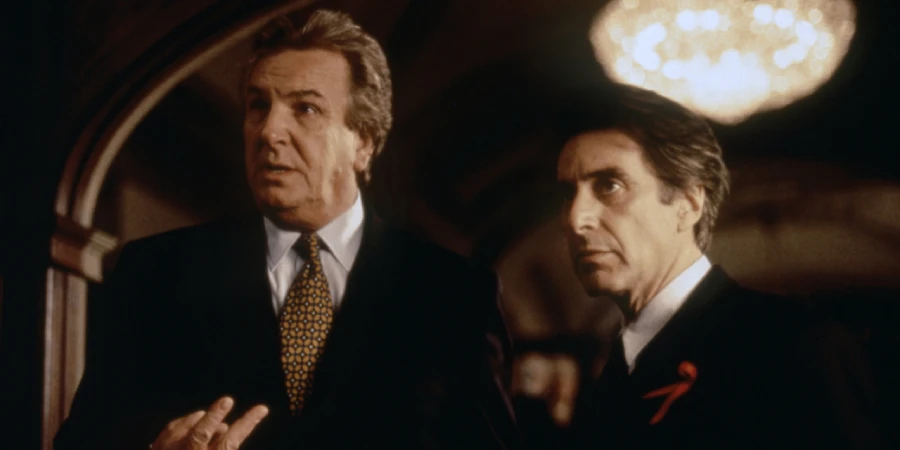

Al Pacino delivers one of his most controlled performances in a film that almost nobody talks about anymore, which is a genuine shame. City Hall (1996) puts a charismatic deputy mayor on a collision course with New York’s political machine after a single stray bullet kills a six-year-old boy. Director Harold Becker builds the corruption slowly, brick by brick, until the whole structure collapses under its own weight. This is a film about loyalty, compromise, and the exact moment a good man decides to stop asking inconvenient questions.
Detailed Summary
A Bullet Changes Everything
A shootout in a Brooklyn street leaves three people dead: a drug dealer, an off-duty police detective, and a six-year-old child named James Bone. New York Deputy Mayor Kevin Calhoun, played by John Cusack, arrives at the scene early and immediately senses something is wrong with the official story. His instinct is correct. The dead detective had ties to organized crime, and the dead drug dealer should have been in prison.
Calhoun discovers that the dealer received a lenient sentence from a judge named Stern, bypassing the normal prosecutorial process. That leniency came with a price, and tracing that price leads Calhoun deeper into a network of political favors that connects the courthouse to City Hall itself.
Mayor Pappas Takes the Stage
Mayor John Pappas, played by Al Pacino, dominates every room he enters. He is a political genius who genuinely believes he does good for New York, and Pacino makes you believe it too, at least for a while. His eulogy for young James Bone at a Brooklyn church is the film’s showpiece scene, a piece of soaring oratory that earns a standing ovation from the congregation.
Pappas genuinely cares about the city, or tells himself he does. Calhoun idolizes him, sees him as a mentor, and that dynamic shapes every choice the deputy mayor makes as the investigation tightens.
Calhoun Pulls on the Thread
Calhoun teams up with a city attorney named Marybeth Cogan, played by Bridget Fonda, who is investigating the same web of connections from a different angle. Together they follow the money and the favors from Judge Stern back to a Brooklyn party boss named Frank Anselmo, played by Danny Aiello. Anselmo is the political fixer who made the soft sentence happen.
What emerges is a classic machine politics arrangement. Anselmo delivers votes and loyalty upward in exchange for protection and influence flowing downward. Every player in the chain assumed the system would keep humming along quietly. A dead child made that impossible.
The Machine Starts to Crack
Calhoun confronts Anselmo, who is sweating under the pressure from multiple directions. Anselmo is not a cartoon villain; he is a neighborhood man who got in too deep and genuinely does not know how to climb out. Aiello plays this with real pathos, making Anselmo sympathetic even as his complicity becomes undeniable.
Calhoun also uncovers that the mob connection runs through Anselmo directly to a Mafia figure who had a stake in the drug dealer’s continued freedom. Every favor granted created a debt, and those debts now pointed back toward City Hall.
Pappas Is Implicated
This is the gut punch the film has been building toward. Calhoun finds evidence suggesting Pappas himself knew about, or even facilitated, the arrangement that kept the drug dealer on the street. Not because Pappas is a gangster, but because political machines run on accommodation, and Pappas made one accommodation too many years ago that compounded into catastrophe.
Cusack’s best moment in the film comes here. Sitting alone in his apartment late at night, Calhoun holds the evidence and says nothing for a long beat, his face cycling through denial, grief, and grim acceptance. No dialogue needed.
Movie Ending
Anselmo, facing exposure and unable to see a way out, takes his own life. His death removes the most vulnerable link in the chain but does not end the investigation. Calhoun now carries everything he knows directly into a confrontation with Mayor Pappas.
Pappas does not deny the essential truth. He explains himself in the way that powerful men explain themselves, with context, with justification, with a kind of exhausted candor that is more disturbing than a flat lie would have been. Pacino plays the scene quietly, which makes it hit harder than any of his more volcanic moments in the film. He asks Calhoun, in effect, what good men are supposed to do inside imperfect systems.
Calhoun has no answer that satisfies either of them. He chooses integrity over loyalty. He does not cover for Pappas. He steps away from City Hall, severing the mentor relationship that defined his career, and allows the investigation to proceed without interference from his office.
No dramatic arrest closes the story. Pappas’s political future hangs in ambiguity. Calhoun walks out into the city, and the film holds on New York for a moment, indifferent and enormous and still standing. It is a deliberately unsatisfying resolution in the best sense: corruption does not end with a clean verdict, and Becker refuses to pretend otherwise.
Are There Post-Credits Scenes?
City Hall has no post-credits scene. When the film ends, it ends. No tags, no teasers, no grace notes after the credits begin to roll.
Type of Movie
City Hall is a political thriller with strong elements of drama and procedural mystery. Its tone is serious and occasionally somber, closer to Sidney Lumet’s New York films than to a mainstream Hollywood thriller. Expect deliberate pacing, heavy dialogue, and character study over action sequences.
Cast
- Al Pacino – Mayor John Pappas
- John Cusack – Deputy Mayor Kevin Calhoun
- Bridget Fonda – Marybeth Cogan
- Danny Aiello – Frank Anselmo
- Martin Landau – Judge Walter Stern
- David Paymer – Deputy Mayor Paul Zapatti
- Tony Franciosa – Moe Alter
Film Music and Composer
Jerry Goldsmith composed the score for City Hall. Goldsmith was one of Hollywood’s most reliable and versatile composers, with a career stretching from Chinatown to L.A. Confidential, and his work here suits the film’s brooding register perfectly.
His score stays largely understated, favoring low brass and restrained orchestration that underscores the film’s mood of institutional dread. Music never swells to tell you how to feel; it presses quietly from underneath, like the corruption it mirrors.



Filming Locations
City Hall shot extensively on location in New York City, using actual civic spaces to ground the story in physical reality. New York City Hall itself appears in the film, lending an authenticity that no studio set could replicate. Seeing real municipal corridors and chambers reinforces the film’s central argument: this city, these buildings, these people are real, and the rot inside them is real too.
Brooklyn locations also feature prominently, matching the film’s recurring tension between neighborhood-level politics and the power concentrated at the top of the city’s government. The geography does meaningful work in the storytelling.
Awards and Nominations
City Hall did not receive significant awards attention during its release cycle. It passed through theaters quietly, which remains one of the more puzzling cultural failures of mid-1990s Hollywood.
Behind the Scenes Insights
- Harold Becker had previously worked with Al Pacino on Sea of Love (1989), so the two brought an existing professional shorthand to the set.
- The script went through multiple writers, with Bo Goldman, Ken Lipper, Paul Schrader, and Nicholas Pileggi all receiving screenplay credits, which is an unusual number of credited contributors for a single film.
- Pacino reportedly prepared for the eulogy scene extensively, treating it almost as a stage monologue requiring sustained energy and precise modulation.
- John Cusack took the role partly because he was interested in working with Pacino and in exploring more politically grounded material than his earlier career had offered.
- The film had a relatively modest release and Polygram Filmed Entertainment did not push it aggressively with audiences, which contributed to its commercial underperformance.
Inspirations and References
Ken Lipper, one of the screenwriters, had real-world experience inside New York City government, having served as a deputy mayor under Ed Koch. His firsthand knowledge of how political machines operate, how favors get traded, and how good intentions corrode shaped the screenplay’s texture in ways that pure invention could not.
The film draws on a long tradition of New York political dramas and owes a visible debt to Sidney Lumet’s work, particularly Prince of the City (1981) and Q&A (1990), films that map similar territory of institutional corruption and individual conscience.
Alternate Endings and Deleted Scenes
No officially documented alternate endings or substantial deleted scene packages have surfaced publicly for City Hall. Given the script’s multiple credited writers, early drafts almost certainly contained different structural choices, but no concrete information about specific cut sequences exists on the record.
Book Adaptations and Differences
City Hall is not based on a book. It is an original screenplay, shaped significantly by Ken Lipper’s personal experience in New York politics rather than any pre-existing source material.


Memorable Scenes and Quotes
Key Scenes
- The eulogy at James Bone’s funeral: Pacino delivers a full-throated, emotionally escalating speech about what New York owes its children. He starts soft, moves through indignation, and arrives at something that sounds like genuine grief. The congregation rises. It is the most theatrical moment in a deliberately theatrical film, and it works completely.
- Calhoun alone with the evidence: Cusack sits in silence, holding documents that implicate his mentor. No score swells. He just sits there, and his stillness communicates more than a monologue would.
- The Pappas confrontation: Pacino lowers his voice to nearly a whisper as he explains his compromises to Calhoun. After all the oratory, quiet is his most effective weapon in this scene.
- Anselmo’s breakdown: Danny Aiello unravels in a scene that refuses to make Anselmo into a simple villain. He is a neighborhood man who bet on the wrong horse, and Aiello’s face shows you every year of that bad bet landing at once.
Iconic Quotes
- “A city is not a city without each of its citizens.” Pappas, during the eulogy.
- “I didn’t come here to destroy you, I came here to tell you what I know.” Calhoun, confronting Pappas.
Easter Eggs and Hidden Details
- Several background shots frame actual New York civic iconography, including architectural details of real government buildings, reinforcing the film’s blurred line between fiction and documentary reality.
- The film’s color palette in the scenes set inside City Hall leans toward deep golds and mahogany browns, contrasting sharply with the cold blue-grey tones used for street-level Brooklyn scenes. This visual distinction quietly maps privilege against precarity.
- Anselmo’s office is cluttered with neighborhood memorabilia and photos of local figures, a detail that characterizes him as a product of a specific place rather than a generic political operative.
Trivia
- Four writers share screenplay credit: Ken Lipper, Paul Schrader, Bo Goldman, and Nicholas Pileggi. Pileggi is best known for writing Wiseguy, the book that became Goodfellas.
- Martin Landau, playing Judge Stern, had just come off his Academy Award-winning turn in Ed Wood (1994), yet his role here went largely unnoticed by awards bodies.
- Harold Becker directed the film at age 60, and it remains one of his most ambitious productions in terms of subject matter and cast.
- City Hall opened in limited release in January 1996 before a wider rollout, typical of studio films that lacked commercial confidence.
- Despite the firepower of its cast and the quality of its script, the film grossed modestly against its production investment, becoming a textbook case of good work ignored on first release.
Why Watch?
Watch this film for the confrontation between Pacino and Cusack in the final act, where two men sit across from each other and talk about political complicity without raising their voices once. Pacino’s restraint in that scene is more interesting than any of his bigger, louder performances from the same decade. Few political thrillers from the 1990s trust their audience this much.
Director’s Other Movies
- The Onion Field (1979)
- Taps (1981)
- Vision Quest (1985)
- The Boost (1988)
- Sea of Love (1989)
- Malice (1993)
- Mercury Rising (1998)
Recommended Films for Fans
- Prince of the City (1981)
- Q&A (1990)
- Serpico (1973)
- The Verdict (1982)
- Michael Clayton (2007)
- State and Main (2000)
- All the President’s Men (1976)