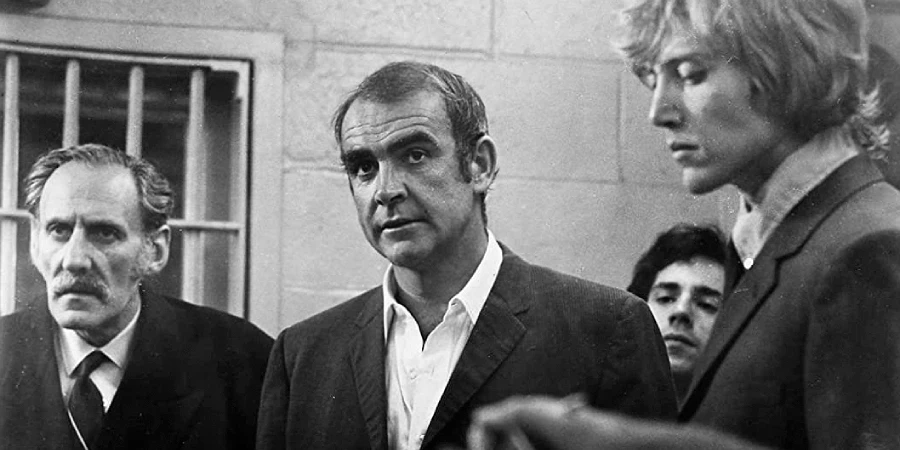

Sidney Lumet made a heist film about surveillance in 1971, and somehow the movie feels more uncomfortable to watch now than it did then. The Anderson Tapes follows a freshly paroled thief who plans to rob an entire luxury Manhattan apartment building, while federal agencies and organized crime figures record his every move without him knowing.
Sean Connery plays Duke Anderson with a strutting, bull-necked confidence that the film systematically dismantles. What Lumet delivers is less a caper and more a slow-burn argument that nobody in modern America, criminal or otherwise, moves through the world unobserved.
Detailed Summary
Duke Anderson Gets Out
After serving ten years in prison, John “Duke” Anderson walks free and immediately reconnects with his girlfriend, Ingrid Everleigh, a kept woman living in a posh Upper East Side apartment building called The Wyndham. Duke is a professional thief, and within hours of his release he is already casing the building with the hungry eyes of a man who sees not luxury but opportunity.
What Duke does not know is that federal agents have been recording him since before he left prison. A conversation he had with a mob contact years earlier put him on a wiretap, and those recordings never stopped accumulating.
The Plan Takes Shape
Duke visits Pat Angelo, a mid-level organized crime figure, to pitch the job. His pitch is audacious: rob every apartment in the building simultaneously on Labor Day weekend, when residents will be away. Angelo is skeptical, then intrigued, then in. Duke assembles a small, colorful crew including The Sniffer, a safecracker with a drug habit, and Salsbury, a specialist whose precise skills round out the team.
Every meeting Duke takes to plan the job gets recorded by someone. Federal agents tape his conversations with Angelo. A gay antiques dealer Duke visits to appraise potential loot has his own recording equipment running for personal reasons. A nursing home connected to one crew member is under audio surveillance for insurance fraud. Duke is building his crime inside a web of microphones he cannot see.
Labor Day Weekend Arrives
Duke and his crew move into the Wyndham on Labor Day weekend, confident the building will be mostly empty. They cut phone lines, restrain the doorman and superintendent, and begin working their way through the apartments floor by floor. It is a methodical, almost clinical operation, and Lumet films it with a procedural cool that makes you root for the crew despite yourself.
Things start fraying almost immediately. Not every resident left for the weekend. A wheelchair-bound boy named Haskins is home. An elderly resident refuses to cooperate quietly. The job, which looked clean on paper, turns messy in practice.
The Walls Close In
Crucially, the police had already been receiving fragments of information from all those surveillance tapes, but nobody connected the dots in time. Different agencies held different pieces of the puzzle, and bureaucratic compartmentalization kept them from sharing. By the time law enforcement realizes a major robbery is in progress at the Wyndham, Duke’s crew is already inside and working.
A massive police response assembles outside. Negotiators, patrol cars, and eventually heavily armed units surround the building. Duke and his crew are trapped inside with hostages and a dwindling set of options.

Movie Ending
Duke decides to try a brazen exit: load the stolen goods into a moving truck and bluff their way out. It does not work. Police open fire, the operation collapses, and most of the crew dies in the chaotic gunfight outside the Wyndham. Duke survives, badly wounded, and gets taken into custody on the street.
What follows is the film’s sharpest punch. Authorities begin reviewing all the surveillance recordings that documented Duke’s every planning move. The irony lands hard: a half-dozen separate agencies had more than enough recorded evidence to stop the robbery before it started. Nobody shared their tapes. Nobody coordinated. Government surveillance was thorough enough to document a crime in exhaustive detail and simultaneously useless at preventing it.
Duke gets convicted on the recordings he never knew existed. He goes back to prison, not because the surveillance system protected anyone, but because it generated evidence after the fact. Lumet closes on that note without softening it. The system watched everything and saved no one.
Are There Post-Credits Scenes?
The Anderson Tapes has no post-credits scene. Lumet was not making a franchise film, and the bleak irony of the ending needs no coda. When the film ends, it ends.
Type of Movie
The Anderson Tapes is a crime thriller with strong elements of dark satire. Its tone sits somewhere between a straightforward heist procedural and a paranoid political film. Lumet keeps the pacing relatively brisk, but the satirical undertow gets heavier as the story progresses.
It is not a comedic film, but it has a dry, acidic wit, especially in how it frames bureaucratic incompetence. Genre-wise, think heist film crossed with surveillance-state commentary.
Cast
- Sean Connery – John “Duke” Anderson
- Dyan Cannon – Ingrid Everleigh
- Martin Balsam – Tommy Haskins
- Ralph Meeker – Delaney
- Alan King – Pat Angelo
- Christopher Walken – The Kid (an early screen role)
- Val Avery – Parelli
- Dick Anthony Williams – Spencer
- Garrett Morris – Everson
Film Music and Composer
Quincy Jones composed the score, and it is one of the most underrated elements of the entire film. Jones uses electronic sounds and unconventional textures that feel genuinely unsettling, reinforcing the surveillance theme without ever becoming obvious about it. The music often sounds like it is being transmitted rather than performed.
Jones was already a versatile composer by this point, with scores including In Cold Blood and In the Heat of the Night to his credit. His work here leans into dissonance and mechanical rhythm, perfectly matching Lumet’s cold procedural aesthetic.


Filming Locations
Lumet shot primarily in New York City, which was his natural habitat. Real Manhattan streets, real apartment building facades, and real urban texture give the film an authenticity that a studio backlot could never replicate. You feel the city’s indifferent density pressing in on every scene.
Shooting on location in New York was a Lumet signature, and here it serves the surveillance theme directly. These are real streets where real people genuinely are observed, photographed, and recorded. Fiction and documentary reality blur usefully.
Awards and Nominations
The Anderson Tapes did not receive significant awards attention during its release cycle. It performed respectably at the box office but was not a major awards contender in a year crowded with heavy competition.
Behind the Scenes Insights
- Sidney Lumet was drawn to the project partly because its surveillance theme connected to broader anxieties about privacy that he found genuinely alarming in American society.
- Christopher Walken’s role as The Kid was an early film appearance, and his nervous, slightly off-kilter energy is already fully present even in a supporting capacity.
- Lumet insisted on shooting in real New York locations rather than constructing sets, a choice that kept costs grounded and added texture to every frame.
- Sean Connery was in a deliberate phase of shedding his James Bond image, and Duke Anderson, a street-level criminal with no gadgets and no glamour, was exactly the kind of role he was seeking.
- Quincy Jones and Lumet collaborated to make the score feel electronic and alienating, treating surveillance technology itself as a kind of sonic environment.
Inspirations and References
The Anderson Tapes is based on the 1969 novel of the same name by Lawrence Sanders. Sanders structured his novel as a collection of fictional transcripts: wiretap logs, surveillance reports, and recorded testimony. It was a formally inventive book, and it arrived at an anxious cultural moment when real debates about government surveillance were intensifying.
The film simplifies Sanders’s documentary structure into a more conventional narrative but keeps the satirical spine. Frank Pierson wrote the screenplay adaptation.
Alternate Endings and Deleted Scenes
No widely documented alternate endings or significant deleted scenes for The Anderson Tapes appear in the public record. Lumet was a disciplined filmmaker who generally shot what he intended to cut together, and he did not have a reputation for extensive alternative material.
Book Adaptations and Differences
Lawrence Sanders’s source novel presents the entire story through fictional documents: transcripts of recordings, surveillance logs, and agency reports. It is a deliberately dry, clinical reading experience that forces the reader to assemble the narrative from bureaucratic fragments. That format is the novel’s whole point.
Frank Pierson’s screenplay abandons that structure almost entirely, converting the story into a straightforward third-person narrative film. Audiences see Duke planning and executing the heist rather than reading transcripts about it afterward. The satirical critique of surveillance survives the translation, but the formally radical presentation does not. Readers of the novel will notice the shift immediately.


Memorable Scenes and Quotes
Key Scenes
- Duke’s first walkthrough of the Wyndham: Connery moves through the lobby with a predator’s patience, his eyes cataloguing exits and schedules while his face stays relaxed. It is a masterclass in acting without dialogue.
- The crew’s entry into the building: Lumet shoots the initial breach with a tight, almost documentary efficiency. No swelling music, no slow motion. Just men doing a job.
- The gunfight outside the Wyndham: Chaotic, loud, and ugly in exactly the right way. There is nothing elegant about it. The crew does not go out in a blaze of cinematic glory; they get cut down in a messy, confused street battle.
- The closing revelation of overlapping surveillance: Lumet crosscuts between different agencies and their recordings, showing how much everyone knew and how little anyone did. It is the film’s angriest sequence.
- Walken’s Kid under pressure: Watch Walken’s hands during the hostage sequences. His fingers move constantly, betraying a nervous energy his face tries to suppress. It is a tiny, specific physical detail that makes the character real.
Iconic Quotes
- “I’ve been in jail. That’s not the same as being dead.” Duke Anderson, asserting himself immediately after release.
- “Everybody’s got an angle. The only question is whether yours is good enough.” Pat Angelo, sizing up Duke’s pitch.
Easter Eggs and Hidden Details
- Background shots throughout the film include visible surveillance cameras and recording equipment placed in ordinary settings, reinforcing the theme without calling attention to themselves.
- Several of the surveillance agency personnel shown briefly are given name tags or desk plaques that reference actual bureaucratic department structures, grounding the satire in procedural specificity.
- Lumet uses audio overlap between scenes at several points, letting one scene’s recording bleed into the next, a subtle formal echo of the surveillance theme.
- Walken’s character is listed in crew materials as “The Kid,” a deliberately generic label that reinforces how interchangeable individual criminals look to the agencies tracking them.
Trivia
- Lawrence Sanders’s novel was his debut, and it became a bestseller, making the film adaptation a quick priority for Columbia Pictures.
- Sean Connery had officially left the James Bond role before this film, which made Duke Anderson a pointed statement about the kind of actor he wanted to be.
- Christopher Walken’s appearance here predates his breakthrough in Annie Hall and The Deer Hunter by several years.
- Quincy Jones’s electronic score was considered unconventional for a crime thriller at the time, when orchestral scores still dominated the genre.
- Sidney Lumet directed the film just two years before Serpico, and his interest in systemic institutional failure is visible in both pictures.
- Frank Pierson, who wrote the screenplay, later wrote Dog Day Afternoon, another Lumet film about a crime that goes catastrophically wrong.
Why Watch?
Connery’s performance earns your attention on its own, but what makes this film worth two hours is Lumet’s surgical anger at institutional incompetence. He builds an entire heist film as an argument that surveillance without accountability is just voyeurism with a badge. That argument has only sharpened with time.
Director’s Other Movies
- 12 Angry Men (1957)
- Serpico (1973)
- Dog Day Afternoon (1975)
- Network (1976)
- Prince of the City (1981)
- The Verdict (1982)
- Running on Empty (1988)
- Before the Devil Knows You’re Dead (2007)