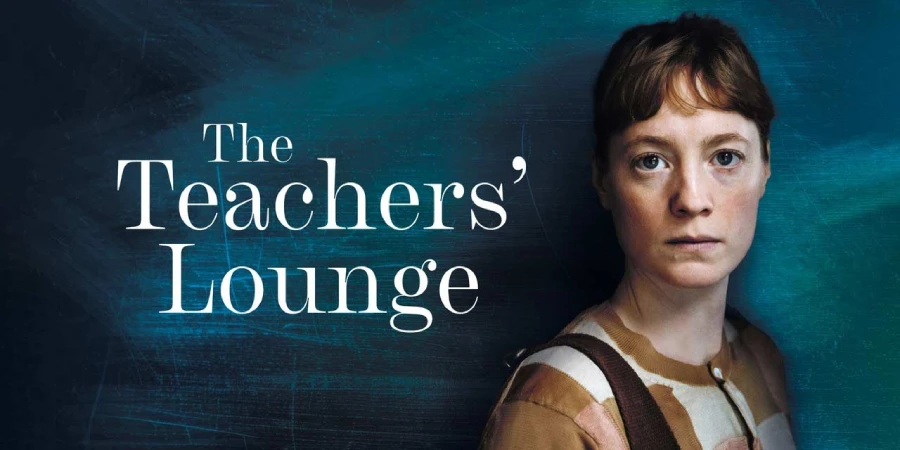

A stolen wallet, a blurry laptop camera screenshot, and a middle school classroom become the ignition points for one of the most nerve-shredding institutional dramas in recent German cinema.
The Teachers’ Lounge (German title: Das Lehrerzimmer) opens with a seemingly minor theft scandal and then watches, with almost clinical patience, as every attempt to do the right thing makes everything catastrophically worse. Director Ilker Çatak traps his idealistic protagonist in a system that punishes integrity, and the film never once lets her, or the audience, breathe easy.
Detailed Summary
Introducing Carla and the Theft Problem
We meet Carla Nowak, a young Polish-German math and PE teacher played by Leonie Benesch, in the middle of a classroom interrogation she did not start. Two of her sixth-grade students, including a boy named Oskar, are under suspicion for a string of petty thefts that have plagued the school. Carla watches her colleagues handle it clumsily, pressuring kids for confessions.
She refuses to let her own students be questioned without evidence. Carla genuinely believes in fairness, and Benesch plays this conviction without a hint of naivety; it reads as principled stubbornness from frame one.
Carla Sets a Trap
When money goes missing from the teachers’ lounge itself, Carla decides to act alone. She leaves her laptop open, wallet visible, and records the room with its camera. She catches a partial image: a distinctive blouse sleeve belonging to Mrs. Kuhn, the school secretary and, critically, Oskar’s mother.
Carla reports what she found to the principal. This is where the film pivots from a simple whodunit into something far more uncomfortable. Carla thought catching the thief would end the problem; instead, it detonates one.
Oskar’s Reaction and the Student Newspaper
Mrs. Kuhn gets confronted and eventually suspended pending investigation. Oskar, who had been a quiet and somewhat closed-off student, becomes a target of social scrutiny. He starts pulling away from Carla, his trust in her visibly cracking.
A group of students running the school newspaper decides to investigate and publish a story about the incident. Carla tries to review their article before publication, and this is where the film’s sharpest, most uncomfortable sequence lives. She crosses a line by asking them to remove certain details, and the students, rightly, call it censorship.
The Institutional Machine Closes In
Carla finds herself squeezed from every direction. Her colleagues think she overstepped. Parents are furious. School leadership performs concern while protecting itself. Every meeting she attends has the texture of a kangaroo court dressed up in polite procedure.
Benesch never lets Carla become a martyr figure, and that is the best directorial decision in the film. Carla is wrong about some things. She is defensive. She makes unilateral choices that affect other people’s lives, and she struggles to acknowledge that her good intentions produced real damage.
The Student Newspaper Goes to War
After Carla’s attempt to soften the article, the student journalists publish anyway, and the fallout accelerates. Their faculty advisor sides with them. Parents flood the school with complaints. Oskar begins openly confronting Carla in class, demanding she admit she destroyed his family.
One scene stands out here: Oskar, standing in the corridor, tells Carla with quiet, controlled fury that she had no right. Benesch’s face in that moment does extraordinary work; she does not deflect, she just absorbs it, and the camera holds on her long enough to make the audience squirm.
Carla’s Isolation Deepens
Carla’s relationship with her colleagues deteriorates further. She feels surveilled, doubted, talked about. A fellow teacher who initially supported her grows distant. Every attempt Carla makes to explain herself lands wrong.
Çatak keeps the camera close throughout this stretch, using tight framing to create a suffocating sense of enclosure. You feel the walls of the institution pressing inward.


Movie Ending
Oskar’s breakdown in the final act is the film’s gut punch. He arrives at school visibly destabilized, having internalized weeks of shame and chaos at home. During a class session, he collapses, either physically or emotionally depending on how you read the scene, and has to be removed.
Carla sits with him afterward in a quiet room. She tries to reach him, and he finally speaks with something approaching raw honesty. She reciprocates, admitting that she does not know if she did the right thing. That admission, quiet and unspectacular, is the closest the film gets to resolution.
What makes the ending so effective is what it refuses to provide. Mrs. Kuhn’s guilt is never definitively confirmed on screen. Nobody is vindicated. No formal apology arrives. Carla remains at the school, teaching, but the damage to her relationships with students and colleagues appears permanent.
A final classroom scene shows Carla attempting to continue a lesson while Oskar sits in the room, present but walled off. She teaches. He sits. Life resumes its surface normalcy over a wound that has not closed. Çatak holds on this domestic return-to-routine long enough that it stops feeling like calm and starts feeling like defeat dressed up as continuity.
Audiences debating whether Carla was right to report Mrs. Kuhn are, in a sense, missing what the film is actually arguing: that institutions are not designed to handle moral complexity, only to manage optics and minimize disruption. Carla expected the system to absorb her honesty and produce justice. It absorbed her honesty and produced chaos, blame-shifting, and institutional self-protection instead.
Are There Post-Credits Scenes?
No. The Teachers’ Lounge contains no post-credits scene. When the film ends, it ends. Given the tone, a post-credits button would feel tonally absurd anyway.
Type of Movie
The Teachers’ Lounge is a psychological drama with strong elements of institutional thriller. Its pacing is slow-burn, its tension interpersonal rather than action-based. Think courtroom drama energy without a courtroom.
Tonally, it sits closer to The Zone of Interest in its cold observational style than to anything crowd-pleasing. It is not a comfortable watch, and it does not want to be.
Cast
- Leonie Benesch – Carla Nowak
- Leonard Stettnisch – Oskar Kuhn
- Eva Löbau – Mrs. Kuhn
- Michael Klammer – Thomas Liebenwerda
- Rafael Stachowiak – Milosz
- Anne-Kathrin Gummich – School Principal Böhm
- Kathrin Wehlisch – Mrs. Kuhn’s colleague
Film Music and Composer
Markus Reuter composed the score for The Teachers’ Lounge. Reuter is known for his work with ambient and progressive music, and his approach here favors texture over melody. Strings appear sparingly, and silence does a significant portion of the emotional heavy lifting.
The score never telegraphs emotion, which fits the film’s refusal to tell you how to feel. When music does arrive, it feels like pressure building rather than feeling being underlined.



Filming Locations
Principal photography took place in Hamburg, Germany. The school used as the primary location was a real functioning school, and Çatak has spoken about the importance of using an actual institutional space rather than a constructed set.
Shooting in a real school creates unavoidable authenticity: narrow corridors, fluorescent lighting, the acoustic quality of gymnasium floors and tiled bathrooms. These spaces feel inhabited rather than designed, and that texture feeds directly into the film’s claustrophobic mood.
Awards and Nominations
The Teachers’ Lounge received significant recognition. It earned a nomination for Best International Feature Film at the Academy Awards (96th ceremony, representing Germany), as well as nominations and wins at the German Film Awards, including recognition for Benesch’s performance and Çatak’s direction. It competed in the Generation section and drew strong critical attention across European festivals.
Behind the Scenes Insights
- Çatak conducted workshops with the young actors before filming to build genuine group dynamics, so the classroom scenes would not feel performed.
- Leonie Benesch reportedly spent time observing actual teachers to develop Carla’s specific classroom physicality, including how she holds her body when losing control of a situation.
- Much of the film shoots in sequence, which helped the actors track the emotional deterioration of their characters in real time.
- Çatak kept the camera placement deliberately restrictive, often shooting from within doorframes or through glass, to replicate the feeling of surveillance that Carla increasingly experiences.
- The student actors who play the newspaper journalists were encouraged to improvise their arguments with Benesch to generate genuine friction rather than scripted debate.
Inspirations and References
Çatak and co-writer Johannes Duncker drew on real debates in German schools about institutional authority, student press freedom, and the ethics of whistleblowing. Germany has a specific cultural sensitivity around surveillance and informing on others, rooted in its 20th-century history, and the film is clearly in dialogue with that anxiety.
Films like The Class (2008) by Laurent Cantet are an obvious touchstone: placing a single committed teacher inside a pressure-cooker classroom environment and watching everything fracture. Çatak takes that template and adds a paranoid institutional layer that pushes it somewhere darker.
Alternate Endings and Deleted Scenes
No alternate endings or officially released deleted scenes have surfaced in press materials or home media releases for The Teachers’ Lounge. Çatak has discussed the difficulty of deciding where to cut the film’s final act, suggesting earlier cuts extended the classroom epilogue, but no specific cut scenes have been made public.
Book Adaptations and Differences
The Teachers’ Lounge is an original screenplay, not based on a book or pre-existing source material. Çatak and Duncker wrote it specifically for the screen.

Memorable Scenes and Quotes
Key Scenes
- The laptop trap reveal: Carla watches the footage back alone, and the moment she recognizes the blouse sleeve, her face goes still. Benesch plays it not as triumph but as dread, which tells you everything about where the film is headed.
- Oskar’s corridor confrontation: He stands close to Carla, speaks quietly, and accuses her without raising his voice. It is more disturbing than shouting would have been.
- The student newspaper meeting: Carla sits across from teenage journalists who are more rigorous about press ethics than most of her adult colleagues. Watching her squirm as they cite principles she herself believes in is genuinely painful.
- The final classroom scene: Carla teaches. Oskar sits in his seat, present but absent. No score, no dramatic punctuation, just the hum of a lesson continuing over broken trust.
- The teachers’ lounge confrontation: Colleagues circle Carla with politely phrased hostility. Nobody raises a voice. Everyone is perfectly civil. It is a masterclass in how institutions weaponize decorum.
Iconic Quotes
- “I only did what I thought was right.” Carla, to a colleague, somewhere in the second act, stated so plainly it becomes the film’s thesis sentence.
- “You had no right.” Oskar, to Carla in the corridor, four words that land with the weight of everything that came before them.
Easter Eggs and Hidden Details
- Carla’s laptop, the device that starts the entire cascade of events, sits open on her desk throughout several subsequent scenes, almost always visible in the background, like a silent accusation.
- Oskar’s seat placement in the classroom shifts subtly across the film: early scenes show him near the front, engaged; later scenes place him toward the edges, physically mirroring his withdrawal.
- The school’s color palette is almost entirely institutional beige and grey, but Carla frequently wears warmer tones in early scenes. By the final act, her wardrobe has shifted toward cooler, more muted colors that blend into the school environment.
- Several scenes are shot through glass partitions or open doorways, framing characters as objects of observation even when they believe they are in private.
Trivia
- The Teachers’ Lounge was Germany’s official submission to the Academy Awards for Best International Feature Film at the 96th ceremony.
- Director Ilker Çatak was born in Berlin to Turkish parents, and his outsider-insider perspective on German institutions informs the film’s specific discomfort with authority structures.
- Co-writer Johannes Duncker has a background that includes work in theater, and the film’s almost stage-like confinement to a single location reflects that influence.
- Leonie Benesch had previously played a young teacher in Michael Haneke’s The White Ribbon (2009), making her casting here carry an intertextual weight for attentive viewers.
- The film’s German title, Das Lehrerzimmer, translates literally as “The Teachers’ Room,” referring specifically to the staff-only space that becomes a site of both surveillance and social politics.
Why Watch?
Benesch’s performance is the reason to show up: she makes Carla’s rigidity feel earned rather than annoying, so when the system grinds her down, it genuinely hurts to watch. Çatak also pulls off something rare: a thriller where every dangerous moment is a faculty meeting or a school corridor conversation. No other 2023 film made bureaucratic process feel this genuinely frightening.
Director’s Other Movies
- Es war einmal Indianerland (2017)
- Ich war noch niemals in New York (2019)
Recommended Films for Fans
- The Class (2008)
- Capernaum (2018)
- A Separation (2011)
- Toni Erdmann (2016)
- The White Ribbon (2009)
- Custody (2017)
- I, Daniel Blake (2016)