The Class (Entre les murs, 2008) is a French drama film directed by Laurent Cantet, based on the semi-autobiographical novel by François Bégaudeau, who also stars as the teacher in the film. It’s a realistic, unfiltered portrayal of life inside a multicultural middle school in Paris — far from the romantic clichés of the city. The film won the Palme d’Or at the 2008 Cannes Film Festival, making it one of the most discussed European dramas of its time.
Detailed Summary
Setting the Scene: The Start of a School Year
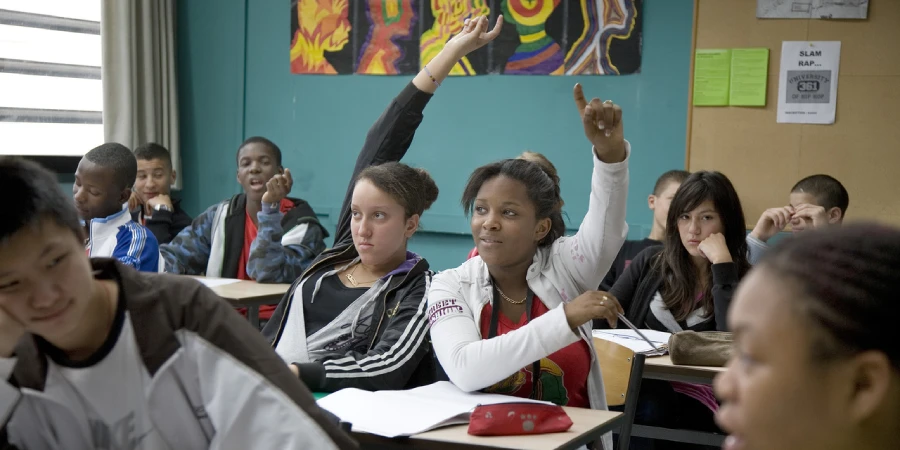
The film takes place almost entirely within the walls of a Parisian secondary school. François Marin (played by Bégaudeau himself) teaches French language and literature to a class filled with diverse, opinionated, and often rebellious students. From the very beginning, we see the daily tension between teacher and students — not of hatred, but of misunderstanding. Marin genuinely wants to teach, but his students challenge him constantly, questioning both his authority and the relevance of what he teaches.
Classroom Dynamics and Conflicts
As weeks go by, the class becomes a microcosm of contemporary French society. Students come from different cultural and ethnic backgrounds, each carrying unique perspectives — and frustrations. Marin struggles to maintain discipline while still wanting to connect with them on a personal level.
Key moments include heated discussions about language, identity, and respect. For instance, when Marin assigns self-descriptive essays, students question his motives — why should they reveal personal things to a teacher they barely trust? The classroom discussions often blur the line between intellectual debate and personal confrontation, a reflection of how education itself can become a battlefield of egos and emotions.
Souleymane’s Story
One of the central storylines revolves around Souleymane, a rebellious student of Malian descent who often finds himself in trouble. His defiance escalates throughout the school year, culminating in a disciplinary hearing after an incident where Marin accidentally insults two students during a heated argument. The situation spirals out of control, leading Souleymane to lash out violently.
The Turning Point: The Hearing
The school’s disciplinary council becomes a key sequence in the film. Teachers, administrators, and students attend as Souleymane faces expulsion. During the hearing, his mother — who doesn’t speak French — sits silently, emphasizing the communication gap not just between teachers and students, but between entire cultures. Despite Marin’s half-hearted defense, Souleymane is expelled. It’s a devastating outcome, both for the boy and for Marin, who begins to question whether he failed his student.

Movie Ending
As the school year comes to an end, Marin holds his final class. There’s no big resolution, no grand emotional payoff — just quiet reflection. Some students thank him, others barely acknowledge his presence. During this final lesson, a shy girl who has remained mostly silent all year approaches Marin and says something unexpected: she feels like she hasn’t learned anything at all.
This simple statement hits Marin deeply. After all the arguments, lessons, and moral debates, this confession leaves him shaken. The camera lingers on his face as he contemplates what teaching really means — did he succeed in reaching any of them?
The film closes with the students rushing outside into the courtyard, full of laughter and noise. Marin stands in the empty classroom, listening to their voices echoing off the walls. There’s no music, no triumphant closure — just the uneasy silence of self-doubt.
The ending underlines the movie’s core message: teaching is not about control, but connection — and sometimes, that connection never quite happens.
Are There Post-Credits Scenes?
No, The Class does not have any post-credits scenes. The story ends firmly with the close of the school year, leaving the viewer to reflect on the themes of education, authority, and identity.
Type of Movie
The Class is a social realist drama and docu-fiction hybrid. It blurs the line between documentary and fiction, using non-professional actors (many of whom were actual students) and improvised dialogue to capture a genuine sense of life inside a classroom.
Cast
- François Bégaudeau as François Marin
- Franck Keïta as Souleymane
- Esmeralda Ouertani as Esmeralda
- Rachel Régulier as Khoumba
- Boubacar Touré as Boubacar
- Jean-Michel Simonet as the Principal
Film Music and Composer
Unlike most mainstream films, The Class has very minimal music. There is no traditional score; Laurent Cantet deliberately avoids it to enhance the realism. The few sounds you hear — chatter, footsteps, the buzz of the fluorescent lights — are all part of the natural soundscape of the school.

Filming Locations
The film was shot at François Dolto Middle School in the 20th arrondissement of Paris, France. This location was crucial for the film’s authenticity. Cantet wanted a real school environment, not a constructed set, so much of the film’s texture — the graffiti, the echoes, the fluorescent lighting — comes directly from the natural environment of the school.
Awards and Nominations
- Palme d’Or (Cannes Film Festival, 2008) – Winner
- Academy Award Nomination for Best Foreign Language Film (2009)
- César Award Nominations – Best Director, Best Film, Best Adapted Screenplay
Behind the Scenes Insights
- Director Laurent Cantet spent a full year preparing with the students before filming began, conducting workshops to help them improvise naturally.
- François Bégaudeau, who wrote the original novel, based the story on his own experiences teaching in a Parisian school.
- Most of the student dialogue was improvised, not scripted. Cantet encouraged natural reactions rather than rehearsed lines.
- The film was shot chronologically, so the emotional development of characters and relationships unfolded naturally over time.
Inspirations and References
The film is adapted from François Bégaudeau’s semi-autobiographical book “Entre les murs”, published in 2006. The book, in turn, was inspired by his real experiences teaching French literature to teenagers in a multicultural Paris school. It also reflects broader themes of post-colonial identity, social inequality, and generational misunderstanding in France.
Alternate Endings and Deleted Scenes
There are no officially released alternate endings. However, Cantet reportedly filmed several classroom discussions that were cut for pacing. Some of these scenes explored more about Souleymane’s home life and Marin’s personal doubts, but they were removed to maintain the film’s tight, documentary-like structure.
Book Adaptation and Differences
The main difference between the book and the film lies in tone.
- The book focuses more on Marin’s internal thoughts and frustrations, offering a deeper psychological portrait of a teacher on the verge of burnout.
- The film externalizes those struggles through dialogue and interaction, focusing more on the students’ perspectives.
In essence, the movie turns a personal diary into a communal experience.

Memorable Scenes and Quotes
Key Scenes
- The opening teacher meeting, showing how bureaucratic and tense the school environment can be.
- The verbal confrontation between Marin and Esmeralda, where respect and language clash.
- Souleymane’s disciplinary hearing — a devastating moment that captures the failure of institutional empathy.
- The final classroom scene, where a student admits she learned nothing.
Iconic Quotes
- François Marin: “I’m not here to humiliate you. I’m here to teach you French.”
- Khoumba: “You always pick on us. You never talk to us like equals.”
- The Student (final scene): “I didn’t learn anything this year.”
Easter Eggs and Hidden Details
- The film’s title, Entre les murs (“Between the Walls”), is symbolic: everything we see happens within the school’s walls — a metaphor for both confinement and community.
- In the background of many classroom scenes, you can spot subtle visual cues (flags, posters) referencing France’s colonial past and multicultural present.
- The real principal and teachers of the school make cameo appearances throughout the film.
Trivia
- The Class was the first French film in 21 years to win the Palme d’Or at Cannes.
- None of the students were professional actors; all were local teenagers from similar backgrounds.
- François Bégaudeau originally didn’t want to play himself, but Cantet insisted to preserve authenticity.
- The film’s entire runtime (128 minutes) was edited from over 100 hours of footage.
Why Watch?
Watch The Class if you want to experience education without Hollywood filters. It’s not about inspirational speeches or grand redemption arcs — it’s about the messy, imperfect, yet deeply human reality of teaching and learning. It’s a film that will leave you thinking long after it ends.
Director’s Other Movies
- Time Out (2001)
- Human Resources (1999)
- The Workshop (2017)
- Return to Ithaca (2014)
Recommended Films for Fans
- Boyhood (2014)
- Dead Poets Society (1989)
- The Teachers’ Lounge (2023)
- The 400 Blows (1959)
- Monsieur Lazhar (2011)
- School Life (2019)