
A boy puts his hand in a box, and an old woman holds a poisoned needle to his neck. If he pulls his hand out, he dies. Dune opens its story with that test and never lowers the needle. Denis Villeneuve turned the novel everyone called unfilmable into a vast, patient, deadly serious epic, and then he stopped halfway. Every spoiler from Caladan to the duel in the sand follows below.
Table of Contents
Detailed Summary
Arrakis, Year 10191
Chani’s narration opens the film over images of her home. Arrakis is beautiful when the sun is low, and brutal the rest of the time, because the Harkonnens have strip-mined its spice for eighty years. Then, without explanation, the Emperor orders them out. The Fremen wonder who their next oppressors will be.
Caladan
Paul Atreides, heir to a green ocean world, dreams of a girl with blue eyes in the desert. His mother, Lady Jessica, belongs to the Bene Gesserit sisterhood and has trained him in their arts, including the Voice, a tone of command that bends listeners’ will. Paul resents the training and the destiny that comes with it.
An Imperial herald arrives, and Duke Leto accepts the fief of Arrakis in a ceremony on the rain-soaked coast. Leto knows the gift is a trap. He also knows that spice is the most valuable substance in the universe, and that the Emperor’s rivals would never let House Atreides keep it.
The Gom Jabbar
Reverend Mother Gaius Helen Mohiam arrives at night and tests Paul with a box that causes pain by nerve induction. If he withdraws his hand, the gom jabbar needle kills him. He endures agony that no previous subject has survived, and the old woman is shaken.
She scolds Jessica afterward. The Bene Gesserit ordered her to bear only daughters, and she disobeyed out of love for Leto. Paul, a boy, might be the Kwisatz Haderach their breeding program has chased for ninety generations, or he might be nothing. Mohiam flies to Giedi Prime and tells the Baron Harkonnen that Paul and Jessica are not to be harmed. He agrees in a way that promises nothing.
Arrival on Arrakis
Duncan Idaho goes ahead to make contact with the Fremen and returns full of admiration for them. The Atreides land at Arrakeen to crowds and bagpipes, and the housekeeper Shadout Mapes gives Jessica a crysknife made from a sandworm’s tooth. Among the Fremen, Jessica is a figure out of prophecy.
Leto meets the Imperial ecologist Dr. Liet-Kynes, who explains the stillsuit, a garment that recycles the body’s water. Paul fits his correctly without being told, and Kynes stares at him. The Fremen leader Stilgar visits the palace, spits on the table as a gift of water, and leaves Leto with a warning about the deep desert.
Spice and the Worm
Kynes takes the duke and his son on an ornithopter flight to watch a spice crawler at work. A sandworm approaches, the carryall that should rescue the crawler never comes, and Leto lands to pull the crew out himself. The worm swallows the machine whole as they lift off.
Paul breathes spice in the chaos and his visions sharpen. He sees Chani again, sees a knife, and sees himself as something he does not want to be.
The Hunter-Seeker
A needle-thin assassination drone slips into Paul’s room and hovers at his face. He freezes, lets it drift, then catches it and crushes it against the wall. Mapes walks in a second later, and the drone, now in his hand, would have killed her.
Leto’s spymaster Thufir Hawat finds the Harkonnen operator in the walls. House Atreides knows the knife is coming; they simply do not know who holds it.
Betrayal
Dr. Wellington Yueh, the family physician, has sold them out. The Baron holds his wife Wanna, and Yueh believes betrayal is the only way to free her. He disables the shields, drugs Leto, and replaces one of the duke’s teeth with a capsule of poison gas, giving him a single chance at the Baron.
Sardaukar troops and Harkonnen soldiers pour into Arrakeen that night. Duncan fights his way out, Gurney Halleck’s men die at the gates, and Piter de Vries kills Yueh as promised, reuniting him with his already murdered wife.
The Death of Duke Leto
Paralyzed and stripped, Leto wakes at a table across from the Baron, who gloats about the Emperor’s part in the trap. Leto bites down on the tooth. Poison fills the room, killing Piter and the guards, and Leto dies watching the Baron float to the ceiling on suspensors.
The Baron survives with burns and a ruined face. He gives Arrakis to his nephew Rabban with one instruction: squeeze.
Escape into the Desert
Harkonnen soldiers fly Paul and Jessica into the desert to die, as the Baron’s way of honoring his word. Paul uses the Voice to make one guard cut Jessica’s gag; she uses it to make the other kill his comrade. Yueh left a stashed tent, stillsuits and a message in the ornithopter, along with the ducal signet ring.
In the tent, spice floods Paul’s mind. He sees a holy war fought in his name across the universe, sees himself as a sleeper now awake, and tells his mother that she and her sisterhood made him into a freak. Then he tells her they will go to the Fremen.
Liet-Kynes
Duncan finds them with Kynes and flies them to an abandoned ecological station. Kynes reveals the Fremen dream of turning Arrakis green, which the Harkonnens would never permit. Sardaukar storm the station, and Duncan holds the door alone so Paul and Jessica can escape in a thopter.
Kynes flees on foot and is cornered by Sardaukar on the open sand. She plants a thumper and declares she serves only one master, Shai-Hulud. The worm takes her and her killers together.
The Storm and the Sand
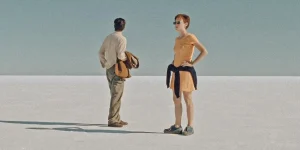
Paul flies into a sandstorm to shake pursuit, cuts the engines, and lets the wind carry the thopter like a leaf. They land beside a rock outcrop. Crossing the open sand toward it, Paul and Jessica hear a worm closing and barely reach the stone.
Stilgar’s Fremen surround them at dawn. Stilgar offers to take the boy and leave the mother, who is water for the tribe. Jessica disarms him in seconds with her Bene Gesserit training, and the rules change.


Movie Ending
A Fremen named Jamis will not accept the outsiders. He invokes the right of challenge against Jessica, and Paul, as her champion, must fight in her place. The duel is to the death, with crysknives, and Paul has never killed anyone.
Chani, the girl from his dreams, hands him her crysknife and tells him it is a good blade. Paul recognizes her and hesitates. In his visions, Jamis was a friend who taught him the ways of the desert; in the sand, Jamis is trying to open his throat.
Paul fights carefully, pinning Jamis twice without finishing him. The Fremen do not understand mercy in a duel, and Jamis uses each reprieve to attack again. Jessica, watching, understands what her son is trying not to become. Paul finally drives the knife into Jamis and holds him as he dies. Then he stands up, and his face has changed.
Stilgar accepts Paul and Jessica into his tribe. Jessica asks where the Fremen are going, and Stilgar answers: to Sietch Tabr, their home, and to the south. Paul asks Chani what happens next. “This is only the beginning,” she says, and the film ends with the Fremen walking into the dunes and a worm cresting in the distance as Paul watches.
Villeneuve ends on the exact moment Paul stops being a refugee and starts being a Fremen, which also means he starts walking toward the war he saw in the tent. The hesitation in the duel matters: Paul knows that every kill pushes him closer to the Lisan al-Gaib, the messiah the Bene Gesserit seeded into Fremen legend centuries ago to protect their own agents.
Audiences left with three questions. Did the Baron really die? No; the gas burned him, and he returns. Why stop here? Villeneuve refused to compress the novel into one film and labeled this “Part One” on screen. Is Gurney dead? The film never shows his death, and the sequel answers.
Are There Post-Credits Scenes?
No. Dune has no mid-credits or post-credits scene. The credits run over Hans Zimmer’s score and end in silence. The final story beat is Chani’s line and the worm on the horizon.
Type of Movie
This is epic science fiction, closer to a political drama than a space battle. Villeneuve treats it as a tragedy in slow motion, with a coup, an assassination and a flight into exile replacing conventional action beats.
The tone is solemn and immense. Humor exists mainly in Duncan Idaho and Gurney Halleck, and it disappears with them. The film runs 155 minutes and carries a PG-13 rating.
Cast
- Timothée Chalamet – Paul Atreides
- Rebecca Ferguson – Lady Jessica
- Oscar Isaac – Duke Leto Atreides
- Josh Brolin – Gurney Halleck
- Stellan Skarsgård – Baron Vladimir Harkonnen
- Dave Bautista – Glossu Rabban
- Stephen McKinley Henderson – Thufir Hawat
- Zendaya – Chani
- Chang Chen – Dr. Wellington Yueh
- Sharon Duncan-Brewster – Dr. Liet-Kynes
- Charlotte Rampling – Reverend Mother Gaius Helen Mohiam
- Jason Momoa – Duncan Idaho
- Javier Bardem – Stilgar
- David Dastmalchian – Piter de Vries
- Babs Olusanmokun – Jamis
- Golda Rosheuvel – Shadout Mapes
- Benjamin Clémentine – Herald of the Change
Film Music and Composer
Hans Zimmer turned down Christopher Nolan’s Tenet to score Dune, which he had wanted to do since reading the book as a teenager. He built the score from invented instruments, processed voices and the wordless wails of singer Loire Cotler, aiming for a sound no audience could place.
Signature cues include “Paul’s Dream”, which opens the film with Chani’s narration; “Herald of the Change”, built on thirty bagpipes for the ceremony on Caladan; “Ripples in the Sand”; and “Armada”. The Atreides arrival on Arrakis also uses bagpipes, played live on set.
Zimmer released three albums: The Dune Sketchbook, the official soundtrack, and The Art and Soul of Dune. The score won him the Academy Award, the BAFTA and the Golden Globe for Best Original Score.

Filming Locations
The desert of Arrakis is mostly Wadi Rum in Jordan, whose red sand and sheer rock walls give the Fremen scenes their scale. The spice-harvesting and sandstorm sequences used the dunes of the Liwa Oasis near Abu Dhabi, where the crew shot in extreme heat to capture the planet’s hostility.
Caladan’s grey coast comes from Stadlandet in Norway, which supplied the rain and black cliffs for the Atreides home. Nearly everything else, from the palace at Arrakeen to the Baron’s chambers, came together on stages at Origo Studios in Budapest.
Cinematographer Greig Fraser shot the film for IMAX, and Villeneuve wanted real sand, real sun and a full-scale ornithopter placed in the desert rather than a green screen.
Awards and Nominations
Dune received ten Academy Award nominations at the 94th Oscars, including Best Picture and Best Adapted Screenplay, and won six: Original Score, Sound, Film Editing, Cinematography, Production Design and Visual Effects. Villeneuve was not nominated for Best Director, a widely criticized omission.
At the BAFTAs it won five awards: Cinematography, Original Score, Production Design, Sound and Special Visual Effects. The film also received the Hugo Award for Best Dramatic Presentation, the same prize Frank Herbert’s novel won in 1966.
Behind the Scenes Insights
- Denis Villeneuve read the novel as a teenager and called it the dream project of his life. Legendary acquired the film rights in 2016 and hired him the following year.
- The screenplay came from Villeneuve, Jon Spaihts and Eric Roth. Villeneuve insisted from the start on two films and refused to shoot a compressed single version.
- Stellan Skarsgård spent hours in prosthetics each day for the Baron, including a full-body suit that let him float in the scene where he rises from the oil bath.
- Linguist David J. Peterson, creator of Dothraki for Game of Thrones, developed the Fremen language Chakobsa and the Sardaukar chant.
- A full-size ornithopter was built and transported into the Jordanian desert so actors could climb in and out of a real machine.
- The Sardaukar chant on Salusa Secundus was performed by a throat singer and processed by Zimmer.
- The pandemic pushed the release from December 2020 to October 2021. Warner Bros. then released it simultaneously on HBO Max, which Villeneuve publicly condemned in an essay for Variety.
- Warner Bros. greenlit Dune: Part Two on October 26, 2021, four days after the film opened in the United States.
Inspirations and References
Frank Herbert published Dune in 1965 after years of research that began with an article about the Oregon dunes and the government’s attempts to control shifting sand. Herbert folded in ecology, Middle Eastern history and religion, the story of T.E. Lawrence leading a desert revolt, and a deep suspicion of charismatic leaders.
The names signal his intent. Atreides points to the House of Atreus from Greek tragedy, and terms like jihad, Mahdi and Lisan al-Gaib come from Arabic. Paul is meant to be a warning, not a hero, which Villeneuve’s film honors by letting the visions of holy war arrive before the triumphs.
Villeneuve knew the earlier attempts well: David Lynch’s 1984 film, the 2000 miniseries, and Alejandro Jodorowsky’s unmade version chronicled in a 2013 documentary. His designs lean on brutalist architecture and the idea that machinery in this universe should look ancient.
Alternate Endings and Deleted Scenes
Villeneuve does not release deleted scenes, and he has said so plainly. The cut material from Dune stays in the vault, and no extended edition exists.
A few cuts are known. Gurney Halleck’s baliset performance was shot and removed, which is why Josh Brolin carries the instrument but never plays it. The novel’s banquet scene, a favorite of readers, was never filmed at all. Villeneuve also chose to withhold Feyd-Rautha entirely, saving him for the sequel.
No alternate ending was shot. The stopping point in the desert was fixed in the script from the beginning, which is why the film carries “Part One” in its opening title.
Book Adaptations and Differences
The film covers roughly the first half of Herbert’s novel, ending at the duel with Jamis. It stays close in structure, but several changes stand out. Liet-Kynes is a man in the book; Villeneuve cast Sharon Duncan-Brewster and gave the character a more defiant death, since the novel leaves Kynes to die in the desert during a spice blow.
Thufir Hawat loses most of his story. In the book, he wrongly suspects Jessica of treason, a thread the film drops. Feyd-Rautha, Count Fenring and the Emperor appear early in the novel and not at all here. Paul’s visions of Chani and of the jihad receive more weight on screen than in the text at this stage.
Herbert’s novel runs on internal monologue, which the film replaces with visions, silence and faces. The Baron’s oil bath and Kynes’s final line are inventions. Paul’s hesitation during the duel, however, comes straight from the book.



Memorable Scenes and Quotes
Key Scenes
- Paul’s hand in the box, with Mohiam’s needle at his neck.
- The Atreides arriving on Arrakis to bagpipes under a white sun.
- The sandworm swallowing the spice crawler.
- The hunter-seeker drifting toward Paul’s face.
- Leto’s last breath across the table from the Baron.
- Paul’s visions in the tent and his fury at his mother.
- Duncan Idaho holding the door.
- Kynes summoning the worm.
- The ornithopter inside the storm.
- The duel with Jamis.
Iconic Quotes
- “Fear is the mind-killer.”
- “Dreams are messages from the deep.”
- “A great man doesn’t seek to lead. He’s called to it.”
- “Here I am. Here I remain.”
- “Desert power.”
- “Tell Rabban to squeeze.”
- “May thy knife chip and shatter.”
- “This is only the beginning.”
Easter Eggs and Hidden Details
- Gurney carries a baliset throughout the film but never plays it, a remnant of the cut performance.
- Dr. Yueh’s forehead bears the diamond tattoo of the Suk School, whose conditioning was supposed to make betrayal impossible.
- A mounted bull’s head travels from Caladan to Arrakeen; the animal killed Leto’s father in the arena, a detail from the novel.
- Paul spots a desert mouse on Arrakis, the creature the Fremen call Muad’Dib, which will become his name.
- Stilgar’s spitting at the council table comes from the book, where Leto’s men nearly draw weapons before understanding the gift.
- Paul’s dream of Jamis as a friend is an exact inversion of their real meeting.
- The Herald of the Change is played by singer Benjamin Clémentine, whose costume and bearing deliberately echo religious ceremony.
- The year 10191 appears on screen, matching the novel’s calendar.
Trivia
- The film grossed around 400 million dollars worldwide despite opening on HBO Max the same day as in theaters.
- Zendaya appears for roughly seven minutes of screen time, most of it in Paul’s visions.
- Hans Zimmer and Villeneuve had wanted to work together for years, and Zimmer scored the film’s teaser with a reworked Pink Floyd song.
- The world premiere took place at the Venice Film Festival on September 3, 2021.
- Herbert’s novel won the first Nebula Award for Best Novel and shared the 1966 Hugo.
- Villeneuve shot the film in 2019, two years before audiences saw it.
- Timothée Chalamet was 23 during filming, playing a 15-year-old in the novel.
- The desert scenes in Abu Dhabi were shot in temperatures that forced the crew to work in short windows around midday.
Why Watch?
No science fiction film of its decade matches Dune for scale, patience and dread. Villeneuve builds a universe you can feel the weight of, then drops a boy into it with a knife and a prophecy. Watch it on the biggest screen you can find.
Director’s Other Movies
- August 32nd on Earth (1998)
- Maelström (2000)
- Polytechnique (2009)
- Incendies (2010)
- Prisoners (2013)
- Enemy (2013)
- Sicario (2015)
- Arrival (2016)
- Blade Runner 2049 (2017)
- Dune: Part Two (2024)