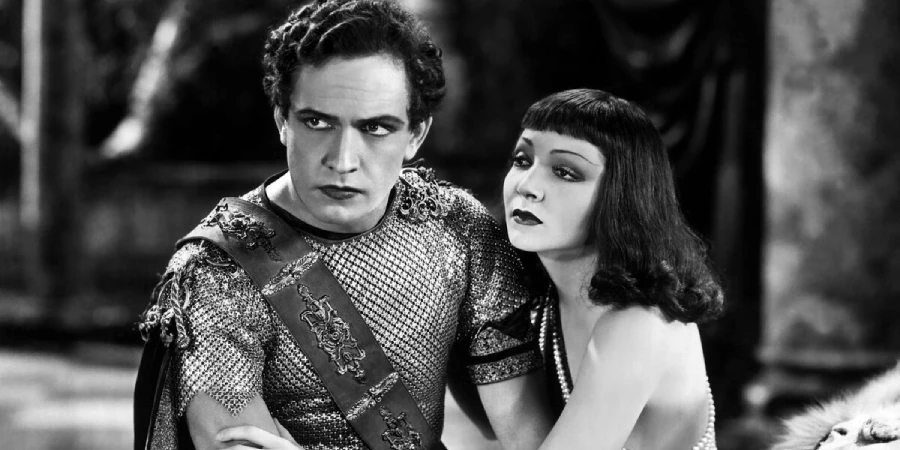

Cecil B. DeMille’s The Sign of the Cross is a masterclass in pre-Code Hollywood indulgence. It wraps a story of faith and persecution in a spectacle of sadism, sexuality, and staggering excess. Consequently, the film remains one of the most glaring reasons the restrictive Hays Code was eventually enforced. It tells a tale of Roman debauchery with an enthusiasm that nearly eclipses its Christian morality tale.
Detailed Summary
The Burning of Rome
The story opens in 64 AD as Rome burns. Emperor Nero (Charles Laughton) gleefully plays his lyre, inspired by the carnage. To deflect blame from himself, his cruel Prefect of the Guard, Tigellinus, suggests a scapegoat. They decide to blame the city’s Christians, a small but growing religious sect.
As a result, a brutal campaign of persecution begins. Roman soldiers hunt Christians through the streets. Their faith makes them easy targets in a city steeped in pagan worship.
A Prefect and a Christian
Amidst the chaos, the powerful Prefect of Rome, Marcus Superbus (Fredric March), encounters a beautiful Christian woman named Mercia (Elissa Landi). He is immediately captivated by her purity and courage. However, she rejects his advances, committed solely to her faith.
Marcus becomes obsessed. He uses his power to track her down, placing her under his “protection” to save her from the city-wide purge. He cannot comprehend why she would choose poverty and faith over the luxury and power he offers.
The Jealousy of an Empress
Meanwhile, Empress Poppaea (Claudette Colbert), Nero’s hedonistic wife, desires Marcus for herself. She notices his obsession with Mercia and grows intensely jealous. Poppaea uses her influence over Nero to further orchestrate the Christians’ suffering, hoping to eliminate her rival.
She schemes to have Mercia captured and condemned. Poppaea’s cruelty is showcased in her decadent lifestyle, most famously in a scene where she bathes in asses’ milk while plotting against the Christians.
The Arena of Horrors
Tigellinus successfully rounds up the Christians, including Mercia. Nero announces lavish games at the Colosseum to celebrate his “victory” and entertain the Roman masses. The main event features Christians being thrown to wild animals.
Marcus races against time to save Mercia. He pleads with Nero, but the emperor is swayed by Poppaea and the roaring crowd. The arena transforms into a theater of cruelty, with gladiators fighting pygmies, and starving lions unleashed upon helpless captives.
Movie Ending
In the film’s final moments, Marcus Superbus makes a last-ditch appeal to Mercia. He stands with her in the tunnel leading to the arena floor, begging her to renounce her faith and live with him. He promises her a life of unparalleled luxury, a world away from the suffering she has known. Mercia gently refuses, explaining her devotion to a kingdom beyond the earthly one.
Her unwavering faith deeply moves him. Realizing that her spiritual world is more powerful than his material one, Marcus makes a profound choice. He asks her if her god can give him the courage to face death. Seeing his sincerity, she tells him it can. Taking her hand, Marcus walks with her out into the arena to face the lions, choosing eternal life with her over a meaningless existence without her. The film ends on their silhouettes advancing toward their fate, a faint cross of light appearing in the sky as their fellow Christians sing a hymn.
Are There Post-Credits Scenes?
No, there are no post-credits scenes. The practice was not common in Hollywood filmmaking during the 1930s.
Type of Movie
The Sign of the Cross is a pre-Code historical epic and religious drama. Before the Hays Code’s strict enforcement in 1934, films could explore adult themes with shocking frankness.
Its tone is a bizarre but fascinating mix of pious reverence and lurid sensationalism. The film presents the Christians’ suffering with solemnity, yet it simultaneously revels in depicting Roman depravity with graphic detail and voyeuristic glee.
Cast
- Fredric March – Marcus Superbus
- Elissa Landi – Mercia
- Charles Laughton – Emperor Nero
- Claudette Colbert – Empress Poppaea
- Ian Keith – Tigellinus
- Vivian Tobin – Dacia
- Harry Beresford – Titus
Film Music and Composer
The score for The Sign of the Cross was composed by Rudolph G. Kopp, a proficient studio composer of the era. He worked alongside other uncredited composers to create the film’s musical landscape.
Notably, the music effectively contrasts the depraved, bombastic themes for Nero’s court with the serene, hymn-like melodies associated with the Christians. This musical duality reinforces the film’s central conflict between pagan excess and spiritual purity.
Filming Locations
The film was shot almost entirely at Paramount Studios in Hollywood, California. As a result, Director Cecil B. DeMille was able to showcase his mastery of the studio backlot, transforming soundstages and outdoor sets into a convincing ancient Rome.
To achieve this, gigantic sets were constructed to replicate Roman villas, the Colosseum, and city streets. Furthermore, the production’s scale was immense for its time, utilizing these controlled environments to stage massive crowd scenes. At the same time, the studio setting allowed for complex special effects, such as the dramatic burning of Rome.
Awards and Nominations
The Sign of the Cross received one Academy Award nomination.
Cinematographer Karl Struss was nominated for Best Cinematography for his innovative and dramatic camerawork, which captured the epic scale and intimate horror of the story.
Behind the Scenes Insights
- Director Cecil B. DeMille had to persuade a hesitant Claudette Colbert to do her infamous nude bathing scene in a tub of asses’ milk. He convinced her by promising utmost privacy and arguing the scene was essential to an authentic portrayal of Poppaea’s decadence.
- For the 1944 re-release, after the Production Code was being enforced, DeMille added a new prologue. It featured two priests in a plane flying over Rome during World War II, discussing how the ancient conflict between tyranny and faith still raged.
- The original 1932 cut of the film was heavily censored after 1934. Over ten minutes of footage, including a suggestive dance near Poppaea and the most graphic arena violence, were removed for subsequent theatrical runs.
- Charles Laughton reportedly based his portrayal of Nero on his landlord, finding inspiration in the man’s petty and eccentric behaviors.
Inspirations and References
The film is based on the 1895 play of the same name by English playwright and novelist Wilson Barrett. Barrett’s play was a massive international success, framing the story as a straightforward religious melodrama.
In addition, DeMille and the screenwriters drew from historical accounts of ancient Rome by writers like Tacitus and Suetonius, particularly for details about Nero’s reign, the Great Fire of Rome, and the persecution of Christians. However, they took significant creative liberties for dramatic effect.
Alternate Endings and Deleted Scenes
No alternate ending for The Sign of the Cross was ever filmed. The finale of Marcus and Mercia walking together into the arena was always the intended climax.
However, the film is famous for its deleted scenes, which were cut to comply with the Motion Picture Production Code. Notable censored content includes an erotic dance sequence performed for Poppaea by a female dancer, shots that made Poppaea’s nudity in the milk bath more explicit, and graphic scenes of violence in the arena. These included Christians being attacked by crocodiles and a woman being assaulted by a gorilla.
Book Adaptations and Differences
The Sign of the Cross is not based on a book but rather the aforementioned 1895 stage play by Wilson Barrett. The play was far more focused on religious sermonizing and less on the graphic spectacle that DeMille brought to the screen.
While Barrett’s play emphasized Mercia’s spiritual journey, DeMille’s film gave equal, if not greater, weight to the lavish depravity of Nero’s court. This shift in focus made the cinematic version a much more controversial and sensational work.


Memorable Scenes and Quotes
Key Scenes
- Poppaea’s Milk Bath: The iconic scene where Empress Poppaea bathes in a massive tub of asses’ milk, plotting against her rivals with decadent indifference. It perfectly encapsulates the film’s pre-Code audacity.
- Rome Burns: Nero stands on his balcony, playing a lyre and singing ecstatically as his city is engulfed in flames. Laughton’s performance masterfully blends childish glee with monstrous cruelty.
- The Arena Spectacle: The film’s climax is a parade of horrors, featuring everything from gladiatorial combat to Christians being devoured by lions. It is a stunning, and disturbing, piece of large-scale filmmaking.
Iconic Quotes
- Nero: (Watching Rome burn) “It’s beautiful! A sea of flame! I wish I were a poet!”
- Marcus Superbus: (To Mercia) “You are a Christian? I am a Roman! And you will love me because I have sworn it!”
- Poppaea: (To Marcus) “You will be my love slave. Your soul will be my footstool!”
Easter Eggs and Hidden Details
- DeMille, known for his attention to detail, reportedly imported genuine artifacts for set dressing, though many were reproductions. The goal was to imbue the Hollywood sets with a sense of historical authenticity.
- Many of the Roman extras’ reactions during the arena sequences are genuine. DeMille used real lions and other wild animals, and the fear seen on some faces was not entirely acting.
- The visual design of Nero a portly, petulant man surrounded by opulence was a deliberate choice to subvert the traditional image of a powerful, physically imposing emperor.
Trivia
- Approximately 8,500 extras were used during the production, a massive number for a film of that era.
- The Sign of the Cross was Cecil B. DeMille’s first sound film in the historical epic genre that would come to define his career.
- The success and controversy of the film, along with She Done Him Wrong and other risqué pictures, are directly credited with forcing Hollywood studios to begin strictly enforcing the Production Code in mid-1934.
Why Watch?
Watch this film to witness Hollywood at its most unrestrained. The Sign of the Cross is a jaw-dropping spectacle of sin and salvation, a historical landmark that shows just how wild movies were before censorship reigned in their ambitions.
Director’s Other Movies
- The Ten Commandments (1923)
- Cleopatra (1934)
- Samson and Delilah (1949)
- The Greatest Show on Earth (1952)
- The Ten Commandments (1956)
Recommended Films for Fans
- Quo Vadis (1951)
- Ben-Hur (1959)
- Spartacus (1960)
- Caligula (1979)
- Gladiator (2000)