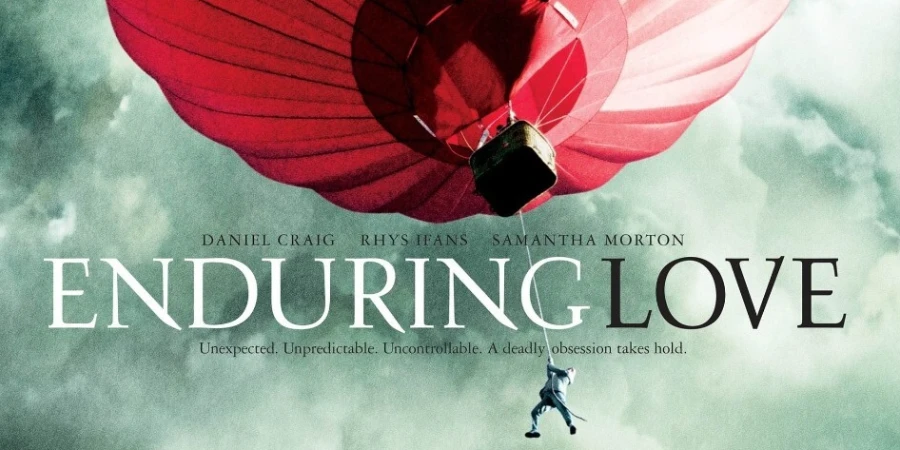

A hot air balloon accident in an English field should not, by any reasonable measure, be the start of a psychological horror story. Yet director Roger Michell turns exactly that moment into one of the most unsettling opening sequences in British cinema of the 2000s.
Joe Rose watches a man fall to his death, and a stranger named Jed Parry stares back at him across a wind-flattened meadow, and nothing is normal again after that. Enduring Love (2004) is a film about how a single glance can rewrite a life.
Detailed Summary
The Picnic and the Balloon
Joe Rose, played by Daniel Craig, is a science writer enjoying a countryside picnic with his partner Claire, played by Samantha Morton. Their afternoon shatters when a runaway hot air balloon drifts across the field, its young passenger trapped in the basket, its rope trailing on the ground.
Several men, including Joe, grab the rope to try to pull the balloon down. A sudden gust lifts the balloon upward. One man, John Logan, refuses to let go and hangs in the air before falling to his death.
Joe releases the rope and survives. That decision haunts him immediately and continues to haunt him throughout the film. At the scene, he makes eye contact with another rope-puller, a young man named Jed Parry, played by Rhys Ifans.
Jed Parry Makes Contact
Jed approaches Joe at the accident scene and asks if they can pray together. Joe declines, uncomfortable and shaken. That refusal, for Jed, is not a rejection. It becomes an invitation.
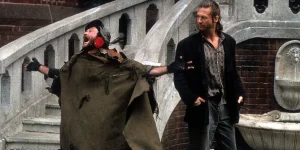
Jed begins calling Joe. He sends letters. He appears outside Joe’s London apartment, standing on the street and watching. Joe’s unease sharpens into genuine alarm, but Claire initially struggles to share his panic.
Joe’s Obsession With Jed’s Obsession
Joe starts researching Jed’s behavior compulsively. He becomes convinced that Jed suffers from de Clérambault’s syndrome, a rare erotomania in which the sufferer believes a person of higher social standing is secretly in love with them. Joe’s certainty grows faster than his evidence.
His fixation on diagnosing Jed begins to mirror Jed’s fixation on him. Roger Michell shoots this parallel deliberately. Both men are obsessives; the film refuses to let you forget that symmetry.
Claire’s Doubt and the Relationship Fracture
Claire grows frightened, but not only of Jed. She grows frightened of Joe. His escalating behavior, his inability to let the incident go, his almost clinical detachment when discussing the dead man Logan, all of it chips away at her trust.
She begins to wonder whether Joe is projecting, inventing a persecutor to escape his own guilt about letting go of the rope. This is one of the film’s sharpest ideas: the audience is never entirely sure, for a stretch, who is losing their grip on reality.
The Restaurant Shooting
Joe and Claire dine at a restaurant. A gunman enters and shoots a man at a nearby table. Joe immediately believes the attack was meant for him, sent by Jed or connected to Jed in some way.
Police and Claire treat his interpretation with skepticism. Joe’s isolation deepens. His behavior at this point is genuinely erratic enough that the film earns the audience’s doubt about him.
Joe Finds a Gun
Joe, now operating almost entirely outside any shared reality with Claire, acquires a gun. This is a pivotal and disturbing turn. He has moved from alarmed victim to armed hunter, and the film makes you feel how quietly that line was crossed.
Claire discovers the gun. She leaves him. Their relationship, already cracked since the balloon accident, finally breaks apart completely here.
Jed Confronts Claire
Jed goes to Claire directly. He tells her that Joe is in love with him and that their relationship is the real obstacle. This scene, with Rhys Ifans delivering quiet, earnest delusion directly to Samantha Morton’s horrified face, is the film’s most chilling stretch of dialogue.
Claire now understands that Jed is real and dangerous. She and Joe have arrived at the same conclusion from opposite directions, too late for their relationship.
The Confrontation and Climax
Joe tracks Jed to a house in the countryside. Jed holds Claire at knifepoint, believing she is the final obstacle between himself and Joe’s love. Joe enters with the gun. The standoff is tense and physically close, shot without theatrical distance.
Joe shoots Jed, wounding him but not killing him. Police arrive. Jed is taken into psychiatric custody. The violence is quick and unglamorous, which feels exactly right for this kind of story.

Movie Ending
Jed does not die. He ends up in a secure psychiatric facility, and the film provides a glimpse of him there, still writing letters to Joe, still convinced of the love between them. Psychiatric intervention has changed nothing inside his head. His certainty survives captivity.
Joe and Claire do not reconcile on screen. Their relationship broke under the weight of the whole ordeal, and the film does not offer a tidy repair. What it offers instead is a coda that shows Joe and Claire together with a child, seemingly having adopted, suggesting that time has moved forward and some kind of life has resumed.
That coda is the film’s most debated choice. Some viewers find it sentimental and at odds with the clinical psychological portrait that came before. Personally, I think it earns a quiet read: these two people survived something corrosive and rebuilt, not because the trauma disappeared, but because they chose to move. The child is not a cure. It is a decision.
Jed’s final letter, read in voiceover, is what truly closes the film. His voice is calm, loving, utterly disconnected from reality. Nothing has reached him. Rhys Ifans delivers it with a gentleness that is far more disturbing than any outburst could be. You leave the film with his voice in your ears, not Joe’s.
Are There Post-Credits Scenes?
Enduring Love has no post-credits scenes. Nothing follows the end titles. The film ends where it intends to end, with Jed’s letter, and there is nothing waiting for you if you stay in your seat.
Type of Movie
Enduring Love sits in the overlap between psychological thriller and drama. Its DNA is closer to literary fiction than genre filmmaking. Pacing is deliberate rather than propulsive, and it prioritizes character deterioration over plot mechanics.
Tonally, the film is cold and controlled, occasionally clinical. It shares more with Polanski’s apartment-paranoia films than with standard British drama. A note of dark irony runs underneath everything, particularly in how it treats obsession as a kind of mirror image of love.
Cast
- Daniel Craig – Joe Rose
- Rhys Ifans – Jed Parry
- Samantha Morton – Claire
- Bill Nighy – Robin
- Susan Lynch – Mrs. Logan
- Helen McCrory – Rachel
- Andrew Lincoln – Spud
- Justin Salinger – Toby
Film Music and Composer
Jeremy Sams composed the score for Enduring Love. His work here favors strings that tighten and release without ever fully resolving, which suits the film’s atmosphere of sustained unease perfectly. Nothing in the score announces danger; it simply makes you feel like something is slightly, persistently wrong.
The opening balloon sequence uses music sparingly, letting ambient wind and crowd sound carry most of the weight. That restraint makes the score’s entries later feel more intrusive and more effective.

Filming Locations
Principal photography took place in and around London, with the pivotal balloon sequence shot in the Oxfordshire countryside. That choice of location matters. The flat, open English fields give the opening scene nowhere to hide, nowhere to run. The landscape itself amplifies the helplessness of the men on the rope.
Joe’s London apartment and the surrounding city streets ground the second half of the film in a believable urban geography. Jed standing outside on a wet street at night feels entirely plausible in that setting, which makes it worse.
Awards and Nominations
Enduring Love did not make a significant mark on the major awards circuits. Rhys Ifans received some critical attention for his performance, but no major nominations followed for the film as a whole.
Behind the Scenes Insights
- Roger Michell reportedly worked closely with Rhys Ifans to ensure Jed’s behavior never tipped into theatrical villainy. The goal was to keep him sympathetic and frightening at the same time.
- Daniel Craig was cast before his profile exploded with Casino Royale (2006). His work here shows the controlled, interior intensity he would later bring to Bond, but in a far more vulnerable register.
- Screenwriter Joe Penhall adapted Ian McEwan’s novel and made significant structural changes, particularly to the ending, to suit the demands of film narrative.
- The balloon accident sequence required careful coordination of extras, rigging, and practical effects to achieve its sense of physical danger without relying on obvious digital work.
- Samantha Morton has spoken about the importance of playing Claire’s skepticism as genuine rather than as a plot function; she wanted the audience to feel the justice of Claire’s doubt, not just its inconvenience for Joe.
Inspirations and References
Enduring Love adapts Ian McEwan’s 1997 novel of the same name. McEwan drew on real documented cases of de Clérambault’s syndrome when constructing Jed Parry’s psychology. The condition, also called erotomania, is rare but clinically recognized.
McEwan’s novel includes a fictional academic appendix presenting Jed’s case as a psychiatric study, which gives the book a documentarian framing. The film drops this device but preserves the clinical undercurrent in its visual style and Joe’s voiceover tendencies.
Michell has cited Roman Polanski’s films, particularly Repulsion and The Tenant, as touchstones for how to depict a reality slowly coming undone from the inside.
Alternate Endings and Deleted Scenes
No widely documented alternate endings or significant deleted scenes from Enduring Love are available in the public record. Joe Penhall’s script departed from McEwan’s novel most notably in the ending, suggesting earlier drafts may have tracked the source material more closely, but no confirmed cut footage has been discussed in major interviews or release materials.
Book Adaptations and Differences
Enduring Love adapts Ian McEwan’s 1997 novel directly. Several meaningful changes separate the two works.
In the novel, Claire is a poet named Clarissa rather than an artist. Her profession matters to McEwan because it sets up a tension between scientific rationalism (Joe) and humanistic intuition (Clarissa). The film softens this thematic opposition somewhat.
McEwan’s ending is darker and more ambiguous. The novel does not offer the coda of Joe and Claire with a child. That reconciliation is entirely a film invention, and readers of the book tend to find it the most controversial departure.
The novel’s famous appendix, a fake psychiatric case study of Jed written in clinical academic language, gives the book a layer of metafictional commentary on how we pathologize and narrate obsession. Dropping this from the film was unavoidable but does cost the adaptation something distinctive.


Memorable Scenes and Quotes
Key Scenes
- The balloon opening: shot from above in a slow overhead pull-back, five men running across a field toward a drifting balloon, then one by one releasing the rope until only Logan hangs in the sky. It is one of the most quietly devastating scene-setters in British film of that decade.
- Jed praying outside the apartment: Joe looks down from his window to see Jed kneeling on the wet pavement, head bowed, perfectly still. No music. The image does more work than any dialogue could.
- The restaurant shooting: chaos erupts, glass breaks, and Joe’s immediate pivot to self-referential paranoia plays out on Craig’s face before a single word is spoken. It is the moment where you genuinely start to question him.
- Jed confronting Claire: Ifans sits across from Morton and calmly explains that Joe loves him. His voice does not waver. Morton’s stillness in response is perfectly judged.
- The final letter in voiceover: Jed reads from inside the facility, serene and unreachable. The camera does not cut to him. You only hear him.
Iconic Quotes
- “What I didn’t know then was that this was the beginning of my education.” – Joe, in voiceover early in the film
- “You know what’s in your heart. You know what you feel for me.” – Jed to Joe, during one of their confrontations
- “He needs you to be the one who doesn’t believe him.” – Jed to Claire, explaining Joe’s situation through his own delusional logic
Easter Eggs and Hidden Details
- The overhead shot of the balloon rescue is composed so that the men on the rope form a shape resembling a hand losing its grip, which prefigures Joe’s central psychological wound.
- Jed’s letters, glimpsed briefly on screen in several scenes, are written in a careful, even elegant hand, a visual detail that underlines how organized and sincere his delusion is rather than chaotic or obviously disturbed.
- Joe’s bookshelves in the apartment are visible in several wide shots. Titles related to psychology and cognitive science appear among them, consistent with his profession and foreshadowing his eventual self-diagnosis of Jed.
- The color palette shifts subtly across the film. Early scenes in the countryside use warm, saturated greens and golds. By the London sequences, the palette drains toward grays and blues. It is a quiet, unforced visual signal of deterioration.
Trivia
- Daniel Craig was not yet a household name when filming began. His casting as Joe Rose was considered a prestige dramatic role at the time, aimed at serious film audiences rather than mainstream ones.
- Rhys Ifans is primarily known for comedic and eccentric supporting roles. His work as Jed Parry is probably the most controlled and genuinely menacing performance of his career, which makes it easy to overlook how much range it required.
- Ian McEwan’s novel was published in 1997 and received strong critical attention in the UK. McEwan was already a significant literary figure by the time the adaptation went into production.
- The film was released in the UK in 2004 and received a modest theatrical run. It found a larger audience through home release and television broadcasts, particularly among fans of McEwan’s writing.
- Roger Michell directed Notting Hill (1999), making Enduring Love a sharp tonal departure from the romantic comedy he was best known for at the time. Both films, strangely, hinge on how a chance encounter rewrites someone’s life.
Why Watch?
Rhys Ifans gives the performance of his career here, and almost nobody talks about it. His Jed Parry is calm where you expect frenzy, tender where you expect threat, and that quiet wrongness is more frightening than any conventionally menacing villain turn. If you want a thriller that trusts you to feel dread without being pushed toward it, this film is your answer.
Director’s Other Movies
- Persuasion (1995)
- Titanic Town (1998)
- Notting Hill (1999)
- Changing Lanes (2002)
- Venus (2006)
- Morning Glory (2010)
- Hyde Park on Hudson (2012)
- Le Week-End (2013)
- My Cousin Rachel (2017)
Recommended Films for Fans
- Repulsion (1965)
- The Tenant (1976)
- One Hour Photo (2002)
- Swimfan (2002)
- You Were Never Really Here (2017)
- Stoker (2013)
- Atonement (2007)
- The Comfort of Strangers (1990)