
Boris Karloff’s flat-topped, bolt-necked monster remains one of cinema’s most iconic images, yet the 1931 Universal picture that created it is far more than a horror novelty. Director James Whale crafted a film that genuinely wrestles with obsession, creation, and the cruelty of rejection. It shocked audiences, thrilled critics, and essentially built the template for the modern horror genre. Nearly a century later, it still works.
Detailed Summary
A Graveyard Introduction
Before the story even begins, a studio spokesman steps out before a curtain and warns the audience about the shocking nature of what they are about to see. This prologue sets a theatrical, carnival-sideshow tone that Whale clearly relished. It also signals, cleverly, that the film intends to disturb.
The story opens proper with Henry Frankenstein and his hunchbacked assistant Fritz robbing a fresh grave by night. Henry is not a villain here; he is a man consumed by a singular, terrifying idea. He wants to create life from death.
The Wrong Brain
Henry sends Fritz to steal a healthy brain from a medical university. Fritz, however, drops the normal brain and substitutes a jar labeled “abnormal brain,” one that belonged to a criminal. This small, clumsy act carries enormous consequences for everything that follows.
Meanwhile, Henry’s fiancee Elizabeth, his friend Victor Moritz, and his former mentor Doctor Waldman grow alarmed by his erratic behavior and isolation. They travel to the old watchtower he has converted into a laboratory. His obsession has clearly overtaken his social obligations and his sanity.
It’s Alive
On a stormy night, using electrical equipment rigged to harness lightning, Henry raises his creation into life. Karloff’s creature rises slowly, turns, and reveals its face for the first time. Henry’s ecstatic cry, “It’s alive!” is one of cinema’s great moments of mad triumph.
The creature is not immediately violent. In contrast, its earliest scenes show genuine childlike curiosity. It responds to light, reaches for sunlight through a roof opening, and seems almost peaceful. Waldman quietly observes that the criminal brain will make the creature dangerous, but Henry refuses to accept this.
Fritz, the Torch, and the Dungeon
Fritz torments the creature with fire and a whip, exploiting its fear of flames. This cruelty is not incidental; it is a direct cause of the violence that follows. The creature, confused and terrified, eventually kills Fritz in the dungeon.
Waldman and Henry sedate the creature and confine it. Waldman argues it must be destroyed. Henry, exhausted and showing signs of a breakdown, agrees to leave the matter to Waldman and returns home to Elizabeth.
Waldman’s Fate and the Creature Unleashed
Waldman begins to dissect the sedated creature on his laboratory table. The creature, however, wakes during the procedure and kills Waldman. It then escapes the laboratory entirely and wanders into the surrounding countryside, free and alone.
These early wanderings reveal the creature’s tragic duality. It is capable of violence, yes, but it is also clearly searching for something, some form of connection or understanding. Whale keeps this ambiguity alive throughout, which is precisely what elevates the film above a simple monster story.
Maria and the Lake
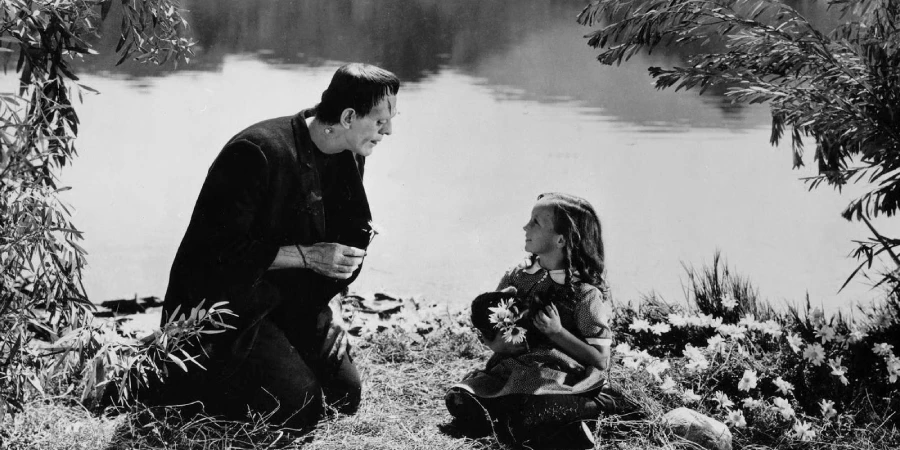
In the film’s most famous and most disturbing scene, the creature encounters a young girl named Maria by a lakeside. She welcomes him without fear, and they play together, throwing flower petals into the water to watch them float. It is a genuinely tender moment.
Then, running out of flowers, the creature throws Maria herself into the water. He does not intend murder; he acts from the same simple logic he applied to the flowers. She drowns. This scene provoked enormous controversy and censors cut it from many prints, which actually made audiences imagine something far more sinister.
Henry’s Wedding and the Hunt Begins
Back at the Frankenstein estate, preparations for Henry and Elizabeth’s wedding proceed. Maria’s father carries her small, wet body through the celebrating village, and the festive mood collapses instantly. This juxtaposition of joy and horror is one of Whale’s most effective directorial choices.
A torch-carrying mob forms and sets out to hunt the creature. Henry joins the search party, separating from the main group as the creature lures him into the mountains. The hunter, notably, becomes the hunted.
Movie Ending
The creature captures Henry and carries him to an old windmill at the top of a hill. Henry fights back and the creature hurls him from the windmill’s upper platform. Henry survives the fall, bruised and unconscious but alive, caught in the windmill’s wooden sails on the way down.
The mob reaches the windmill and sets fire to it. The creature, trapped inside, burns as the structure collapses around it. Whale films this not as a triumphant victory but as something grimmer, a mob destroying what it fears and does not understand. The creature screams and the windmill falls.
Audiences in 1931 were left with a brief, almost tacked-on epilogue showing Henry recovering at home, surrounded by his family. His father, Baron Frankenstein, toasts Henry and Elizabeth’s future with a glass of wine in a tone of cheerful normalcy. This ending deliberately deflates the preceding horror with a kind of forced optimism, which some viewers find jarring and others find darkly funny.
What makes the ending resonate most is what it refuses to provide: justice, clarity, or moral resolution. The creature dies having never understood why it was hated. Henry survives having never truly reckoned with his responsibility. Moreover, the mob celebrates without fully processing what it has destroyed. Nobody wins, and the film knows it.
Are There Post-Credits Scenes?
No. Frankenstein contains no post-credits scene of any kind. Universal productions of this era did not use that convention. Once the epilogue ends, the film simply concludes.
Type of Movie
Frankenstein is a Gothic horror film with strong science fiction undertones. Its tone blends genuine dread with theatrical expressionism, owing a significant visual debt to German cinema of the 1920s. Whale leans into shadow, architecture, and atmosphere as much as plot.
Underneath the horror framing, the film functions as a tragedy. It is the story of a creator who abandons his creation and a creation that never had a fair chance. In contrast to simpler monster narratives, this one asks difficult questions and leaves them unanswered.
Cast
- Boris Karloff – The Monster
- Colin Clive – Henry Frankenstein
- Mae Clarke – Elizabeth
- John Boles – Victor Moritz
- Edward Van Sloan – Doctor Waldman
- Dwight Frye – Fritz
- Frederick Kerr – Baron Frankenstein
- Marilyn Harris – Maria
Film Music and Composer
David Broekman served as the music director for Frankenstein, overseeing the film’s score. Early sound-era Universal horror films relied heavily on library music and orchestral arrangements rather than fully original compositions. The result is an atmospheric, if somewhat patchwork, sonic backdrop.
Music plays a relatively restrained role compared to later horror scores. However, the sparse approach actually heightens tension in key moments, allowing silence and ambient sound to carry significant weight. The laboratory scenes, for instance, depend more on electrical crackle and thunder than on any orchestral swell.
Filming Locations
Frankenstein was shot almost entirely on Universal Studios backlot in Hollywood, California. Whale and his team built elaborate studio sets to create the watchtower laboratory, the village, the lakeside, and the mountain windmill. Using controlled studio environments gave Whale precise command over lighting and shadow.
This tight studio shooting reinforced the film’s theatrical, expressionist visual style. Real locations would have introduced natural light and practical limitations that worked against the artificial, heightened world Whale wanted to construct. Consequently, every frame feels deliberately composed rather than merely captured.
Awards and Nominations
Frankenstein was not a major awards contender during the formal ceremony circuit of its era, and it received no significant Oscar nominations. However, its cultural and commercial impact far outweighed any formal recognition. In later decades, various preservation and legacy bodies honored the film as a landmark of American cinema.
Behind the Scenes Insights
- Boris Karloff was cast relatively late in production; Bela Lugosi was considered for the role but reportedly turned it down, finding the heavily physical, non-speaking part unappealing.
- Karloff’s iconic monster makeup was designed by Jack Pierce, whose process reportedly took several hours each day to apply.
- Colin Clive’s intense, high-strung performance as Henry reflected real personal instability; his frantic energy on screen was not entirely manufactured.
- James Whale approached the material with a mixture of genuine artistic ambition and a sharp sense of irony, treating the horror with both respect and wit.
- The famous “It’s alive!” scene originally featured much stronger dialogue invoking God, which censors in several regions required to be softened.
- Karloff built sympathy for the creature through purely physical performance, communicating confusion, longing, and pain without a single line of dialogue.
- The elevated boots and heavy costume Karloff wore contributed authentically to the creature’s lumbering, unsteady gait.
Inspirations and References
Frankenstein adapts Mary Shelley‘s 1818 novel Frankenstein; or, The Modern Prometheus, though the film draws more directly from a 1927 stage adaptation by Peggy Webling. Webling’s version made significant changes to Shelley’s story, and many of those changes appear in the film rather than anything sourced from the novel directly.
German Expressionist cinema, particularly the work coming out of studios like UFA in the early 1920s, heavily influenced Whale’s visual approach. Films such as The Cabinet of Dr. Caligari and Nosferatu established the visual grammar of shadow, distortion, and architectural menace that Frankenstein adopts and refines. Whale, furthermore, brought a distinctly British theatrical sensibility to material rooted in European literary tradition.
Alternate Endings and Deleted Scenes
Several regional censors required cuts to the film, most notably to the scene involving Maria at the lake. In many early prints, the moment where the creature throws Maria into the water was removed entirely. As a result, audiences saw the playful flower-tossing scene cut abruptly, which paradoxically caused some viewers to assume something even more violent had occurred.
Some early prints also had the most blasphemous version of Henry’s “It’s alive!” speech audibly altered or muted. Subsequent restorations have worked to return these elements to the film. No substantial alternate ending to the main narrative appears to exist in documented production records.
Book Adaptations and Differences
Mary Shelley’s original novel differs from this film in profound ways. In Shelley’s text, the creature is articulate, well-read, and capable of extended philosophical argument. The film strips all of this away, reducing the creature to a mute, physically expressive figure whose inner life audiences must infer.
Shelley’s novel also follows a much broader narrative structure, including Arctic framing sequences and the creature’s years of self-education in isolation. The film compresses everything ruthlessly into a tight, single-location drama. In addition, the novel places far greater moral weight on Frankenstein’s irresponsibility, while the film distributes blame more ambiguously across Henry, Fritz, and Waldman. The names themselves differ: Shelley’s scientist is Victor, not Henry, a change introduced through the Webling stage adaptation.
Memorable Scenes and Quotes
Key Scenes
- The opening graveyard robbery, which immediately establishes Henry’s transgressive obsession.
- The creation scene, with lightning, electrical apparatus, and Henry’s triumphant screaming, remains one of horror cinema’s defining set pieces.
- Fritz tormenting the chained creature with fire, revealing how human cruelty provokes the violence that follows.
- The creature reaching toward a beam of sunlight through the laboratory roof, a small, wordless moment of extraordinary pathos.
- Maria and the creature by the lake, a scene of genuine tenderness that turns suddenly and irreversibly tragic.
- Maria’s father carrying her body through the village during the wedding celebrations, a masterclass in tonal contrast.
- The burning windmill finale, framed as a spectacle of mob violence rather than heroic triumph.
Iconic Quotes
- “It’s alive! It’s alive! In the name of God, now I know what it feels like to be God!” (Henry Frankenstein, partially censored in early releases)
- “You have created a monster and it will destroy you!” (Doctor Waldman)
- “Crazy, am I? We’ll see whether I’m crazy or not.” (Henry Frankenstein)
Easter Eggs and Hidden Details
- Jack Pierce designed the flat-topped skull to suggest that the top of the head had been surgically removed and replaced, a practical storytelling choice embedded directly in the makeup design.
- The two bolts on the creature’s neck function as electrodes, the points through which electrical current entered the body during reanimation. Many viewers accept them purely as visual iconography without registering their narrative logic.
- The label on the jar Fritz drops reads “dysfunctio cerebri” in some prints, a subtle Latin detail that reinforces the pseudo-medical framing of the horror.
- Whale frames the creature’s first appearance from behind, then in partial shadow, before finally revealing the full face. This deliberate withholding mirrors classic theatrical reveal techniques.
- The windmill at the climax appears in multiple Universal horror productions of this period, serving as a recurring studio backlot set dressed differently for various productions.
Trivia
- Frankenstein was a massive box office success, reportedly earning many times its production budget and cementing Universal’s dominance in horror.
- Boris Karloff received no billing on the original promotional materials; his name was replaced by a question mark, a marketing choice that paradoxically made him more famous.
- Colin Clive was actually British, and his clipped, theatrical delivery gave Henry Frankenstein a heightened quality that suited Whale’s expressionist vision perfectly.
- The film runs approximately 71 minutes, demonstrating that Whale and Universal understood how to maintain relentless pacing without overstaying their welcome.
- James Whale agreed to direct the film partly because he saw it as an opportunity for genuine artistic experimentation within a commercial framework, not merely a paycheck assignment.
- Karloff’s creature design has become so culturally dominant that many people encountering Shelley’s novel for the first time are genuinely surprised that the creature looks nothing like this in the original text.
- Frankenstein and Dracula, released the same year, together launched the Universal Monsters franchise and shaped Hollywood horror for decades.
Why Watch?
Few films have shaped a genre so completely and remained so genuinely watchable after nearly a century. Karloff’s physical performance is a masterwork of wordless emotion, and Whale’s direction is confident, stylish, and surprisingly humane. At just over 70 minutes, it wastes nothing. Consequently, it rewards both first-time viewers and those returning to examine its craft more carefully.
Director’s Other Movies
- Waterloo Bridge (1931)
- The Old Dark House (1932)
- The Invisible Man (1933)
- Bride of Frankenstein (1935)
- Show Boat (1936)
- The Road Back (1937)
Recommended Films for Fans
- Dracula (1931)
- Bride of Frankenstein (1935)
- The Mummy (1932)
- The Old Dark House (1932)
- The Invisible Man (1933)
- Nosferatu (1922)
- The Cabinet of Dr. Caligari (1920)