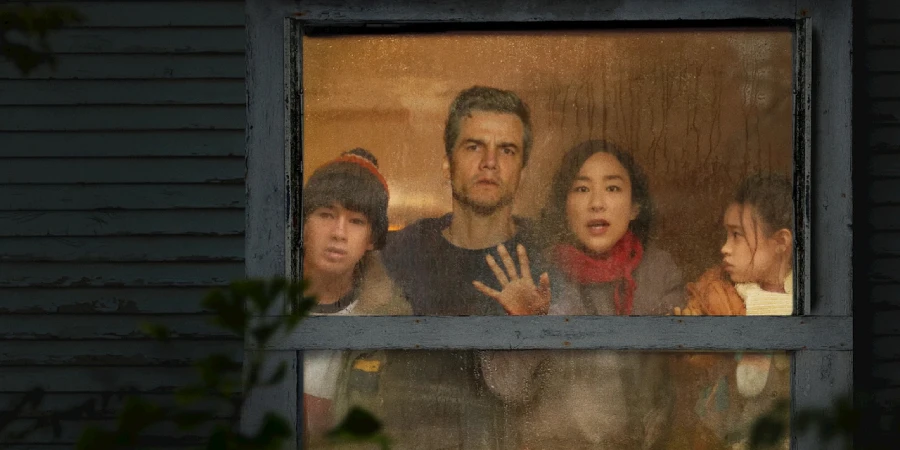

Imagine waking up one rainy morning to find your front door welded shut by an invisible force. That is the nightmare fueling The Last House, Louis Leterrier’s Netflix sci-fi thriller starring Greta Lee and Wagner Moura. What begins as a locked-room mystery slowly mutates into a five-year survival epic with tentacled visitors from the deep. Buckle up, because we are spoiling every last secret below.
Detailed Summary
An Ordinary Family, an Extraordinary Storm
Jason (Wagner Moura) and Ann (Greta Lee) live a comfortable suburban life in the Seattle area with their kids, twelve-year-old Graham and eight-year-old Ruth. Jason, a struggling engineer, spends time fishing and notices something odd: he has not caught a big fish in months. That small detail becomes chilling foreshadowing once the truth surfaces.
Sealed Inside
A massive rainstorm settles over the neighborhood, and suddenly nothing opens. Doors will not budge, windows will not break, and every attempt at escape fails. Through the glass, the Delgados watch their neighbors struggle with the exact same predicament.
Rationing, Loss, and Desperation
Supplies dwindle fast, so the family begins strict rationing. Their beloved dog Cass runs out of heart medication, and Jason puts him down as an act of mercy. Later, Graham kills the family’s pet fish to provide food during a moment of near starvation.
Tragedy strikes beyond their walls too. Mrs. Richardson, the dentist’s wife across the street, dies, along with a woman caught outside when the storm began.
Then Ruth gets bitten by a ferret that stumbles into their food trap. She falls dangerously ill and needs antibiotics. In desperation, Jason tries to ram the car through the garage door; the crash knocks him out and reveals deeper cracks forming in the house.
The Five-Year Time Jump
More than halfway through, the film leaps forward five years. A loosened chimney cap has created one small opening in the barrier, and Jason exploits it brilliantly. He rigs traps through the chimney to catch animals (the crew nicknamed this “chimney fishing”) and builds water-collection systems that irrigate crops growing inside the house.
Nearly everything gets repurposed: bicycle parts, vacuums, furniture, clothing, and kitchen tools. Meanwhile, the house itself begins to sink, and the family realizes time is running out.
The Visitors Revealed
Creatures with squiggly tentacles, which the family calls “the visitors,” invade the home during a downpour. Everyone hides, but they finally glimpse the beings controlling the rain. Ruth connects the creatures to imagery from her childhood books and reaches a stunning conclusion.
These are not aliens. They are ancient sea creatures that emerged from the ocean depths after humanity polluted the planet and effectively boiled the seas. Now they are raising the water and reclaiming the world that was always theirs.


Movie Ending
Jason gathers his family and declares, “Today is the last day in this house.” Together they rig the entire home with improvised traps, Home Alone style, and lure a creature inside. After a brutal struggle that floods the house with rainwater, the plan works and the visitor is caught.
Ann, notably, must dive into the sewer system beneath the house before the whole structure fills with water. These sequences were shot in genuinely submerged sets, which explains why the finale feels so suffocating.
Then comes the pivot that defines the film. Ruth recognizes that the trapped creature is trying to communicate, not attack. Jason has spent the entire movie trying to control, fix, or destroy every threat; this time, he trusts his daughter and puts his weapons down.
His mercy changes everything. The freed creature opens the front door, and when other visitors move in to attack, it warns them off. Humanity, at least this one family, has proven capable of coexistence, so the creatures retreat to the sea.
Outside, the Delgados discover their city underwater. They take a neighbor’s boat and sail off in search of a new life. Just before the credits, Ruth speaks into a radio and asks if any other survivors are out there; a staticky voice answers, “Hello?”
Who says it? Leterrier refuses to reveal the answer, teasing only that the voice belongs to a “very, very, very iconic” person. He insists viewers will never know for sure, though the moment clearly leaves the door open for a sequel.
Are There Post-Credits Scenes?
No, The Last House does not include a post-credits scene. Its big final tease, the mysterious radio “Hello,” plays right before the credits roll, so you can safely stop watching once they start.
Type of Movie
The Last House blends science fiction, survival horror, and psychological thriller into one claustrophobic package. Netflix rates it PG-13, and it runs 112 minutes.
Tonally, it swings between intimate family drama and creature-feature dread. In addition, an unmistakable eco-parable runs underneath the scares.
Cast
- Greta Lee – Ann
- Wagner Moura – Jason
- Riley Chung – Ruth (8 years old)
- Emma Ho – Ruth (13 years old)
- Noah Alexander Sosnowski – Graham (12 years old)
- Gabriel Barbosa – Graham (17 years old)
- Arden Cho – Adult Ruth
- Audrey Anderson – Susan
- Sid Edwards – Max Richardson
- Lewis Goody – Greg
Film Music and Composer
Berlin-based composer Yair Elazar Glotman wrote the original score. Trained as a classical orchestral contrabass player, he previously scored Netflix’s Reptile and A24’s False Positive, and he co-composed Last and First Men with his late mentor Jóhann Jóhannsson.
His soundtrack album spans 26 tracks and roughly 53 minutes on Netflix Music. Notable cues include “Entering 11817,” “Chimney Fishing,” “The Flood,” “Panic in the Attic,” and “Concerto for the Last House,” a collaboration with pianist Nitai Hershkovits.


Filming Locations
Despite its Seattle-area setting, the production never left England. Cameras rolled from roughly late March through June 2025, primarily at Shepperton Studios in Surrey, where the filmmakers built the entire neighborhood, not just the house, on a soundstage.
Additional exterior work used the Littleton House Estate, areas around the River Ash, and the wider London region, with a unit also reported at Calshot Beach in Hampshire. Consequently, the crew controlled every drop of rain and could physically flood a purpose-built version of the house for the underwater finale.
That control matters enormously to the story. A film about a sealed, decaying, eventually submerged home simply could not work on a real suburban street.
Awards and Nominations
The Last House premiered in August 2026, so awards season has not yet weighed in. It has no major nominations to date, though it did become the number one movie on Netflix during its first week.
Behind the Scenes Insights
- Production ran under the mysterious working title 11817, which is the Delgado family’s house number.
- Leterrier shot the first act on 35 mm film, then switched to digital after the five-year time jump to visually mark the shift.
- Production designer Kevin Jenkins created the creature look almost instantly; the winning design came from only his second drawing.
- A practical silicone creature suit, operated by a puppeteer inside, performed in the flooded rooms before visual effects enhanced it.
- Survival consultant Megan Hine grounded the family’s improvised systems in real survival logic: shelter, water, food, fire, and sleep.
- Marine coordinator Ian Creed put the cast through five underwater training sessions, progressing from basic scuba to breath-holding without equipment.
- To make tank water look murky, the crew mixed in broccoli; the cast jokingly called it “broccoli water.”
- Greta Lee learned to dive for the role and, by her own account, conquered a fear of sharks along the way.
- Designers built the house’s ruined year-five version first, then worked backward, while the shoot itself ran largely in chronological order so the actors aged with the set.
Inspirations and References
Screenwriter Matthew Robinson (The Invention of Lying, Dora and the Lost City of Gold) penned an original script, but the pandemic clearly haunts it. Leterrier has said he hoped the world would emerge from COVID with a different mindset, and he wants his fictional family to succeed where reality fell short.
For the creature reveals, the filmmakers studied classic monster cinema, specifically Jaws, Alien, and The Thing, embracing the “less is more” philosophy of glimpsed horror. Furthermore, the story carries a pointed environmental message about overconsumption and warming oceans.
Alternate Endings and Deleted Scenes
Netflix and Leterrier have not publicly disclosed any alternate endings or deleted scenes so far. Given the deliberately unresolved “Hello” radio call, the ambiguity appears fully intentional rather than the result of cut material.
Book Adaptations and Differences
The Last House is not based on a book. It comes from an original screenplay by Matthew Robinson, so there is no source novel to compare.


Memorable Scenes and Quotes
Key Scenes
- Every door and window refusing to open as the rain begins, the moment the safe haven becomes a prison
- Jason putting down the family dog Cass after his heart medication runs out
- Jason ramming the car into the garage door to save a feverish Ruth, only to knock himself out
- The chimney cap breaking loose, giving the family their single “chink in the armor”
- The visitors entering the home while the family hides, revealing their tentacled forms
- The trap sequence and flood during the family’s last stand
- Ann’s dive through the sewer beneath the sinking house
- Jason freeing the creature, and the creature opening the front door in return
- The family sailing away over their drowned city as a voice crackles, “Hello?”
Iconic Quotes
- “Today is the last day in this house.” (Jason)
- “Are there any other survivors out there?” (Ruth, into the radio)
- “Hello?” (the unidentified voice that ends the film)
Easter Eggs and Hidden Details
- Jason’s early complaint about catching no big fish quietly signals that ocean life has already fled the creatures rising from the depths.
- Ruth’s childhood books contain imagery echoing the visitors, which lets her identify them as sea creatures before anyone else.
- The working title 11817 survives as the house number and even appears in score track titles like “Entering 11817.”
- The rain itself functions as the creatures’ tool; sealed houses and rising water are their method of reclaiming territory, hidden in plain sight from the first scene.
Trivia
- Netflix promoted the film with a stunt performer literally living inside a billboard on Sunset Boulevard.
- Wagner Moura described an emotional on-set handover when younger actors Riley Chung and Noah Alexander Sosnowski passed their roles to Emma Ho and Gabriel Barbosa for the post-time-jump scenes.
- Leterrier frames the twist as a reversal of the invasion genre: humans, not the creatures, are the true aliens on this planet.
- Cinematographer Pål Ulvik Rokseth shot the film, with Chernin Entertainment and 3 Arts Entertainment among the production companies.
- According to Leterrier, other humans likely survived worldwide, particularly people on high ground or in tall buildings.
Why Watch?
Watch it for two magnetic leads trapped in one impossible house, and for a monster movie that flips into an unexpectedly hopeful fable. Admittedly, the mystery outshines its answers. Still, the flooded finale, shot in real water, delivers genuine spectacle.
Director’s Other Movies
- The Transporter (2002)
- Transporter 2 (2005)
- Unleashed (2005)
- The Incredible Hulk (2008)
- Clash of the Titans (2010)
- Now You See Me (2013)
- The Brothers Grimsby (2016)
- Fast X (2023)