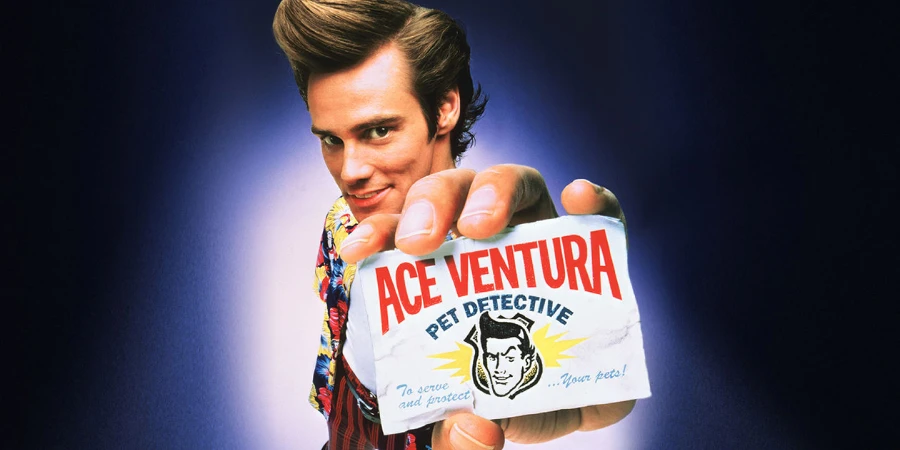

Jim Carrey spent most of 1993 shooting Ace Ventura: Pet Detective while simultaneously filming The Mask and Dumb and Dumber, a schedule that would destroy most actors and apparently fueled one of the most physically committed comedy performances ever put on film.
Every muscle in Carrey’s face seems to have its own contractual obligation. This is a movie where a man exits a rhinoceros hindquarters, covered in fake fluids, to the applause of a live crowd, and somehow it works.
Detailed Summary
Ace Ventura Introduces Himself
We open on a delivery man. He drops boxes, kicks packages, and slams a parcel against a door frame repeatedly. That delivery man is Ace Ventura, animal-obsessed private detective, and the bit perfectly establishes his entire personality in under two minutes.
Ace lives in a Miami apartment crammed with rescued animals. His landlord hates him. Neighbors hate him. His animals adore him, which is all that matters to Ace.
The Case: Snowflake Goes Missing
Ace gets hired by Melissa Robinson, a publicist for the Miami Dolphins, to find Snowflake, the team’s dolphin mascot who has been stolen ahead of the Super Bowl. The case feels small. It refuses to stay that way.
Ace digs into former Dolphins players who might hold a grudge. His investigation leads him to Ray Finkle, a kicker who missed a field goal during a previous Super Bowl and subsequently went insane, blaming quarterback Dan Marino personally.
Breaking Into Finkle’s House
Ace visits the Finkle family home, a deeply unsettling shrine to obsession. Ray’s old room is plastered floor-to-ceiling with photos of Dan Marino, all with the eyes scratched out. Finkle escaped from a mental institution years earlier and vanished.
Ace finds a clue hidden in the shrine: a laces-out reference, Finkle’s fixation on the botched hold that caused his missed kick.
Lieutenant Einhorn Becomes a Problem
Lieutenant Lois Einhorn, played by Sean Young, antagonizes Ace throughout the investigation. She dismisses him, threatens him, and actively works to shut down his case. Ace finds her suspicious. Most viewers assume she is simply obstructionist law enforcement doing the movie villain thing.
Snowflake and Marino Kidnapped
As Super Bowl week arrives, Dan Marino himself gets kidnapped alongside Snowflake. Ace realizes the stakes have climbed dramatically. The kidnapper is not just stealing a mascot for laughs; they want to humiliate Marino in front of the world.
Ace Cracks the Case
Ace pieces it together in one of the film’s genuinely clever plotting moments. Ray Finkle escaped the institution, assumed a new identity, joined the Miami police force, and became Lieutenant Lois Einhorn. Einhorn is Finkle. Finkle is Einhorn.
Ace discovers the physical evidence in a bathroom scene that the film plays with broad comedy but which lands as a legitimate reveal. He confronts his memories of kissing Einhorn earlier in the film and promptly has an extended meltdown, burning his clothes and scrubbing his mouth with a toilet brush.

Movie Ending
Ace tracks Snowflake and Marino to a remote coastal location. Einhorn has rigged the situation to shoot Marino and let Snowflake die, framing it as the ultimate revenge against the man she blames for ruining her football career.
Ace arrives, does his thing, and exposes Einhorn in front of dozens of police officers and NFL personnel. His method of exposure is exactly as crude and broadly comedic as everything preceding it. He forces Einhorn into a situation that publicly reveals her biological sex, and the cops who had kissed or touched her all begin vomiting in unison.
This sequence is the film’s most dated moment by a significant margin. Played as a gross-out punchline in 1994, it reads now as deeply transphobic, using a trans woman’s body as the punchline to a disgust gag. Worth naming plainly.
Marino gets rescued. Snowflake swims free. Ace takes a dramatic bow on the dock. The film wraps with the kind of triumphant absurdist cheer that Carrey’s performance earns through sheer physical willpower.
Are There Post-Credits Scenes?
Ace Ventura: Pet Detective has no post-credits scene. Once the story ends, it ends. No teases, no bonus footage, nothing hiding after the credits roll.
Type of Movie
This is a broad slapstick comedy with a thin but functional mystery plot underneath it. Tonally, it sits somewhere between a live-action cartoon and a one-man variety show built around Carrey’s physical performance. Family-adjacent in its content but not exactly a kids’ film.
Cast
- Jim Carrey – Ace Ventura
- Courteney Cox – Melissa Robinson
- Sean Young – Lieutenant Lois Einhorn / Ray Finkle
- Tone Loc – Emilio
- Dan Marino – Himself
- Noble Willingham – Riddle
- Troy Evans – Podacter
- Raynor Scheine – Woodstock
Film Music and Composer
Ira Newborn composed the score. Newborn was a veteran of broad American comedies, having scored films like The Blues Brothers and Naked Gun, which made him a natural fit for Ace’s cartoonish energy.
The soundtrack leans heavily on licensed tracks alongside Newborn’s score. Cannibal Corpse appear in the film performing “Hammer Smashed Face,” a cameo that remains one of the more surreal pop-culture collisions of the early nineties.

Filming Locations
Production shot primarily in Miami, Florida. The city’s heat, color, and coastal landscape give the film a specific sensory identity: bright pastel buildings, open water, and the kind of sweaty, chaotic energy that suits Ace’s lifestyle perfectly.
Filming around actual Miami Dolphins facilities and involving real NFL players added a texture of authenticity that kept the sports subplot grounded. Dan Marino’s willingness to appear and poke fun at himself gave the film unexpected goodwill.
Awards and Nominations
Ace Ventura: Pet Detective was not a major awards contender. Jim Carrey received a MTV Movie Award nomination for Best Comedic Performance, which accurately reflects the film’s cultural standing: a mainstream crowd-pleaser rather than a critical darling.
Behind the Scenes Insights
- Jim Carrey helped develop the Ace Ventura character before the script existed in its final form, pitching a rougher concept that the studio shaped into the finished film.
- Director Tom Shadyac was making his feature directorial debut with this film, which is easy to forget given how confidently it deploys Carrey’s energy.
- Carrey was not yet a major star when production began; the film’s enormous box office success launched him into the stratosphere almost overnight alongside his two other 1994 releases.
- Dan Marino’s involvement required real coordination with the NFL, and his performance (relaxed, self-deprecating) surprised people who expected a wooden celebrity cameo.
- Many of Ace’s animal wrangling scenes required extensive coordination with trained animals, and Carrey reportedly formed genuine bonds with several of them during production.
Inspirations and References
The film does not adapt a pre-existing book, comic, or true story. Jack Bernstein wrote the original screenplay from a concept that Carrey helped shape. Ace’s character draws loosely on the tradition of the screwball private detective, a figure riffing on noir conventions while flipping them into absurdity.
The missing-mascot premise may have drawn loose inspiration from real NFL security incidents and general sports paranoia culture, but no specific documented source inspired the plot directly.
Alternate Endings and Deleted Scenes
No widely documented alternate ending exists for Ace Ventura: Pet Detective. Some deleted and extended scenes have circulated over the years in home video releases, showing additional bits of Ace’s apartment life and extended comedy sequences that the theatrical cut trimmed for pacing.
Nothing among the cut material fundamentally changes the story or ending. The trimming appears to have been purely rhythmic, keeping Carrey’s performance from overstaying its welcome in any single sequence.
Book Adaptations and Differences
Ace Ventura: Pet Detective is not based on a book. It is an original screenplay. A novelization may have followed the film’s release, as was common for successful comedies of that era, but the film itself drew from no literary source.
Memorable Scenes and Quotes
Key Scenes
- The opening delivery sequence, where Carrey destroys a package in increasingly creative ways before revealing himself as the “hero” of the film.
- Ace’s apartment introduction, where dozens of animals emerge from every corner while his landlord screams from the doorway.
- The Finkle bedroom scene, with its wall of defaced Marino photographs building genuine unease before snapping back into comedy.
- Ace reconstructing the Finkle/Einhorn connection in a rapid-fire monologue delivered to Melissa and a room of bewildered police officers.
- The bathroom realization scene, where Carrey burns his clothes and scrubs his mouth in an extended physical breakdown.
- The Cannibal Corpse cameo at the club, which arrives without warning and leaves without explanation.
- The rhino birth sequence, where Ace crawls out of a prop animal in full costume while a crowd of onlookers watches in horror.
Iconic Quotes
- “Alrighty then!”
- “Do NOT go in there!”
- “Laces out, Dan!”
- “Re-hee-hee-heeally.”
- “If I’m not back in five minutes… just wait longer.”
Easter Eggs and Hidden Details
- Ace’s apartment contains a surprisingly large number of distinct animal species if you pause and scan the background carefully; the production clearly went well beyond what was strictly necessary for the plot.
- Carrey’s hair in the film changes subtly in texture and shape across scenes in ways that appear to reflect actual days of shooting rather than deliberate continuity choices.
- Einhorn’s police desk has paperwork visible in background shots that references fictitious case files, some of which contain silly names if you read them closely.
- Several extras in the crowd during the stadium sequences are actual Miami Dolphins staff and personnel rather than hired extras.
Trivia
- Jim Carrey earned a relatively modest salary for this film; its massive box office success directly fueled the astronomical fees he commanded for his subsequent projects.
- The film was shot quickly and under a tight budget by studio standards, which may partly explain its loose, improvisational energy.
- Tom Shadyac and Carrey developed a strong working relationship here and went on to collaborate again on Liar Liar.
- Carrey reportedly stayed in character as Ace between takes, which either charmed or exhausted everyone on set depending on whom you ask.
- Sean Young’s casting against type, playing a villain rather than the romantic leads she was known for, gave her one of the more memorable performances of her career even if the material around her is troubling in retrospect.
- The film opened in February 1994, a traditionally weak release window, and still became a significant box office hit, catching studios off guard.
- Carrey improvised a substantial portion of his dialogue, and the production allowed considerable room for him to work in that mode.
Why Watch?
Watch it for Carrey’s face alone. No CGI, no stunt doubles for the comedy: just one man contorting his body into shapes that suggest he has no skeleton and complete commitment to every single bit, including the ones that probably looked insane on paper. The rhino scene is genuinely funnier than most comedies manage in their entire runtime.
Director’s Other Movies
- Liar Liar (1997)
- Patch Adams (1998)
- Nutty Professor II: The Klumps (2000)
- Bruce Almighty (2003)
- Evan Almighty (2007)
Recommended Films for Fans
- The Mask (1994)
- Ace Ventura: When Nature Calls (1995)
- Dumb and Dumber (1994)
- Liar Liar (1997)
- Beverly Hills Cop (1984)
- The Cable Guy (1996)
- There’s Something About Mary (1998)