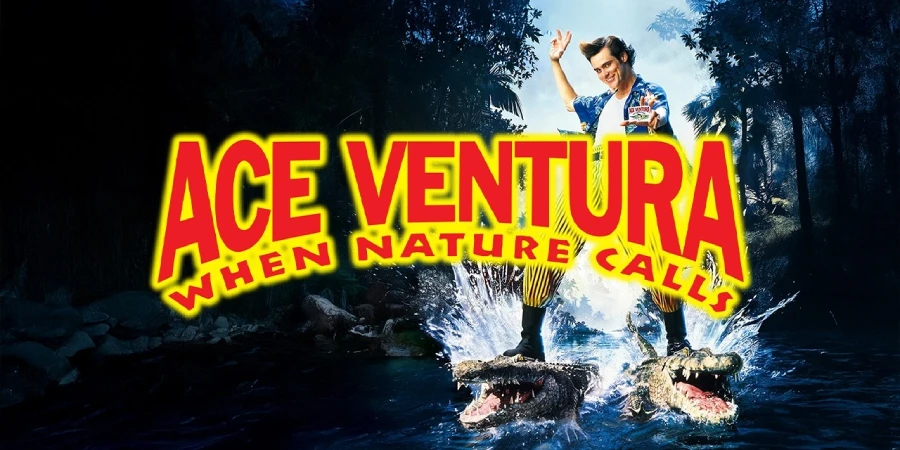

Jim Carrey contorts his body through the rear end of a mechanical rhinoceros, emerges covered in slime to the sound of dramatic orchestral music, and the crowd in the theater loses its mind. That single scene tells you everything you need to know about Ace Ventura: When Nature Calls.
This 1995 sequel leans harder into absurdism than its predecessor, trading Miami neon for African jungles and doubling down on Carrey at his most physically unhinged. It is loud, stupid, and genuinely funny in ways that polished studio comedies rarely dare to be.
Detailed Summary
The Himalayan Opening
The film opens as a direct parody of Cliffhanger, with Ace high in the Himalayas, attempting to rescue a raccoon stranded on a mountain ledge. He fails. The raccoon falls, and Ace watches, horrified, unable to save it. This moment of comedic tragedy sends him into a spiritual retreat at a Tibetan monastery.
He spends his days there meditating, eating, and annoying the monks. A British emissary named Fulton Greenwall arrives to pull him back into action. Ace initially refuses, but the promise of a bat-related case in Africa eventually wins him over.
The Mission in Africa
Greenwall briefs Ace on the situation. A sacred white bat named Shikaka has gone missing from the Wachati tribe. Its safe return is critical: the Wachati are about to forge a peace alliance with the neighboring Wachootoo tribe through an arranged marriage between their princess and the Wachootoo chief’s son.
Without the bat, the alliance falls apart and war breaks out. Ace agrees to find it. He heads to Africa and immediately begins clashing with the local British authorities, particularly a pompous consul named Vincent Cadby.
Ace Investigates
Ace digs into the mystery with his signature chaos. He visits both tribes, survives a series of elaborate traps and challenges set by the Wachootoo chief, and generally offends everyone around him while somehow gathering clues.
One standout sequence involves Ace navigating an elaborate obstacle course set by the Wachootoo to prove his worthiness. Carrey’s physical performance here is genuinely impressive; he throws himself at every stunt with zero hesitation, and the choreography of his pratfalls feels almost athletic.
Ace also encounters Cadby repeatedly, and each meeting deepens his suspicion that the consul is hiding something. Cadby’s behavior is too controlled, too hostile toward the investigation.
Uncovering the Conspiracy
Ace eventually uncovers the real scheme. Cadby stole the bat himself. His motive is to trigger the war between the two tribes so that a massive safari resort can be built on their land after they destroy each other. It is a colonial land-grab disguised as a diplomatic crisis.
Cadby had Shikaka smuggled to his compound and kept hidden. Once Ace pieces this together, the film shifts into its chaotic finale.
Ace Among the Wachati
Before the finale, some of the film’s funniest cultural-clash material comes from Ace living among the Wachati. He navigates bizarre customs, participates in tribal rituals, and at one point sits cross-legged in a hut while a chief speaks at length through a translator who delivers increasingly wild interpretations.
One memorable gag involves Ace discovering that a gift he received is not what he initially thought, leading to one of Carrey’s best physical reaction shots in the film. His face does about six emotions in three seconds.

Movie Ending
Cadby’s plan crumbles when Ace retrieves Shikaka and prepares to deliver the bat to the Wachati ceremony. Just as the peace marriage is about to finalize, a catastrophic revelation surfaces: the Wachati princess is not a virgin, a requirement of the alliance.
Ace, in a panic, admits he is responsible. This is played entirely for mortified laughs, with Carrey’s expression cycling from guilt to sheer terror as tribal warriors close in on him. He attempts to flee and creates absolute mayhem at the ceremony.
Cadby is exposed in front of both tribes and the British authorities. His scheme collapses publicly, and he gets carried off by the angry crowd. Ace, remarkably, survives by finally presenting Shikaka to both tribes, restoring the sacred bond and preventing the war.
Greenwall, who has spent the whole film watching Ace demolish every social convention around him, gets his own comedic sendoff. In a last-second twist, Greenwall is revealed to have broken a Wachootoo taboo earlier in the film without knowing it, and the warriors set their sights on him as Ace cheerfully walks away. It is a neat little button that rewards attentive viewers who caught the earlier setup.
No grand emotional resolution ties the film up neatly. Ace wins by being Ace: chaotic, shameless, and accidentally effective. That refusal to give him a sentimental arc is exactly the right call for this character.
Are There Post-Credits Scenes?
Ace Ventura: When Nature Calls does not include any post-credits scenes. Once the credits roll, that is all you get. Feel free to leave the theater.
Type of Movie
This is a slapstick comedy with light adventure elements. Its tone sits firmly in anarchic farce, closer to a live-action cartoon than a conventional buddy comedy. Carrey’s performance style demands that the surrounding film match his energy, and director Steve Oedekerk mostly keeps pace.
Cast
- Jim Carrey – Ace Ventura
- Ian McNeice – Fulton Greenwall
- Simon Callow – Vincent Cadby
- Maynard Eziashi – Ouda
- Bob Gunton – Burton Quinn
- Sophie Okonedo – The Wachati Princess
- Adewale Akinnuoye-Agbaje – Hitu
Film Music and Composer
Robert Folk composed the score for the film. Folk had a long background in comedy scoring, and his work here leans into broad orchestral comedy cues that underscore Carrey’s physical gags without overexplaining them.
The score largely stays out of the way, which is the correct instinct. Carrey’s timing does not need musical underlining; it lands on its own. Folk’s African-inflected percussion pieces work particularly well during the tribal sequences, giving those scenes a sense of place without veering into caricature.

Filming Locations
Principal photography took place largely in Charlotte, North Carolina, with studio sets recreating the African environments. Some location work captured actual exterior landscapes to lend the jungle sequences visual credibility.
Shooting in North Carolina rather than Africa was a practical production decision, but the film’s art direction works hard to compensate. The set design for the tribal villages is detailed enough that it rarely pulls you out of the fiction, even if a seasoned traveler would spot the seams.
Awards and Nominations
Ace Ventura: When Nature Calls was not a major awards contender. It picked up nominations at the MTV Movie Awards and similar populist ceremonies, reflecting its audience appeal rather than critical prestige.
Behind the Scenes Insights
- Jim Carrey was paid significantly more for this sequel than for the original Ace Ventura: Pet Detective, reflecting his explosive rise to stardom in 1994 following The Mask and Dumb and Dumber.
- Director Steve Oedekerk stepped in after Tom Shadyac, who directed the first film, did not return for the sequel.
- Oedekerk wrote the screenplay and tailored many of the gags specifically around Carrey’s improvisational instincts, leaving room in the script for Carrey to riff.
- Carrey reportedly developed much of his physical business on set in collaboration with Oedekerk rather than rehearsing it in advance.
- The rhinoceros birth sequence required extensive practical effects work, including a full-scale prop animal built specifically for that gag.
- Carrey performed many of his own physical stunts throughout the production, which contributed to the genuine kineticism of the performance.
Inspirations and References
The film draws loosely on the tradition of colonial adventure comedies, sending an absurdist American archetype into a setting usually reserved for serious adventure films. Think of it as a deliberate inversion of earnest safari pictures.
The opening Himalayan sequence is a direct parody of Cliffhanger (1993), complete with matching visual grammar and music stings. Oedekerk structured it as a loving send-up of action movie heroics, then immediately undercuts the heroism by killing the raccoon and sending Ace into emotional collapse.
The broader plot borrows from the tradition of British colonial mystery stories, where a missing sacred object triggers a geopolitical crisis. It plays these conventions completely straight before Carrey’s presence detonates them.
Alternate Endings and Deleted Scenes
No officially released alternate ending exists for the film. Some deleted material surfaced in behind-the-scenes discussions over the years, including extended improvisation sequences that ran long and were cut for pacing.
Given Carrey’s improvisational approach on set, it is likely that considerable footage exists that never made the final cut. None of it has received a formal home video release with detailed documentation.
Book Adaptations and Differences
Ace Ventura: When Nature Calls is not based on any book. It is an original screenplay written by Steve Oedekerk, building on the character established in the first film.

Memorable Scenes and Quotes
Key Scenes
- Ace emerging from the mechanical rhinoceros in slow motion, drenched in slime, while dramatic music swells around him.
- The Himalayan raccoon rescue gone catastrophically wrong, played as pure deadpan tragedy.
- Ace’s obstacle course challenge with the Wachootoo, where Carrey’s body seems to operate independently of physics.
- Ace discovering his bedroom is infested with bats and reacting with absolute delight rather than fear, which tells you everything about his character in five seconds.
- Ace performing a puppet show with his own buttocks in front of a group of British officials, a scene that should not work but absolutely does.
- The ceremony finale descending into complete chaos as Ace’s confession triggers a tribal standoff.
Iconic Quotes
- “Shikaka.” (Delivered with escalating reverence throughout the film, then used as a weapon in the finale.)
- “Do NOT go in there!”
- “Like a glove!”
- “Spank you, spank you very much.”
Easter Eggs and Hidden Details
- The Greenwall taboo setup is planted early and easy to miss; a Wachootoo elder reacts with visible horror to something Greenwall does, and the film does not explain it until the final scene pays it off.
- Several background extras in the tribal scenes are clearly trying not to laugh during Carrey’s more unhinged improvised moments.
- Oedekerk includes a quick visual nod to the original film’s animal-loving themes by populating Ace’s monastery retreat with various small animals he has apparently adopted.
- Cadby’s office contains subtle visual details that hint at his colonial ambitions before the plot explicitly reveals them.
Trivia
- The film was a massive commercial success, opening at number one at the box office despite mixed reviews from critics.
- Jim Carrey did not return for the direct-to-video sequel Ace Ventura Jr.: Pet Detective (2009), which recast the role with a child actor.
- Steve Oedekerk later became known for the Kung Pow! franchise of parody films.
- Simon Callow, who plays villain Cadby, is a classically trained theater actor, which makes his commitment to the film’s absurdity all the more impressive.
- Sophie Okonedo, who plays the Wachati princess, went on to receive an Academy Award nomination for Hotel Rwanda (2004), making this one of the more quietly remarkable early credits in a major dramatic career.
- Carrey and Oedekerk worked together to create the bat-room delight scene specifically to contrast Ace’s reaction with what a normal person would do, underlining his animal obsession as a defining character trait.
Why Watch?
Nobody commits to a bit quite like Jim Carrey at this particular moment in his career, and the rhinoceros sequence alone is worth your time as a study in physical comedy craft. Carrey’s body does things in this film that most trained clowns would refuse to attempt, and Oedekerk is smart enough to hold the camera steady and let it breathe. It is a film that trusts its star completely, and that trust pays off.
Director’s Other Movies
- Kung Pow: Enter the Fist (2002)
- Barnyard (2006)
Recommended Films for Fans
- Ace Ventura: Pet Detective (1994)
- The Mask (1994)
- Dumb and Dumber (1994)
- Liar Liar (1997)
- Pink Panther (2006)
- Johnny English (2003)