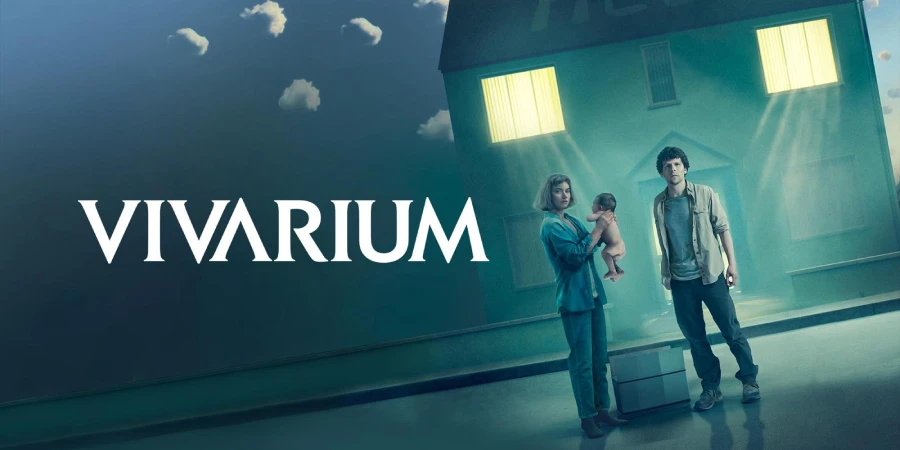

Forget haunted houses and serial killers. Vivarium found something far more unsettling to put on screen: a semi-detached house, a perfect lawn, and a baby that screams until it gets fed. Director Lorcan Finnegan’s 2019 film weaponizes the aesthetics of suburban domesticity against its characters, turning the promise of a starter home into a slow death sentence. Jesse Eisenberg and Imogen Poots spend roughly ninety minutes trapped in a pastel nightmare, and watching them crack is genuinely difficult to shake.
Detailed Summary
The Opening: A Cuckoo in the Nest
Finnegan opens the film with a close-up of a cuckoo chick shoving other eggs out of a nest while a schoolteacher named Gemma watches. She explains the behavior to her young students with quiet dread. This is not subtle, but it works: the film’s central metaphor arrives before the title card does.
Gemma, played by Imogen Poots, teaches at a primary school. Her boyfriend Tom, played by Jesse Eisenberg, works as a gardener. They are a plausible, warm couple looking to buy their first home together.
Martin and the Estate Agent
A strange estate agent named Martin approaches them. He is pale, stiff, and smiles in a way that suggests he learned smiling from a manual. Martin takes them to view a property in a housing development called Yonder.
Yonder is immediately wrong. Every house is identical. Every lawn is the same shade of green. Clouds hang overhead in formations that look painted rather than natural. When Martin abruptly disappears mid-tour, Gemma and Tom try to drive away but find themselves looping back to house number nine no matter which direction they take.
Trapped in House Number Nine
Nights pass. Food and supplies appear in cardboard boxes on the doorstep, but there is no sign of who delivers them. Tom burns house number nine to the ground in desperation. By morning, it has been rebuilt exactly as it was. Escape attempts fail completely, and the film lets that futility settle in slowly rather than rushing to the next plot beat.
A new box arrives containing an infant and a note: “Raise the child and be released.” Neither Tom nor Gemma wants the baby. It screams at an inhuman pitch until fed, then stares at them with flat, calculating eyes.
The Child Grows at an Unnatural Rate
Within days, the boy ages dramatically. He mimics Gemma and Tom’s voices with uncanny accuracy, repeating phrases back at them in a distorted echo. Poots plays Gemma’s revulsion beautifully here: she keeps her distance from the child, unable to pretend, while Tom slowly loses himself in futile manual labor.
Tom begins digging a hole in the garden. He has no particular plan; the digging just gives him something to do. It consumes him completely, becoming his own form of the suburban grind taken to a physical extreme.
The Boy’s True Nature Emerges
As the boy grows into a lanky, unsettling teenager, he watches an instruction video on a television that appeared in the house. The video shows a couple raising a child and going about domestic routines. He seems to be learning how to perform humanity rather than experiencing it.
Gemma discovers a book in the boy’s room with images inside that look like maps of Yonder, and anatomical diagrams of something that is not quite human. She begins to understand that the boy is not a child in any meaningful sense. He is a parasite being raised by hosts.
Tom’s Decline and Death
Tom digs deeper and deeper until he uncovers a green panel beneath the soil. He pries it open and descends into a tunnel. Inside, he sees other houses in Yonder from underneath, and he witnesses a void-like space that suggests the entire development exists in some constructed, possibly non-physical dimension.
Tom grows gravely ill. He deteriorates rapidly, his body hollowing out as if something is draining him from the inside. He dies in the hole he spent the film digging, which is probably the most on-the-nose piece of visual symbolism Finnegan deploys, but it earns its bluntness by arriving after so much patient, slow-burn dread.
Gemma Fights Back
Gemma, now alone with the boy, attacks him with a shovel. He sheds a thin skin from his face, revealing the same pale, blank visage as Martin, the original estate agent. She stabs him repeatedly. He does not die from her blows. He simply packs Tom’s body into a bag, drives away from Yonder in a car, and disappears to presumably repeat the process with new victims.
Movie Ending
Gemma collapses in the house after her assault on the boy fails to kill him. She has used everything she had left. Her body gives out quickly, echoing Tom’s deterioration in a compressed timeframe.
She dies inside house number nine. The boy, now fully adult in appearance, loads her body into a green bag. He drives to a real estate office in the real world, positions himself behind the desk, and puts on Martin’s name badge. He is the next Martin. He will lure the next couple to Yonder.
The cycle is explicit and deliberate. These creatures propagate by tricking humans into raising one of their young, consuming the hosts in the process, and then deploying the grown offspring as bait for the next generation of victims. Finnegan frames the final shot on that real estate office with grim calm, no dramatic swell, no catharsis. The horror is structural, not personal. Nobody was singled out. Gemma and Tom were just available.
What the film refuses to explain is what these creatures actually are, where Yonder exists, or what they want beyond reproduction. That ambiguity is a genuine strength, not a cop-out. Audiences looking for a mythology will leave frustrated, but the film is not interested in lore. It is interested in the feeling of being consumed by something you thought was ordinary life.
Are There Post-Credits Scenes?
Vivarium has no post-credits scene. Once the final shot fades, the film is done. Staying in your seat will reward you with nothing except more time to sit with what you just watched, which is arguably its own kind of punishment.
Type of Movie
Vivarium sits at the intersection of science fiction horror and psychological thriller. Its tone is bleak, slow-burn, and relentlessly suffocating. Fans of folk horror and Kafka-influenced weird fiction will feel at home here.
This is not a jump-scare film. Dread accumulates through repetition and geometry rather than shocks. Calling it a “slow burn” undersells how genuinely airless the pacing becomes, intentionally so.
Cast
- Imogen Poots – Gemma
- Jesse Eisenberg – Tom
- Senan Jennings – Young Boy
- Eanna Hardwicke – Older Boy
- Jonathan Aris – Martin
Film Music and Composer
Composer Kristian Eidnes Andersen scored the film. His work leans into dissonance and unease rather than melodic hooks. Strings drift without resolving, ambient tones hum beneath scenes at frequencies that register more as pressure than music.
Andersen has worked extensively in European genre cinema and television. His score for Vivarium functions as another layer of environmental wrongness, reinforcing the sense that Yonder operates on frequencies slightly outside normal human experience.


Filming Locations
Principal photography took place in Ireland, where the production team built the Yonder housing estate on a purpose-built set. Irish production infrastructure supported the film’s unusually controlled visual requirements.
Building the estate as a real physical set rather than relying entirely on digital extension was a significant practical choice. Eisenberg and Poots had actual identical houses stretching around them. That physical reality reads on screen: the wrongness of Yonder has weight and texture that a green-screen backdrop would not have provided.
Awards and Nominations
Vivarium received attention on the international festival circuit, including a screening at Cannes 2019 in the Critics’ Week section. It earned nominations at various genre-focused awards events but did not collect major mainstream awards recognition.
Behind the Scenes Insights
- Director Lorcan Finnegan developed the concept with writer Garret Shanley, expanding it from an earlier short film also titled Foxes.
- Jesse Eisenberg has spoken about the physical demands of the digging sequences, which required him to spend considerable time actually in a deep pit on set.
- Imogen Poots has noted that the repetitive environment made the shoot psychologically taxing in ways that fed directly into her performance.
- The identical houses in Yonder were practical builds, not pure digital fabrication, giving the cast a genuinely disorienting physical environment to work in.
- Finnegan worked closely with his production design team to ensure every house looked not just identical but slightly too perfect, with no visible aging or weathering on any surface.
Inspirations and References
Garret Shanley has cited the behavior of cuckoo birds as the central biological inspiration. Cuckoos lay eggs in other birds’ nests and let host parents exhaust themselves raising a parasite chick. The film literalizes this as a species-level reproductive strategy.
Kafka’s work, particularly The Trial and its sense of inescapable, sourceless institutional entrapment, clearly informed the tone. The housing development as a maze with no exit echoes Kafka’s architecture of futility.
Suburban horror as a genre, from The Stepford Wives onward, provides a cultural backdrop. Finnegan pushes past social satire, though. Where earlier suburban horror critiques conformity and consumerism, Vivarium treats the suburb itself as a predatory organism.
Alternate Endings and Deleted Scenes
No officially confirmed alternate endings or significant deleted scenes have been made public for Vivarium. Finnegan has not discussed major structural cuts in available interviews. The film as released appears to reflect the intended vision without notable deviation.
Book Adaptations and Differences
Vivarium is not based on a book. Garret Shanley wrote an original screenplay developed with Lorcan Finnegan. The cuckoo concept originated in their earlier collaborative short work and grew into the feature through their ongoing writing partnership.

Memorable Scenes and Quotes
Key Scenes
- The opening cuckoo sequence, in which a chick mechanically pushes eggs from the nest while Gemma watches with a look that mixes scientific interest and quiet horror.
- Tom burning house number nine to the ground, only to find it fully restored by morning, sitting clean and identical in the pale light.
- The boy mimicking Tom and Gemma’s voices at the dinner table: he repeats a phrase back in both their voices simultaneously, his face showing zero emotion while they sit frozen across from him.
- Gemma discovering the book with anatomical diagrams and maps, her hands moving carefully through the pages as the camera stays close on the images rather than cutting to her reaction face.
- Tom descending through the tunnel beneath the garden and seeing Yonder from below, the houses hanging in darkness like a fabricated set viewed from backstage.
- The final shot of the boy, now fully adult, settling behind the real estate office desk and clipping on Martin’s badge with practiced ease.
Iconic Quotes
- “Raise the child and be released.” (the note accompanying the infant, the film’s most chilling six words)
- “I’m not your mother.” (Gemma to the boy, delivered by Poots with exhaustion rather than anger, which makes it land harder)
Easter Eggs and Hidden Details
- The clouds in Yonder are always in the same formation. Pay attention across multiple scenes and you will notice they never change position or shape, suggesting the sky itself is a constructed backdrop.
- Martin’s body language at the estate office mirrors the older boy’s body language exactly, confirming their shared nature before the film states it explicitly.
- The television in the house plays instructional content that closely resembles actual mid-century domestic educational films, a detail that roots the film’s surrealism in recognizable cultural memory.
- The green color palette is consistent across the food boxes, the lawns, the tunnel panel, and even the bags used to dispose of the bodies, suggesting a single unifying organism or system behind Yonder’s design.
- Numbers on the houses appear briefly in background shots beyond house nine, implying a much larger-scale operation than the two victims we follow.
Trivia
- The title Vivarium refers to an enclosure for keeping and observing living animals, framing the human characters as specimens being kept rather than people living their lives.
- Lorcan Finnegan’s earlier short film Foxes explored similar themes of entrapment in unnatural suburban environments and served as a conceptual precursor to this feature.
- Imogen Poots and Jesse Eisenberg had no prior collaborative history before this film, and their dynamic reportedly developed quickly during production thanks to the isolating nature of the set.
- Young actor Senan Jennings, who plays the boy in his earlier years, reportedly found ways to make his performance feel genuinely alien by reducing his blink rate during takes.
- Vivarium premiered at Cannes in May 2019 before receiving wider international distribution.
Why Watch?
Imogen Poots carries this film on her back and almost nobody talks about it enough. Her Gemma refuses to perform maternal warmth she does not feel, and that refusal makes her the most honest character in the movie. Watch it specifically to see a horror film that treats its female lead’s disgust as a form of clarity rather than a flaw to overcome.
Director’s Other Movies
- Foxes (2011) (short film)
- Without Name (2016)