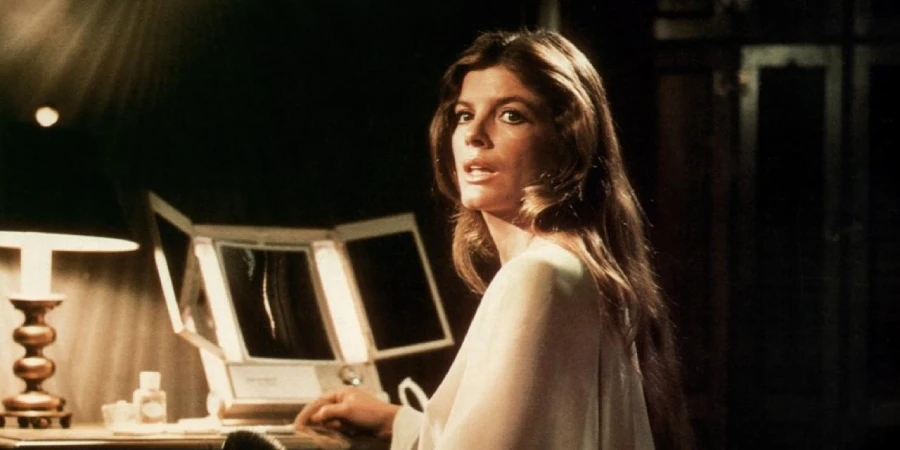

Somewhere in the manicured lawns and spotless kitchens of Stepford, Connecticut, something has gone terribly wrong with the women. Bryan Forbes’s 1975 adaptation of Ira Levin’s novel hits you with dread before it ever shows you a single robot, because the horror lives in the smiling faces of perfectly pleasant housewives who have clearly lost something they can never get back.
Katharine Ross carries almost every frame with a controlled anxiety that the film absolutely depends on, and she delivers. This is a movie about paranoia, conformity, and the quiet violence of domestic expectation, and it refuses to let you laugh it off.
Detailed Summary
Joanna and Walter Arrive in Stepford
Joanna Eberhart is a photographer and ambitious woman who moves with her husband Walter and their children from New York City to the fictional suburb of Stepford, Connecticut. Walter pitches the move as a chance for a quieter, safer life. Joanna is skeptical but willing to try.
Almost immediately, Joanna notices something off about the women of Stepford. They are beautiful, soft-spoken, and obsessively devoted to housework and pleasing their husbands. They talk about cleaning products with a glazed enthusiasm that reads less like contentment and more like programming.
Joanna Finds a Friend in Bobbie
Joanna connects with Bobbie Markowe, a sharp, funny, and outspoken newcomer who shares her suspicion that the Stepford wives are strange. Bobbie is a relief in a film full of eerie calm, and her scenes with Joanna crackle with the kind of genuine warmth the town conspicuously lacks.
Together they try to organize a women’s consciousness-raising group. Nobody shows up. The Stepford wives are not interested in feminism, ambition, or anything that does not involve their husbands’ comfort.
The Men’s Association
Walter joins the Stepford Men’s Association, a private club that no woman ever enters. Joanna grows suspicious of it. She senses it sits at the center of whatever is happening to the town’s women.
Walter becomes increasingly absorbed by the group. His behavior toward Joanna shifts, subtly but noticeably. He starts pushing back against her photography ambitions and seems less interested in who she actually is.
Joanna Investigates
Joanna discovers that many of the Stepford wives used to be very different women. She finds records suggesting Bobbie’s predecessor was outspoken and politically active before moving to Stepford. Other wives had careers and strong personalities that simply vanished after settling in town.
She also meets Dale Coba, the Men’s Association’s leader, who is charming and unsettling in equal measure. He is a former Disneyland engineer, a detail the film drops with ominous precision because it tells you exactly what kind of man designs women for a living.
Bobbie Changes
This is where the film truly chills you. Joanna visits Bobbie one day expecting her sharp, conspiratorial friend. Instead she finds a glassy-eyed woman cheerfully scrubbing her kitchen, talking about recipes, calling her husband wonderful. Paula Prentiss plays the transformation with a stillness that is deeply wrong, a smile held just a half-second too long.
Joanna realizes the transformation has already happened. She is now entirely alone in Stepford, surrounded by duplicates of women who no longer exist.
Joanna’s Desperation
Joanna goes to a psychiatrist, who dismisses her concerns. She tries to convince Walter that something criminal is happening. He does not believe her, or pretends not to. Her isolation becomes total and suffocating.
She attempts to leave Stepford with her children but Walter stops her. She goes back to the Men’s Association building alone, which is exactly the wrong decision, and the film lets you feel the full weight of that mistake.
The Confrontation in the Association House
Inside the Men’s Association, Joanna finds a replica of herself, a robot version built to replace her. She confronts it in a sequence that Forbes shoots with a cool, unhurried dread. Two Joannas circle each other in the dim house, and the camera refuses to tell you which one to trust.
Joanna lunges at the replica. There is a struggle. The lights go out.


Movie Ending
What comes next is the film’s most devastating move. We cut to a grocery store. A new version of Joanna, dressed in a flowing white gown, glides through the aisles with the same vacant grace as every other Stepford wife. She is gone. Walter won.
Joanna’s friend Carol Van Sant walks past her in the store, equally replaced. The two robot women exchange polite pleasantries and drift away from each other like beautiful furniture. Bobbie is there too, equally hollow. The film does not show you the murder. It does not need to. Showing you the aftermath is so much worse.
Forbes closes on a slow, wide tracking shot through the supermarket, the camera gliding past wife after wife after wife in white, all perfect, all empty. It is one of the most quietly devastating final images in American horror cinema, not because it is violent, but because it is so ordinary. The Stepford men got exactly what they wanted, and the film offers zero comfort and zero escape.
Audiences often wonder whether Joanna somehow survived or whether the ending leaves ambiguity. It does not. The screenplay and Forbes’s direction are unambiguous: Joanna was killed, and a robot replica took her place. Her death happens off screen, but her replacement walks, smiles, and shops in her body. That is the point. The world keeps moving, the store stays open, and nobody notices anything wrong.
Are There Post-Credits Scenes?
No. The Stepford Wives has no post-credits scene. The film ends on that supermarket tracking shot, and that image is the last thing Forbes wants in your head.
Type of Movie
This is a psychological thriller with strong elements of science fiction horror and social satire. The tone is slow-burn and deeply unsettling rather than viscerally scary.
Forbes keeps the film grounded in a domestic, almost mundane realism for most of its runtime. That restraint makes the horror land harder when it finally arrives.
Cast
- Katharine Ross – Joanna Eberhart
- Paula Prentiss – Bobbie Markowe
- Peter Masterson – Walter Eberhart
- Nanette Newman – Carol Van Sant
- Patrick O’Neal – Dale Coba
- Tina Louise – Charmaine Wimpiris
- Carol Rossen – Dr. Fancher
- William Prince – Ted Van Sant
Film Music and Composer
Michael Small composed the score. Small was a reliable collaborator on paranoia thrillers during the 1970s, having also scored Klute and Night Moves, and he understood exactly how to make comfortable spaces feel wrong.
His work here uses sparse, unsettling orchestration rather than obvious horror cues. Music creeps under scenes rather than announcing itself, which perfectly serves Forbes’s restrained approach. The score is arguably the most underrated technical element of the entire film.


Filming Locations
Principal photography took place in Darien, Connecticut, and other locations in Fairfield County. These were real, affluent New England suburbs, not sets, and that choice matters enormously.
Shooting in actual neighborhoods gave the film a documentary stillness. Wide streets, immaculate lawns, and large colonial houses do not look like a Hollywood backlot. They look like a place people actually live, which is precisely what makes the horror feel plausible rather than theatrical.
Awards and Nominations
The Stepford Wives did not receive major awards attention upon its original release, which feels like a genuine critical failure in retrospect. Paula Prentiss’s performance alone deserved recognition.
Behind the Scenes Insights
- Bryan Forbes, a British director, was somewhat of an outside choice for a film so deeply rooted in American suburban anxiety, but his outsider perspective arguably sharpened the satire.
- Katharine Ross reportedly found the role emotionally exhausting, largely because Joanna spends so much of the film utterly disbelieved by everyone around her.
- Nanette Newman, who plays Carol Van Sant, is Forbes’s wife in real life. Her casting as the most serene and unsettling of the Stepford wives carries an irony that Forbes has acknowledged with good humor.
- Ira Levin visited the set during production and was reportedly satisfied with how the adaptation was taking shape.
- The production worked hard to keep the exact nature of the wives ambiguous for as long as possible, avoiding any explicit mechanical imagery until very late in the film.
Inspirations and References
The film adapts Ira Levin’s 1972 novel of the same name directly. Levin wrote the book as a satirical response to the backlash against second-wave feminism, imagining the endpoint of a culture that wanted women reduced to domestic functions.
Levin was also drawing on the suburban conformity critiques that ran through American literature and sociology in the postwar decades. Books like The Feminine Mystique by Betty Friedan, published in 1963, mapped the psychological suffocation of suburban housewives in ways that clearly fed into Levin’s concept.
Science fiction traditions, particularly the body double and android replacement anxieties explored in Jack Finney’s The Body Snatchers, also run visibly through the material.
Alternate Endings and Deleted Scenes
No widely documented alternate endings or significant deleted scenes from the 1975 production have entered the public record. Forbes committed to his bleak conclusion and did not appear to hedge.
It is worth noting that the 2004 remake took a dramatically different approach to the ending, softening and then partially reversing the horror, which illustrates just how confident and uncompromising the original’s ending actually was.
Book Adaptations and Differences
The film adapts Ira Levin’s novel fairly closely in terms of plot and character. Screenwriter William Goldman made several adjustments to pacing and characterization, most notably deepening the friendship between Joanna and Bobbie, which is one of the smartest decisions in the whole production.
Goldman also sharpened Joanna’s active investigative instincts. In the novel, her terror is somewhat more passive. Giving her more agency makes her eventual defeat feel more brutal rather than merely inevitable.
One significant difference: Levin’s novel leaves a slight degree of ambiguity about whether the wives are robots or simply drugged and brainwashed. Forbes and Goldman commit fully to the android interpretation, which gives the film its clean, cold horror logic.



Memorable Scenes and Quotes
Key Scenes
- Bobbie’s transformation reveal: Joanna arrives expecting her friend and finds a stranger wearing Bobbie’s face. Prentiss holds the smile fractionally too long each time, and the scene is unwatchable in the best way.
- The supermarket opening: Forbes introduces the Stepford wives early with a wide shot of them gliding past Joanna in the grocery store, all flowing hair and serene smiles, instantly establishing the film’s central wrongness.
- Joanna and the replica: Two Katharine Rosses circling each other in a dark room, the camera slow and steady, refusing to cut away or give you a jump scare. Forbes trusts the image completely.
- The final tracking shot: The camera moves slowly through the supermarket past wife after wife in white. No music sting, no dramatic moment. Just the terrible ordinariness of it all.
- Joanna’s failed escape: She tries to drive away with her children and Walter stops her calmly, reasonably, in broad daylight. The domesticity of it is the horror.
Iconic Quotes
- “I’ll just die if I don’t get this recipe.” – A Stepford wife, delivering a line that sounds like a joke until you realize it is a confession.
- “They’re so lifelike. They’re so real.” – A line from Joanna that flips on itself once you understand exactly what she is talking about.
Easter Eggs and Hidden Details
- Dale Coba’s background as a former Disneyland engineer is mentioned almost casually, but it frames the entire film. Disneyland is famous for its animatronics and its commitment to manufactured happiness. Forbes plants this and walks away.
- Joanna’s photography hobby is not incidental. A photographer studies faces and notices when something in an image is wrong. The film quietly tells you from the start that she is exactly the right person to notice the truth about Stepford.
- Nanette Newman’s Carol Van Sant appears very early in the film as one of the first wives Joanna encounters. Watching the film a second time, knowing what Carol is, her earliest scenes become entirely different.
- The Stepford wives almost universally wear light, flowing clothes throughout the film. Joanna wears darker, more structured clothing. The wardrobe contrast codes the two worlds without dialogue.
- The Men’s Association building is old, dark, and deliberately masculine in its architecture, a visual contrast to the bright, white domestic spaces the wives inhabit. Forbes shoots it like a different film is happening inside.
Trivia
- Ira Levin also wrote Rosemary’s Baby, another horror novel about a woman whose husband conspires with a community against her. The two books form an unofficial thematic pair.
- William Goldman, who adapted the screenplay, was one of the most celebrated screenwriters working in Hollywood during the 1970s, known for Butch Cassidy and the Sundance Kid and All the President’s Men.
- The word “Stepford” entered the English language as a cultural shorthand for mindless conformity and specifically for women who subordinate themselves entirely to domestic roles. Very few film titles achieve that kind of linguistic legacy.
- Bryan Forbes directed the film largely because he felt strongly about its feminist underpinnings, not despite being a male director but, he argued, precisely because the story needed someone who could approach the male characters’ perspective from inside it.
- Paula Prentiss was considered one of the sharpest comic actresses working in Hollywood at the time, which made her casting as the wry Bobbie inspired. Her transformation is so effective partly because you genuinely love her before it happens.
- The film was marketed relatively straightforwardly as a thriller, which meant some audiences expecting more conventional horror were disoriented by its slow, cerebral pace. Critical reappraisal over subsequent decades has been kinder than the original reception.
Why Watch?
Paula Prentiss’s performance is the most undervalued reason to sit with this film. She makes Bobbie so funny and alive in the first half that watching her vacant smile in the second half produces genuine grief. Forbes and Goldman understood that you cannot horrify an audience that does not care, so they made you care first, and that decision is what separates this film from cheaper imitators.
Director’s Other Movies
- Whistle Down the Wind (1961)
- The L-Shaped Room (1962)
- Seance on a Wet Afternoon (1964)
- King Rat (1965)
- The Whisperers (1967)
- The Raging Moon (1971)