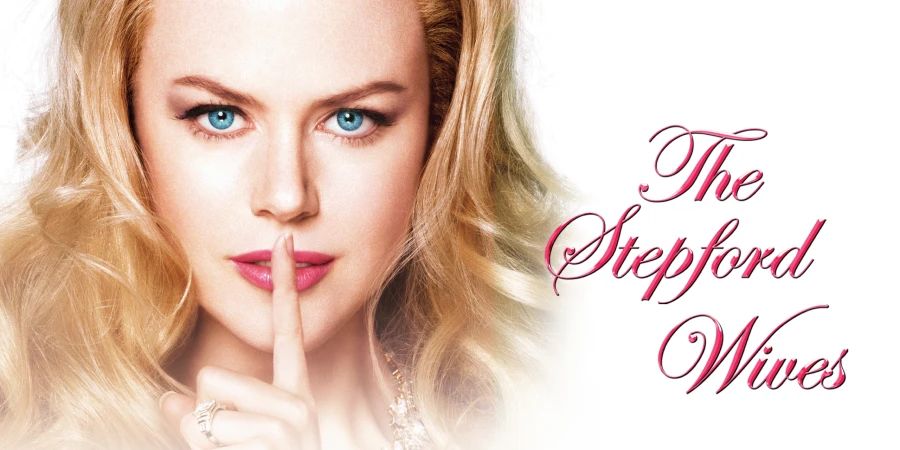

Nicole Kidman playing a high-powered television executive who gets slowly replaced by a robot is either the most perfect casting of the 2000s or a cosmic joke at her expense, and the 2004 remake of The Stepford Wives never quite decides which. Frank Oz directs this big-budget, star-studded satire that starts as sharp suburban comedy and dissolves into something messier and more confused. It bombed with critics, made modest money, and gets dismissed constantly, yet it contains genuinely funny performances and a third act so chaotic it demands attention.
Detailed Summary
Joanna Eberhart’s Firing and Breakdown
Joanna Eberhart, played by Nicole Kidman, runs a major television network as its top programming executive. She greenlit reality shows designed to humiliate people, and after a contestant shoots his wife and nearly shoots Joanna on live television, the network fires her on the spot.
Joanna suffers a visible breakdown. Her husband Walter, played by Matthew Broderick, decides the family needs a fresh start far from Manhattan.
Welcome to Stepford
Walter moves Joanna and their two kids to Stepford, Connecticut, a picture-perfect gated community that looks like someone fed a golf resort and a 1950s housewife fantasy into a wood chipper and called the result charming.
Every woman in Stepford bakes, smiles, defers to her husband, and dresses like she wandered off a department store mannequin. Joanna notices this immediately and finds it deeply unsettling.
Joanna Meets Her Neighbors
Joanna befriends two fellow Stepford newcomers: Roger, played by Roger Bart, a gay architect whose partner Herb eventually gets “Stepfordized” into a compliant bore, and Bobbie Markowitz, played by Bette Midler, a loud, sardonic author whose every instinct is to mock the community around her. These two become Joanna’s allies and comedic relief throughout the film’s middle section.
Bobbie, in particular, is the most entertaining presence in the early going. Midler plays her as a gloriously unfiltered New Yorker who cannot believe this place is real.
The Men’s Club and Mike Wellington
Walter gets drawn into the Stepford Men’s Association, run by Mike Wellington, played by Christopher Walken in a performance that is either brilliantly deadpan or completely detached depending on your tolerance for Walken doing Walken things.
Mike and his wife Claire, played by Glenn Close, preside over Stepford like benevolent gods of conformity. Claire hands out cookies and radiates a brittle warmth that immediately reads as threatening.
The Wives Start Acting Strange
Joanna watches the Stepford wives perform impossible domestic feats. One wife dispenses cash from an ATM simply by touching it. Another lights up like a Christmas tree, literally, during a holiday party. A third wife runs on a treadmill while knitting and holding a conversation simultaneously.
Something is clearly wrong with these women. Joanna starts investigating, and the film shifts into a light thriller gear as she and Bobbie piece together the truth.
Bobbie Changes
In the film’s most jarring tonal shift, Bobbie suddenly becomes a Stepford wife overnight. She appears at Joanna’s door in a floral dress, carrying a pie, speaking in a sing-song voice, with zero trace of her former personality.
This moment genuinely unnerves. Midler plays the transformed Bobbie with an eerie blankness that makes the comedy curdle into something colder.
Walter’s Betrayal
Joanna discovers that Walter has joined the conspiracy and agreed to have her converted. He feels emasculated after years of living in her professional shadow and wants a compliant wife who will finally put him first.
This is the film’s most dramatically interesting beat, and it deserves more time than the script gives it. Broderick plays Walter’s shame with visible discomfort, which is actually the right choice for the character.
Joanna Gets Captured
Mike and the men take Joanna to the Men’s Club to undergo the conversion process. She gets strapped into a chair inside a facility hidden beneath the building. Roger, who had been converted briefly, snaps back to himself and helps Joanna resist.
At this point the film accelerates into its chaotic finale, and the tonal gears grind loudly.



Movie Ending
Joanna confronts Mike Wellington in the control room beneath the Men’s Club, and here the film drops its biggest and most divisive plot twist. Claire Wellington is not a converted human wife. She is a robot who was built by Mike from the start.
Mike, a former robotics engineer from MIT, lost his mind after his human achievements made Claire feel inferior. He built a robot wife as a replacement and then decided to offer the same “service” to every unhappy husband in Stepford. Claire has been running on circuitry the whole film, which retroactively explains her uncanny warmth and physical perfection.
Joanna, freed and furious, activates a malfunction in Claire’s systems. Claire begins to glitch, sparks fly, and she eventually short-circuits and destroys the entire facility in a chaotic explosion of machinery and fire. Glenn Close plays these final moments with an almost operatic physical commitment, throwing herself around the set with real dedication.
Walter, horrified by what he nearly allowed to happen, chooses Joanna. He pulls the plug on his part of the conspiracy. The Men’s Club burns down, the conversion facility is destroyed, and the Stepford wives who had been converted are apparently restored to their former selves, Bobbie included.
A brief epilogue shows the tables turned. Joanna returns to television, now producing a reality show about the Stepford scandal. The former Stepford husbands are meek and domestic, following their empowered wives around like lost puppies. It is the film’s broadest joke and its weakest beat, too tidy and too smug to land as genuine satire.
What matters is the Claire reveal: the film argues that the entire Stepford project was never about male insecurity alone. It was one obsessive man’s grief dressed up as a social movement. That reading is more interesting than anything the script does with it.
Are There Post-Credits Scenes?
No. The Stepford Wives (2004) contains no post-credits scene. Once the epilogue closes, the film is done. You can leave the theater immediately without missing anything.
Type of Movie
This is a satirical dark comedy with thriller elements. Frank Oz pitches it squarely at broad comedy, which conflicts with the darker sci-fi horror of its source material and creates a persistent tonal wobble throughout.
Audiences expecting straight horror will be frustrated. Audiences expecting consistent laughs will also hit patches of genuine unease. It is a hybrid that never fully commits to either mode.
Cast
- Nicole Kidman – Joanna Eberhart
- Matthew Broderick – Walter Eberhart
- Bette Midler – Bobbie Markowitz
- Glenn Close – Claire Wellington
- Christopher Walken – Mike Wellington
- Roger Bart – Roger Bannister
- David Marshall Grant – Herb Markowitz
- Jon Lovitz – Dave Markowitz
- Faith Hill – Sarah Sunderson
- Carrie Preston – Carol Van Sant
Film Music and Composer
David Arnold composed the score. Arnold was already well known for his work on multiple James Bond films by the time he took this project, and he brings a lush, slightly ironic orchestral sweetness to Stepford’s pastel world.
His score mimics the glossy contentment of the community, all bright strings and pleasant motifs that feel subtly wrong, which is the ideal approach for material like this. The music does quiet satirical work that the script sometimes fails to do.



Filming Locations
Principal photography took place in Westport, Connecticut, which provided the film’s pristine New England suburban streets. Westport’s real wealth and manicured aesthetics suited Stepford’s exaggerated perfection without requiring excessive set dressing.
Additional shooting happened in and around New York City, standing in for the opening network scenes. Using actual Manhattan energy for Joanna’s professional world sharpens the contrast when she lands in Stepford’s suffocating calm.
Awards and Nominations
The Stepford Wives (2004) did not receive significant awards recognition. It picked up Razzie nominations, reflecting its poor critical reception, but won nothing of note on either end of the awards spectrum.
Behind the Scenes Insights
- The production went through significant script rewrites during filming, and the tonal inconsistencies in the final cut reflect those on-the-fly changes rather than a single coherent creative vision.
- Frank Oz reportedly clashed with studio executives over the film’s tone, with the studio pushing for broader comedy and Oz initially favoring something darker.
- Glenn Close reportedly developed much of Claire’s physical mannerisms herself, which explains why the robot reveal in the finale feels more grounded than the rest of the ending.
- Nicole Kidman was coming off her Oscar win for The Hours (2002) and took this project as a deliberate shift toward lighter commercial fare.
- Multiple endings were shot, reflecting the production’s genuine uncertainty about what kind of film it wanted to be.
- Bette Midler improvised several of Bobbie’s sharpest lines, and the best exchanges in her scenes carry the loose rhythm of someone who was not working entirely from the page.
Inspirations and References
The film adapts Ira Levin’s 1972 novel The Stepford Wives, which also inspired the 1975 film of the same name directed by Bryan Forbes. Levin wrote his novel as a pointed critique of second-wave feminism’s opposition and the cultural pressure on women to abandon ambition for domesticity.
The 2004 version adds overt camp and comedy that the source material never intended. It references 1950s domestic advertising culture visually throughout, from the pastel color palette to the wives’ costuming, which deliberately evokes vintage housewife imagery.
Alternate Endings and Deleted Scenes
Multiple endings were filmed. One version reportedly kept the wives as fully robotic replacements throughout, more faithful to Levin’s novel, and played the finale as genuine horror rather than comedy. Test audiences rejected the darker cut.
Another version apparently had Walter more complicit and less redeemable, giving the ending a bleaker emotional charge. Studio pressure pushed the film toward its current redemptive arc, which many critics found unconvincing given what Walter does in the second act.
Several Bobbie scenes were cut that reportedly extended her investigation arc. Given how entertaining Midler is in the film, losing those scenes was a genuine loss for the final product.
Book Adaptations and Differences
Ira Levin’s 1972 novel is a lean, genuinely disturbing thriller. In it, the wives are fully replaced by lifelike robots, and the ending offers no redemption, no comedy, and no reversal. Joanna loses. Full stop.
The 2004 film inverts this completely. It adds humor, a gay male character, a robot wife as the villain’s creation rather than the victim, and a happy ending where the conversions are reversible. These changes strip the story of its teeth.
Levin’s novel also lacks the Men’s Club as an organized institution run by a single obsessive. Distributing the blame across a community of husbands made the original story’s critique sharper. Funneling it through Christopher Walken’s eccentric Mike Wellington makes it more absurd but less political.


Memorable Scenes and Quotes
Key Scenes
- Joanna watching a Stepford wife dispense money from an ATM by pressing her palm against it, her face cycling from confusion to controlled panic.
- Bobbie appearing at Joanna’s door post-conversion in a floral dress, smiling beatifically, pie in hand, all trace of her former personality surgically removed.
- A Stepford wife running a treadmill while simultaneously knitting and holding a cheerful conversation with the women around her.
- Glenn Close’s Claire Wellington short-circuiting in the finale, sparks erupting from her body as she staggers through the control room before the facility collapses around her.
- The opening television segment showing Joanna’s career highlights, a punchy satirical montage of the reality shows she produced, which sets up the film’s media critique before abandoning it entirely.
Iconic Quotes
- Bobbie: “I’m a Stepford wife. I bake. I don’t think.”
- Joanna: “These women are like… perfect.”
- Mike Wellington: “We built something here. Something beautiful.”
Easter Eggs and Hidden Details
- Several of the reality show titles visible in the opening montage satirize specific early-2000s reality programming trends, referencing formats that were genuinely popular around the film’s release.
- The Stepford homes use almost exclusively warm yellows, creams, and pinks in their interiors, a color palette that references 1950s kitchen advertising design with deliberate precision.
- Roger’s architectural drawings, briefly visible in his home, contain sketches of buildings that lean modernist and angular, a visual shorthand for his outsider status in Stepford’s retro aesthetic world.
- Claire Wellington always stands slightly too still in group scenes, a subtle physical tell that rewards attention on a second viewing once you know her secret.
- The Men’s Club exterior features classical columns that visually echo civic buildings and courthouses, a quiet architectural joke about the men treating their conspiracy as legitimate governance.
Trivia
- Faith Hill, the country music star, appears in her acting debut as a Stepford wife. She has almost no dialogue, but her physical presence fits the film’s mannequin aesthetic perfectly.
- The film was a reunion of sorts for Glenn Close and a satirical suburban genre, given her history with dark domestic thrillers going back to Fatal Attraction.
- Roger Bart’s character Roger is an addition to the story not present in Levin’s novel, created partly to allow the satire to comment on gender conformity beyond heterosexual marriage.
- Christopher Walken reportedly brought several line readings to set that were not in the script, and some made it into the final cut, contributing to Mike Wellington’s unpredictable cadence.
- Frank Oz is primarily famous as a puppeteer and voice performer responsible for iconic Muppets characters, which makes his directing career an underappreciated separate chapter of his work.
- Nicole Kidman wore a blonde wig for most of the production to differentiate Joanna’s appearance from her own post-The Hours image.
Why Watch?
Watch it for Glenn Close, who commits so fully to Claire Wellington that she makes the robot reveal genuinely shocking despite arriving in a film that has telegraphed its absurdity for ninety minutes. Midler’s pre-conversion Bobbie is also sharp enough to justify the runtime on her own. This is a film worth watching for its performances, not its coherence.
Director’s Other Movies
- Dirty Rotten Scoundrels (1988)
- What About Bob? (1991)
- Housesitter (1992)
- In and Out (1997)
- Bowfinger (1999)
- The Score (2001)
Recommended Films for Fans
- The Stepford Wives (1975)
- Get Out (2017)
- Pleasantville (1998)
- Invasion of the Body Snatchers (1978)
- Midsommar (2019)
- Knives Out (2019)
- Serial Mom (1994)