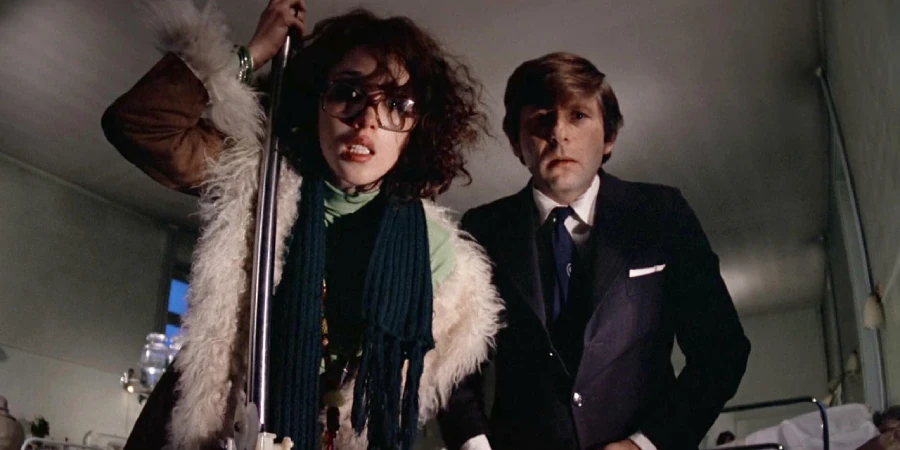

Roman Polanski shot himself jumping out of a window twice, and both times the stunt went wrong enough that he kept the footage. That detail tells you almost everything about The Tenant (1976): a film so committed to its own suffocating logic that the director bled for it, literally. Polanski plays Trelkovsky, a meek Polish immigrant in Paris who rents an apartment vacated by a woman who threw herself through the window, and the film watches, very patiently, as he becomes her. This is paranoid cinema with a scalpel where other films use a sledgehammer.
Detailed Summary
Trelkovsky Finds the Apartment
Trelkovsky is a quiet, apologetic office clerk who desperately wants an apartment in Paris. He visits a grim, courtyard-facing building managed by the cold landlord Monsieur Zy, played by Melvyn Douglas. A previous tenant, a young woman named Simone Choule, jumped through the window and currently lies dying in hospital.
Trelkovsky visits Simone in the hospital, where she is wrapped almost entirely in bandages. She opens her eyes, looks at him, and lets out a single, horrifying scream. He leaves deeply unsettled, and she dies shortly after. He gets the apartment.
Moving In and the First Signs of Pressure
Trelkovsky moves in and almost immediately the neighbors begin complaining. Any noise, any footstep, any sound past a certain hour draws sharp reprimands from Zy. A woman named Stella, whom Trelkovsky met at Simone’s hospital bedside, becomes his tentative romantic interest.
He starts noticing strange things. A single tooth sits inside a hole in the wall, wrapped in cloth. He catches neighbors standing motionless in the communal bathroom across the courtyard, staring out at him for long, unexplained stretches. Something is watching him, or he believes it is.
The Identity Erosion Begins
Trelkovsky begins drinking the same Egyptian cigarettes Simone used to smoke. He orders hot chocolate at a café, then realizes it was Simone’s usual order. He does not consciously choose these things. They seem to happen to him.
His friends visit one evening and make noise. The neighbors pound on the walls and gather in the hallway in silent, threatening numbers. Zy confronts Trelkovsky the next morning with barely concealed contempt. The building’s collective pressure is relentless and escalating.
Paranoia Deepens
Trelkovsky starts finding women’s clothing in the apartment. He tries on a dress, then a wig. He studies his reflection in the mirror and begins to see Simone’s face where his own should be. Polanski shoots these scenes with clinical stillness, letting the horror accumulate rather than announce itself.
He becomes convinced the other tenants are conspiring to turn him into Simone so they can drive him to suicide. He tries to resist. He buys men’s clothes deliberately. He argues with himself in the mirror. None of it holds.
The Relationship with Stella
Stella, played by Isabelle Adjani, is not given much to do in the screenplay, and that is honestly one of the film’s weaker decisions. She functions more as a witness than a character. Their intimacy never quite convinces, partly because Trelkovsky is already too far gone by the time they grow close.
She does provide a crucial late scene where she sees him fully dressed as a woman and does not run. Her horrified compassion is one of the few moments of genuine human warmth in a film that otherwise keeps warmth at arm’s length.
Full Psychological Collapse
Trelkovsky, now wearing full makeup and women’s clothing inside the apartment, hears what sounds like a party in the apartment above. He goes upstairs and finds a gathering of neighbors who seem to be performing a ritual or ceremony, faces painted, staring at him in silence. Whether this actually happens or exists only in his mind is genuinely unclear.
He runs. He arms himself with a knife. He attacks a stranger he becomes convinced is following him. His grip on ordinary life has completely dissolved.
Movie Ending
Trelkovsky, dressed fully as Simone, climbs to the window of his apartment. Polanski shoots this with an almost ceremonial slowness. He throws himself through it and crashes into the courtyard below.
He survives the first fall. He drags himself back upstairs and does it again. This is where Polanski used himself as the stunt performer and sustained real injuries both takes. He crashes into the courtyard a second time, and this time the film cuts to a hospital room.
In the hospital, Trelkovsky lies bandaged exactly as Simone was at the start of the film. Stella and another figure come to visit. He opens his eyes, looks at them, and screams the same terrible scream Simone gave at the beginning. Cut to black.
What Polanski constructs here is a closed loop. The film argues, quietly but without mercy, that Trelkovsky was not driven mad so much as absorbed. The apartment, the building, and possibly Paris itself needed a Simone, and it found one. Whether the conspiracy is real or entirely a product of his disintegrating psyche is a question the film refuses to answer, and that refusal is the point. Both readings are equally supported and equally awful.
The final scream is the film’s most devastating moment precisely because it has already happened. We have seen it. We know what it means. Polanski makes us watch the cycle complete itself with no possibility of escape.
Are There Post-Credits Scenes?
The Tenant has no post-credits scenes. It ends on that scream and offers nothing after. Given the film’s tone, a post-credits scene would be almost offensive.
Type of Movie
The Tenant is a psychological horror film with strong elements of paranoid thriller and body horror. Its tone is cold, oppressive, and darkly absurdist in places. Polanski keeps the register almost deadpan, which makes the horror land harder.
It belongs to the same family as Repulsion and Rosemary’s Baby, completing what critics sometimes call Polanski’s Apartment Trilogy. All three films use enclosed domestic space as a trap for a slowly unraveling mind.
Cast
- Roman Polanski – Trelkovsky
- Isabelle Adjani – Stella
- Melvyn Douglas – Monsieur Zy
- Shelley Winters – The Concierge
- Jo Van Fleet – Madame Dioz
- Bernard Fresson – Scope
- Lila Kedrova – Madame Gaderian
Film Music and Composer
Philippe Sarde composed the score. Sarde was one of the most prolific French composers working in cinema during the 1970s and 1980s, and his collaboration with Polanski here is one of his finer achievements. His score moves between elegiac chamber music and something colder and more unsettling.
There is a recurring theme associated with Trelkovsky’s deterioration that starts small and melodic, then stretches and warps as the film progresses. The music never announces dread; it insinuates it. That restraint suits the film perfectly.


Filming Locations
Principal photography took place in Paris, which was essential to the film’s mood. The specific texture of Haussmann-era apartment buildings, all uniform stone facades and enclosed courtyards, creates a city that feels like an organism rather than a backdrop.
The building used in the film, with its high courtyard walls and narrow sightlines, turns architecture into psychology. When Trelkovsky looks across the courtyard and sees neighbors standing motionless in the bathroom window at night, the geometry of the space makes the shot genuinely frightening. You feel the distance and the exposure simultaneously.
Polanski also shot interior scenes at Paramount Studios in France, allowing tight control over the apartment set. The combination of real Parisian exteriors and controlled studio interiors gives the film its specific unreality.
Awards and Nominations
The Tenant received no major awards recognition upon its release. It competed at the Cannes Film Festival in 1976 but did not win the Palme d’Or. Critical reception at the time was mixed, and the film’s reputation has grown considerably in the decades since.
Behind the Scenes Insights
- Polanski originally planned to cast someone else as Trelkovsky but eventually decided only he could fully inhabit the role’s particular quality of passive, accumulating wrongness.
- He performed both window-jump stunts himself and was injured during filming. He kept the footage because the imperfect, pained quality of the falls served the scene.
- Shelley Winters, who plays the concierge, had previously appeared in Rosemary’s Baby through a production connection to the Polanski circle, though she was not in that film. Her casting here draws on her ability to project a particular kind of smothering, institutional menace.
- Isabelle Adjani took the role during a period when she was already one of France’s most talked-about young actresses. The part demanded very little of her range, which frustrated some critics, though her presence adds a layer of almost unreal beauty that contrasts sharply with Trelkovsky’s shabbiness.
- Polanski had the apartment set designed to feel slightly too small, with ceilings slightly too low, to create subliminal claustrophobia on camera.
- The film was shot in English, which contributes to Trelkovsky’s sense of alienation. A Polish man speaking English in Paris is nobody’s native speaker, occupying a perpetual linguistic gap.
Inspirations and References
The film adapts Roland Topor‘s 1964 novel Le Locataire chimérique. Topor was a Polish-French writer and artist associated with the Panic Movement, a surrealist collective that deliberately aimed to produce works of chaos and terror. His sensibility permeates every frame of Polanski’s adaptation.
Polanski drew on his own experience as a perpetual outsider, a Polish immigrant navigating European cities where he never quite belonged. That biographical undercurrent gives Trelkovsky’s alienation a weight that goes beyond standard horror plotting.
Kafka’s The Trial and The Metamorphosis are the obvious literary ancestors here. Trelkovsky’s transformation follows Kafkaesque logic: bureaucratic, incremental, and presented with an absurd straight face.
Alternate Endings and Deleted Scenes
No officially documented alternate endings or significant deleted scenes have been confirmed for The Tenant. Polanski worked closely from Topor’s novel and the film’s ending mirrors the book’s circular structure quite faithfully.
Some early cuts reportedly ran slightly longer with additional scenes of Trelkovsky’s daily office life, which would have extended the contrast between his mundane exterior and his disintegrating interior. These trims tightened the film’s pace without losing anything essential.
Book Adaptations and Differences
The Tenant adapts Roland Topor’s novel Le Locataire chimérique. Polanski’s screenplay, co-written with Gérard Brach, is fairly faithful to the source. The novel’s tone, its flat, affectless narration of increasingly extreme events, translates directly into the film’s visual deadpan.
One meaningful difference is emphasis. Topor’s novel spends more time inside Trelkovsky’s reasoning, showing the internal logic by which he convinces himself the conspiracy is real. Polanski’s film is more ambiguous, keeping the audience at the same epistemic distance as everyone else.
Polanski also intensifies the cross-dressing and gender transformation elements, making them more central and more visceral than in the book. This sharpens the body horror dimension considerably.

Memorable Scenes and Quotes
Key Scenes
- Simone’s scream in the hospital: Trelkovsky leans toward the bandaged figure in the bed. She slowly turns her head, opens her eyes, and releases a scream that fills the room. He stumbles back. The sound design here is extraordinarily unpleasant, and it pays off again at the film’s end.
- The bathroom watchers: Trelkovsky notices, through his window at night, a figure standing completely still in the communal bathroom window across the courtyard. Later he looks again and finds more of them, standing in silence, faces pale in the dark. Nobody moves. Nobody speaks. Polanski holds the shot long enough to make your skin prickle.
- Trelkovsky at the mirror: He sits in Simone’s clothing and wig, face made up, and stares at his reflection. For a moment, Polanski cuts to a shot where the face in the mirror is not quite his. It is one of those moments where practical filmmaking produces something genuinely disturbing.
- The upstairs party: Trelkovsky enters what should be an empty apartment to find neighbors with painted faces engaged in an incomprehensible ceremony. No one acknowledges him. No one explains anything. The scene plays like a waking nightmare, lit in jaundiced yellows and browns.
- The double window jump: Trelkovsky hurls himself through the window, crashes below, survives, and then climbs up and does it again. Watching Polanski’s actual body hit the ground twice has an awful documentary quality that no stunt team could replicate.
Iconic Quotes
- “At what precise moment does an individual stop being who he thinks he is?” This line, which Trelkovsky delivers in voiceover, is the film’s thesis statement, asked plainly and never answered.
- “I think I’m pregnant.” Said by Trelkovsky to Stella, dressed as a woman, in a moment of dissociation that is funny and horrifying simultaneously. Polanski plays it with total seriousness, which is the only correct choice.
Easter Eggs and Hidden Details
- The tooth found in the wall is a direct echo of a detail in Topor’s novel and functions as a physical marker of Simone’s presence. Finding it is the first moment where the apartment asserts that it already has an occupant.
- Trelkovsky’s name contains an echo of Polanski’s own Polish origins, a small autobiographical signal embedded in the character’s foreignness.
- The Anubis poster on the apartment wall, depicting the Egyptian god of death and transition, appears early and remains throughout. It watches every scene where Trelkovsky moves further from himself.
- In the final hospital scene, the arrangement of Stella and her companion mirrors almost exactly the composition of the earlier hospital scene where Trelkovsky and Stella visited Simone. Polanski closes the loop visually before the scream confirms it.
- Several of the neighbors who appear as silent, threatening figures in the courtyard sequences are played by crew members and non-actors, giving their faces an unfamiliar, slightly wrong quality that a cast of recognizable performers could not provide.
Trivia
- Polanski cast himself partly because he identified personally with the experience of being a foreigner in a country that would never fully accept him, drawing on his own history of displacement across Poland, France, and the United States.
- Gérard Brach, Polanski’s longtime screenwriting collaborator, co-wrote the script. Brach also co-wrote Repulsion and Rosemary’s Baby, making him the connective tissue of the Apartment Trilogy.
- Isabelle Adjani appeared in François Truffaut’s The Story of Adele H. the previous year, in 1975, which brought her international attention. Her casting in The Tenant was a significant prestige signal for the production.
- Shelley Winters brings a kind of theatrical weight to the concierge role that makes her feel like she might be the ringleader of whatever conspiracy may or may not exist. Casting someone of her stature in a supporting role was a deliberate choice to make every corner of the building feel dangerous.
- The film was a French-American co-production, which explains the casting mix of French, American, and international actors all speaking English.
- The Tenant was not a commercial success on initial release. Critics at the time found it cold and self-indulgent. Its current reputation as a major horror film came almost entirely through home video and repertory screenings over the following decades.
Why Watch?
Watch this film for what Polanski does with his own face. Casting himself was a provocation and a confession, and watching a real director wear a dead woman’s wig and stare into a mirror while the camera holds its nerve is unlike anything else in 1970s horror. No other film in the Apartment Trilogy puts this much of the filmmaker’s actual self on the line.
Director’s Other Movies
- Knife in the Water (1962)
- Repulsion (1965)
- Cul-de-sac (1966)
- Rosemary’s Baby (1968)
- Chinatown (1974)
- Tess (1979)
- The Pianist (2002)
- The Ghost Writer (2010)
- Carnage (2011)