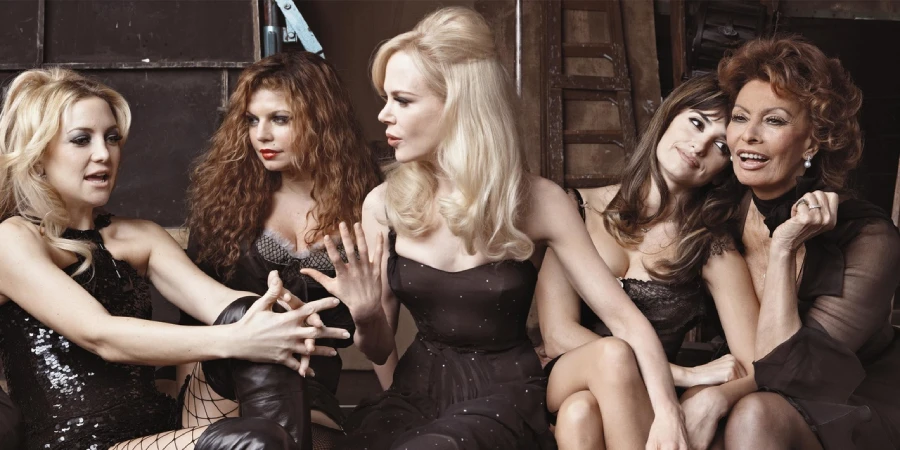

Guido Contini cannot write a single word of his new film, and somehow that creative paralysis becomes the most lavishly staged spectacle of 2009. Rob Marshall took Federico Fellini’s semi-autobiographical nightmare, filtered it through a Broadway musical, and served it up with nine women competing for screen time against Daniel Day-Lewis in a perpetual state of handsome collapse. Some of it works brilliantly. Some of it absolutely does not, and the gap between those two categories is exactly what makes Nine worth dissecting.
Detailed Summary
Guido Contini and the Empty Page
We open in a film studio in Rome, circa 1965. Guido Contini, Italy’s most celebrated film director, stands before his cast and crew with nothing to show them. He has no script. He has no concept. He has scheduled the start of production on a film called Italia and arrived completely empty-handed.
Guido stalls with elaborate charm, promising everything while delivering nothing. His producer Liliane La Fleur, played by Judi Dench, keeps the machinery running while Guido retreats into fantasy.
The Women Who Define Him
Guido’s inner world is populated almost entirely by women. His wife Luisa, played by Marion Cotillard, suspects infidelity and waits patiently for a husband who is emotionally absent even when physically present. His mistress Carla, played by Penelope Cruz, arrives by train and offers uncomplicated physical passion that Guido craves but cannot respect.
Claudia, his muse and leading lady played by Nicole Kidman, represents the ideal he can never possess. She is the woman he projects his artistic fantasies onto, and she knows it. Their scene together in a hotel suite is one of the film’s sharpest moments: Claudia asks Guido what her character wants, and he cannot answer because he has never actually thought about her as a person.
Flashbacks to Saraghina
Young Guido’s formative encounter with Saraghina, played by Fergie, unfolds on a crumbling beach. Saraghina is a large, wild woman who dances the rumba for coins, and young Guido watches her with a mixture of terror and desire. This memory shapes everything about his relationship with women.
Catholic priests discover the boy at the beach and drag him back to school for punishment and shame. The film suggests this collision between desire and guilt is what broke Guido’s emotional development early.
Luisa Reaches Her Limit
Luisa discovers Guido’s ongoing affair with Carla. Rather than exploding, Cotillard plays the scene with a quiet, devastating internal collapse. She sings “My Husband Makes Movies” and lays bare exactly how much she has surrendered to a man who treats his life as raw material for art.
Luisa eventually leaves. She does not give Guido a dramatic ultimatum. She simply stops being available to him, which is far more damaging to a man whose entire self-image depends on women’s attention.
Stephanie and the Press
Fashion journalist Stephanie, played by Kate Hudson, conducts an interview with Guido that becomes a flirtatious, performative dance. Her number “Cinema Italiano” celebrates Italian film culture with a knowing wink. It is the most purely fun sequence in the film, even if Hudson feels slightly outgunned by the company she keeps in this cast.
La Fleur and Guido’s Mother
Producer Liliane La Fleur serves as Guido’s most grounded emotional support. Judi Dench brings wry warmth to every scene, and her number “Folies Bergere” captures a woman who has seen everything and chosen pragmatic affection over judgment. Guido’s memory of his Mother, played by Sophia Loren, wraps him in nostalgia and unresolved longing.
Sophia Loren singing “Guardo il mondo dall’alto” is genuinely moving, partly because of what Loren herself represents to Italian cinema history.
Production Collapses
With no script materializing, the production of Italia falls apart entirely. The press turns on Guido. Liliane cannot protect him indefinitely. Carla, pregnant, suffers a breakdown. Luisa has filed for divorce.
Guido sits alone in the ruins of a grand interior set, surrounded by empty chairs and useless props. Every woman he has used as a crutch has either left or been damaged by him. He has nothing and no one.
Movie Ending
Guido wanders through the wreckage of his career and personal life, genuinely stripped of illusion for once. He cancels Italia publicly, which functions less as a defeat and more as the first honest act we have seen from him. Admitting failure costs him the armor he has worn for his entire adult life.
In the final sequence, Guido imagines all the women of his life assembled on a stage. This is not triumphant wish fulfillment. It reads more like an inventory, a reckoning with every person he failed to truly see. He conducts them, but the gesture carries grief rather than control.
Then Guido returns to work, this time with the ghost of young Guido at his side. He begins writing. The film he starts is clearly autobiographical, drawn from everything we have just witnessed. He finally has his material because he finally let himself feel it rather than perform around it.
What the film argues is that Guido’s creative crisis and his emotional crisis are identical. He could not make art because he had walled himself off from genuine feeling. Losing everything cracked that wall open. It is a bittersweet resolution: Guido may become a better artist, but the film does not pretend he becomes a better man in any immediate, satisfying way. Luisa does not return. The damage done to Carla is not repaired. Artistic renewal here carries a steep human price.
Are There Post-Credits Scenes?
Nine has no post-credits scenes. Once the final number concludes and Guido sits down to write, the film simply ends. There is nothing waiting after the credits for patient viewers.
Type of Movie
Nine is a musical drama with strong elements of psychological character study. Its tone shifts between lush fantasy spectacle and genuinely painful domestic drama, sometimes within the same scene. Think backstage musical crossed with a mid-life crisis film set in the golden age of Italian cinema.
Rob Marshall directs the musical numbers as theatrical setpieces performed on a largely bare stage against inky black backgrounds, deliberately separating fantasy from reality. The dramatic scenes feel almost like a different, quieter film trying to breathe between the productions numbers.
Cast
- Daniel Day-Lewis – Guido Contini
- Marion Cotillard – Luisa Contini
- Penelope Cruz – Carla
- Nicole Kidman – Claudia
- Judi Dench – Liliane La Fleur
- Kate Hudson – Stephanie
- Fergie – Saraghina
- Sophia Loren – Guido’s Mother
- Stacy Ferguson (Fergie) – Saraghina
Film Music and Composer
The score and musical arrangements come from the original Broadway production, with music and lyrics by Maury Yeston. Yeston wrote the stage musical in 1982, drawing directly from Nino Rota’s spirit without copying it.
Stand-out numbers include “Be Italian” performed by Fergie on that wind-battered beach, “Take It All” performed by Marion Cotillard in what is easily the emotional peak of the film, and “Cinema Italiano” performed by Kate Hudson with enormous energy. Cotillard’s delivery of “Take It All” is the best single performance in the entire film: she plants her feet, spreads her arms, and sings straight at Guido with the specific fury of a woman who has been patient far too long.
Andrea Guerra handled the film’s underscore and additional orchestrations. The production design and musical staging were supervised to complement the theatrical, stage-derived aesthetic.
Filming Locations
Principal photography took place at Shepperton Studios in England, a deliberate choice that reinforces the theatrical artifice at the heart of the film. Shooting on studio stages rather than on location in Rome meant Marshall could construct his stylized world without the messiness of documentary realism.
Some location work took place in Italy, capturing exteriors that ground Guido’s world in recognizable 1960s Italian film culture. The Cinecittà aesthetic is evoked throughout, even when the actual cameras were rolling in Surrey.
Shooting in England while telling a deeply Italian story is either a brilliant bit of meta-commentary on artifice or a practical production decision. Given how aggressively theatrical the film is, it feels like the former.
Awards and Nominations
Nine received multiple Academy Award nominations, including Best Supporting Actress for Penelope Cruz and recognition for costume design and cinematography. Cruz had won for Vicky Cristina Barcelona the previous year and did not repeat here.
It also received Golden Globe nominations across acting and musical categories. The film’s awards season performance was respectable rather than dominant, which mirrors its critical reception: admired in parts, questioned as a whole.
Behind the Scenes Insights
- Daniel Day-Lewis learned to sing for the role, which is not something his career had previously required. His commitment to preparation extended to vocal training alongside his usual immersive character work.
- Rob Marshall had previously directed Chicago and brought the same philosophy of staging musical numbers as theatrical fantasies rather than realistic diegetic performances.
- Penelope Cruz and Sophia Loren, both Italian cinema icons in different ways, brought genuine cultural weight to their casting that went beyond their individual roles.
- Marion Cotillard performed “Take It All” largely in one extended take for filming purposes, and the rawness of her physical commitment on stage during that number gives the final cut its bruising quality.
- The film assembled one of the most decorated casts of any musical in recent memory, with multiple Oscar winners and nominees sharing scenes.
- Judi Dench has spoken about the physical demands of the production numbers, which required weeks of rehearsal from all cast members regardless of how much screen time their dancing would receive.
Inspirations and References
Nine draws its DNA directly from Federico Fellini’s 1963 film 8½. That film followed Guido Anselmi, a director paralyzed by creative block, surrounded by women who represented different aspects of his psyche. Marshall’s film is a musical adaptation of the 1982 Broadway show, which itself adapted 8½.
Fellini’s influence on the visual design is everywhere: the spa setting, the film-within-a-film anxiety, the Catholic guilt, the fantasy sequences bleeding into memory. Where Fellini kept everything ambiguous and dreamlike, the musical format forces more emotional legibility.
Arthur Kopit wrote the original book for the Broadway musical, later revised by Mario Fratti.
Alternate Endings and Deleted Scenes
No widely documented alternate endings exist in the public record for Nine. The home release included some additional musical material and extended sequences that did not make the theatrical cut.
Given the sprawling cast, it is almost certain that additional musical numbers or character moments were filmed and reduced in editing, but no specific deleted scene has entered significant public discussion.
Book Adaptations and Differences
Nine is not based on a book. It adapts the 1982 Broadway musical of the same name, which itself drew from Fellini’s film 8½. For a full comparison of source material differences, the Fellini film is the relevant text, not a novel.
Key differences from 8½ include the obviously musical format, the Americanized sensibility of certain characters (particularly Stephanie), and the film’s slightly more redemptive emotional arc for Guido.



Memorable Scenes and Quotes
Key Scenes
- Cotillard’s “Take It All”: Luisa strips away every pretense on a bare stage, arms outstretched, voice climbing, and delivers what functions as both a divorce proceeding and a liberation. No prop, no costume flourish, just a woman standing in light deciding she is done.
- Fergie’s “Be Italian”: Saraghina dances on a grey beach with absolute physical ferocity, skirts flying, while young Guido watches. Fergie commits fully and the number lands with genuine force.
- Claudia’s hotel suite scene: Kidman sits across from Day-Lewis and asks him a simple question about her character. His inability to answer says more about Guido than any confessional monologue could.
- The empty production set: Guido sits alone amid abandoned props and set pieces, and the camera simply holds on Day-Lewis in stillness. It is one of the film’s few moments of complete quiet.
- Cruz’s “A Call From the Vatican”: Carla performs her number in a hotel room with cheerful obliviousness to her own situation, which makes it both funny and quietly sad.
Iconic Quotes
- “My husband makes movies.” Luisa, with layered resignation.
- “You’re not a director, Guido. You’re a tourist.” Claudia, cutting him precisely where it hurts.
- “I have always been your biggest fan.” Liliane, with warmth that also carries a warning.
Easter Eggs and Hidden Details
- The number nine recurs throughout: nine women, nine muses, nine letters in “Guido” and “Contini” combined in certain production materials. The film treats the number as structurally meaningful beyond just the title.
- The costume design deliberately echoes specific Fellini films: Luisa’s wardrobe references La dolce vita visual codes.
- Young Guido’s school uniform in the Saraghina flashback matches the Catholic school aesthetic Fellini depicted in 8½ almost exactly, a deliberate visual quotation.
- The bare black stage used for the musical numbers visually resembles a film editing suite stripped of footage, reinforcing Guido’s creative emptiness.
- Sophia Loren’s casting as Guido’s mother creates an implicit wink to Italian film history, given her own decades-long collaboration with Italian directors.
Trivia
- Daniel Day-Lewis is not primarily known as a singer, making his casting a genuine risk that the production team clearly debated at length.
- This was one of Sophia Loren’s few English-language film appearances in recent decades.
- Rob Marshall assembled a cast with a combined acting pedigree that included multiple Academy Awards among its members before production even began.
- The Broadway musical premiered in 1982 and ran for over 700 performances, winning multiple Tony Awards.
- Kate Hudson’s “Cinema Italiano” was written specifically for the film and does not appear in the original stage production.
- Fergie, the Black Eyed Peas vocalist, had no prior major film acting experience before this role.
- The film’s production design aimed to evoke Cinecittà studios from the 1960s, the actual home of much of Italian cinema’s golden period.
Why Watch?
Cotillard’s “Take It All” alone justifies the price of admission: she turns a three-minute number into a complete dramatic arc that most films cannot achieve in two hours. Day-Lewis navigating a musical is a genuinely strange sight worth experiencing, and the contrast between his physical precision and the genre’s demands creates a tension that oddly suits Guido’s character. Flawed and uneven, Nine is more interesting than most perfect films.
Director’s Other Movies
- Chicago (2002)
- Memoirs of a Geisha (2005)
- Pirates of the Caribbean: On Stranger Tides (2011)
- Into the Woods (2014)
- Mary Poppins Returns (2018)