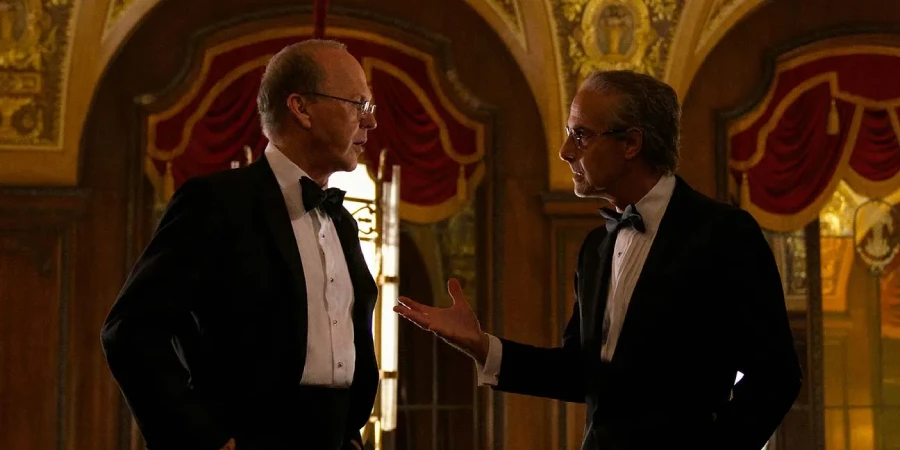

Worth puts a dollar figure on grief, and that premise alone should make your stomach turn. Based on the true story of Kenneth Feinberg and the September 11th Victim Compensation Fund, this film asks a question most of us never want to answer: how much is a human life worth? Director Sara Colangelo delivers a restrained, deeply moral drama that refuses easy answers. It is uncomfortable viewing, and that is precisely the point.
Detailed Summary
Kenneth Feinberg Takes the Job
Washington attorney Kenneth Feinberg, played by Michael Keaton, accepts the role of Special Master of the September 11th Victim Compensation Fund in the aftermath of the 2001 attacks. Congress created the fund to provide financial compensation to victims’ families, but the catch is significant: families who accept the money must waive their right to sue the airlines involved.
Feinberg approaches the task like a pure legal problem. His formula calculates payouts based on the victim’s projected lifetime earnings, which immediately creates a tiered system that values a Wall Street banker far above a janitor or a firefighter.
The Formula and Its Cold Logic
Feinberg and his partner Camille Biros, played by Amy Ryan, begin holding town halls to explain the fund to grieving families. However, the reception is hostile from the start. Families feel reduced to numbers on a spreadsheet rather than treated as human beings.
Feinberg, initially rigid and almost clinical in his approach, insists the formula is fair because it mirrors existing legal standards. He struggles to understand why people resist a system he sees as both logical and generous.
Charles Wolf Enters the Picture
The film’s emotional core arrives with Charles Wolf, played powerfully by Stanley Tucci. Wolf lost his wife, Kit, in the towers and subsequently launched a campaign called “Fix the Fund” to challenge Feinberg’s methodology. He gathers thousands of signatures from families who refuse to participate under the current formula.
Wolf is not angry in a theatrical way. His grief is quiet, steady, and devastating. He represents all the families who feel the government and the legal system have reduced their loved ones to economic units.
The Human Stories Start Breaking Through
As Feinberg conducts individual hearings, specific stories begin to chip away at his professional detachment. A widow named Maureen Donahue Moriarty, whose firefighter husband died in the towers, confronts him directly about why her husband’s life should be valued less than a stockbroker’s simply because he chose public service.
Another family reveals that their son was gay and had a long-term partner, but because their relationship lacked legal recognition at the time, his partner stands to receive nothing from the fund. These cases force Feinberg to reckon with the gaps in his own framework.
Feinberg’s Internal Shift
Feinberg begins listening more and calculating less. He starts meeting with families outside of formal hearings, sitting with them in their homes and truly hearing what their loved ones meant to them. Camille Biros pushes him toward this shift, recognizing before he does that the fund will fail if it cannot win trust.
Moreover, Feinberg starts grappling with his own motivations. He initially took the job partly for its prestige and historical significance. Confronting that truth proves uncomfortable for a man who has presented himself as a selfless public servant.
The Deadline Pressure Mounts
Congress set a strict deadline for families to enroll in the fund. As the clock runs down, enrollment numbers remain dangerously low, largely because of the Fix the Fund campaign. Feinberg realizes he cannot hit the required participation rate without winning over Wolf’s coalition.
Consequently, Feinberg reaches out to Wolf directly and asks to meet. This marks one of the film’s pivotal turning points, as two men who represent fundamentally different approaches to grief and justice finally sit across from each other.
Feinberg and Wolf’s Confrontation
Their meeting is tense and honest. Wolf does not want more money for himself; he wants equal dignity for every victim. He argues that the formula’s income-based calculation sends a moral message that America values wealthy lives more than working-class ones.
Feinberg, for the first time, does not argue back with legal precedent. He listens. This scene represents the film’s moral and dramatic peak, and both Keaton and Tucci deliver it with extraordinary restraint.


Movie Ending
Feinberg agrees to revise the fund’s formula in a meaningful way. He raises the minimum award for every family, effectively compressing the gap between the highest and lowest payouts. He cannot make the fund perfectly equal, but he makes it significantly more humane.
Wolf drops his campaign and encourages families to enroll. As a result, enrollment surges past the required threshold in the final days before the deadline. The fund ultimately compensates the vast majority of eligible families who chose to participate.
In the film’s final moments, Feinberg reflects on what the experience cost him emotionally and what it taught him. He acknowledges, quietly and without self-congratulation, that he came into the job believing law could solve grief. He leaves understanding that it cannot, and that the most important thing he did was simply show up and listen.
Title cards confirm that the real Feinberg later went on to administer compensation funds for other tragedies, including the Virginia Tech shooting and the BP Deepwater Horizon disaster. This context reframes the entire film as the origin story of a man who learned, painfully, how to do an impossible job with humanity.
Are There Post-Credits Scenes?
Worth contains no post-credits scenes. After the title cards, the film ends. You can safely leave when the credits roll.
Type of Movie
Worth is a legal drama and biographical film with a strong ethical and emotional undercurrent. Its tone is somber, deliberate, and quietly intense throughout. Do not expect courtroom theatrics or Hollywood-style speeches; this film earns its emotional beats through restraint and patience.
In contrast to many post-9/11 films that lean into spectacle or sentiment, Worth stays almost stubbornly ground-level. It is a film about bureaucracy, and somehow that makes it more affecting, not less.
Cast
- Michael Keaton – Kenneth Feinberg
- Stanley Tucci – Charles Wolf
- Amy Ryan – Camille Biros
- Tate Donovan – Lee Quinn
- Shunori Ramanathan – Priya Khundi
- Laura Benanti – Caitlin Connors
- Matchstick (the dog) – himself, more or less
Film Music and Composer
The score for Worth was composed by Marc Shaiman, a veteran composer known for his wide range across drama, comedy, and musical theater. His work here is deliberately understated, allowing the emotional weight of individual scenes to breathe without musical manipulation.
Shaiman avoids the soaring orchestral swells that typically underscore 9/11-related films. Instead, he opts for sparse, quiet arrangements that feel almost reluctant to intrude on grief. The result is a score that supports rather than leads the audience’s emotional response.


Filming Locations
Principal photography took place primarily in New Jersey and New York, which grounded the film in the actual geography of the tragedy it depicts. Shooting near the real settings gave the production an authenticity that studio recreations rarely achieve.
Some scenes were filmed in Washington, D.C., reflecting the political and governmental dimensions of Feinberg’s work. These locations reinforce the film’s central tension between cold institutional power and the very human communities that power is supposed to serve.
Awards and Nominations
Worth received positive critical attention after its premiere at the Sundance Film Festival, but it did not accumulate major awards nominations during the cycle following its Netflix release. Both Keaton and Tucci received praise from critics, though that recognition did not translate into significant awards traction.
Behind the Scenes Insights
- Director Sara Colangelo conducted extensive research into the real September 11th Victim Compensation Fund and interviewed people connected to the process before production began.
- Michael Keaton spent time with the real Kenneth Feinberg in preparation for the role, studying his mannerisms, his speaking style, and his particular brand of lawyerly confidence.
- The film premiered at the 2020 Sundance Film Festival before Netflix acquired distribution rights.
- Screenwriter Max Borenstein worked from Feinberg’s own memoir as a primary source, giving the script a grounding in firsthand perspective.
- Stanley Tucci approached Charles Wolf as a character defined by quiet determination rather than explosive emotion, a deliberate choice that makes his scenes feel unusually real.
- Colangelo kept the visual style clean and functional, resisting any impulse to aestheticize either grief or bureaucracy in ways that might feel exploitative.
Inspirations and References
The film draws directly from Kenneth Feinberg’s memoir, What Is Life Worth?, published in 2005. Feinberg wrote candidly about the emotional and ethical challenges he faced administering the fund, and that candor runs throughout the screenplay.
The story also implicitly references the broader American legal tradition of tort law and how courts have historically calculated damages in wrongful death cases. Understanding that context makes Feinberg’s initial formula feel less monstrous and more like a logical extension of existing legal logic, which is part of what makes it so troubling.
Alternate Endings and Deleted Scenes
No officially confirmed alternate endings or significant deleted scenes have been publicly detailed for Worth. Sara Colangelo has not released extended cuts or a director’s cut through Netflix’s platform as of this writing.
Given the film’s tight narrative focus and measured pacing, the final cut appears to reflect the intended vision closely. Notably, no substantial behind-the-scenes material has surfaced suggesting major editorial battles or reconsidered story directions.
Book Adaptations and Differences
Worth is based on What Is Life Worth? by Kenneth Feinberg, published in 2005. The memoir offers Feinberg’s first-person account of the fund’s creation and administration, including his evolving understanding of grief and justice.
The screenplay takes some dramatic license with the character of Charles Wolf, shaping him into a more prominent dramatic foil than the memoir’s structure allows. In addition, certain composite characters and compressed timelines serve the film’s narrative without materially distorting the historical record. Feinberg’s fundamental arc from detached technician to humanized listener remains faithful to the memoir’s central argument.



Memorable Scenes and Quotes
Key Scenes
- The first town hall meeting, where grieving families openly confront Feinberg’s formula and shatter his assumption that logic alone will satisfy them.
- Feinberg’s private meeting with a widow who explains why her firefighter husband chose his career, forcing Feinberg to question what the fund’s formula actually says about American values.
- The quiet, charged confrontation between Feinberg and Wolf, where two men talk past their anger and actually hear each other for the first time.
- Feinberg sitting alone with his thoughts near the end of the film, processing the weight of what he has been part of.
- The scene involving the gay partner of a victim, which exposes a legal blind spot that Feinberg must decide whether to address within his authority.
Iconic Quotes
- “You’re not here to replace what people lost. You’re here to tell them what it’s worth.” (Camille Biros, cutting to the moral center of the entire enterprise)
- “I know what the law says. But what do you say?” (Charles Wolf, pressing Feinberg beyond his legal framework)
- Feinberg’s admission, near the film’s end, that the job changed him in ways he did not anticipate and did not entirely welcome.
Easter Eggs and Hidden Details
- Several background extras in the town hall scenes are reportedly family members of actual 9/11 victims, lending an additional layer of authenticity to those sequences.
- Feinberg’s office set is deliberately cluttered with legal briefs and documents that reference real cases in compensation law history, visible in background shots.
- The film’s color palette shifts subtly as Feinberg’s character changes: early scenes favor cool blues and grays, while later scenes introduce warmer tones as he opens up emotionally.
- Charles Wolf’s apartment is dressed with specific personal details referencing his wife Kit, including photographs that ground his grief in something specific rather than abstract.
Trivia
- The real Kenneth Feinberg has gone on to administer multiple major compensation funds in the United States, making him one of the most significant figures in the history of American mass tort law.
- Michael Keaton and Stanley Tucci have relatively limited screen time together, yet their shared scenes generate much of the film’s dramatic electricity.
- Director Sara Colangelo previously directed The Kindergarten Teacher (2018), which also starred Maggie Gyllenhaal and similarly focused on moral ambiguity and good intentions gone sideways.
- Netflix acquired Worth after its Sundance premiere, releasing it on the platform in September 2021, on the twentieth anniversary of the 9/11 attacks, a deliberate and meaningful release timing choice.
- Screenwriter Max Borenstein is perhaps better known for blockbuster work on the Godzilla franchise, making Worth a significant departure in tone and scale.
- The fund ultimately distributed approximately 7 billion dollars to nearly 5,600 families, one of the largest government compensation programs in American history.
Why Watch?
Worth earns its place as essential viewing because it takes an impossible subject and handles it with uncommon honesty. Keaton and Tucci give two of their most controlled and affecting performances, and Colangelo never lets sentiment override the film’s moral complexity. Furthermore, it asks questions about value, justice, and human dignity that land far beyond the specific historical events it depicts.
Director’s Other Movies
- The Kindergarten Teacher (2018)
- Little Accidents (2014)
Recommended Films for Fans
- Spotlight (2015)
- Dark Waters (2019)
- Sully (2016)
- The Report (2019)
- United 93 (2006)
- Michael Clayton (2007)
- First Reformed (2017)