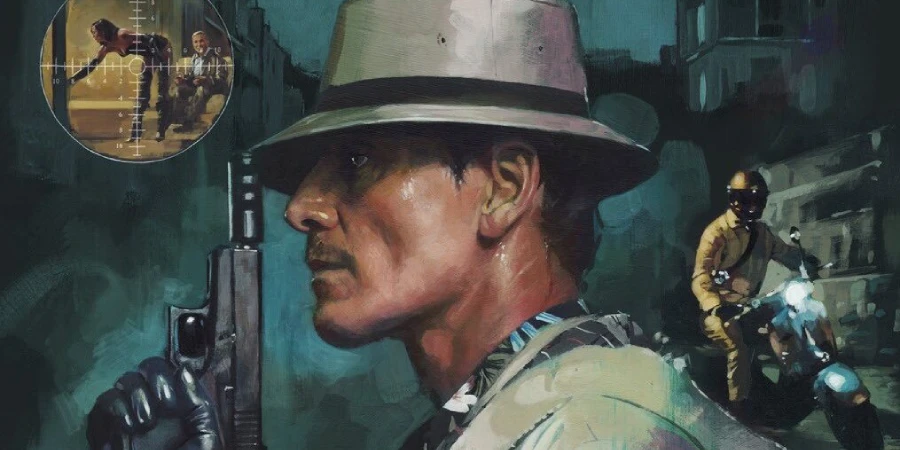

David Fincher spent most of his career making films about obsessive men who impose order on a chaotic world, and The Killer (2023) is the purest expression of that fixation yet. Michael Fassbender plays a hitman who misses a shot and then watches his carefully constructed worldview collapse around him. Fassbender barely blinks for two hours, and that restraint is the whole point.
This is a film about a man who believes discipline is identity, and Fincher takes genuine pleasure in proving him wrong.
Detailed Summary
Paris: The Long Wait
We open in Paris, where the Killer has rented a WeWork co-working space across the street from a luxury hotel. He has been waiting for days, maybe longer. Fincher holds on this surveillance routine with almost uncomfortable patience.
The Killer narrates throughout, reciting a personal philosophy built on mantras: stick to the plan, trust no one, anticipate, never improvise. He eats McDonald’s. He does yoga. He listens to The Smiths on repeat. It is deliberately mundane, and that mundanity is the film’s first joke on its protagonist.
When the target finally appears at a window, the Killer fires. He misses. He kills a woman who was not supposed to be there instead, and just like that, the plan is ruined. He slips out of Paris with the calm efficiency of someone who has rehearsed this exit, but the calm is already a performance.
The Client Pulls the Contract
Back in the Dominican Republic, the Killer returns to a secluded property he shares with his partner, Magdala. He finds the place trashed and Magdala beaten within an inch of her life. Two people had come looking for him, sent by his employer to clean up the liability he had become.
This is where the film pivots from a character study into something closer to a revenge thriller, though Fincher resists that framing at every turn. Magdala survives, but the attack on her is the one thing the Killer’s code did not account for: a personal stake. He makes the decision to hunt down everyone in the chain of command responsible.
New Orleans: The Lawyer
His first stop is New Orleans, where he tracks down a fixer named Hodges, played by Charles Parnell. Hodges brokered the contract, and the Killer needs names. The interrogation scene is tense not because of violence but because of how quietly Fassbender conducts it, voice flat, posture precise, as if filing paperwork rather than threatening someone’s life.
Hodges gives up two names: a bruiser called the Brute and a woman known as the Expert. He also points upward, toward a wealthy client named Claybourne. The Killer lets Hodges live, which is one of the film’s more interesting moral wrinkles, and then immediately moves down his list.
Florida: The Brute
In Florida, the Killer tracks down the Brute, played by Sala Baker. What follows is the film’s most visceral sequence: a brutal, exhausting hand-to-hand fight in a suburban home. No slick choreography, no cool music cue. The two men destroy the kitchen, the living room, the hallway, and each other.
Fincher shoots the fight with ugly practicality. Furniture breaks. Both men get hurt. The Killer does not win cleanly; he wins by outlasting. He eventually drowns the Brute in a dog bowl, which is as unglamorous as assassination gets. It is the film’s most honest statement about what this profession actually looks like.
New York: The Expert
Tilda Swinton appears as the Expert in a single extended scene set in a Manhattan restaurant. She is extraordinary, doing more with body language and precise word choices than most actors do with full dramatic arcs. Her character knows exactly what is happening and seems almost amused by it.
She and the Killer talk around what they are for several minutes, each probing the other. She eventually reveals Claybourne’s location. The scene ends with her death, which happens off-screen, a choice that feels deliberate: Fincher refuses to let the film luxuriate in her elimination the way genre films usually would.
The Hamptons: Claybourne
Claybourne, played by Arliss Howard, lives in a sprawling beachside estate and turns out to be a surprisingly ordinary-seeming man. He is rich, cowardly, and completely unprepared for the Killer’s arrival. The confrontation is quiet and brief.
Rather than kill Claybourne, the Killer delivers a threat: come after me again, and I finish what I started. It is a calculated choice rooted in self-interest rather than mercy. Killing Claybourne would create more problems; letting him live, terrified, is a more efficient solution. The Killer’s logic remains consistent even as the film questions whether that logic is worth anything.


Movie Ending
After leaving Claybourne alive, the Killer returns to Magdala in the Dominican Republic. She is healing. They sit together outside. He narrates one final time, still running through his mantras, but something has shifted in the delivery. He sounds less convinced.
Fincher ends on Fassbender’s face in repose, and it is the most ambiguous image in the film. Has the Killer changed? Almost certainly not. But the film has shown us that his philosophy is a coping mechanism, not a system. He missed one shot, and the entire architecture of his self-concept cracked. He patched it by completing his mission, but the crack is still there.
What audiences most want to know: did the Killer win? He survived. He protected Magdala. He neutralized the threat. By his own metrics, yes, he won. But Fincher frames the ending with enough stillness that winning feels hollow. The Killer’s worldview promised him invulnerability through discipline, and that promise was broken the moment he pulled the trigger in Paris and hit the wrong person. Nothing that follows repairs that fundamental failure.
Magdala barely speaks throughout the film. She exists, pointedly, as the one human connection the Killer acknowledges. Her survival is the emotional anchor of the ending, and Fincher is smart enough not to oversell it. There is no reunion score, no cathartic embrace. They just sit there, which is exactly right.
Are There Post-Credits Scenes?
The Killer has no post-credits scene. Fincher is not that kind of filmmaker. Once the film ends, it ends.
Type of Movie
The Killer is a neo-noir thriller with strong elements of dark satire and character study. Its pacing is deliberately slow and methodical, matching the protagonist’s psychology rather than genre expectations.
Tonally, it walks a thin line between dry comedy and existential unease. Fincher plays the hitman’s pompous internal monologue for laughs without ever fully undercutting the tension underneath it. Anyone expecting a standard action film will be genuinely surprised by how little action there is, and by how much that restraint accomplishes.
Cast
- Michael Fassbender – The Killer
- Tilda Swinton – The Expert
- Charles Parnell – Hodges
- Arliss Howard – Claybourne
- Sophie Charlotte – Magdala
- Sala Baker – The Brute
- Emiliana Vasconcelos – The Nark
Film Music and Composer
Trent Reznor and Atticus Ross composed the score, which is their fourth collaboration with Fincher. Their work here is sparse and electronic, favoring ambient drones and unsettling textures over conventional thriller music.
The score does not announce itself. It functions more like weather: you feel it before you consciously notice it. That approach fits perfectly with a protagonist who performs emotional detachment as a professional skill.
The Smiths’ music, selected by the Killer as his surveillance playlist, is the film’s most pointed musical joke. Morrissey’s melodramatic romanticism playing against a stone-faced assassin doing yoga is funny, but it also suggests something repressed inside the character. Reznor and Ross wisely keep their own score out of the way and let that irony breathe.


Filming Locations
Principal photography took place across multiple countries, including France, the Dominican Republic, and the United States. New Orleans, New York, and Florida all appear in the American stretch of the film.
Paris carries the film’s opening weight, and Fincher uses the city not as romance but as anonymity. The WeWork space is grimly generic on purpose: a hitman renting a hot desk is a running absurdist gag about modern capitalism. The Dominican Republic locations give the film its only sense of warmth, and that contrast does real emotional work.
New Orleans feels appropriately decadent and slightly rotten, which suits the Hodges scenes. New York is sleek and expensive, a fitting backdrop for the Expert’s single appearance. Each location has a distinct visual temperature, and Fincher’s cinematographer Erik Messerschmidt shoots them with flat precision rather than postcard beauty.
Awards and Nominations
The Killer competed at the Venice Film Festival in 2023, where Fincher received the Golden Lion for Best Film nomination. Tilda Swinton’s brief performance generated significant awards conversation, though her screen time made a formal nomination difficult for most bodies.
Behind the Scenes Insights
- David Fincher shot the film for Netflix, marking another chapter in a creative partnership that also produced Mank and the series Mindhunter.
- Fassbender came out of a period of reduced screen appearances for this role, and his performance required him to suppress nearly every conventional acting instinct.
- Fincher is known for shooting many takes, and the Paris surveillance sequence reportedly required extensive repetition to achieve the precise level of tedium Fincher wanted.
- Tilda Swinton’s single restaurant scene was reportedly shot over a concentrated period, with minimal coverage, which explains its unusually intimate, theatrical quality.
- The hand-to-hand fight with the Brute underwent considerable choreographic work to look as unchoreographed as possible, a deliberate anti-action-movie choice.
- Reznor and Ross worked on the score while Fincher was still editing, allowing the music to develop alongside picture rather than being composed to a locked cut.
Inspirations and References
The Killer is based on the French graphic novel series of the same name, written by Matz (Alexis Nolent) and illustrated by Luc Jacamon, published starting in 1998. Screenwriter Andrew Kevin Walker, who also wrote Se7en, adapted the source material.
Walker and Fincher clearly drew from the existentialist noir tradition, particularly films where the protagonist’s internal monologue is more interesting than the plot mechanics. Jean-Pierre Melville’s Le Samourai (1967) is an obvious reference point: a hitman defined by ritual and silence, except Fincher punctures the romanticism Melville preserved.
There is also a debt to American Psycho’s satirical register, using the professional hitman as a vehicle for skewering corporate self-help culture. The Killer’s mantras sound disturbingly like productivity influencer content, and that parallel is almost certainly intentional.
Alternate Endings and Deleted Scenes
No alternate endings or significant deleted scenes have been publicly confirmed or released for The Killer. Fincher operates with tight editorial control, and his films rarely generate the kind of extended cut mythology that surrounds other directors’ work.
Book Adaptations and Differences
The graphic novel series by Matz and Jacamon spans multiple volumes and covers significantly more of the Killer’s career than the film does. Walker’s adaptation compresses and selects, focusing on a single job gone wrong rather than attempting to adapt the full breadth of the source material.
Some supporting characters and subplots from the comics do not appear in the film. The tone remains consistent, but the film leans harder into black comedy than the graphic novels, which carry a somewhat straighter noir sensibility. Fincher adds the satirical corporate angle, particularly the WeWork detail, which feels like a modern invention rather than a direct lift from the source.

Memorable Scenes and Quotes
Key Scenes
- The Paris surveillance sequence: ten-plus minutes of a man waiting, eating fast food, doing yoga, and listening to The Smiths, before a single catastrophic trigger pull.
- The Florida brawl with the Brute: a grinding, ugly fight through a suburban home that ends in a dog bowl and leaves both men visibly wrecked.
- The New York restaurant scene with the Expert: Tilda Swinton holding court with precise, half-coded language while Fassbender barely reacts. Easily the best scene in the film.
- The Hamptons confrontation with Claybourne: the deflation of the film’s apparent antagonist into a frightened, ordinary rich man.
- The final shot of Magdala and the Killer sitting outside in the Dominican Republic, silent, the mission over but nothing resolved.
Iconic Quotes
- “Stick to your plan. Anticipate, don’t improvise. Trust no one. Never yield an advantage. Fight only the battle you’re paid to fight.”
- “Forbid empathy. Empathy is weakness.”
- “How many of us truly live by our convictions?”
Easter Eggs and Hidden Details
- The Killer uses a different alias at each location, all drawn from pop culture figures, a quiet joke about assumed identities and disposable personas.
- His Smiths playlist is not random: the lyrics of tracks like “How Soon Is Now?” and “There Is a Light That Never Goes Out” create ironic counterpoint to a man who denies emotional attachment.
- The WeWork location in Paris subtly comments on how global capitalism has made anonymity purchasable by the hour, which mirrors how the Killer commodifies violence.
- The dog bowl that becomes the Brute’s cause of death sits visible in the background of multiple shots before the fight begins, a planted detail most viewers will only notice on a second watch.
- Fincher frames several surveillance shots from the Killer’s eye level, placing the audience literally in his perspective before revealing how limited and fallible that perspective actually is.
Trivia
- Andrew Kevin Walker also wrote the screenplay for Se7en (1995), reuniting him with Fincher after nearly three decades.
- Michael Fassbender had been largely absent from major film roles for several years before taking this part.
- This is Fincher’s second film shot for Netflix following Mank (2020).
- The graphic novel source material began publication in 1998 in France and has been translated and published internationally.
- Tilda Swinton’s entire performance occupies a single extended scene, making it one of the most discussed brief appearances in recent memory relative to its runtime.
- Fincher has cited the graphic novel as something he had been interested in adapting for years before the Netflix deal made it viable.
Why Watch?
Fassbender’s performance is the reason. He builds a complete, suffocating psychology out of stillness and minor physical adjustments, and watching that psychology splinter across two hours is genuinely gripping in a way that no conventional action beat could match. Fincher uses the hitman genre as a delivery mechanism for a very funny, very cold critique of self-optimization culture. That combination is rarer than it sounds.
Director’s Other Movies
- Alien 3 (1992)
- Se7en (1995)
- The Game (1997)
- Fight Club (1999)
- Panic Room (2002)
- Zodiac (2007)
- The Curious Case of Benjamin Button (2008)
- The Social Network (2010)
- The Girl with the Dragon Tattoo (2011)
- Gone Girl (2014)
- Mank (2020)