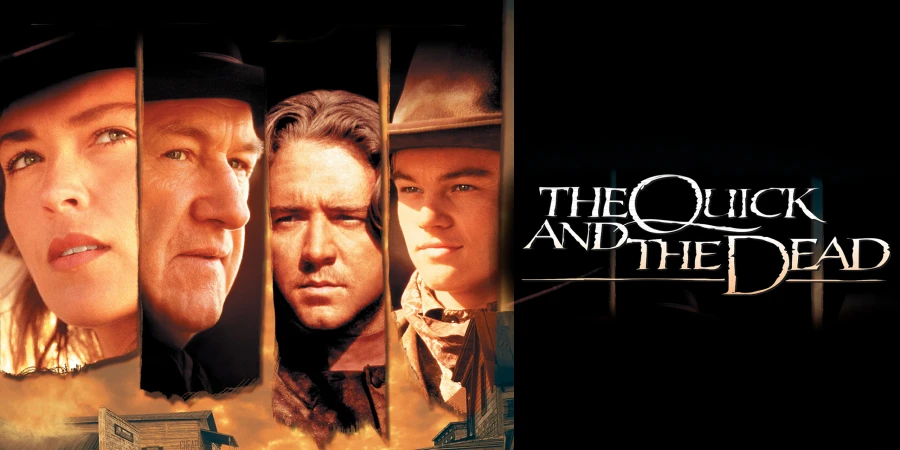
Sharon Stone walks into a town of killers and immediately gets underestimated by every man in it. That setup alone makes The Quick and the Dead one of the more quietly subversive Westerns of the 1990s. Director Sam Raimi brings his carnival-horror sensibility to the genre, shooting gunfights like surgical procedures, with clocks ticking in close-up and sunlight slicing through bullet holes in human chests. It is deliriously stylish, occasionally ridiculous, and completely committed to its own spectacle.
Detailed Summary
A Stranger Rides into Redemption
A lone woman rides into the frontier town of Redemption. She calls herself Ellen, though the film withholds her full backstory for a long while. Redemption is controlled by a ruthless warlord named John Herod, played by Gene Hackman, who runs an annual quick-draw elimination tournament that forces the town’s citizens into bloody compliance.
Ellen enters the tournament without explaining herself to anyone. Suspicion and contempt greet her from every direction. Herod watches her with a predator’s calculation from the moment she arrives.
The Tournament Begins
Herod runs the contest like a showman and a tyrant simultaneously. Each duel takes place in the town’s main street at a scheduled time, and the rules are brutally simple: draw first, shoot to kill. Contestants include a boastful gunslinger named Spotted Horse, a quick-handed gambler named Eugene Dred, and a reformed preacher called Cort, played by Russell Crowe.
Cort is Herod’s prisoner and former pupil. Herod forces him into the contest in chains, half as entertainment and half as punishment for Cort’s religious conversion. Crowe plays Cort as someone carrying genuine guilt, flinching at his own speed with a gun.
The early rounds establish the tournament’s structure and the town’s fear. Raimi films each duel with Dutch angles, extreme close-ups of trigger fingers, and that signature clock-face imagery. Nobody watches these duels out of excitement; they watch because not watching would offend Herod.
The Kid Wants a Name
Leonardo DiCaprio plays “The Kid,” a young gunslinger who claims to be Herod’s biological son. He enters the tournament hungry for his father’s acknowledgment. Herod neither confirms nor denies the paternity claim, which is a specific kind of cruelty DiCaprio sells with wounded bravado.
The Kid is the most crowd-pleasing fighter in the early rounds. He’s fast, flashy, and desperately wants the crowd’s approval. DiCaprio was already building serious momentum after What’s Eating Gilbert Grape, and his performance here is looser and more fun than his dramatic work, without being less committed.
Ellen’s True Motive Revealed
Raimi deploys flashbacks to explain Ellen’s presence. As a child, she watched Herod execute her father, a marshal, forcing young Ellen to hold the rope suspending him. She fumbled her pistol when given the chance to shoot Herod and save her father, and her father died. She has returned to Redemption for one reason only.
These flashbacks reframe every scene Ellen has played with Herod. His politeness toward her curdles into something more sinister once you understand the history. Stone plays Ellen’s controlled fury with minimal expression, which is the right choice; the character can’t afford to show anything until the moment she chooses to.
Alliances and Eliminations
Ellen develops a complicated dynamic with Cort. He recognizes she’s a skilled shooter and she recognizes his reluctance to kill again. Their connection never becomes a conventional romance, which the film deserves credit for resisting.
Competitors fall one by one. Spotted Horse loses to Ellen in a genuinely tense duel. Dred loses to Cort. Each elimination strips the tournament down toward its inevitable confrontation between Herod and the people he has most wronged.
The Kid’s Duel with Herod
This is the film’s gut-punch moment. The Kid advances far enough to face Herod in the semi-finals. He believes his father won’t actually shoot him. Herod shoots him.
DiCaprio’s death scene is the film’s emotional center. The Kid slides down a post in disbelief, looking less like a tough gunslinger and more like a boy who never got the hug he wanted. It resets the audience’s understanding of Herod from “menacing villain” to something colder and more genuinely monstrous.
Movie Ending
Ellen’s final duel with Herod arrives with a twist she engineered in secret. She faked her own death in a previous round by using a blank, having bribed the town’s blind gun-shop owner to supply the loaded cartridge to her while Herod’s man loaded a blank into her opponent’s weapon. It is a convoluted scheme that the film makes feel satisfying through sheer momentum.
When the truth comes out and she faces Herod directly, she shoots him dead in the street. He drops without ceremony. Raimi gives him no redemptive final words and no dramatic monologue; Herod simply loses and falls, which feels like the correct punishment for someone who staged death as entertainment.
Before leaving, Ellen detonates explosives planted throughout Redemption. She blows Herod’s house into rubble, clearing the town of his physical legacy. Cort stays behind; he seems to take on the role of marshal for Redemption, a quiet nod to his arc from killer to man of conscience.
Ellen rides out alone. She passes the site of her father’s death, and the film lets her go without sentimental ceremony. No tearful goodbye, no victory speech. She came to kill one man and she killed him, and Raimi respects the character enough to end there.
Are There Post-Credits Scenes?
The Quick and the Dead has no post-credits scene. Once Ellen rides out of Redemption, the film is done. You can leave when the credits start.
Type of Movie
This is a revisionist Western with a heavy slant toward stylized action and black comedy. Raimi never lets you forget you’re watching a genre exercise; the film winks at its own absurdity while still delivering genuine tension in the dueling sequences.
Tonally, it sits somewhere between Sergio Leone’s spaghetti Westerns and a Sam Raimi horror film. The kills are theatrical. The lighting is theatrical. Even the villain’s villainy is theatrical. That self-awareness is either the film’s greatest strength or its most polarizing quality, depending on your appetite for style-over-sincerity.
Cast
- Sharon Stone – Ellen (The Lady)
- Gene Hackman – John Herod
- Russell Crowe – Cort
- Leonardo DiCaprio – Fee Herod, “The Kid”
- Tobin Bell – Dog Kelly
- Lance Henriksen – Ace Hanlon
- Keith David – Sgt. Clay Cantrell
- Gary Sinise – Marshal (flashback)
- Pat Hingle – Horace the Bartender
- Woody Strode – Blind Pete
Film Music and Composer
Alan Silvestri composed the score. He builds the music around driving percussion and brass stabs that echo the Leone tradition without simply copying Ennio Morricone. Each duel gets a distinct musical escalation, the timpani tightening as the clock counts down.
Silvestri’s work here is among his more underappreciated scores. Most people associate him with Back to the Future or Forrest Gump, but his work in The Quick and the Dead shows a composer genuinely enjoying the constraints of the genre. It crackles in a way his safer scores never quite do.
Filming Locations
Primary filming took place in Arizona, with Old Tucson Studios serving as the main backlot for Redemption’s town streets. Old Tucson has hosted countless Westerns over the decades, and Raimi uses the familiar architecture with full awareness that audiences recognize it from other films.
The desert landscape surrounding the town reinforces the story’s isolation. Redemption isn’t just a place; it’s a trap, and the surrounding emptiness makes escape look like an impossible fantasy until Ellen proves it isn’t. Raimi lights the desert sun as a hostile force, blinding and relentless.
Awards and Nominations
The Quick and the Dead received limited awards attention upon release. It received a Saturn Award nomination from the Academy of Science Fiction, Fantasy and Horror Films in the category of Best Costumes.
Behind the Scenes Insights
- Sharon Stone was the driving force behind the production. She personally championed the project, produced it through her company, and pushed hard to get it made at a studio level after years of development.
- Stone also campaigned to cast Leonardo DiCaprio as The Kid. The studio reportedly resisted, and Stone used her own salary to cover part of his fee. DiCaprio at the time was not yet the guaranteed box office name he would shortly become.
- Russell Crowe was a relatively unknown quantity to American audiences before this film. His casting as Cort was a risk that paid off; the brooding physicality he brought to the role helped set the template for his Hollywood leading-man career.
- Raimi and his cinematographer Dante Spinotti developed a specific visual approach for the dueling sequences, using high-speed close-ups of eyes, hands, and clock mechanisms to build tension in a way that owed more to horror editing than to classic Western pacing.
- Several practical effects were used for the bullet-hole shots, particularly the sequences where sunlight pours through a fresh wound. Raimi had explored similar visceral imagery in his horror work and applied it here without toning it down.
- Gene Hackman reportedly had reservations about the role initially, finding Herod almost cartoonishly evil. He committed fully once he decided to play the character’s cruelty with total conviction rather than winking irony.
Inspirations and References
The film was based on a short story by Simon Moore, who also wrote the screenplay. Moore drew on the conventions of the spaghetti Western, especially Sergio Leone’s “Dollars Trilogy” and Once Upon a Time in the West. The mysterious stranger with a secret vendetta is a direct genre inheritance.
Kurosawa’s influence is present in the tournament structure. Films like Yojimbo established the template of a skilled outsider entering a corrupt town’s power game, and Moore’s story follows that logic faithfully. Raimi, who has cited Kurosawa as a major influence across his career, leans into that lineage.
The visual grammar of the duel sequences draws heavily from Leone’s extreme close-up technique, especially the eye-to-hand-to-gun rhythm. Raimi acknowledges the debt openly by exaggerating it to near-parody levels, adding spinning POV shots and Looney Tunes-adjacent camera angles that push Leone’s style past its original limits.
Alternate Endings and Deleted Scenes
No officially released alternate ending exists for The Quick and the Dead. Various scenes were trimmed during editing to tighten the film’s pace, particularly material expanding on secondary tournament contestants. None of these deletions appear to have been officially released.
Some early cuts reportedly included more backstory for Herod, providing context for his relationship with Cort’s past. Removing this material was a defensible editorial choice; the less explained Herod is, the more frightening he functions as a presence.
Book Adaptations and Differences
The Quick and the Dead is not based on a novel. It originated as an original screenplay by Simon Moore, built on his own short story. No book adaptation exists to compare it against.
Memorable Scenes and Quotes
Key Scenes
- The Kid’s death: DiCaprio slides down the post, his face cycling through shock, betrayal, and resignation in under ten seconds. Herod watches with no visible emotion. It is the film’s best single moment of acting from both performers.
- Ellen vs. Spotted Horse: A coiled, patient duel where Raimi cuts between extreme close-ups of eyes and the sun until the shot comes. The edit is so tight it feels like a splice.
- The childhood flashback: Young Ellen drops the gun. Her father looks at her, not with anger but with something worse, understanding. The rope goes taut. Raimi cuts away before she hits the ground emotionally.
- The faked death reveal: Ellen appears to die mid-tournament. Herod allows himself a moment of satisfaction. The film lets that moment breathe before pulling the rug.
- Herod’s final duel: Sunlight pours through a hole in Herod’s chest as he falls. The shot borrows directly from horror imagery and absolutely earns its excess in context.
Iconic Quotes
- “You’ve been living in shit so long you can’t smell it anymore.” (Ellen to Herod)
- “You can be fast on the draw and still end up dead.” (Cort)
- “I’m in this contest. I could win.” (The Kid, with DiCaprio’s slightly too-hopeful delivery making it heartbreaking in retrospect)
- “Every man I’ve ever met has wanted to play games with me.” (Ellen)
Easter Eggs and Hidden Details
- The name of the town, Redemption, does double duty. It describes what Ellen seeks for herself and what she ultimately brings to the town by destroying Herod’s hold on it. Raimi never underlines the irony verbally; he trusts the audience to find it.
- Raimi’s signature 1973 Oldsmobile Delta 88, which appears in nearly all of his films as a personal talisman, reportedly makes an appearance in the film’s background, though it is blink-and-miss in a Western context.
- Several of the clock close-ups during dueling sequences are positioned at exactly high noon, a deliberate nod to Fred Zinnemann’s High Noon, the Western that arguably defined the morally isolated protagonist facing a corrupt town alone.
- The blind gun shop owner’s role in the plot is seeded very early; Raimi shows the shop prominently in establishing shots, as if marking it for later, but most viewers won’t register its importance until the twist lands.
- Herod’s house sitting physically above the rest of the town, on elevated ground, is a set design choice that maps his dominance over Redemption spatially. Every scene in the street forces characters to look up toward his position.
Trivia
- Woody Strode, who plays Blind Pete, was a veteran of classic Hollywood Westerns, including Spartacus and Once Upon a Time in the West. His casting is a direct genre homage.
- This was one of Russell Crowe’s first major American studio productions. He had worked extensively in Australian film and television before landing this role.
- Sharon Stone held significant creative control over the production through her production company, an unusual level of power for an actress at that time in a major studio Western.
- The film was released in February 1995, a notoriously difficult window for releases. It underperformed at the box office despite generally enthusiastic responses to its style from genre fans.
- Gene Hackman was in the middle of a remarkably busy stretch during the 1990s that included Unforgiven, The Firm, and The Birdcage. His Herod shares some DNA with Little Bill Daggett from Unforgiven, though played with more theatrical relish.
- Dante Spinotti’s cinematography uses a heavily saturated color palette for the sky and dust, pushing the amber and blue contrast far past naturalism into something closer to a comic book aesthetic.
Why Watch?
Watch it for Gene Hackman, who plays Herod with a cheerful, bone-deep malevolence that makes you realize how rarely villains are written with genuine wit. Stone holding the entire film together on sheer physical presence is the second reason. Raimi’s duel sequences alone justify the runtime; nobody in 1995 was shooting gunfights like this.
Director’s Other Movies
- The Evil Dead (1981)
- Evil Dead II (1987)
- Darkman (1990)
- Army of Darkness (1992)
- A Simple Plan (1998)
- For Love of the Game (1999)
- The Gift (2000)
- Spider-Man (2002)
- Spider-Man 2 (2004)
- Spider-Man 3 (2007)
- Drag Me to Hell (2009)
- Oz the Great and Powerful (2013)