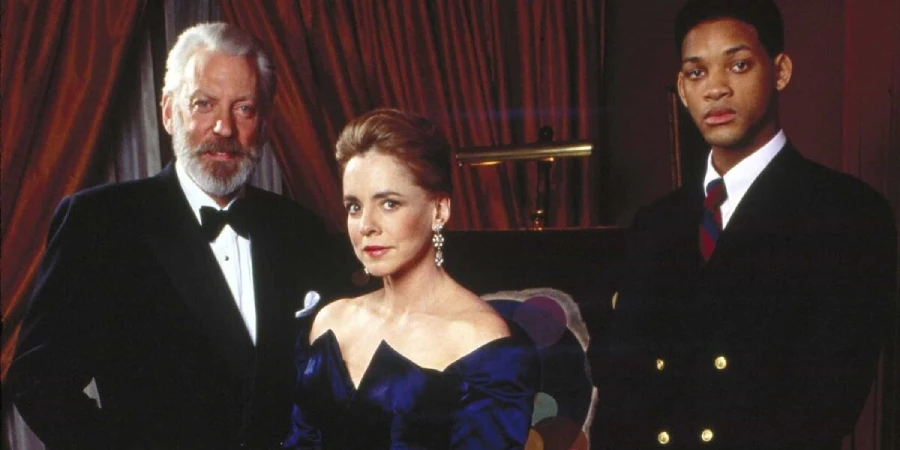

A charming young Black man shows up at a wealthy Manhattan couple’s door, claiming to be a friend of their children and the son of Sidney Poitier, and somehow that premise alone fractures an entire social class. Six Degrees of Separation (1993) is a razor-sharp dissection of privilege, performance, and the lies we tell ourselves about who we are. Director Fred Schepisi adapted John Guare’s celebrated play into a film that is equal parts comedy, tragedy, and social horror. It rewards close attention, and it punishes complacency.
Detailed Summary
A Stranger at the Door
Ouisa and Flan Kittredge, played by Stockard Channing and Donald Sutherland, are hosting a wealthy South African investor named Geoffrey when a young man named Paul appears at their apartment door. Paul claims he was mugged, that he knows their children from Harvard, and that his father is none other than Sidney Poitier. He is charming, eloquent, and utterly convincing.
Paul cooks them a magnificent meal, discusses art and literature with effortless grace, and captivates everyone in the room. Flan, who deals in expensive art, is immediately seduced by Paul’s polish and pedigree. Geoffrey, meanwhile, responds warmly to the Sidney Poitier connection, and the evening feels almost magical.
The Morning After
Ouisa wakes to find Paul in bed with a male hustler he invited into their apartment without permission. Flan furiously throws Paul out, and the spell breaks. However, the Kittredges are left rattled and oddly fascinated, not just embarrassed.
Paul vanishes as quickly as he arrived, but he leaves behind a profound confusion. Ouisa in particular cannot stop thinking about him. She keeps asking herself what exactly happened that night, and why it mattered so much.
The Con Spreads Across Manhattan
Other wealthy couples begin surfacing with the same story. Kitty and Larkin, friends of the Kittredges, also welcomed Paul into their home after the same pitch. He played the same role, used the same charm, and pulled the same trick. As a result, the social circle starts piecing together a pattern.
The Kittredges track down their actual children, who have no idea who Paul is. Nobody named Paul attended Harvard with them. Furthermore, no connection to Sidney Poitier exists whatsoever. Paul is entirely invented.
Rick and Elizabeth
Paul’s con has far darker consequences for two younger victims. Rick, a young man from Utah trying to make it in New York, encounters Paul and falls genuinely under his spell. Paul convinces Rick to hand over money and then disappears. In contrast to the Kittredges, who lose little more than their dignity, Rick loses everything he has.
Rick’s girlfriend Elizabeth watches helplessly as Rick unravels. He eventually jumps to his death from a building, a tragedy that runs parallel to the Kittredges’ drawing-room comedy. This death gives the film its moral weight and its most devastating argument about class.
Tracking Paul Down
Ouisa becomes almost obsessed with finding Paul. She learns his real name may be connected to a young man named Trent Conway, a wealthy kid who tutored Paul in how to infiltrate elite circles. Trent, it seems, taught Paul everything: the names to drop, the schools to reference, the manners to perform.
Flan, on the other hand, treats the whole affair as a fascinating anecdote. He retells the story at dinner parties for entertainment. Ouisa finds this increasingly unbearable, because she senses that Paul’s story deserves more than cocktail-party gossip.
Paul Is Found
Paul resurfaces and reaches out to Ouisa directly. She genuinely wants to help him, and she promises she can get him legal representation if he turns himself in to the police. Paul agrees, and Ouisa feels a rare moment of real human connection crossing the usual boundaries of class and race.
She calls the police to arrange a safe surrender. However, by the time officers arrive, Paul is gone. He slips away again, and Ouisa never sees him again. Later, she learns that Paul has been arrested and, after that, she hears he has died, though the circumstances remain vague.


Movie Ending
Ouisa and Flan attend yet another social gathering near the film’s close, and Flan once again trots out the Paul story as after-dinner entertainment. Ouisa reaches her breaking point. She confronts Flan directly: Paul was a real person, not a dinner party anecdote, and she is furious that their social circle has reduced his life to a punchline.
Her final monologue is the film’s emotional detonation. She reflects on the idea behind the title: that every human being on earth connects to every other through just six degrees of separation. In theory, this means everyone shares a chain of connection. In practice, Ouisa realizes, people like her and Flan use those connections only when it suits them and discard people like Paul the moment they become inconvenient.
Paul’s death closes a door that Ouisa genuinely wanted to open. She had wanted to treat him as a full human being, and the system around her, including her own husband, refused to allow it. The ending resists easy resolution. Flan is not a villain; he is simply a man incapable of being changed by an encounter that changed his wife profoundly. Ouisa is left alone with a grief nobody around her understands or takes seriously.
Audiences often wonder whether Paul’s death is confirmed or ambiguous. The film keeps it deliberately unclear, which is precisely the point. Paul was always slightly unreal to the people around him, and his death simply completes that erasure. Ouisa mourns him, and nobody else does.
Are There Post-Credits Scenes?
Six Degrees of Separation contains no post-credits scenes whatsoever. Once the film ends, it ends. Given the film’s theatrical, introspective tone, a post-credits surprise would feel completely out of place.
Type of Movie
This film sits at an unusual intersection of genres. It functions primarily as a social drama but carries significant threads of dark comedy and psychological thriller. The tone shifts constantly, moving from brittle Upper East Side wit to genuine tragedy without warning.
Audiences expecting a straightforward con-man movie will find something far more unsettling. Six Degrees of Separation is ultimately a film about identity, class, and performance, asking whether the self is something you possess or something you construct for an audience.
Cast
- Stockard Channing – Ouisa Kittredge
- Will Smith – Paul
- Donald Sutherland – Flan Kittredge
- Ian McKellen – Geoffrey
- Mary Beth Hurt – Kitty
- Bruce Davison – Larkin
- Richard Masur – Dr. Fine
- Anthony Michael Hall – Trent Conway
- Heather Graham – Elizabeth
- Eric Thal – Rick
Film Music and Composer
Jerry Goldsmith composed the score for Six Degrees of Separation. Goldsmith brought his characteristic sophistication to the project, crafting music that supports the film’s emotional undercurrents without overwhelming the dialogue-driven drama. His score stays restrained, which suits the material perfectly.
Goldsmith was one of Hollywood’s most prolific and respected composers, with credits spanning decades and genres. His work here prioritizes atmosphere over spectacle, which reflects the film’s theatrical origins. Notably, the score never tries to tell you how to feel; it simply accompanies.

Filming Locations
Six Degrees of Separation shot primarily in New York City, which is not merely a backdrop but the film’s entire social context. Manhattan’s Upper East Side, with its prewar apartment buildings and art-world wealth, gives the Kittredges’ world its credible texture.
Shooting on location rather than on a soundstage grounds the film’s theatrical origins in something tangible and real. New York is a city of surfaces and performances, which mirrors the film’s central argument about identity. Consequently, every location choice reinforces the theme rather than just servicing the plot.
Awards and Nominations
Stockard Channing received an Academy Award nomination for Best Actress for her performance as Ouisa, which many critics considered the finest work of her career. She also received a Golden Globe nomination for the same role.
The film itself did not win major awards, but Channing’s nomination acknowledged what the film does best: center an extraordinary performance in material that might otherwise feel like a theatrical exercise. Moreover, the nomination helped draw wider audiences to a film that might have remained a niche arthouse title.
Behind the Scenes Insights
- Will Smith famously refused to film the kissing scene between Paul and Rick, a decision he later publicly stated he regretted. Denzel Washington had advised him against it, and Smith has said he should have trusted the material instead.
- Stockard Channing had originated the role of Ouisa on Broadway, which gave her an extraordinary command of the character before cameras ever rolled.
- Director Fred Schepisi worked closely with playwright John Guare, who also wrote the screenplay adaptation, ensuring fidelity to the original text’s voice.
- Smith’s casting was considered a risk at the time; he was primarily known as a rapper and a sitcom star, and Six Degrees of Separation marked his first serious dramatic film role.
- The film’s production design deliberately emphasized the Kittredges’ art collection, reinforcing the idea that their world treats everything, including people, as objects to be appraised and displayed.
Inspirations and References
Six Degrees of Separation draws directly from the real-life case of David Hampton, a young man who in the 1980s posed as Sidney Poitier’s son and conned his way into the homes of wealthy New Yorkers. Playwright John Guare learned of Hampton’s story and recognized its potential as a lens for examining American class and race.
Guare transformed the factual case into something far more philosophical. He incorporated the six degrees of separation concept, popularized by social psychologist Stanley Milgram’s research on human connectivity, as the film’s governing metaphor. In addition, Guare structured the story so that the con-man plot becomes almost secondary to the question of what connects human beings across social divides.
Alternate Endings and Deleted Scenes
No widely documented alternate endings or significant deleted scenes exist for Six Degrees of Separation in the public record. The film closely follows Guare’s stage play, which itself has a well-established structure that the filmmakers respected.
Given that Guare wrote the screenplay himself, substantial deviation from his theatrical text was unlikely. The film therefore feels unusually faithful to its source, with few signs of scenes cut for pacing or content.
Book Adaptations and Differences
Six Degrees of Separation adapts John Guare’s 1990 stage play of the same name, not a novel or book. Guare himself wrote the screenplay, which preserves much of the play’s structure, including the device of characters narrating events directly to the audience.
However, film naturally externalizes what theatre keeps internal. Scenes that existed only in description on stage could now be shown directly on screen. Guare used this to deepen the contrast between the Kittredges’ glittering world and the tragedy of Rick’s death, giving the film a visual weight the play could only imply.

Memorable Scenes and Quotes
Key Scenes
- Paul’s dinner: Paul cooks an elaborate meal for the Kittredges and Geoffrey, holding the table spellbound with his charm, his Poitier stories, and his analysis of The Catcher in the Rye. It is one of cinema’s great seductions.
- The hustler in bed: Flan discovers Paul with a male hustler and erupts, ending the fantasy of the evening in a moment of cold, embarrassed fury.
- Rick’s death: Elizabeth’s account of Rick’s spiral and suicide shifts the film’s register entirely, from comedy to something genuinely devastating.
- Ouisa’s phone call: Paul calls Ouisa and they share a quiet, honest conversation that feels more real than anything either of them shares with their respective social worlds.
- Ouisa’s final monologue: She confronts Flan and their guests about reducing Paul to a story, delivering the film’s central argument with controlled fury and grief.
Iconic Quotes
- “I read somewhere that everybody on this planet is separated by only six other people. Six degrees of separation. Between us and everybody else on this planet.” (Ouisa)
- “What is it about us? We can’t take in the other, the stranger, unless he comes to us through the known.” (Ouisa)
- “I am not a story. I am a person.” (Paul, in spirit, as Ouisa gives him this dignity in her retelling)
Easter Eggs and Hidden Details
- The painting that Flan keeps referencing throughout the film, a Kandinsky with two sides, one representational and one abstract, functions as a direct visual metaphor for Paul’s dual nature: the performed self and whatever lies beneath.
- Paul’s analysis of The Catcher in the Rye during dinner foreshadows the film’s themes of identity and performed authenticity; Holden Caulfield’s obsession with phoniness mirrors the film’s core argument about the Kittredges’ world.
- Trent Conway’s role as Paul’s tutor quietly implicates elite society itself in the con; the wealthy, in effect, provided the blueprint Paul used to infiltrate them.
- Rick and Elizabeth serve as a deliberate class counterpoint to Ouisa and Flan. Both couples process the Paul encounter very differently, which visually and narratively underlines how wealth insulates people from consequence.
Trivia
- Will Smith has cited his decision not to film the kissing scene as one of his greatest professional regrets, discussing it publicly on multiple occasions over the years.
- The real David Hampton, who inspired the story, reportedly resented the play and the film, feeling he deserved compensation and credit for providing the material.
- Stockard Channing performed Ouisa on Broadway before bringing the role to film, making her one of the few actors in the production with full theatrical ownership of her character.
- This was one of Ian McKellen’s earlier prominent American film appearances, predating his breakthrough Hollywood roles in the late 1990s and early 2000s.
- Anthony Michael Hall’s casting as Trent Conway was a deliberate departure from his earlier teen-comedy image, signaling a turn toward more adult dramatic work.
- John Guare’s play premiered on Broadway in 1990 and received strong critical acclaim before the film adaptation entered production.
Why Watch?
Six Degrees of Separation offers one of cinema’s sharpest and most unsettling portraits of class, race, and self-deception. Stockard Channing delivers a towering performance, and Will Smith proves, even in an early career turn, that he had genuine dramatic depth. This film asks hard questions about human connection and provides no comfortable answers, which is precisely why it stays with you.
Director’s Other Movies
- The Chant of Jimmie Blacksmith (1978)
- Barbarosa (1982)
- Roxanne (1987)
- A Cry in the Dark (1988)
- The Russia House (1990)
- I.Q. (1994)
- Fierce Creatures (1997)
- Last Orders (2001)
Recommended Films for Fans
- The Talented Mr. Ripley (1999)
- Catch Me If You Can (2002)
- Metropolitan (1990)
- The House of the Spirits (1993)
- Gosford Park (2001)
- Parasite (2019)
- Quiz Show (1994)