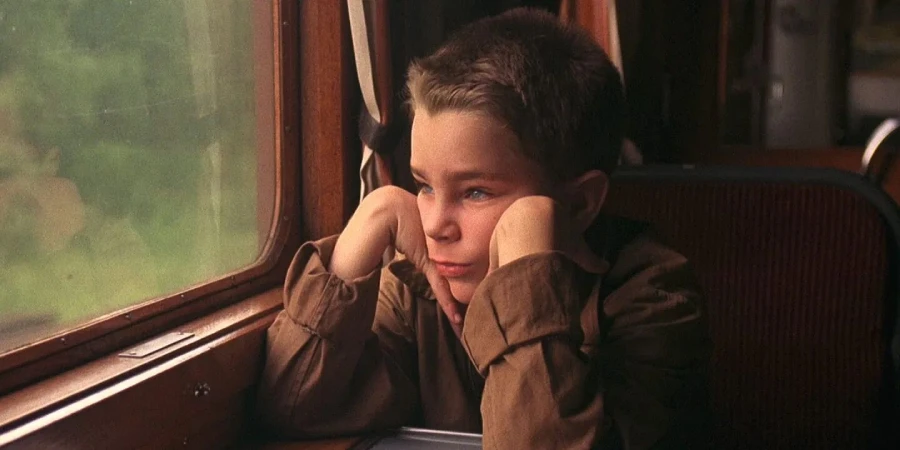

A boy compares himself to Laika, the Soviet space dog sent to die alone in orbit, and somehow that comparison feels completely earned. My Life as a Dog is a Swedish film directed by Lasse Hallström that follows twelve-year-old Ingemar through a summer of loss, confusion, and unexpected warmth in rural Sweden.
It is funny and quietly devastating in equal measure, often within the same scene. Few films about childhood grief manage to feel this honest without tipping into sentimentality.
Detailed Summary
Ingemar’s Chaotic Home Life
We meet Ingemar Johansson in the late 1950s, living with his older brother Erik and their seriously ill mother. She has tuberculosis and struggles to manage the boys, whose rambunctious energy makes her condition worse. Ingemar copes by narrating his own misfortunes out loud, measuring them against greater tragedies in history, a habit that is equal parts heartbreaking and genuinely funny.
His dog, Sickan, is a constant comfort. Ingemar loves Sickan with a fierce, uncomplicated devotion that the film treats with complete seriousness.
Separation and the Dog’s Fate
When their mother’s illness worsens, the brothers are sent to live with different relatives. Ingemar goes to stay with his Uncle Gunnar and Aunt Ulla in the small glassblowing village of Småland. Before he leaves, he is told Sickan will be looked after, but he worries constantly about the dog’s fate.
Late in the film, Ingemar learns that Sickan was sent to a kennel and died there. Nobody told him. That revelation hits with a slow, sickening weight, partly because Hallström withholds it for so long and partly because Ingemar has been quietly bracing for it the entire time.
Life in Småland
Småland turns out to be an oddly welcoming place. Gunnar is warm, gentle, and a little hapless. Ulla is practical and kind. Ingemar slots into village life with surprising ease, befriending a collection of eccentric adults and children.
One standout relationship is with Arvidsson, an elderly man who has Ingemar read aloud from a lingerie catalogue. It is absurd and also oddly tender. Hallström plays it completely straight, which is exactly the right call.
Saga and Gender Identity
Ingemar befriends Saga, a tomboy his age who plays football with the boys and binds her chest to hide her developing body. Their friendship is one of the film’s real pleasures. Saga is fierce and guarded, and Melinda Kinnaman‘s performance gives her a specific, restless energy that never feels like a type.
Ingemar is drawn to Saga without fully understanding why. Their relationship sits somewhere between childhood friendship and something more complicated, and the film is wise enough not to force it into a neat category.
The Glass Factory and the Adults Around Ingemar
Much of village life centers on the local glass factory. Ingemar spends time with the glassblowers, watching them work, absorbing their rhythms. Hallström lingers on the physical details of the work, the heat, the glow, the molten glass pulled into shape.
These sequences give the film much of its texture. Ingemar is not a passive observer of adult life; he absorbs it, catalogs it, stores it alongside his private comparisons to Laika and other sufferers.
Return Home and His Mother’s Death
Ingemar returns home at one point when his mother’s condition deteriorates. The visit is painful. She is weaker, more irritable, and the household feels fragile. Ingemar tries to be good and fails in small, human ways.
His mother dies. Hallström does not stage this as a big dramatic scene. Ingemar processes it from a distance, filtered through his habit of comparison and narration. That restraint makes it more affecting than any tear-soaked deathbed scene could.
Back to Småland
After his mother’s death, Ingemar returns to Småland. Life continues. Saga keeps playing football. Gunnar keeps being gentle and fumbling. The village absorbs Ingemar’s grief without making a ceremony of it.
That absorption is the film’s quiet argument: that children survive loss not through grand catharsis but through the accumulation of small, ordinary moments with people who are simply present.
Movie Ending
Winter arrives in Småland. Saga, whose developing body has made it increasingly hard to keep playing with the boys, finally has a confrontation on the football field. Her chest binding is exposed, and the boys react with the predictable cruelty of their age. It is a short, sharp moment of humiliation that Hallström does not dramatize excessively.
Ingemar tries to comfort Saga afterward. In a scene that is both funny and genuinely sweet, he kisses her. She punches him. Then she kisses him back. It is an imperfect, clumsy, completely believable exchange between two kids who have no idea what they are doing.
Snow covers the village. Ingemar sits inside and narrates again, returning to his Laika comparison one last time. He thinks about all the things that could have been worse. He thinks about the dog in the capsule, circling the Earth with no way home. And then, in a small but meaningful visual choice, Hallström cuts to the sky.
It is not a resolution in any tidy sense. Ingemar has lost his mother, lost his dog, and moved through a year of quiet dislocation. What he has found is a kind of provisional home in Småland and a vocabulary for his own grief. The film ends not with closure but with continuation, which is, in fact, the most honest thing it could do.
Are There Post-Credits Scenes?
No. My Life as a Dog has no post-credits scenes. When the film ends, it ends. Sit with it.
Type of Movie
This is a coming-of-age drama with a strong current of gentle comedy running beneath it. Tonally, it resists easy categorization. It is not a weepie, not a nostalgia piece, and not a quirky indie in the modern sense, even though it shares DNA with all three.
Think of it as bittersweet realism. The comedy and the grief sit right next to each other without either undermining the other, which is the hardest tonal balance to pull off and the one Hallström gets exactly right here.
Cast
- Anton Glanzelius – Ingemar Johansson
- Melinda Kinnaman – Saga
- Anki Lidén – Ingemar’s Mother
- Tomas von Brömssen – Uncle Gunnar
- Ing-Marie Carlsson – Berit
- Manfred Serner – Erik
- Lennart Hjulström – Arvidsson
Film Music and Composer
The score was composed by Björn Isfält, a Swedish composer with a long career in film and television. His work here is unshowy and perfectly calibrated. He favors spare, gentle melodic lines that suggest childhood memory without laying on the nostalgia too thick.
Isfält’s music knows when to pull back. Some of the film’s most affecting moments play without any score at all, which is a smart choice. When music does arrive, it feels earned rather than instructional.


Filming Locations
Principal photography took place in Småland, Sweden, the same region where the source novel is set. That geographic authenticity matters. The landscape, flat, cold, dotted with glass factories and small wooden houses, gives the film a specific, lived-in texture that no studio recreation could replicate.
Shooting in the actual region also grounds the film’s period detail. The late-1950s Swedish countryside looks exactly like itself here: modest, functional, not picturesque in a tourist-brochure way but quietly beautiful in a way that sneaks up on you.
Awards and Nominations
My Life as a Dog earned considerable international recognition. It received two Academy Award nominations, one for Best Director and one for Best Adapted Screenplay, a rare achievement for a Swedish-language film at the time.
It won multiple Guldbagge Awards, the Swedish national film prizes, including Best Film and Best Director for Hallström. The film also won a Golden Globe for Best Foreign Language Film.
Behind the Scenes Insights
- Anton Glanzelius was a non-professional child actor when cast. Hallström drew a remarkably naturalistic performance from him by keeping the atmosphere on set relaxed and playful.
- Hallström co-wrote the screenplay with Brasse Brännström and Per Berglund, adapting the source novel carefully to preserve its episodic, memory-like structure.
- The production was relatively modest in scale, which suited the material. A bigger budget might have polished away the rough edges that make the film feel so genuine.
- Hallström has cited his own Swedish upbringing as a direct influence on his approach to the material, particularly the mix of warmth and melancholy he associates with that era and region.
- Melinda Kinnaman, who played Saga, came from a prominent Swedish acting family. Her comfort in front of the camera gives Saga a self-possession that the role absolutely requires.
Inspirations and References
The film is based on the 1983 semi-autobiographical novel Mitt liv som hund by Swedish author Reidar Jönsson. Jönsson drew on his own childhood experiences growing up in Småland during the late 1950s. The novel’s episodic, memory-driven structure carried directly into the film’s screenplay.
The repeated references to Laika, the Soviet space dog launched in 1957 with no plan for return, are drawn from the novel and function as Ingemar’s primary emotional anchor. Laika is not a metaphor Ingemar consciously constructs; it is simply the thing he reaches for when the world feels too heavy.
Alternate Endings and Deleted Scenes
No officially documented alternate endings or significant deleted scenes are publicly known for My Life as a Dog. Hallström has not released a director’s cut or extended version. If alternate material exists in an archive, it has not entered the public record.
Book Adaptations and Differences
My Life as a Dog adapts Reidar Jönsson’s novel of the same name. The screenplay compresses and reshapes some of the book’s episodes for narrative economy. Certain supporting characters are simplified or merged compared to their novel counterparts.
The emotional arc remains faithful. Both the novel and the film use Ingemar’s habit of comparison as the central structural device. Jönsson’s voice in the source text is wry and observational, and the film preserves that quality largely through Glanzelius‘s narration and physical performance.


Memorable Scenes and Quotes
Key Scenes
- Ingemar reading aloud from the lingerie catalogue to the bedridden Arvidsson, both of them utterly serious about the exercise, is the film’s funniest and most unexpectedly sweet scene.
- Saga’s chest binding being exposed on the football field: a short, brutal beat that Hallström handles without melodrama, which makes it land harder.
- Ingemar learning that Sickan died in the kennel: he does not cry on screen. He just goes quiet. Glanzelius conveys the whole weight of it through stillness and a slight tightening around the eyes.
- The final kiss between Ingemar and Saga, clumsy and mutual and immediately followed by her punching him, is the most perfectly observed adolescent moment in the film.
- Ingemar watching the glassblowers at work, his face lit orange by the furnace, absorbing something he cannot yet name.
Iconic Quotes
- “You have to compare all the time. You have to realize there are people who are worse off.” (Ingemar’s recurring refrain, the film’s emotional spine.)
- “Poor Laika. They didn’t even try to get her back.” (Simple, devastating, delivered with complete matter-of-factness.)
Easter Eggs and Hidden Details
- The year is never stated explicitly in dialogue, but production design and background radio broadcasts place events carefully in the late 1950s, with Laika’s 1957 launch serving as a quiet chronological anchor.
- Gunnar’s workshop is cluttered with half-finished projects, a visual shorthand for his character: well-meaning, enthusiastic, perpetually incomplete.
- Ingemar’s habit of lying on his back and staring upward recurs throughout the film. Each time the framing is slightly different, subtly tracking his emotional state without any dialogue.
- Background conversations in the village often mirror or rhyme with Ingemar’s private emotional situation, functioning as a kind of Greek chorus he never consciously registers.
Trivia
- Anton Glanzelius largely stepped away from acting after his child career, making his performance here a genuinely singular artifact.
- The film was one of the projects that brought Lasse Hallström to Hollywood’s attention, leading directly to his move toward English-language productions.
- My Life as a Dog was Sweden’s official submission for the Academy Award for Best Foreign Language Film for its eligibility year.
- Reidar Jönsson, the novel’s author, was reportedly closely involved with and supportive of the adaptation.
- The film’s release helped spark renewed international interest in Swedish cinema during the mid-1980s.
Why Watch?
Anton Glanzelius gives one of the great child performances in world cinema, and the proof is in the kennel scene, where he learns Sickan is dead and does absolutely nothing visible except go still. Hallström trusts that stillness completely. Watch this film for that single beat if nothing else convinces you.
Director’s Other Movies
- ABBA: The Movie (1977)
- What’s Eating Gilbert Grape (1993)
- The Cider House Rules (1999)
- Chocolat (2000)
- The Shipping News (2001)
- Casanova (2005)
- Hachi: A Dog’s Tale (2009)
Recommended Films for Fans
- Fanny and Alexander (1982)
- Au Revoir les Enfants (1987)
- Cinema Paradiso (1988)
- Stand by Me (1986)
- The 400 Blows (1959)
- Ponette (1996)
- Munyurangabo (2007)