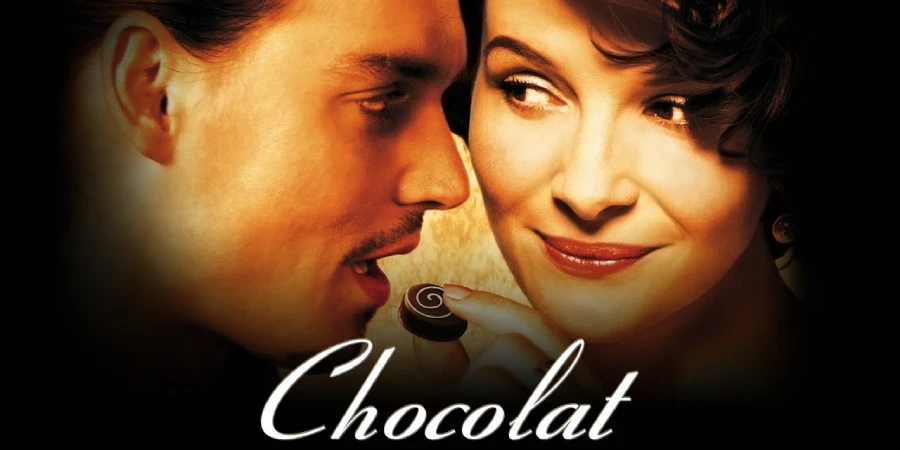

A widow and her daughter blow into a quiet French village with the north wind, set up a chocolate shop during Lent, and proceed to crack a repressed community open like a good truffle. Chocolat (2000) is warmer than it looks and sneakier than it sounds.
Lasse Hallström’s film courts sentimentality aggressively, yet it earns most of what it reaches for, largely because Juliette Binoche plays Vianne Thierry as a woman with genuine steel beneath the whimsy. This is a film worth pulling apart.
Detailed Summary
The North Wind Arrives in Lansquenet
A narrator, voiced by Judi Dench’s character Armande Voizin, opens the story with a fairy-tale framing. It is the beginning of Lent, 1959, in the fictional French village of Lansquenet-sous-Tannes. Vianne Thierry arrives with her daughter Anouk and a suitcase full of chocolates, renting a shop directly across from the church.
Count Reynaud, the village’s self-appointed moral guardian, takes immediate offense. He controls the local priest, Père Reynaud’s words sometimes literally ghostwritten in the priest’s weekly sermons. Vianne’s timing, opening a chocolate shop during a Christian season of abstinence, reads to him as a direct provocation.
The Shop Opens, the Village Divides
Vianne has a gift: she reads people and prescribes the exact chocolate they need. Armande, a sharp-tongued elderly woman estranged from her daughter Caroline, becomes one of Vianne’s first allies. Caroline is rigid and overprotective, keeping Armande away from her own grandson Luc.
Vianne arranges secret meetings between Armande and Luc, who share a love of drawing. These scenes carry the film’s sweetest emotional charge, partly because Dench plays Armande with a delightful refusal to be pitied. Caroline, played by Carrie-Anne Moss, functions as a smaller mirror of Reynaud: both characters mistake control for love.
Josephine Breaks Free
Josephine Muscat is the film’s most quietly devastating character. Her husband Serge beats her, and the village largely looks away. Vianne gives her shelter above the chocolate shop, then teaches her to make chocolates, and Josephine begins to rebuild an identity she had nearly lost entirely.
Alfred Molina plays Serge as a bully who is also pitiable, a man who performs piety to cover shame. Reynaud recruits Serge into his “moral” campaign against Vianne, which is one of the screenplay’s sharper ironies: the repressive community protects abusers while targeting a harmless chocolatier.
Roux and the River People Arrive
A group of Irish Romani travellers moor their boats on the river, and Reynaud immediately targets them as a threat to village decency. Their leader, Roux, is played by Johnny Depp with a guitar, a leather jacket, and a River-Shannon lilt that charmed audiences worldwide.
Vianne and Roux fall into a slow, easy attraction. He represents the same rootless freedom she has always lived, and for the first time she considers that freedom might actually feel lonely rather than liberating. Anouk, meanwhile, befriends a young Romani boy, which deepens her already painful longing for a stable home.
Reynaud’s Campaign and Anouk’s Crisis
Reynaud pressures shopkeepers to shun Vianne, writes letters to the mayor’s office, and engineers the eviction of the river travellers. His tactics are petty but effective. Vianne begins to consider leaving, which would confirm what Anouk has always feared: that they never stay anywhere long enough to belong.
Anouk’s imaginary kangaroo companion, Pantouffle, is the film’s most efficient piece of visual shorthand for her emotional state. When Pantouffle begins to fade from Anouk’s imagination, we understand she is grieving, not just restless. It is a small, well-judged detail that avoids spelling itself out in dialogue.
The Festival and Reynaud’s Breaking Point
Vianne plans an Easter chocolate festival to coincide with the end of Lent. Armande throws herself a birthday party on Roux’s boat, inviting Luc and several friends for a night of food, dancing, and laughter. It is a beautiful scene, shot with warm amber light and Dench performing with uncomplicated joy.
Reynaud’s campaign intensifies. He burns the river travellers’ boats, driving Roux out of the village. Then, alone one night, Reynaud breaks into Vianne’s shop and begins destroying the Easter display, but he cannot stop himself from eating the chocolate. He gorges himself, falls apart, and weeps on the floor of the shop he has vandalized.


Movie Ending
Reynaud’s collapse in the chocolate shop is the pivot everything else turns on. Alfred Molina plays it without a shred of vanity: chocolate smeared on his face, expensive coat ruined, a man whose self-constructed fortress of moral authority crumbles into sugar and tears. It is the best scene in the film, and it works precisely because Molina refuses to make Reynaud sympathetic in a cheap way. He earns the pathos through the wreckage.
Vianne discovers the destruction the next morning. Her first impulse is to pack up and leave, following the north wind as she always has. Anouk, furious and heartbroken, finally says what she has needed to say: she does not want to keep running. She wants to stay.
That confrontation shakes Vianne into a decision. She acknowledges that her own restlessness, inherited from her mother and dressed up as freedom, has cost her daughter a home. She decides to stay in Lansquenet.
Easter Sunday arrives. Père Reynaud gives a sermon, but this one is his own voice rather than Reynaud’s script. He speaks about goodness in simple, unguarded terms. Reynaud himself appears in the church doorway, chastened, changed in a way that feels earned rather than miraculous.
Armande dies quietly during the night following her birthday party, presumably of natural causes related to her diabetes, which she has refused to manage. It is the film’s sharpest emotional beat because her death is also her choice: she lived that evening fully and on her own terms. Luc finds her at peace.
Roux returns to the village at the close. He and Vianne share a look that suggests a future without spelling one out in dialogue, which is exactly the right call. Anouk’s imaginary kangaroo Pantouffle reappears, signalling that her sense of security has returned. The north wind blows away, leaving the village changed and Vianne rooted for the first time.
Are There Post-Credits Scenes?
Chocolat contains no post-credits scenes. Once the credits roll, that is genuinely the end. You are free to go find a chocolate shop.
Type of Movie
Chocolat is a romantic drama with strong fable qualities. Its tone sits somewhere between fairy tale and social comedy, light enough to be accessible, pointed enough to carry genuine criticism of religious dogma and social conformity.
It is firmly a feel-good film, but not a naive one. Armande’s death and Josephine’s story of abuse give it enough gravity to avoid becoming a confection in the dismissive sense of that word.
Cast
- Juliette Binoche – Vianne Thierry
- Alfred Molina – Comte de Reynaud
- Johnny Depp – Roux
- Judi Dench – Armande Voizin
- Lena Olin – Josephine Muscat
- Peter Stormare – Serge Muscat
- Carrie-Anne Moss – Caroline Clairmont
- Hugh O’Conor – Père Francis Reynaud
- Victoire Thivisol – Anouk Thierry
- John Wood – Vicomte de Reynaud (the narrator’s father figure)
Film Music and Composer
Rachel Portman composed the score, and it suits the film’s fairy-tale warmth without smothering it. Portman favors light orchestral textures, acoustic guitar, and a recurring gentle motif that echoes the film’s theme of movement and return.
She had previously won an Academy Award for her score to Emma (1996), and her work on Chocolat earned her an Oscar nomination in the Best Original Score category. Johnny Depp performed guitar on several tracks, which adds an authentic quality to Roux’s scenes by the river.

Filming Locations
Principal photography took place in Flavigny-sur-Ozerain, a medieval village in Burgundy, France. The location was chosen for its preserved architecture and winding stone streets, which give Lansquenet-sous-Tannes a convincing sense of timeless insularity.
Interior scenes, including the chocolate shop set, were built and filmed at Pinewood Studios in England. The combination of real French village exteriors and controlled studio interiors allowed the production to maintain tonal consistency between the grounded and the slightly magical.
The river scenes involving Roux’s boat were filmed along the River Epte in Normandy, a location that carries a naturally romantic quality in late afternoon light.
Awards and Nominations
Chocolat received five Academy Award nominations, including Best Picture, Best Actress (Juliette Binoche), Best Supporting Actress (Judi Dench), Best Adapted Screenplay, and Best Original Score (Rachel Portman). It won none of those Oscars, losing Best Picture to Gladiator in a ceremony that remains controversial among film fans.
Juliette Binoche had already won an Oscar for The English Patient (1996), which arguably reduced her perceived underdog status. Judi Dench’s nomination was deserved, and the fact that she lost is one of those Academy decisions that time has not been kind to.
Behind the Scenes Insights
- Director Lasse Hallström was drawn to the project because of its resemblance to themes in his earlier film My Life as a Dog: outsiders disrupting closed communities.
- Juliette Binoche spent time learning chocolate-making techniques so her work in the shop scenes would read as genuinely skilled rather than performed.
- Johnny Depp brought his own guitar to set and played informally between takes, which helped establish Roux’s relaxed, self-contained quality on screen.
- Alfred Molina reportedly found the emotional extremity of Reynaud’s breakdown scene physically and psychologically demanding to film.
- The production sourced real chocolates from a Belgian chocolatier for close-up shots, prioritizing visual authenticity over prop chocolate.
- Victoire Thivisol, who played Anouk, had previously won the Best Actress award at the Cannes Film Festival as a child for Ponette (1996), making her one of the most decorated child actors in French cinema at the time.
Inspirations and References
The film adapts Joanne Harris’s 1999 novel of the same name. Harris drew on her own French heritage and her experiences growing up in a small community defined by rigid social expectations. The novel has autobiographical undercurrents, particularly in its depiction of how outsiders disrupt comfortable community myths.
Harris has cited magical realist literature as an influence, particularly the tradition of writers like Gabriel García Márquez, where everyday objects carry symbolic and sometimes literal transformative power. In Chocolat, chocolate functions in exactly this way.
Alternate Endings and Deleted Scenes
No officially released alternate ending exists for Chocolat. The theatrical cut is the only widely available version, and no director’s cut or extended edition has been released commercially.
Some deleted scenes were included on DVD releases, primarily character moments that deepened the village residents’ relationships with Vianne but were cut for pacing. None of them substantially alter the film’s themes or conclusion.
Book Adaptations and Differences
The film adapts Joanne Harris’s novel with significant changes. In the book, Reynaud is a far darker and more genuinely sinister figure: his interior monologue is one of two alternating first-person narrators alongside Vianne, which gives him a complexity the film can only gesture toward.
Roux is a less romantic figure in the novel. His relationship with Vianne is more ambiguous and less conventionally hopeful. The film softens and simplifies this dynamic considerably, partly to give Johnny Depp a more straightforwardly appealing character.
Armande’s death occurs in both versions, but its emotional staging differs. The novel handles it with a more unsentimental rhythm, while the film gives it the amber-lit warmth of a proper farewell scene. Both approaches work, but they reflect the different registers of each medium.

Memorable Scenes and Quotes
Key Scenes
- Reynaud destroys the shop: Alfred Molina alone in the darkened chocolate shop, smashing displays, then eating chocolate from the floor, his face smeared and his composure completely gone. No dialogue. All performance.
- Armande’s birthday party on the boat: Warm lantern light, dancing, Judi Dench laughing with Luc. The scene carries the specific joy of someone choosing to live fully despite knowing their time is limited.
- Vianne reads Reynaud’s chocolate preference: She holds up a small chocolate figure in the shape of a woman and tells him she thinks he does not want to know what he wants. His expression flickers before he shuts down. A sharp, precise exchange.
- Anouk tells Vianne she wants to stay: Victoire Thivisol delivers the scene with a child’s direct anger, no theatrical tears, just the flat statement of a person who has reached her limit. It is more affecting for its restraint.
- Josephine serves chocolate behind the counter: After everything Serge put her through, she stands in Vianne’s shop, competent and calm, wearing an apron instead of bruises. The camera lets you sit with it.
Iconic Quotes
- “We can’t go on forever just saying no to things.” (Anouk to Vianne)
- “I’m not sure what the theme of my homily today ought to be. Do I want to speak of the miracle of Our Lord’s divine transformation? Not really, no. I don’t want to talk about His divinity. I’d rather talk about His humanity.” (Père Reynaud’s Easter sermon)
- “If you were a piece of chocolate, what would you be? You’re a creme de cassis, Madame Audel. You’re sweet on the outside, but underneath you’re very passionate.” (Vianne to a customer)
Easter Eggs and Hidden Details
- Vianne’s compass, which she uses to determine when to leave a place, points north when she first arrives in Lansquenet. By the film’s end, she has stopped consulting it, a small visual signal that she has chosen rootedness over instinct.
- Anouk’s imaginary kangaroo Pantouffle appears clearly in scenes where she feels secure and fades or disappears when she is anxious or grieving, functioning as a consistent visual barometer of her emotional state throughout the film.
- Reynaud’s immaculate suits grow progressively more disheveled as the film continues, a deliberate costuming choice that tracks his internal unraveling before the chocolate shop scene makes it explicit.
- The chocolates Vianne creates for specific characters reflect their hidden desires: she gives Armande’s daughter a chocolate that Armande herself would have chosen, suggesting Vianne sees what Caroline refuses to acknowledge about herself.
- Roux’s boat is named after a real river in Ireland, a quiet nod to his character’s cultural background that most non-Irish viewers would miss entirely.
Trivia
- Victoire Thivisol spoke very little English at the time of filming; much of her performance was directed through a translator on set.
- The village of Flavigny-sur-Ozerain is itself famous for a real anise candy called anis de Flavigny, which has been produced there by monks for centuries. The casting of a confection-centered story in this location was not accidental.
- Joanne Harris has a cameo in the film as a villager, one of those blink-and-you-miss-it appearances that requires a pause on streaming to confirm.
- The screenplay was written by Robert Nelson Jacobs, adapting Harris’s novel. Jacobs later wrote the screenplay for The Shipping News (2001).
- Lasse Hallström shot the village exteriors in autumn and early winter to capture the grey, cold quality of a community that has shut warmth out. Vianne’s shop interior, by contrast, was lit with consistent amber and gold tones.
- This was one of Johnny Depp’s last major studio films before Pirates of the Caribbean (2003) changed the scale of his career permanently.
Why Watch?
Alfred Molina’s performance as Reynaud alone justifies two hours of your time: he takes a character who could have been a cartoon villain and plays every crack in the man’s self-image with precise, uncomfortable honesty. Binoche matches him scene for scene. This is a film about appetite in the broadest sense, and it makes that argument through chocolate, community, and two performances that never once condescend to their audience.
Director’s Other Movies
- My Life as a Dog (1985)
- What’s Eating Gilbert Grape (1993)
- The Cider House Rules (1999)
- The Shipping News (2001)
- Casanova (2005)
- Hachi: A Dog’s Tale (2009)
- Salmon Fishing in the Yemen (2011)
- A Dog’s Purpose (2017)
Recommended Films for Fans
- Babette’s Feast (1987)
- Like Water for Chocolate (1992)
- Amelie (2001)
- Eat Drink Man Woman (1994)
- Bella Martha (2001)
- Enchanted April (1991)
- Big Night (1996)