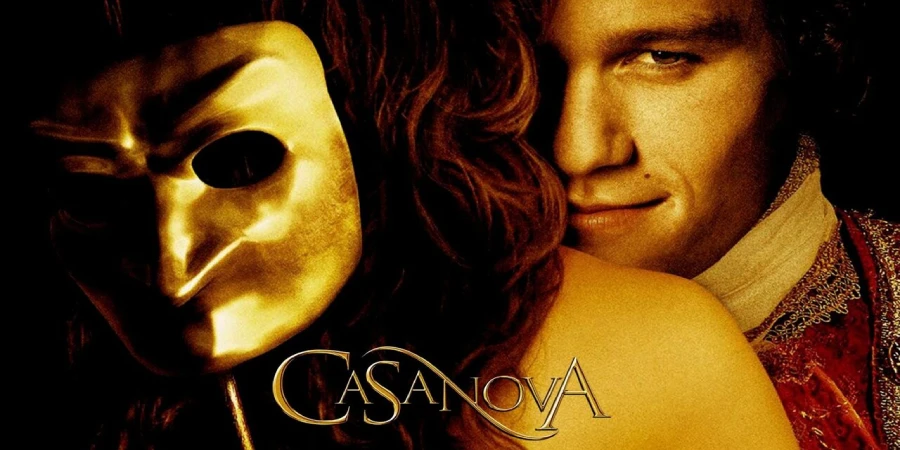

Heath Ledger plays Casanova as a man genuinely surprised by the one woman who refuses to be charmed, and that single reversal is what gives this frothy Venetian romp its teeth. Director Lasse Hallstrom shoots the city like a confection, all peach light and tilting canal reflections, but the screenplay keeps undercutting the fantasy with sharp comic timing.
Sienna Miller’s Francesca is not a passive love interest; she actively outmaneuvers Casanova at nearly every turn. This is a studio crowd-pleaser that earns its happy ending through wit rather than sentiment.
Detailed Summary
Casanova’s Opening Reputation and the Convent Escape
We meet Giacomo Casanova mid-seduction, sneaking out of a Venice convent while dodging the authorities. He is the city’s most celebrated libertine, a man whose exploits are the subject of gossip in every salon and gondola. Bishop Pucci, a zealous church official, has made it his mission to bring Casanova down.
The Doge of Venice delivers an ultimatum: Casanova must marry a respectable woman or face permanent exile. This opening sequence establishes the comic stakes cleanly and quickly. He is not a villain; he is a charming disaster who needs a plot to interrupt him.
Casanova Pursues Victoria and Meets Francesca
Casanova sets his sights on Victoria, a young noblewoman whose family would satisfy the Doge’s demand. He attends a lecture by the feminist writer Francesca Bruni, who publishes her radical pamphlets under a male pseudonym. Casanova intends to win Victoria but finds himself completely unprepared for Francesca’s sharp tongue.
Francesca publicly dismantles Casanova’s philosophy of seduction without even knowing who he is at first. Sienna Miller delivers these moments with real comic precision, leaning forward in the frame, voice cutting through the crowd. It is the best scene in the film’s first act, and it sets up the entire dynamic between the two leads.
The Identity Tangles Begin
Casanova discovers that Francesca is engaged to Paprizzio, a wealthy lard merchant from Genoa. Desperate to get close to her, Casanova disguises himself as Paprizzio. The real Paprizzio, played by Oliver Platt with tremendous physical comedy, arrives in Venice at exactly the wrong moment.
Paprizzio then assumes the identity of Giovanni Bruni, Francesca’s brother, to avoid the social awkwardness of his situation. Giovanni himself is being chased by creditors. The film layers these mistaken identities with genuine structural confidence, stacking complications that could easily collapse into chaos but stay surprisingly coherent.
Bishop Pucci Closes In
Bishop Pucci arrives in Venice with full papal authority to arrest Casanova on charges of heresy and licentiousness. He is a cold, methodical antagonist who provides real menace beneath the comedy. Jeremy Irons commits completely to the role, playing Pucci with reptilian calm rather than theatrical bluster.
Pucci begins systematically exposing the identity swaps happening across Venice’s social calendar. Every new dinner party, masquerade, or canal-side encounter risks total unraveling. Hallstrom uses these near-misses to generate genuine comedic tension rather than just chaos for its own sake.
Francesca Falls for “Paprizzio”
Francesca, believing Casanova is the real Paprizzio, begins spending genuine time with him. She finds this version of him thoughtful, respectful, and intellectually engaged. Casanova, for perhaps the first time in his life, is actually listening to a woman rather than performing for one.
Their scenes together in this middle section carry real warmth. Ledger drops the theatrical swagger and lets something quieter through, especially in a late-afternoon conversation where Francesca reads aloud and Casanova watches her face instead of her figure. That small physical choice says more than a dozen witty lines.
The Unraveling at the Masquerade Ball
A grand masquerade ball becomes the film’s centerpiece of confusion. Every identity becomes simultaneously threatened. Pucci circulates through the crowd, Bishop’s men at his shoulders, systematically cornering suspects.
Francesca’s mother, Andrea, has been secretly developing feelings for the real Paprizzio while believing he is Giovanni. This subplot pays off here in a genuinely funny sequence involving a balcony, a mistaken embrace, and a dropped mask. Oliver Platt handles the physical comedy of this scene with the confidence of a much more experienced comic actor than the film’s marketing suggested.
The Truth Comes Out
Casanova’s true identity comes out in the worst possible way, in public, in front of Francesca’s family and Pucci’s agents simultaneously. Francesca feels betrayed. She had genuinely connected with the man she knew as Paprizzio, and discovering that man was the infamous libertine lands as a real emotional blow, not just a plot complication.
Ledger plays Casanova’s exposure with surprising vulnerability. He does not charm his way out; he simply stands there as the performance collapses around him. It is one of the better-acted moments in what could have been a purely decorative film.


Movie Ending
Pucci moves to arrest Casanova, and the climax spills across Venice’s rooftops and bridges in a chase sequence Hallstrom shoots with genuine kinetic energy. Casanova fights not to escape but to reach Francesca before she leaves Venice permanently, having accepted that her writing career requires her to flee to a more tolerant city.
Francesca, confronted with Casanova’s actual pursuit rather than his usual seduction routine, has to decide whether the man she fell for was real or just another mask. She chooses to believe the feeling was genuine. The two confess their feelings on a rooftop while Pucci’s men crash into each other below.
Paprizzio and Francesca’s mother, Andrea, end up together in a pairing that feels both absurd and earned. Giovanni’s debt problems get resolved through the general chaos. Pucci is publicly humiliated when his own past indiscretions surface, undercutting his moral authority in front of the Doge.
Casanova and Francesca escape Venice together, sailing away from the city as the golden light catches the water. The film does not pretend this is a somber choice; it leans into the romantic fantasy with full commitment. Refreshingly, the ending earns its warmth by having put Casanova through genuine humiliation first, which makes the reconciliation feel like something rather than nothing.
Are There Post-Credits Scenes?
No. Casanova (2005) contains no post-credits scenes. When the credits roll, the film is finished. You can safely leave the theater or stop the stream.
Type of Movie
Casanova is a romantic comedy with period adventure elements. Its tone sits firmly in the territory of light farce: fast-talking, identity-swapping, and resolutely cheerful. Think Shakespearean comedy structure transplanted into 18th-century Venice with a Hollywood gloss.
The film never attempts darkness. It is comfortable in its own genre and does not apologize for the lightness. For audiences burned by self-serious historical dramas, that clarity of purpose is a genuine virtue.
Cast
- Heath Ledger – Giacomo Casanova
- Sienna Miller – Francesca Bruni
- Jeremy Irons – Bishop Pucci
- Oliver Platt – Paprizzio
- Lena Olin – Andrea Bruni
- Charlie Cox – Giovanni Bruni
- Omid Djalili – Lupo
- Stephen Greif – The Doge
Film Music and Composer
Alexandre Desplat composed the score for Casanova. His work here is playful and light, full of harpsichord runs and strings that dart and swoop like the comedy itself. Desplat was already building the reputation that would later make him one of cinema’s most sought-after composers.
The score never tries to deepen the film emotionally beyond what the screenplay earns. That restraint is exactly right. A more ambitious score would have tipped the film’s tone toward self-importance, and Desplat seems to understand that precision.


Filming Locations
Production filmed extensively in Venice, Italy, which gives the film an authenticity that no studio set could replicate. The canals, bridges, and Baroque architecture are not backdrop decoration; they actively shape the comedy, providing natural obstacles and hiding spots for the identity-swap sequences.
Several interior scenes were filmed at Venetian palaces and on location in the Veneto region. Hallstrom and cinematographer Oliver Stapleton bathe the city in warm amber tones that make Venice look like the setting of a slightly gilded dream. That visual choice is intentional: this is Venice as romantic myth, not historical document.
Awards and Nominations
Casanova received limited awards attention during its season. It was not a significant presence at major ceremonies. The film performed modestly at the box office and largely bypassed awards conversation entirely.
Behind the Scenes Insights
- Heath Ledger reportedly threw himself into the physical comedy with considerable enthusiasm, performing many of the rooftop and chase sequences himself.
- Oliver Platt has spoken about the physical demands of the masquerade ball sequence, noting that multiple takes were required to keep the comic timing tight across such a large ensemble.
- Lasse Hallstrom pushed for real Venice locations over studio reconstruction because he believed the city’s actual geography would make the chase sequences funnier and more disorienting.
- Jeremy Irons prepared for Bishop Pucci by researching actual church inquisitors of the period, bringing historical texture to what could have been a purely comic-book villain.
- Sienna Miller has noted that the physical blocking of her debate scenes with Ledger required significant rehearsal to hit both the comedic beats and the genuine intellectual sparring the script required.
Inspirations and References
The film draws on the historical figure of Giacomo Casanova, the 18th-century Venetian adventurer who wrote his own memoirs, Histoire de ma vie (History of My Life). The real Casanova was a far more complicated and darker figure than this film portrays.
Screenwriters Kimberly Simi and Jeffrey Hatcher borrowed the broad outlines of Casanova’s Venice period but invented Francesca Bruni entirely. She functions as a composite of the era’s early feminist writers rather than any single historical person. The identity-swap structure owes a clear debt to the comedies of Carlo Goldoni, the Venetian playwright who was Casanova’s exact contemporary.
Alternate Endings and Deleted Scenes
No officially released alternate endings or significant deleted scene packages have been made public for Casanova. Home video releases did not include extensive bonus materials documenting cut content. If alternate material exists, it has not surfaced publicly in any form this critic can verify.
Book Adaptations and Differences
Casanova (2005) is not based on a specific book. The screenplay is an original work, though it draws loosely on the historical Casanova’s memoirs for atmosphere and setting. Francesca Bruni and the core romantic plot are invented for the film.


Memorable Scenes and Quotes
Key Scenes
- Francesca publicly debates the man she does not yet know is Casanova, dismantling his arguments about female virtue while he watches, genuinely unsettled for the first time onscreen.
- The masquerade ball sequence, in which every identity swap threatens to collapse simultaneously while Pucci moves through the crowd with quiet menace and Paprizzio blunders through a balcony embrace.
- Casanova’s exposure scene, where Ledger stands still and lets the performance fall away from his face, choosing restraint over charm at the exact moment the script demands it.
- The rooftop chase finale, where the comedy and the romantic confession happen at the same altitude and at the same speed, making the climax feel genuinely breathless rather than staged.
- Paprizzio and Andrea’s accidental courtship scenes, which Oliver Platt and Lena Olin play with a warmth that nearly steals the film from the leads.
Iconic Quotes
- “I am not what I have done.” Casanova to Francesca, during the scene where his identity is exposed.
- Francesca’s lecture hall declaration that a woman’s virtue is her own business and not the church’s inventory.
- Pucci’s dry announcement upon arriving in Venice that he has never failed an investigation, delivered by Irons with the quiet confidence of a man who has never been wrong yet.
Easter Eggs and Hidden Details
- Several background extras in the masquerade ball scene wear masks that are accurate reproductions of traditional Venetian bauta and moretta designs, reflecting the real masquerade culture of 18th-century Venice.
- The book Francesca reads aloud in her quiet afternoon scene with Casanova is a period-appropriate text rather than a prop dummy, a detail visible if you pause on the pages.
- Casanova’s recurring use of a specific red cloak as a disguise echoes the real historical Casanova’s documented fondness for theatrical self-presentation in his memoirs.
- Goldoni’s name appears briefly on a playbill visible in one of the theater scenes, a nod to Casanova’s contemporary whose comic plays directly inspired the film’s structure.
Trivia
- Heath Ledger was 25 years old during filming, which made him unusually young for a performer carrying a period romantic lead of this scale.
- Oliver Platt’s Paprizzio was significantly expanded during production after early test screenings responded enthusiastically to the character’s physical comedy.
- Venice’s canal system required the production to use historically accurate gondolas rather than motorized boats for all water-based scenes, which slowed certain shooting days considerably.
- Jeremy Irons and Heath Ledger had no scenes together for much of the shoot until the final chase sequence, which gave their eventual confrontation a genuine first-meeting energy on camera.
- Sienna Miller performed her lecture hall scenes without significant stunt or stand-in work, delivering the rapid-fire dialogue across multiple takes in a large practical space with period acoustics.
Why Watch?
Watch it for Oliver Platt’s Paprizzio, a performance so committed to physical embarrassment and accidental dignity that it threatens to restructure your entire understanding of comic supporting work. Platt turns a lard merchant into the film’s moral center, which nobody saw coming. Ledger holds the lead with ease, but Platt is where the real surprise lives.
Director’s Other Movies
- My Life as a Dog (1985)
- The Cider House Rules (1999)
- Chocolat (2000)
- An Unfinished Life (2005)
- The Hoax (2006)
- Hachi: A Dog’s Tale (2009)
- Safe Haven (2013)
Recommended Films for Fans
- Shakespeare in Love (1998)
- Much Ado About Nothing (1993)
- Chocolat (2000)
- The Mask of Zorro (1998)
- Cyrano de Bergerac (1990)
- Ever After (1998)
- Ridicule (1996)