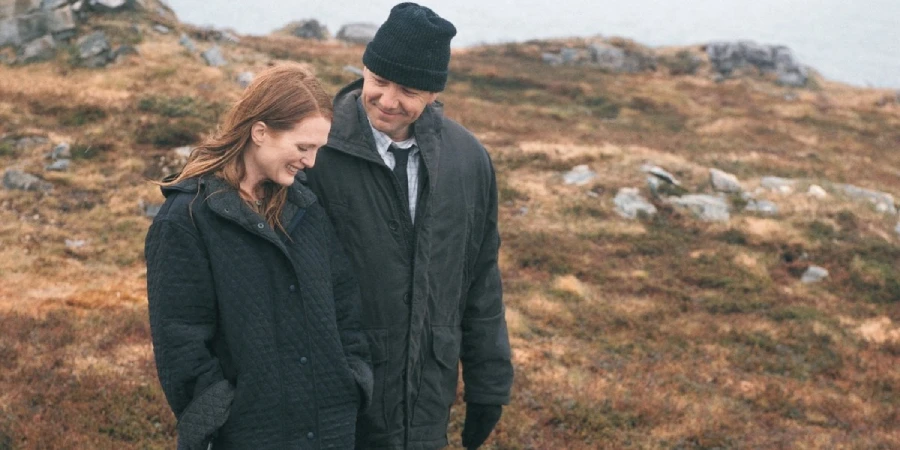

Kevin Spacey plays a man so defeated by life that his neck barely holds his head upright, and that slouch carries the entire first act of The Shipping News (2001). Director Lasse Hallström brought Annie Proulx’s Pulitzer Prize-winning novel to the screen with a cast that should have guaranteed awards glory, yet the film landed quietly and left quickly. It deserves a second look. Grief, guilt, and a bleak Newfoundland coastline turn out to be surprisingly good company.
Detailed Summary
Quoyle’s Miserable Beginning
We meet Quoyle (Kevin Spacey) as a man utterly without agency. He drifts through upstate New York, working a dead-end newspaper job, physically hunched as if apologizing for existing.
He falls for Petal Bear (Cate Blanchett), a woman who is openly contemptuous of him from the moment they meet. She cheats on him constantly, treats him like furniture, and makes zero effort to hide either.
Their union produces two daughters, Bunny and Sunshine. Petal sells the girls to a child trafficking ring while Quoyle is out, then dies in a car accident before he can fully process what she has done.
Aunt Agnis Arrives
Into this wreckage walks Aunt Agnis Hamm (Judi Dench), Quoyle’s only living relative. She is brisk, practical, and quietly broken in her own way, though she hides it expertly.
Agnis proposes they return to the family’s ancestral home in Newfoundland, a remote, wind-blasted outpost called Quoyle’s Point. Quoyle, having nothing left, agrees. The girls are recovered from the traffickers before any harm reaches them.
Arriving at Quoyle’s Point
Newfoundland hits the screen like a physical force. Hallström shoots the coastline in greys and cold blues, and the ancestral house sits on bare rock, roped down against the wind because it would otherwise blow away.
That detail is not metaphorical decoration; the house is literally tethered to the earth. Quoyle is too, in his own wrecked way, held in place by his daughters rather than by any personal ambition.
A New Job at the Newspaper
Quoyle gets a job at the local paper, The Gammy Bird, run by the eccentric Jack Buggit (Scott Glenn). His assignment: cover the shipping news, cataloguing boats coming in and out of the harbour.
It is the most thankless beat imaginable, and Quoyle takes it seriously anyway. That seriousness, played by Spacey with total absence of irony, is one of the film’s quiet pleasures.
Wavey Prowse and the Possibility of Connection
Quoyle meets Wavey Prowse (Julianne Moore), a local widow with a son who has developmental difficulties. She is warm, guarded, and refreshingly normal compared to the eccentric locals surrounding Quoyle.
Their relationship builds slowly, two damaged people circling each other with caution. Moore plays Wavey’s hesitation with a kind of still watchfulness; every conversation feels like a negotiation neither party wants to lose.
The House and Its Secrets
As winter deepens, the ancestral house cracks open its history. Agnis reveals that the Quoyle family had a brutal past, pirates and predators, men who terrorized the coast and preyed on their own kin.
Agnis herself carries a wound from that past: she was abused by Quoyle’s father as a child. Dench delivers this revelation quietly, almost flatly, which makes it land harder than any dramatic outburst could.
Quoyle Finds His Voice
Covering a gruesome car accident, Quoyle writes a piece that surprises even Jack Buggit. It is honest, careful, and humane, and it earns Quoyle a grudging respect in the newsroom.
Slowly, he starts to stand up straighter. Not in a triumphant montage way, but in the incremental, almost invisible way real people change when they stop waiting for permission to exist.
Jack Buggit’s Death and Resurrection
Jack Buggit drowns at sea. His body is brought in, laid out, and his community gathers to mourn. Then he sits up on the table, alive, having apparently survived through sheer stubbornness.
It is the film’s most overtly magical moment, and Scott Glenn plays the return from death with such matter-of-fact calm that you almost accept it as normal Newfoundland weather. The scene is odd, funny, and strangely moving.
The House Breaks Free
A storm finally tears the ancestral house from its moorings. It slides off the rock and into the sea. Quoyle watches it go, and the film treats this as liberation rather than loss.
Everything that tethered him to family shame and inherited misery disappears beneath the water. What remains is the land, the community he has built, and Wavey.


Movie Ending
Quoyle chooses to stay in Newfoundland. That decision, which seems small on paper, carries the full weight of everything the film has spent two hours building toward.
He and Wavey move toward each other without grand declarations. Their final scenes together are quiet, domestic, shot in the cold grey light that Hallström has used throughout. Nothing glows or swells artificially. Spacey lets Quoyle’s face do the work, a man who has simply stopped bracing for the next blow.
Agnis, her own ghosts finally spoken aloud, finds a measure of peace. She stays too. The Quoyle family, such as it is, reconstituted and cleaned of its worst history, puts down roots in the place it once fled.
Bunny’s recurring nightmare about a white dog, which runs through the film as a thread of childhood anxiety, fades. The girls settle. Quoyle writes. Life, modest and real and sufficient, resumes.
What the ending refuses to do is redeem the past. Petal remains monstrous in memory. The family history of abuse and violence does not get a tidy reframing. Quoyle just learns to carry it differently, which is the most honest version of recovery the film could offer.
Are There Post-Credits Scenes?
The Shipping News has no post-credits scene. Once the film ends, it ends. No teasers, no tags, nothing. You can leave when the credits roll.
Type of Movie
This is a drama with strong elements of literary fiction adaptation. The tone sits somewhere between melancholy and drily comic, which is exactly where Proulx’s novel lives.
Expect slow pacing, character study over plot mechanics, and a visual palette that prioritizes atmosphere over action. Audiences hunting for momentum will struggle. Those who like films that breathe will find it rewarding.
Cast
- Kevin Spacey – Quoyle
- Julianne Moore – Wavey Prowse
- Judi Dench – Aunt Agnis Hamm
- Cate Blanchett – Petal Bear
- Scott Glenn – Jack Buggit
- Pete Postlethwaite – Tert Card
- Rhys Ifans – Beaufield Nutbeem
- Gordon Pinsent – Billy Pretty
- Jeanetta Arnette – Mercalia
- Larry Pine – Dennis Buggit
Film Music and Composer
Christopher Young composed the score. Young is best known for his horror work, including Hellraiser and Drag Me to Hell, which makes him an unconventional but shrewd choice for a film about inherited trauma and coastal bleakness.
His score leans into sparse, wind-like textures and Celtic-inflected strings that evoke the Newfoundland soundscape without resorting to postcard prettiness. It supports the images without crowding them, which is exactly what a film this quiet needs.



Filming Locations
Principal photography took place in Newfoundland, Canada, specifically around the coastal communities that Proulx described in her novel. The production also used some locations in Nova Scotia.
Newfoundland is not a gentle backdrop. Its rocky shorelines, flat grey skies, and isolation are practically co-stars, and Hallström’s camera treats them that way. Shooting on location rather than on a constructed set gives the film a texture no studio backlot could replicate.
The ancestral Quoyle house, roped to its rock, was a physical set built for production. Watching it sit there against the Atlantic wind makes the metaphor feel earned rather than imposed.
Awards and Nominations
Despite its prestigious cast and literary pedigree, The Shipping News received limited awards attention upon release. Judi Dench earned some critics’ recognition for her supporting work, but the film did not achieve significant awards traction during its season.
Behind the Scenes Insights
- Director Lasse Hallström had previously adapted a beloved novel with The Cider House Rules (1999), so he came to The Shipping News with clear experience navigating literary material that resists conventional plot structure.
- Kevin Spacey worked on his physical posture and carriage throughout production, using Quoyle’s chronic slouch as a physical key to the character’s psychology rather than relying purely on dialogue or expression.
- Cate Blanchett’s screen time is relatively brief given her billing, but she reportedly committed fully to making Petal genuinely repellent rather than softening the character into someone the audience might pity.
- Filming in Newfoundland during autumn and winter meant the cast and crew dealt with genuine Atlantic weather conditions, which contributed to the authentic discomfort visible in many outdoor scenes.
- Gordon Pinsent, a beloved Canadian actor, was cast as Billy Pretty partly to anchor the film’s Newfoundland authenticity with a performer audiences in that region would recognize and trust.
Inspirations and References
The film adapts The Shipping News by Annie Proulx, published in 1993. Proulx won both the Pulitzer Prize for Fiction and the National Book Award for the novel.
Proulx wrote the book after spending time in Newfoundland and becoming absorbed by its culture, dialect, and landscape. Her use of newspaper headline fragments as chapter titles carries over into the film’s structure, though more loosely.
Alternate Endings and Deleted Scenes
No officially released alternate ending or substantial deleted scene package exists for this film in the public record. The theatrical cut appears to represent Hallström’s intended version.
Given the novel’s density, screenwriter Robert Nelson Jacobs made significant compression choices, meaning entire subplots from the book were cut before cameras rolled rather than shot and removed in editing.
Book Adaptations and Differences
Proulx’s novel is considerably darker and more episodic than the film. Several supporting characters receive much fuller treatment on the page, particularly the newspaper staff at The Gammy Bird.
Petal Bear’s betrayal, selling the children, is handled in the novel with more drawn-out horror. The film compresses this into a plot point that arrives and passes quickly, which arguably softens its impact more than it should.
Bunny’s psychological state gets more sustained attention in the book. Proulx treats the child’s anxiety and strange visions with a kind of folk-horror seriousness that the film touches but does not fully develop.
Quoyle’s professional growth is more gradual and more detailed in the source material. Proulx gives considerable space to the peculiarities of small-town Newfoundland journalism, and those textures get condensed on screen.



Memorable Scenes and Quotes
Key Scenes
- Quoyle watching Petal’s car burn after the accident, his face registering grief and guilt in equal measure, unable to separate love from humiliation even in the moment of her death.
- Agnis confessing her abuse to Quoyle while the wind hammers the house; Dench keeps her hands folded in her lap the entire time, perfectly still, as if stillness is the only form of control available to her.
- Jack Buggit sitting up on the funeral table while his community stands frozen around him; Glenn blinks, looks around, and simply asks what all the fuss is about.
- The ancestral house sliding off its rock and into the sea during the storm, shot from a distance so the structure looks small and the ocean looks enormous.
- Quoyle and Wavey standing at the harbour in near-silence, the camera holding on their faces longer than a conventional scene would allow, trusting the actors to fill the frame without dialogue.
Iconic Quotes
- “We are all wrecked ships finding our way home.”
- Jack Buggit, on the purpose of the shipping column: it tells people what arrived, what left, and what sank. Quoyle eventually understands he is writing about himself.
Easter Eggs and Hidden Details
- The knot illustrations that appear periodically as visual chapter markers reference Proulx’s original novel, where each chapter opens with a description of a specific nautical knot and its meaning.
- Bunny’s white dog nightmare, recurring across the film, connects to Newfoundland folklore traditions around animals as omens, a layer that rewards viewers familiar with the region’s storytelling culture.
- The colour palette of Quoyle’s clothing shifts subtly across the film: early scenes dress him in washed-out greys and beiges, while later scenes introduce small amounts of warmer tone, barely perceptible but consistent with his psychological state.
- The physical posture of nearly every character in the film reflects their relationship to shame: Quoyle’s slouch, Agnis’s rigid spine, Wavey’s careful stillness. Hallström blocked the actors’ bodies to read as biography.
Trivia
- Annie Proulx’s novel was considered nearly unfilmable by several producers before Miramax committed to the project, primarily because its structure resists conventional three-act plotting.
- Kevin Spacey was drawn to the role partly because of how physically specific Quoyle is; he described the character’s hunched physicality as a kind of armor the man wears against the world.
- Julianne Moore and Kevin Spacey had not worked together before this film, yet their scenes together have an ease that critics noted positively, even when other elements of the film drew mixed responses.
- Gordon Pinsent, who plays Billy Pretty, is one of Canada’s most celebrated actors and his casting was widely praised by Canadian critics who felt the film needed his particular regional authority.
- The film was released in the United States in late December 2001, positioning it for awards consideration, but it struggled to find an audience in a season dominated by larger-scale productions.
- Robert Nelson Jacobs, the screenwriter, also adapted Chocolat for Hallström, making this their second collaboration on literary material with difficult emotional terrain.
Why Watch?
Watch it for Kevin Spacey’s physical performance alone: a grown man slowly learning to hold his own head up is not a flashy premise, but Spacey makes it genuinely moving. Judi Dench’s single confessional scene is worth thirty minutes of almost any other film. This is a grief film that refuses to make grief pretty, and that refusal is its real achievement.
Director’s Other Movies
- My Life as a Dog (1985)
- What’s Eating Gilbert Grape (1993)
- The Cider House Rules (1999)
- Chocolat (2000)
- Casanova (2005)
- The Hoax (2006)
Recommended Films for Fans
- Affliction (1997)
- Away from Her (2006)
- The Sweet Hereafter (1997)
- Tender Mercies (1983)
- Nebraska (2013)
- Household Saints (1993)