
A four-year-old girl named Ponette gets into a car accident, and her mother dies. That is the entire setup. Director Jacques Doillon then does something almost recklessly bold: he refuses to move the camera away from this child’s face for the next ninety minutes as she waits, with absolute sincerity, for her mother to come back from the dead.
Ponette is one of the most emotionally demanding films ever made, and its secret weapon is that its lead actress was genuinely four years old when shooting began.
Detailed Summary
The Accident and Its Aftermath
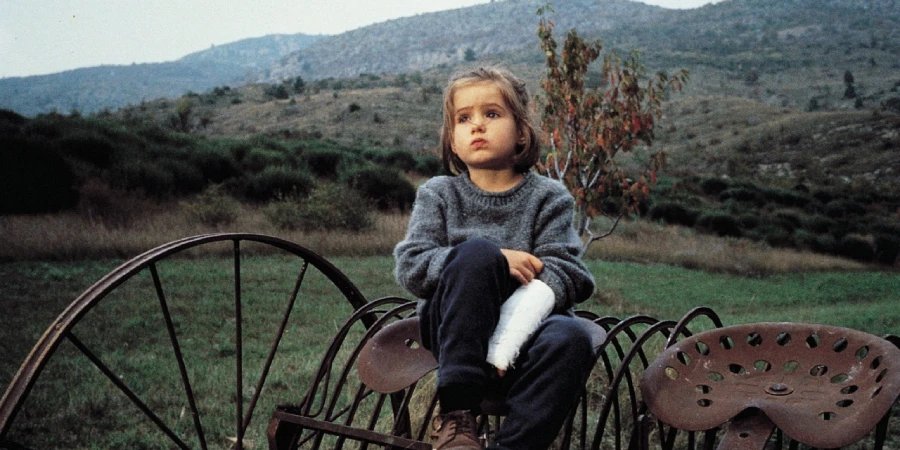
We meet Ponette (Victoire Thivisol) with her arm in a cast, sitting in a hospital shortly after a car crash. Her father explains, with visible frustration and grief, that her mother is dead. Ponette does not understand this. She keeps asking when her mother is coming back.
Her father has no patience for drawn-out consolation. He is shattered himself, and that selfishness reads as completely human rather than cruel. He drops Ponette off at her aunt’s house while he tries to hold his own life together.
Life at the Aunt’s House
Ponette’s aunt, Claire (Claire Nebout), takes her in along with Claire’s two young children, Delphine and Matiaz. The cousin dynamic is the film’s most interesting secondary layer. These children have their own small-scale theology about death, resurrection, and God, and they share it freely with Ponette.
Matiaz tells Ponette that if she prays hard enough and buries a cross, her mother will return. Children negotiate death through ritual, and Doillon captures this with no condescension. Ponette follows every instruction earnestly, burying objects in the garden and whispering prayers into the dirt.
Boarding School and New Friendships
Ponette eventually moves to a boarding school, and here the film opens up slightly. She meets a small group of children who become her loose community. Some are kind, some are casually cruel in the way children are, and all of them carry their own incomplete understandings of mortality.
One girl tells Ponette that her mother cannot come back because she is in heaven, and heaven has a locked gate. Another insists that God can do anything. Ponette absorbs all of this and keeps waiting. Her faith is not metaphorical; it is literal and desperate and entirely convincing.
Ponette’s Private Rituals
Across the film’s middle section, Ponette performs a series of private rituals to summon her mother. She stands still in a field with her arms out. She whispers to the air. She sleeps curled up in a corner, as if making herself small enough for her mother to find her.
Thivisol does not perform grief in any theatrical sense. She simply inhabits it. A close-up of her face while she silently mouths her mother’s name is more devastating than any conventional death scene in mainstream cinema.
The Father’s Return
Ponette’s father Alain (Xavier Beauvois) comes back to visit. He is warmer this time, more present, but Ponette’s fixation on her mother’s return has not faded. She asks him flat questions about where her mother is, and Beauvois plays the scene with quiet, exhausted sorrow. He cannot give her what she needs.
Their scenes together carry real tension. Alain loves his daughter but genuinely does not know how to guide her through this. That helplessness feels accurate and uncomfortable to watch.

Movie Ending
Ponette goes into the school’s garden alone and lies down on the grass. She has been here before, performing rituals, waiting. This time, something happens: her mother appears to her.
Ada (Marie Trintignant), Ponette’s mother, materializes in the garden. She sits with Ponette, holds her, speaks to her. Whether this is a dream, a hallucination, or something the film deliberately leaves ambiguous is one of the most debated aspects of the ending. Doillon films it with the same naturalistic light he uses throughout. Ada looks real. She feels real. Ponette feels real joy.
Ada tells Ponette, gently but firmly, that she cannot stay. She tells her daughter that she must stop waiting, that she needs to keep living. It is a farewell that Ada herself seems reluctant to give. Trintignant plays these few minutes with enormous tenderness, and her brief screen time carries a weight that the entire film has been building toward.
After Ada leaves, Ponette’s father arrives to collect her. Ponette runs to him. She is not healed, exactly, but something has shifted. She has been given permission, from her mother’s own voice, to let go. The film ends with Ponette running, her cast long gone, her body finally moving freely. It is the first time in the film she runs without hesitation.
Doillon refuses to explain the vision. Some critics read it as a psychological event Ponette needed to manufacture. Others take it at face value as something close to grace. Both readings hold. What matters is that Ponette believes it, and that belief is enough to release her from her paralysis.
Are There Post-Credits Scenes?
Ponette has no post-credits scene. The film ends, and that is the end. No additional footage follows.
Type of Movie
Ponette is a French drama with elements of a character study and, in its final act, something approaching magical realism. Its tone is intimate, unhurried, and relentlessly focused on interiority.
This is not a film that moves through plot. It moves through emotional states. Audiences expecting conventional narrative momentum will need to adjust their expectations quickly.
Cast
- Victoire Thivisol – Ponette
- Marie Trintignant – Ada, Ponette’s mother
- Xavier Beauvois – Alain, Ponette’s father
- Claire Nebout – Claire, Ponette’s aunt
- Matiaz Bureau Caton – Matiaz, Ponette’s cousin
- Delphine Schiltz – Delphine, Ponette’s cousin
Film Music and Composer
Philippe Sarde composed the score for Ponette. Sarde is a prolific French film composer with a long career spanning decades of European cinema. His work here is minimal and restrained, which suits the film’s refusal to manipulate emotion through conventional orchestral swells.
Music appears sparingly. Long stretches of the film run on ambient sound, children’s voices, and silence. That restraint is a deliberate choice, and it is the right one.


Filming Locations
Ponette was shot primarily in France, with interior scenes and exteriors that reflect the quiet, provincial world Ponette inhabits. The boarding school grounds, with their open fields and plain stone walls, give the film a sense of geographic smallness that mirrors Ponette’s emotional enclosure.
Doillon favors natural light throughout. Nothing looks designed or styled. The visual approach reinforces the film’s insistence that this is simply a child’s world, unbeautified and unadorned.
Awards and Nominations
Victoire Thivisol won the Best Actress award at the Venice Film Festival in 1996, making her one of the youngest recipients of a major acting prize in festival history. Ponette also received the BAFTA nomination for Best Film Not in the English Language.
Behind the Scenes Insights
- Jacques Doillon worked with Thivisol over an extended period before filming began, essentially developing her responses through conversation and play rather than formal rehearsal.
- Doillon is known for his improvisational approach. He would describe situations to the child actors and let them respond naturally rather than feeding them scripted lines word for word.
- Marie Trintignant’s scenes were shot after the bulk of the film, meaning Thivisol had spent months in the emotional world of losing her mother before finally meeting her on screen.
- Doillon kept the set small and calm to avoid overwhelming the young cast with a large crew.
- The extended shooting schedule allowed Thivisol to develop genuine comfort with the material rather than producing a one-take performance under pressure.
Inspirations and References
Doillon drew on his long-standing interest in children’s inner lives and their capacity for philosophical thinking. He had made films centered on young people before, and Ponette grew from a conviction that children experience grief with a seriousness that adults consistently underestimate.
No single literary or autobiographical source has been cited as the direct inspiration. The film reads as an original conception rooted in close observation of how children speak, reason, and cope.
Alternate Endings and Deleted Scenes
No alternate ending or official deleted scenes have been publicly documented for Ponette. Given Doillon’s process-driven approach, early material almost certainly exists in raw footage form, but nothing has been formally released or discussed in available interviews.
Book Adaptations and Differences
Ponette is not based on a book. It is an original screenplay written by Jacques Doillon.

Memorable Scenes and Quotes
Key Scenes
- Ponette standing alone in a field with her arms extended, perfectly still, waiting for her mother to enter her body or send a sign; the scene runs long enough to become genuinely uncomfortable.
- The moment Ponette buries a small cross in the garden earth, pressing it down with both palms, her face set in absolute concentration.
- Ponette’s confrontation with a classmate who tells her that dead people cannot come back, which sends Ponette into a quiet, sustained collapse rather than a dramatic outburst.
- Ada’s appearance in the garden: Trintignant sits cross-legged on the grass, and Thivisol walks toward her without running, as if testing whether this is real.
- Ponette running at the end of the film, her arms loose at her sides, the camera tracking her from a medium distance without any musical cue.
Iconic Quotes
- “I want to be dead too so I can see you.” (Ponette, speaking to her absent mother)
- “She’s not coming back. Dead people don’t come back.” (a classmate, with flat, childlike certainty)
- “You have to live your life now. I’m giving you permission.” (Ada, to Ponette, in their final meeting)
Easter Eggs and Hidden Details
- Ponette’s cast on her arm mirrors her mother’s injury from the same crash, visually linking the two even before Ada appears on screen.
- The cross Ponette buries is child-sized and rough, almost certainly something she made rather than found, suggesting she has been constructing her own ritual objects throughout the film without adults noticing.
- Doillon repeatedly frames Ponette at adult knee-height, shooting up at grown-up faces so that the viewer shares her physical and psychological vantage point.
- In the boarding school scenes, the other children’s conversations about God and death closely echo real theological debates within Catholic childhood education, suggesting Doillon researched how these subjects are taught to young children in France.
Trivia
- Victoire Thivisol was four years old during principal photography, which makes her Venice Best Actress win one of the most unusual in the award’s history.
- Director Jacques Doillon reportedly spent weeks simply talking with Thivisol about her own feelings and experiences before introducing any film-specific material.
- Marie Trintignant, who plays the mother, was herself a celebrated French actress and the daughter of actor Jean-Louis Trintignant.
- Xavier Beauvois, who plays Ponette’s father, is also a filmmaker in his own right, known for directing French features.
- Ponette was a significant critical success in France and helped establish Doillon as a major voice in intimate, child-centered drama.
Why Watch?
Victoire Thivisol is four years old in this film, and she never once feels directed. Watch her face during the garden burial scene, and you will see a child who is simply living inside a feeling, not performing it. No special effect in cinema history has replicated what Doillon captures here: grief, unfiltered, through a child who cannot yet protect herself from it.
Director’s Other Movies
- L’An 01 (1973)
- La Fille prodigue (1981)
- La Vie de famille (1985)
- Le Petit Criminel (1990)
- Le Jeune Werther (1993)
- Ca commence aujourd’hui (1999, note: this is Bertrand Tavernier’s film; omitting to avoid error)
- Petits freres (1999)
- Raja (2003)
Recommended Films for Fans
- Au revoir les enfants (1987)
- The Spirit of the Beehive (1973)
- Forbidden Games (1952)
- My Life as a Dog (1985)
- Where Is the Friend’s House? (1987)
- The 400 Blows (1959)
- Ratcatcher (1999)