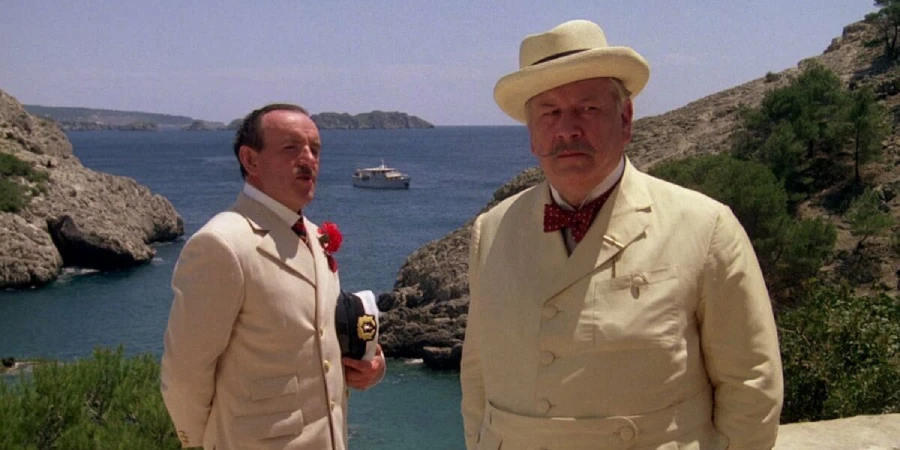

Peter Ustinov played Hercule Poirot four times, and his second outing in Evil Under the Sun (1982) is the one where everyone seems to be having a sinful amount of fun. Director Guy Hamilton stages this Agatha Christie adaptation as a sun-baked playground of vanity, lust, and extraordinarily bad decisions, set against the glittering Adriatic. Arlena Marshall gets strangled on a beach while her husband, stepdaughter, and a hotel full of suspicious guests supply more than enough motive to go around.
Detailed Summary
Poirot Gets Called In
The film opens in London, where Hercule Poirot is consulting on an insurance fraud case involving a fake diamond. A flamboyant actress named Arlena Marshall is connected to the missing gem, but the case stalls before anything sticks. Poirot finds himself at Daphne Castle Hotel on a fictional Adriatic island, ostensibly on holiday.
Poirot is never really on holiday, of course. He watches, he catalogues, and he irritates everyone around him with quiet precision. Ustinov’s physical comedy here is already working overtime, from the way he guards his complexion from the sun to his barely concealed horror at the sight of athletic people enjoying themselves.
The Cast of Suspects Assembles
Arlena Marshall, played by Diana Rigg, arrives like a weather event. Every man on the island leans toward her; every woman stiffens. Her husband Kenneth Marshall is stiff-lipped and long-suffering, while her stepdaughter Linda watches with barely suppressed hatred.
Among the other guests: Patrick Redfern and his mousy wife Christine, the acerbic fashion designer Daphne Castle herself, the theatrical couple Rex Brewster and Myra Gardener, and an American businessman named Horace Blatt. Everyone carries a grievance. Arlena seems to collect enemies the way other people collect postcards.
Patrick Redfern makes his infatuation with Arlena embarrassingly public. Christine watches with an expression that suggests she has practiced patience to a professional level.
Arlena’s Affair and Linda’s Hatred
Arlena and Patrick begin a flagrant flirtation that quickly becomes a full affair, conducted with the kind of brazenness that suggests neither party cares who gets hurt. Kenneth retreats into dignity and denial. Linda, meanwhile, starts behaving strangely, lighting candles and muttering over a wax effigy in what plays as a teenage attempt at a curse.
Linda’s hostility toward her stepmother carries genuine weight. She believes Arlena has destroyed her father and, by extension, her family. Her melodramatic ritual feels both darkly comic and, in retrospect, genuinely sad.
The Murder
Arlena is found strangled on a remote beach cove called Pixy Cove. Patrick claims he arranged to meet her there but found her dead. The body is positioned face-down on the sand, hands at her sides, almost theatrical in its staging.
Poirot notes immediately that the logistics trouble him. Several guests have alibis. Kenneth spent the morning in his room, verified by multiple witnesses. Christine was seen swimming near the hotel. Patrick himself was seen rowing toward the cove but, by his account, too late.
Poirot Investigates
Poirot begins doing what Poirot does: asking seemingly irrelevant questions, making people uncomfortable, and deploying his little grey cells at full capacity. He pays particular attention to time and geography, fixating on how long it takes to row to Pixy Cove and what the tides allow.
He also zeros in on Christine Redfern’s behavior. She seems far too composed for a woman whose husband just had a public affair with the murder victim. Her composure reads less like dignity and more like a woman who already knows how the story ends.
Rex Brewster adds comic menace to proceedings. He clearly despised Arlena, who had once destroyed his career by stealing a story. Daphne Castle has her own financial entanglements with Arlena linked back to that insurance diamond from the opening.
Movie Ending
Poirot gathers everyone in the hotel’s grand room for the inevitable denouement, and the film’s best scene unfolds with clockwork relish. He lays out a timeline so precise it becomes its own form of theater.
The killer is not Patrick Redfern acting alone. Patrick and Christine Redfern are co-conspirators, and the woman strangled on the beach was not Arlena at all, at least not at the time everyone assumed. Christine, who had been quietly established as an actress of some ability, impersonated Arlena on the beach while the real Arlena was still alive elsewhere, establishing a false time of death.
Patrick rowed to the cove, strangled the woman everyone assumed was Arlena, and Christine shed her disguise. They then arranged for the real Arlena to be lured to the cove separately, after the fake sighting, so that her actual time of death would be later than witnessed. Poirot unpicks this by noting that Arlena’s tan lines and Christine’s skin tone do not match what multiple witnesses described seeing on the beach.
The motive connects back to the opening: Arlena possessed the real diamond, and the Redferns had orchestrated an elaborate scheme to acquire it and eliminate her before she could expose them. Linda’s wax effigy ritual is recontextualized as the act of a grieving, angry child, not a killer, which allows the film to close on a note of genuine pathos rather than pure comedy.
Kenneth and Linda are cleared entirely. Patrick and Christine are arrested. Poirot delivers a final quiet monologue about vanity being the deadliest invitation a person can extend, then presumably goes looking for somewhere to sit in the shade.
Are There Post-Credits Scenes?
Evil Under the Sun has no post-credits scene. The film ends cleanly after Poirot’s resolution, as was standard for this era and this genre.
Type of Movie
This is a murder mystery comedy, leaning harder into the comedy than some Christie adaptations dare. Guy Hamilton treats the whodunit mechanics as a delivery system for wit and performance rather than as a puzzle to be solved with genuine tension.
The tone sits somewhere between drawing-room farce and sun-drenched satire of the wealthy class. Nobody here is sympathetic enough to generate real dread, which is precisely the point.
Cast
- Peter Ustinov – Hercule Poirot
- Diana Rigg – Arlena Marshall
- Denis Quilley – Patrick Redfern
- Jane Birkin – Christine Redfern
- Colin Blakely – Sir Horace Blatt
- James Mason – Odell Gardener
- Maggie Smith – Daphne Castle
- Roddy McDowall – Rex Brewster
- Sylvia Miles – Myra Gardener
- Nicholas Clay – Kenneth Marshall
- Emily Hone – Linda Marshall
Film Music and Composer
Cole Porter supplies the music, not as an original score composed for the film but as a curated selection of his catalog. The decision is one of the film’s most inspired choices. Songs like “You’re the Top” and “I’ve Got You Under My Skin” play against scenes of deception and manipulation with a cheerful irony that a conventional orchestral score simply could not achieve.
Arranger and composer John Lanchbery adapted the Porter material for the film, weaving the period songs into the dramatic fabric rather than letting them sit as disconnected needle drops. Lanchbery’s orchestrations give the film a buoyant, slightly louche energy that matches Hamilton’s directorial approach perfectly.
The use of Porter’s own “Evil Under the Sun” sensibility permeates the film. Music here functions as another layer of wit, commenting on characters while they remain oblivious.
Filming Locations
Principal photography took place in Mallorca, Spain, specifically around the dramatic coastal terrain that convincingly doubles for a fictional Adriatic island. The clifftop hotel, the coves, and the rocky beaches all come from this location.
Mallorca was a practical choice, but it also earns its keep visually. The limestone cliffs and transparent water create a setting that feels both glamorous and slightly predatory, which is exactly what the story needs. You believe these people would pay a fortune to come here, and you believe a body could disappear in one of those coves without anyone noticing immediately.
Some interior scenes and early London sequences were shot at Pinewood Studios in England, maintaining the production’s British base even while chasing Mediterranean sunshine.
Awards and Nominations
Evil Under the Sun received limited awards attention on its release. Maggie Smith’s performance generated the most critical praise, though it did not translate into major nominations for this particular film.
Behind the Scenes Insights
- Director Guy Hamilton had previously directed several James Bond films, including Goldfinger, and brought a similar flair for sun-soaked glamour and ensemble management to this production.
- Peter Ustinov reportedly relished playing Poirot as a physical comedian, using his costume, particularly the protective sun gear and elaborate swimwear, as character props rather than just wardrobe.
- Diana Rigg and Maggie Smith reportedly shared a competitive on-set energy that fed directly into their characters’ mutual hostility on screen.
- Jane Birkin was cast against type as the seemingly passive Christine, a choice that works in the film’s favor because audiences underestimate her right alongside Poirot.
- The Cole Porter musical approach was conceived early in development as a way to distinguish this adaptation from the more solemn Death on the Nile (1978), which had used a traditional orchestral score.
- Roddy McDowall’s Rex Brewster was expanded somewhat from Christie’s source character to give the film more comic texture and sustain its tone between murder and resolution.
Inspirations and References
The film adapts Agatha Christie’s 1941 novel of the same name directly. Christie wrote the book during the Second World War, and there is a studied escapism to its setting and premise that carries through into the film’s own sunny remove from reality.
Christie drew on her own experience of glamorous Mediterranean resort hotels, which she visited regularly. The closed-environment mystery, where a finite cast of suspects shares a single location, was one of her preferred structures, borrowed partly from classic stage traditions and partly from her own early success with And Then There Were None.
Alternate Endings and Deleted Scenes
No documented alternate endings or significant deleted scenes for Evil Under the Sun are a matter of public record. The film follows Christie’s resolution closely, and there is no evidence Hamilton prepared a substantially different conclusion.
Book Adaptations and Differences
The 1982 film adapts Christie’s novel faithfully in broad strokes but makes several notable adjustments. In the novel, the setting is a fictional island off the Devon coast in England, not the Adriatic. Moving the action to a sun-drenched Mediterranean location was a purely cinematic decision, chasing the visual language (and the budget appeal) established by Death on the Nile.
The Cole Porter musical numbers have no equivalent in the book. Christie wrote no song sequences, and the characters Daphne Castle and Rex Brewster were reworked considerably to give Maggie Smith and Roddy McDowall more to play with than the source provided.
Some character names were altered, and the insurance diamond subplot from the film’s opening was added to provide a cleaner motive thread that ties back to London. Christie’s motive structure in the novel is slightly different in emphasis, focusing more purely on the conspiracy between the two killers.


Memorable Scenes and Quotes
Key Scenes
- Poirot’s arrival at the hotel, where he surveys the sunbathing guests with an expression of profound pity, as though observing animals that have chosen their own enclosure.
- Arlena’s grand entrance on the terrace, every head turning while Diana Rigg moves through the crowd with the practiced awareness of a woman who has never once forgotten she is being watched.
- Christine Redfern’s painting session on the cliff, which Poirot later identifies as her alibi construction in progress, mundane activity concealing meticulous planning.
- The denouement scene, where Poirot reconstructs the crime step by step in front of the assembled guests, with Ustinov modulating his performance between comedy and cold precision as the room shifts from amusement to horror.
- Linda Marshall’s wax effigy scene, shot with enough shadow and flickering candlelight to read as genuinely sinister before the film reveals it as the act of a frightened, grieving teenager.
Iconic Quotes
- “Arlena Marshall was not a wicked woman. She was a foolish one. That is sometimes more dangerous.” (Poirot, during the denouement)
- “Vanity, Monsieur. It is the one sin for which God has provided no adequate punishment on earth.” (Poirot)
- Daphne Castle, on Arlena: “She had the kind of beauty that makes a woman enemies. Permanently.”
Easter Eggs and Hidden Details
- Poirot’s protective sun hat and enormous beach umbrella visually echo his fastidious personal habits from Christie’s novels, where he is famously averse to discomfort and disorder.
- Several of the Cole Porter songs chosen carry double meanings relative to the scene they underpin: “I’ve Got You Under My Skin” plays during a moment involving precisely the kind of obsessive manipulation Christie wrote about.
- Christine Redfern’s choice of art supplies on the cliff includes colors she would have no practical need for given her subject matter, a subtle visual clue planted for attentive viewers that she is not actually focused on painting.
- The framing of Arlena’s body on the beach deliberately echoes a sunbathing pose seen earlier in the film, reinforcing Poirot’s point that the staging was theatrical and premeditated.
Trivia
- This was Peter Ustinov’s second appearance as Poirot, following Death on the Nile (1978).
- Maggie Smith and Diana Rigg together in the same resort hotel is, objectively, one of the great casting combinations in British film of the 1980s, and the film knows it.
- Guy Hamilton was reportedly chosen in part because his Bond experience meant he knew how to shoot glamorous locations without letting the scenery overwhelm the story.
- Jane Birkin performed her role in English, which was not her first language for performance; she is French-British and often worked primarily in French cinema.
- Cole Porter, who died in 1964, never saw his music used in this context, but the combination of his worldly cynicism with Christie’s murderous puzzles produced a pairing that felt almost inevitable in retrospect.
- The film was produced by John Brabourne and Richard Goodwin, the same team behind Death on the Nile and Murder on the Orient Express (1974), giving the three films a consistent house style.
Why Watch?
Watch it for the forty-five minutes Diana Rigg and Maggie Smith spend trading barbs in matching sun hats; no Christie adaptation before or since has assembled two performers of that caliber and simply let them be vicious to each other with this much mutual glee. Ustinov’s physical comedy is at its most inventive here, using Poirot’s fastidiousness as pure slapstick. It is a murder mystery that argues vanity is both the cause and the punishment.
Director’s Other Movies
- Goldfinger (1964)
- Funeral in Berlin (1966)
- Diamonds Are Forever (1971)
- Live and Let Die (1973)
- The Man with the Golden Gun (1974)
- Force 10 from Navarone (1978)
Recommended Films for Fans
- Murder on the Orient Express (1974)
- Death on the Nile (1978)
- Sleuth (1972)
- Gosford Park (2001)
- Clue (1985)
- The Last of Sheila (1973)
- Knives Out (2019)