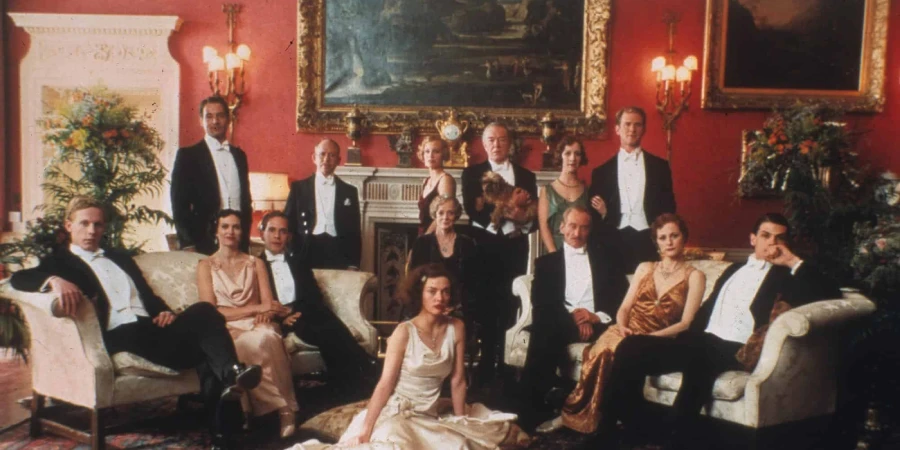

Every murder mystery needs a body, but Gosford Park waits almost ninety minutes to provide one, and that patience is exactly the point. Robert Altman packs a 1930s English country house with thirty-odd characters, upstairs and downstairs, and lets them breathe, bicker, and betray each other long before anyone reaches for a weapon. What you get is less a whodunit and more a forensic study of the British class system, where the real crime is the way the wealthy treat the people who make their lives possible. Maggie Smith delivers a cutting line about “the gift of being a good employer,” and the film never lets you forget the bitterness beneath that joke.
Detailed Summary
Arrivals at Gosford Park
On a wet November weekend in 1932, a convoy of cars descends on Gosford Park, the country estate of Sir William McCordle. Guests arrive for a shooting party: the imperious Constance, Countess of Trentham (Maggie Smith), her niece Isobel, the Scottish industrialist Lord Kilminster, the film producer Morris Weissman (Bob Balaban), and a collection of minor aristocrats with major financial anxieties.
Each guest brings a servant. Those servants file downstairs to a parallel world, mirroring the hierarchy above them with remarkable precision. Head butler Jennings (Alan Bates) runs the lower half of the house with the same rigid formality that Sir William McCordle (Michael Gambon) rules the upper half.
The Social Machinery Below Stairs
Altman’s camera drifts between both worlds without fanfare. Below stairs, we meet Mrs. Wilson (Helen Mirren), the head housekeeper, and Mrs. Croft (Eileen Atkins), the cook. A frostiness exists between these two women that nobody can fully explain, and the film deliberately delays that explanation.
New parlour maid Mary Maceachran (Kelly Macdonald) arrives as our audience surrogate. She observes everything, understands little at first, and asks the questions we would ask. Her wide-eyed perspective gives us a way into a world governed by rules she was never taught.
Weissman, Novello, and the Upstairs Charade
Morris Weissman brought along his valet, Henry Denton (Ryan Phillippe), who is not actually a valet. Weissman also invited Ivor Novello (Jeremy Northam), the real-life actor and songwriter, partly as entertainment and partly to squeeze information for a Charlie Chan film he is producing. Novello eventually sits at the piano and plays, and those scenes are the warmest in the film.
Northam’s Novello is the most generous presence in the house, a man who exists across class lines without much discomfort. Watching the servants quietly gather at the edges of the hallway to listen to him play feels genuinely moving without Altman ever underlining it.
Sir William’s Secret and the Motive Factory
Sir William McCordle is not a pleasant man. He controls several relatives financially, including Lady Trentham, whose annuity he threatens to cut. Gambon plays him as a man who enjoys the leverage more than the money, a cold bully who mistakes ownership for affection.
Gradually, the film reveals that multiple guests have reason to want William dead. His wife, Lady Sylvia (Kristin Scott Thomas), is having an affair. His sister-in-law Louisa (Geraldine Somerville) has a history with him. Even Weissman’s valet turns out to be an undercover journalist.
The Murder
Late at night, someone stabs Sir William in the library. Except he was already dying. A second party had poisoned him first, meaning two people independently decided on the same night to kill the same man. Inspector Thompson (Stephen Fry) arrives to investigate and immediately demonstrates a spectacular talent for missing the point.
Thompson is played as a bumbling, socially intimidated figure who is far more concerned with impressing the aristocrats than solving the crime. Fry’s performance is sharp comic work, and his Inspector exists to show how completely the class system can paralyze even official authority.
The Revelation Below Stairs
Mary, increasingly curious, pieces together the truth. Mrs. Wilson poisoned William. She had a reason nobody else knew: decades earlier, as a young woman named Elsie, she had a child by William McCordle. He forced her to give the baby up. That child grew up to be Robert Parks (Clive Owen), who arrived at the house as a valet specifically to kill his father.
Parks did stab William, but by that point the poison had already done its work. Mrs. Wilson knew Parks was her son and knew why he came. She poisoned William first precisely so that Parks would not have to carry the guilt of being a murderer.

Movie Ending
Mary confronts Mrs. Wilson and states plainly that she knows what happened. Mrs. Wilson neither denies it nor collapses into confession. Helen Mirren plays the scene with a stillness that reads as both grief and relief, a woman who spent thirty years waiting to do one thing and did it.
Mary chooses not to tell Inspector Thompson. She has spent the entire film watching the wealthy treat servants as furniture, and her silence is a form of judgment. She does not protect Mrs. Wilson out of sentiment; she refuses to hand a killer to a system that created the conditions for the killing.
Parks leaves without knowing his mother’s full role in events. Mrs. Wilson stays at Gosford Park. Lady Trentham departs in her car, still acidic, still dependent, her annuity now presumably secured now that William is dead. Life above stairs continues with minimal disruption, which is exactly Altman’s point.
No justice arrives. No punishment falls. The murder investigation produces nothing because Inspector Thompson lacks either the skill or the courage to press the people who actually matter. Mary drives away, and the film ends on that quiet, unsentimental refusal to offer resolution.
Are There Post-Credits Scenes?
Gosford Park has no post-credits scenes. The film ends, the credits roll, and that is that. Given the film’s commitment to withholding easy satisfaction, this feels entirely appropriate.
Type of Movie
Gosford Park is a murder mystery in structure and a social satire in spirit. It belongs to the country house mystery tradition but dismantles the genre’s usual pleasures as it goes. Altman is far less interested in who did it than in why the conditions existed for the crime to happen.
Tonally, the film balances dry comedy, slow-burn drama, and genuine melancholy. It never tips into farce, even when Stephen Fry’s Inspector Thompson threatens to take it there. Call it a satirical drama with a murder mystery chassis.
Cast
- Maggie Smith – Constance, Countess of Trentham
- Michael Gambon – Sir William McCordle
- Kristin Scott Thomas – Lady Sylvia McCordle
- Eileen Atkins – Mrs. Croft
- Helen Mirren – Mrs. Wilson
- Clive Owen – Robert Parks
- Kelly Macdonald – Mary Maceachran
- Jeremy Northam – Ivor Novello
- Ryan Phillippe – Henry Denton
- Bob Balaban – Morris Weissman
- Stephen Fry – Inspector Thompson
- Emily Watson – Elsie
- Derek Jacobi – Probert (Sylvia’s butler)
- Charles Dance – Lord Stockbridge
- Tom Hollander – Anthony Meredith
- Geraldine Somerville – Louisa, Lady Stockbridge
- Natasha Wightman – Lavinia, Lady Meredith
- James Wilby – Freddie Nesbitt
- Sophie Thompson – Dorothy Nesbitt
- Richard E. Grant – George, Weissman’s valet
Film Music and Composer
Patrick Doyle composed the score for Gosford Park. Doyle is a Scottish composer with a long collaboration history with Kenneth Branagh, and his work here is restrained by design. Altman never wanted the music to do emotional heavy lifting.
Much of what you hear in the film is diegetic, meaning it comes from within the world of the story. Jeremy Northam’s Ivor Novello performs actual songs associated with the real Novello at the piano, and those performances carry more emotional weight than any underscoring could manage.
Doyle’s original score sits quietly beneath key scenes without announcing itself. For a film this crowded and busy, the musical restraint is a smart choice. It lets the dialogue and the performances do the work.

Filming Locations
Production designer Stephen Altman (Robert’s son) built and dressed several key sets, but the production also used real English country houses. Wrotham Park in Hertfordshire served as the exterior of Gosford Park. Its grand Palladian facade gave the film exactly the kind of imposing, slightly chilly grandeur the story required.
Interior scenes used a combination of Wrotham Park’s actual rooms and purpose-built sets at Shepperton Studios. Using real locations for exteriors and controlled sets for interiors gave the crew the flexibility Altman needed for his multi-camera, overlapping-dialogue approach.
The choice of real English locations matters thematically. These houses existed. The class dynamics the film depicts were real. Shooting in and around authentic architecture gives the satire a grounding it would lack on a purely fabricated set.
Awards and Nominations
Gosford Park received seven Academy Award nominations, winning one: Best Original Screenplay for Julian Fellowes. That win launched Fellowes toward a career that eventually produced Downton Abbey, which owes this film a significant debt.
Robert Altman received a BAFTA nomination for Best Direction, and the film collected multiple BAFTA nominations including Best Film. Helen Mirren and Maggie Smith both received recognition from various critics’ circles for their performances.
Behind the Scenes Insights
- Robert Altman used multiple cameras simultaneously, which allowed actors to improvise and react naturally rather than hitting precise marks for a single lens.
- Many cast members did not know the full plot before filming began. Altman deliberately withheld information to keep reactions genuine.
- The upstairs and downstairs cast members were kept somewhat separate during production, reinforcing the social division the film depicts.
- Julian Fellowes wrote the screenplay based on an idea by Altman and producer Bob Balaban. Fellowes drew on his own background in British aristocratic society.
- Ryan Phillippe, an American, had to master not just an English accent but the specific physical comportment of a servant, which required considerable preparation.
- Helen Mirren has said that Mrs. Wilson was one of the most challenging roles of her career because the character reveals so little while feeling so much.
- Altman encouraged actors to invent backstories for their characters that the screenplay never explicitly states.
- The overlapping dialogue that Altman favored meant that in many scenes, multiple conversations occur simultaneously and only become fully clear on repeated viewings.
Inspirations and References
Robert Altman cited the country house murder mystery tradition as both an inspiration and a target. Agatha Christie’s work looms over the film as something to be affectionately subverted. Christie’s genre gave audiences the comfort of solutions; Altman strips that comfort away.
Julian Fellowes drew on his firsthand knowledge of the British aristocracy and its domestic rituals. His screenplay reflects genuine familiarity with the protocols, hierarchies, and unspoken codes of country house life in the interwar period.
The real Ivor Novello was a major figure in British entertainment in the 1920s and 1930s, and his inclusion grounds the film in actual cultural history. Altman used Novello as a way to show how celebrity could briefly dissolve class barriers without actually threatening them.
Alternate Endings and Deleted Scenes
No officially released alternate ending exists for Gosford Park. Altman was not a filmmaker who typically prepared multiple endings for test audiences, and the film’s conclusion reflects his creative vision without recorded alternatives.
Given the multi-camera approach and the sheer volume of overlapping action that Altman shot, a significant amount of material was filmed that did not make the final cut. Several subplots that appear underdeveloped in the finished film, particularly those involving minor guests upstairs, likely had more screen time in earlier cuts.
Book Adaptations and Differences
Gosford Park is not based on a book. Julian Fellowes wrote an original screenplay from a story concept developed with Altman and Balaban. No source novel exists to compare it against.

Memorable Scenes and Quotes
Key Scenes
- Ivor Novello sits at the piano after dinner and begins playing. Servants drift silently to doorways and the edges of the room. Nobody asks them to leave. Altman holds on their faces while Northam sings, and for a few minutes the house feels almost human.
- Mrs. Wilson and Mrs. Croft sit across a table and exchange clipped, loaded sentences. Eileen Atkins and Helen Mirren play a scene of extraordinary suppressed fury, and the camera barely moves. Everything happens in the pauses between words.
- Mary watches Mrs. Wilson prepare something in the kitchen late at night. She does not understand what she is seeing yet, but Kelly Macdonald’s face carries the film’s central mystery in real time.
- Inspector Thompson interviews the household, visibly more nervous than anyone he is questioning. Stephen Fry lets the character’s inadequacy show through small physical flinches and over-eager smiles.
- The scene where Mrs. Wilson tells Mary, without stating it directly, what she did and why. Mirren sits very still. Her hands rest flat on the table. She speaks quietly and precisely, and it is devastating.
Iconic Quotes
- “I’m the perfect guest. I never say what I think.” – Constance, Countess of Trentham
- “What gift? I ask myself. The gift of a good employer. That’s all.” – Constance
- “I know things. That’s my job.” – Mrs. Wilson
- “Every perfect murder requires a motive.” – Inspector Thompson (paraphrased)
Easter Eggs and Hidden Details
- The film’s mirroring structure is deliberate: nearly every upstairs character has a downstairs equivalent who reflects or inverts their traits. Altman and Fellowes built this in from the screenplay stage.
- Henry Denton’s fake valet identity is subtly telegraphed early: he holds silverware awkwardly, hesitates at doors, and takes direction from other servants in a way a trained valet would never need.
- Mrs. Croft and Mrs. Wilson’s shared history gets hinted at through a very early shot where Mrs. Croft reacts to Mrs. Wilson’s name before they have formally interacted on screen.
- The shot of rain-soaked cars arriving at the start establishes social rank through vehicle quality long before any character speaks a word.
- Ivor Novello’s songs are period-accurate and were associated with the real Novello, adding a layer of historical texture that rewards anyone familiar with the era.
Trivia
- Julian Fellowes used the experience of writing this screenplay as direct research for creating Downton Abbey, which premiered in 2010.
- Robert Altman received an honorary Academy Award in 2006, and Gosford Park is frequently cited as one of his final great works.
- Bob Balaban, who plays the Hollywood producer Morris Weissman, also served as a producer on the film. His character is essentially a wry self-portrait of an outsider trying to decode British social behavior.
- The film features one of the largest ensembles Altman ever assembled, and he gave each actor enough personal history for their character to feel like a protagonist of their own untold story.
- Clive Owen prepared for the role of Parks by researching the emotional psychology of people who discover they were given up for adoption, bringing a specific internal logic to a character with very little dialogue.
- Stephen Fry based his performance of Inspector Thompson partly on the British social instinct to prioritize politeness over competence in uncomfortable situations.
Why Watch?
Helen Mirren’s final scene, sitting at that table with her hands flat and her voice perfectly level, is reason enough. She plays a woman who committed murder as an act of maternal love, and Altman frames it with zero melodrama, which makes it hit much harder than any scored-up revelation would. If you care about what great screen acting actually looks like, this film shows it repeatedly and without apology.
Director’s Other Movies
- M*A*S*H (1970)
- McCabe and Mrs. Miller (1971)
- Nashville (1975)
- The Player (1992)
- Short Cuts (1993)
- Prêt-à-Porter (1994)
- Kansas City (1996)
- Cookie’s Fortune (1999)
- The Company (2003)
- A Prairie Home Companion (2006)
Recommended Films for Fans
- The Rules of the Game (1939)
- Downton Abbey (2019)
- Clue (1985)
- Nashville (1975)
- Knives Out (2019)
- The Remains of the Day (1993)