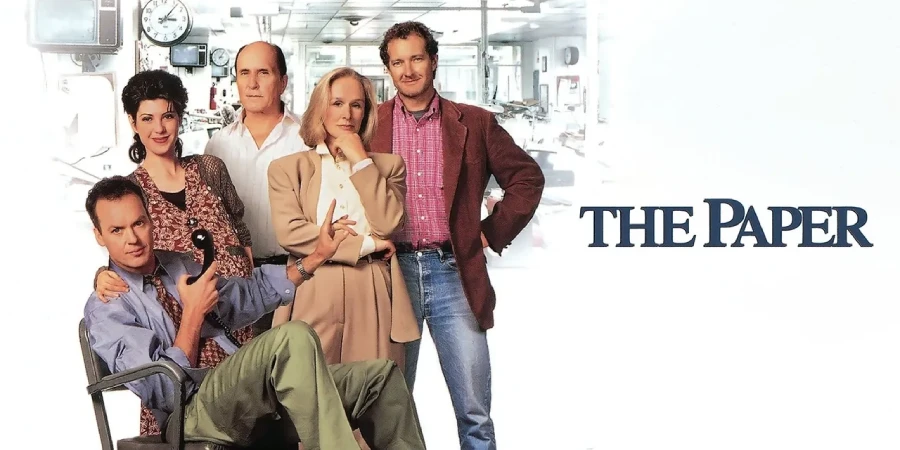

Ron Howard made a newspaper comedy in 1994 that nobody really talks about anymore, and that is a genuine shame. The Paper crams an entire moral crisis, a crumbling marriage, a corporate power struggle, and a fistfight in a hallway into a single frantic workday at a New York City tabloid. Michael Keaton plays a man too wired on coffee and adrenaline to notice his life falling apart around him. It is one of the sharpest workplace films of its decade.
Detailed Summary
Meet Henry Hackett, the Man Who Cannot Say No
Henry Hackett works as metro editor at The New York Sun, a scrappy tabloid that lives and dies by its front page. He is perpetually underpaid, perpetually stressed, and perpetually one bad day away from a nervous breakdown. His pregnant wife Martha, played by Marisa Tomei, is counting down the hours until he quits and takes a better-paying job at a more respectable paper.
That better job is a real possibility. A broadsheet called The Sentinel has offered Henry a position, and his interview with editor Alicia Clark kicks off the film’s first act. Henry clearly wants the money and stability. He just cannot bring himself to care about a paper that runs stories on zoning regulations.
The Story That Changes Everything
Two young Black men, Wilder and McCain, get arrested near the scene of a double murder involving two white businessmen. The Sun‘s city editor Graham Keighley smells something wrong about the arrest. Henry agrees. All signs point to a setup, and the pair start digging to prove the police arrested the wrong men.
Managing editor Alicia Clark, not to be confused with the broadsheet editor, controls the budget and wants a cheap, easy front page. She is played by Glenn Close with a cold precision that makes every scene she inhabits feel slightly dangerous. She wants to run the arrest story straight, naming the two young men as suspects.
Henry vs. Alicia: The Fight for the Front Page
Henry wants to hold the story and dig for the truth. Alicia wants to go to print and save money on overtime. Their conflict drives the entire second act of the film. This is not a subtle disagreement; it is a full organizational war fought through phone calls, hallway confrontations, and budget spreadsheets.
Howard stages their arguments with a real sense of institutional pressure. Alicia is not simply a villain. She has a newspaper to run and a bottom line to protect, and Close plays every one of those anxieties with visible tension in her jaw and shoulders.
The Sanders Thread
Veteran columnist Bernie White, played by Robert Duvall, runs a parallel storyline about mortality and regret. His doctor delivers some ominous news about his health. Bernie spends much of the film wandering through his own history, reconnecting with his estranged daughter, and filing columns that his editor may not even run.
Duvall brings a worn-in gravity to the role. Bernie feels like a man who chose the newspaper over everything else in his life and is only now calculating what that cost him. His scenes with his daughter carry a quiet ache that the faster-paced Hackett storyline cannot quite replicate.
Martha Reaches Her Breaking Point
Martha Hackett is nine months pregnant and has been patient long enough. Marisa Tomei plays her not as a nagging spouse but as an intelligent woman who understands exactly what she married and has finally decided to renegotiate the terms. She wants Henry at home. She wants a real conversation. She gets a pager number and a distracted wave.
Her subplot gives the film its emotional grounding. Without Martha, The Paper risks becoming pure workplace farce. Tomei earns every scene she gets, and her confrontation with Henry outside the newspaper offices lands harder than almost anything else in the film.
The Investigation Pays Off
Henry and Graham piece together enough evidence to strongly suggest the two arrested men had nothing to do with the murders. A source confirms the fix is in. Henry tries to reach Alicia to stop the presses. She refuses. She has already authorized the print run, and overtime costs are already mounting.
This is where the film shifts from office comedy to genuine moral drama. Running a false story that brands two innocent men as murder suspects is not just bad journalism. It could destroy lives. Henry knows this, and Keaton plays the desperation with a barely contained physical energy, pacing, grabbing phones, talking over everyone in the room.
The Hallway Fistfight
Henry physically tries to stop the presses. Alicia physically tries to stop Henry. They end up in a hallway brawl that is simultaneously absurd and completely earned by everything that came before it. Close throws a real punch, and Keaton takes it. The fight is sloppy and undignified in exactly the right way.
It is the best moment in the film, full stop. Two adults who have been conducting a civilized professional war all day finally drop the pretense. Howard lets the scene run without cutting away too quickly, and the result is both funny and genuinely unsettling.
Movie Ending
Henry stops the presses. He gets enough information confirmed to justify pulling the original headline and replacing it with the truth: the two young men are innocent, and the police made a bad arrest. The Sun scoops everyone, including the broadsheet that nearly hired Henry away from this circus.
Alicia, having lost the fight, watches the corrected paper go to print. Close plays this moment without a clean redemption arc. Alicia does not suddenly see the light. She absorbs the defeat, files it, and gets back to managing the paper she has always managed. It is a refreshingly unsentimental choice.
Martha goes into labor during the chaos. Henry rushes to the hospital and gets there in time, a detail the film treats as a close call rather than a guaranteed happy ending. Their son is born, and Henry holds him in the kind of exhausted relief that reads as something genuinely earned rather than a bow slapped on top of the plot.
Bernie White gets his column printed. His estranged daughter reads it. Whether that fixes anything between them is left open, which is exactly the right call. Howard does not oversell the reconciliation, and Duvall does not ask for it. Bernie simply did his job one more time and let the words do whatever they could.
Henry turns down the Sentinel job. He stays at The Sun. It pays badly, it nearly gave him a breakdown, and it will probably do the same thing again tomorrow. He stays because it is the only place where the work actually feels like it matters. That is the film’s argument, and it earns it.
Are There Post-Credits Scenes?
The Paper has no post-credits scenes. Howard wraps everything up before the credits begin, and there is nothing waiting on the other side of them.
Type of Movie
The Paper is a comedy-drama with strong thriller mechanics borrowed from the newsroom genre. Its pacing is relentless and its tone swings between sharp workplace satire and genuine emotional weight. It fits comfortably alongside films like Broadcast News and All the President’s Men in the tradition of American newspaper cinema.
Its humor is character-driven rather than situational. Nobody delivers jokes. People just talk at an accelerated, overlapping pace that generates comedy as a byproduct of stress.
Cast
- Michael Keaton – Henry Hackett
- Robert Duvall – Bernie White
- Glenn Close – Alicia Clark
- Marisa Tomei – Martha Hackett
- Randy Quaid – Michael McDougal
- Jason Robards – Graham Keighley
- Jason Alexander – Marion Sandusky
- Spalding Gray – Paul Bladden
- Catherine O’Hara – Susan
Film Music and Composer
Randy Newman composed the score for The Paper. His work here leans into the New York setting with brassy, slightly cynical orchestration that mirrors the tabloid world’s mix of hustle and showmanship. Newman’s scoring voice suits the film’s tonal oscillation between comedy and sincerity.
Newman was already a well-established film composer by 1994, with credits including The Natural and Awakenings. His score for The Paper does not try to overwhelm the performances. It underlines without underlining too hard, which is exactly the right instinct for a film this packed with dialogue.
Filming Locations
Principal photography took place in New York City. Howard and his crew shot on location throughout Manhattan, using real streets, real traffic, and real urban density to keep the film’s sense of chaos authentic. A fictional tabloid set in New York absolutely needs to feel like New York, and it does.
The newsroom itself was a production design built to feel lived-in rather than cinematic. Desks are cluttered. Lighting is fluorescent and unforgiving. The space looks like a place where people eat lunch at their keyboards and never quite go home.
Awards and Nominations
Marisa Tomei received a Golden Globe nomination for her performance as Martha Hackett. Randy Newman’s score also attracted recognition from various critics’ organizations. The Paper did not collect major awards hardware, which remains one of the quieter injustices in the film’s reception history.
Behind the Scenes Insights
- Ron Howard reportedly spent considerable time with actual New York tabloid journalists before production began, absorbing the rhythms and culture of deadline-driven newsrooms.
- Michael Keaton and Ron Howard had already worked together on Night Shift (1982), and their comfort with each other’s working styles shows in Keaton’s looseness and confidence in the role.
- Glenn Close prepared for Alicia by researching female managing editors and the specific institutional pressures they faced in American newsrooms of the early 1990s.
- The screenplay was written by David Koepp and his brother Stephen Koepp, and David Koepp had already established himself as a major Hollywood writer by the time production began.
- Robert Duvall has spoken in interviews about identifying personally with Bernie White’s sense of professional identity and late-career reflection.
- The hallway fight between Close and Keaton was choreographed to look specifically unpolished, avoiding any action-movie sheen in favor of an awkward, realistic scuffle.
Inspirations and References
David Koepp’s brother Stephen Koepp worked as a journalist, and that insider knowledge fed directly into the screenplay’s texture. The film draws on the real culture of American tabloid journalism in New York City during the late 20th century rather than romanticizing it.
Classic American newspaper films clearly influenced the tone. His Girl Friday and The Front Page, both built on rapid overlapping dialogue and newsroom moral compromise, are obvious ancestors. Howard’s film updates that tradition for a post-Watergate generation that had already absorbed All the President’s Men.
Alternate Endings and Deleted Scenes
No officially documented alternate endings or significant deleted scenes have been widely reported for The Paper. Howard has discussed the editing process in general terms, noting that the film’s pacing required tight cuts, but no specific excised material has surfaced publicly. What made it to theaters appears to be close to Howard’s original vision.
Book Adaptations and Differences
The Paper is not based on a book. David and Stephen Koepp wrote an original screenplay. No source novel or nonfiction account underlies the story, though real journalistic culture clearly informed every scene.
Memorable Scenes and Quotes
Key Scenes
- Henry and Alicia’s hallway brawl, where professional rivalry collapses into physical confrontation, with Close landing a punch that Keaton clearly felt.
- Martha confronting Henry outside the building at night, her coat pulled tight against the cold, telling him clearly that she needs a partner, not a byline.
- Bernie receiving bad news from his doctor and sitting in the exam room in silence while Howard holds on Duvall’s face without cutting away.
- Henry racing back to the newsroom, phone cord stretched across the room, trying to stop the print run as the clock counts down.
- Graham Keighley walking the floor of the newsroom early in the film, establishing the paper’s culture with a single slow tracking shot through the organized chaos.
Iconic Quotes
- “It’s one day. It’s just one day.” (Henry, repeating his own rationalization until it stops working.)
- “I want to be home before the baby.” (Martha, making a demand that sounds simple and carries enormous weight in context.)
- Bernie, reflecting on his career: “I wrote a million words and I can’t remember most of them.”
Easter Eggs and Hidden Details
- Several background extras in the newsroom scenes were actual New York journalists and newspaper workers, lending authentic body language and behavior to the crowd scenes.
- Newspapers visible in the background of certain shots reference real New York tabloid design conventions from the early 1990s, grounding the fictional Sun in a recognizable visual context.
- Randy Quaid’s character McDougal, a reporter obsessed with a parking meter corruption story, functions as a running joke but his storyline quietly mirrors the larger theme of journalists fixating on the wrong story at the wrong time.
- Henry’s office is decorated with front pages from previous stories, each one a glimpse into the history of The Sun that the film never pauses to explain.
Trivia
- The Paper was one of several high-profile films released in 1994 that centered on professional environments under pressure, a year that also gave audiences Quiz Show and other workplace dramas.
- Michael Keaton was coming off a run of major franchise films and took the role specifically because it gave him room to play an ordinary, flawed working adult rather than a larger-than-life figure.
- The film runs at a pace that Howard described as deliberately aggressive, designed to simulate the physical sensation of deadline pressure for the audience.
- Jason Alexander, between seasons of Seinfeld, plays Marion Sandusky, a reporter whose chronic anxiety about his personal finances adds a dry comedic undercurrent to the newsroom atmosphere.
- Randy Newman’s involvement marked one of several collaborations between Newman and major Hollywood directors in the early-to-mid 1990s, cementing his reputation as a go-to composer for character-driven American films.
- David Koepp went on to write Jurassic Park, Mission: Impossible, and other major blockbusters, making The Paper something of a quieter entry in an otherwise large-scale portfolio.
Why Watch?
Watch it for Glenn Close, who plays Alicia Clark without a single wasted gesture, building a character the script could easily have reduced to an obstacle but Close insists on making fully human. Keaton matches her at every turn, and their dynamic generates more tension than most thrillers manage with car chases. The Paper understands that workplaces are where people reveal their actual values, and it makes that case with real wit and a genuinely earned emotional gut-punch in the final twenty minutes.
Director’s Other Movies
- Night Shift (1982)
- Splash (1984)
- Cocoon (1985)
- Parenthood (1989)
- Backdraft (1991)
- Far and Away (1992)
- Apollo 13 (1995)
- Ransom (1996)
- A Beautiful Mind (2001)
- Cinderella Man (2005)
- Frost/Nixon (2008)
Recommended Films for Fans
- Broadcast News (1987)
- All the President’s Men (1976)
- His Girl Friday (1940)
- Spotlight (2015)
- Network (1976)
- The Insider (1999)
- Absence of Malice (1981)