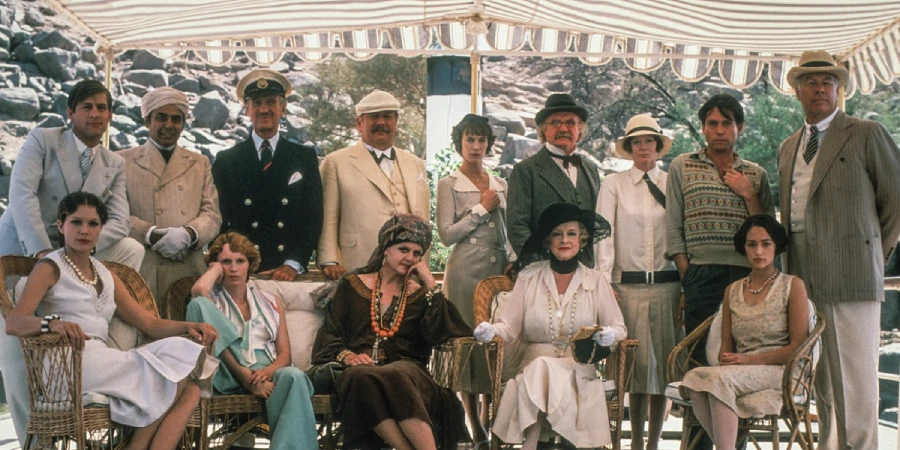
Peter Ustinov played Hercule Poirot six times, and his very first outing in Death on the Nile (1978) remains the one that got everything right. Director John Guillermin assembled a jaw-dropping ensemble cast on location in Egypt, handed them Agatha Christie’s most mechanically precise murder plot, and let the desert sun do half the cinematographic work. What followed was a glossy, sun-baked whodunit where three people pulled the trigger on one victim, and the film earns every minute of its runtime making you believe each suspect did it alone.
Detailed Summary
A Fortune, a Fiancé, and a Stolen Love
Linnet Ridgeway (Lois Chiles) is breathtakingly wealthy and unabashedly aware of it. Her best friend Jacqueline de Bellefort (Mia Farrow) introduces her to fiancé Simon Doyle (Simon MacCorkindale), and within weeks Linnet has taken Simon for herself and married him. Jacqueline does not quietly disappear into heartbreak; she follows the newlyweds across Europe and eventually onto a Nile cruise, making scenes and refusing to let them forget what they did.
Poirot happens to be aboard the Karnak, the riverboat carrying the honeymooners and an assortment of wealthy, grievance-carrying passengers. Colonel Race (David Niven) accompanies him as a kind of patrician sounding board. Guillermin frames the Karnak against temple walls and open desert with a genuine sense of scale that smaller productions would never attempt.
Threats, Accidents, and a Growing Sense of Dread
Jacqueline publicly threatens Linnet on multiple occasions, loudly enough that half the ship hears her. A boulder nearly crushes the newlyweds near Abu Simbel. Linnet’s shawl disappears and later reappears on a different passenger’s cabin floor, smeared with paint that was left on a deck railing.
Each near-miss raises the question of who specifically is trying to kill Linnet, and Jacqueline seems like the obvious answer. That obviousness is precisely what Christie, and the screenplay, are counting on you to accept. Poirot watches it all with his characteristic stillness, cataloguing details everyone else waves off as coincidence.
The Murder of Linnet Doyle
Linnet is shot through the head in her cabin while the ship docks at night. A letter J, written in her own blood, points the finger directly at Jacqueline. Except Jacqueline cannot have done it: she shot Simon in the leg during a public argument earlier that evening, and witnesses confirm she sat in the ship’s salon all night under observation while a doctor attended to Simon.
Two more deaths follow quickly. Louise Bourget (Jane Birkin), Linnet’s maid, hints to Poirot that she witnessed something and can be bribed. She turns up stabbed before she collects a franc. Andrew Pennington (George Kennedy), Linnet’s American trustee, also comes under suspicion after financial irregularities in Linnet’s estate surface during the investigation.
Poirot Assembles the Grey Cells
Poirot methodically eliminates and implicates passengers one by one. Salome Otterbourne (Angela Lansbury), a romance novelist with a drinking problem, claims she saw the murderer enter Linnet’s cabin. She never finishes the sentence; a shot from offscreen kills her mid-accusation. Her daughter Rosalie (Olivia Hussey) had been shielding her mother’s alcoholism throughout the voyage, a secret that briefly cast suspicion on the girl for the wrong reasons.
Miss Bowers (Maggie Smith) is the acerbic companion-nurse to the kleptomaniac American socialite Marie Van Schuyler (Bette Davis). Poirot eventually recovers the missing necklace Linnet was wearing, stolen by Van Schuyler in a moment of compulsion. The necklace is a red herring for the murder itself, but it demonstrates how many separate schemes were running simultaneously on that boat.
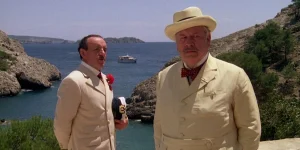

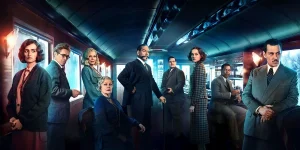
Movie Ending
Poirot gathers everyone in the salon and lays out what actually happened. Simon and Jacqueline conspired together. They were never truly estranged; the entire love triangle was staged. The plan called for Jacqueline to publicly shoot Simon in the leg with a blank, establish his alibi as a bedridden victim, then slip him the real gun. Simon crept to Linnet’s cabin, shot her dead, returned to his bunk, and Jacqueline fired a second shot into the deck to account for the real bullet sound.
The blood-written “J” was Simon’s work, a planted accusation against Jacqueline designed to misdirect, which almost succeeded. Louise the maid had seen or heard enough to understand the truth and tried to blackmail the killers. Simon, still supposedly immobilized, managed to kill her with a concealed knife. Mrs. Otterbourne’s murder was Jacqueline’s work; the moment Otterbourne began to speak, Jacqueline shot her to keep the conspiracy intact.
Ustinov’s Poirot delivers this revelation with quiet, almost mournful authority. He does not gloat. When he lays out how two people who loved each other chose to destroy everyone around them for money, his face carries something closer to exhaustion than triumph. It is the finest moment in Ustinov’s entire run as the character.
Cornered and exposed, Jacqueline shoots Simon and then turns the gun on herself. They die together on the deck of the Karnak, the Nile monuments indifferent in the background. Race and Poirot stand over them without a tidy moral summation. Guillermin wisely lets the image carry the weight rather than reaching for a closing speech.
Are There Post-Credits Scenes?
No. Death on the Nile ends on the image of the two dead conspirators and offers nothing after the credits begin. This was 1978, long before post-credits scenes became a marketing expectation. Stay seated only if you genuinely love John Addison’s score playing out.
Type of Movie
This is a classic whodunit mystery with strong ensemble drama elements. The tone is sunny and opulent on the surface, with genuine menace underneath. Think of it as a golden-age mystery thriller with the pacing of a leisurely Nile cruise that suddenly reveals it was never leisurely at all.
Cast
- Peter Ustinov – Hercule Poirot
- Lois Chiles – Linnet Ridgeway Doyle
- Mia Farrow – Jacqueline de Bellefort
- Simon MacCorkindale – Simon Doyle
- David Niven – Colonel Race
- Angela Lansbury – Salome Otterbourne
- Maggie Smith – Miss Bowers
- Bette Davis – Marie Van Schuyler
- George Kennedy – Andrew Pennington
- Jane Birkin – Louise Bourget
- Olivia Hussey – Rosalie Otterbourne
- Jack Warden – Dr. Bessner
- Jon Finch – James Ferguson
- I.S. Johar – Manager Bobbinaydah
- Harry Andrews – Barnstaple
Film Music and Composer
Nino Rota scored the film, and his work here deserves far more attention than it typically gets. Addison blends Egyptian modal scales with the lush orchestral palette of late-1970s Hollywood, producing something that feels genuinely foreign and glamorous at the same time. The main theme carries a lilting, deceptive cheerfulness that keeps undercutting itself with minor-key turns.
Filming Locations
Production filmed extensively in Egypt, including at the temples of Abu Simbel, Karnak, and along the actual Nile River. These were not second-unit establishing shots; cast members were physically present against these backdrops. Shooting at Abu Simbel gave the film a visual authority that sets it apart from any studio-bound version of the same story.
Some interior scenes were completed at Twickenham Film Studios in England. The combination of real Egyptian architecture and controlled studio interiors gives the film a layered visual texture: the exteriors feel genuinely vast, while the cabins and salons feel appropriately claustrophobic for a sealed-room murder scenario.
Guillermin understood that Egypt is itself a character in Christie’s novel, and he shot it that way. A close-up of Poirot against a colossus at Abu Simbel makes the little Belgian detective look absurdly small and human, which is quietly funny and quietly right.
Awards and Nominations
Death on the Nile won the Academy Award for Best Costume Design, with Anthony Powell taking home the Oscar. The film earned Powell recognition for his period-appropriate, character-specific wardrobe work across the large ensemble. Angela Lansbury’s turbans and Maggie Smith’s crisp severity in particular speak directly to Powell’s choices.
Behind the Scenes Insights
- Peter Ustinov reportedly prepared extensively for the role by studying earlier screen portrayals of Poirot and then consciously choosing a warmer, more humorous interpretation than any predecessor had attempted.
- Filming in Egypt presented significant logistical challenges, including extreme heat, difficult desert terrain, and the coordination required to shoot at protected ancient sites.
- Angela Lansbury leaned enthusiastically into Salome Otterbourne’s theatrical excess. Her performance as the boozy, self-dramatizing novelist is the most openly comedic in the film, and she commits to every second of it.
- Bette Davis and Maggie Smith reportedly had a prickly relationship on set, which, intentionally or not, fed directly into the brittle dynamic between Van Schuyler and Miss Bowers on screen.
- Director John Guillermin had experience shooting large-scale productions in challenging environments, having previously directed The Towering Inferno (1974).
- Mia Farrow prepared for her portrayal of Jacqueline by working on conveying obsessive love without making the character simply unsympathetic from the first frame.
Inspirations and References
The film adapts Agatha Christie’s 1937 novel of the same name, considered one of her finest. Christie built the story around a genuinely audacious structural conceit: the most obvious suspect is innocent, and the two characters who seem most victimized are the killers. That inversion is what makes the solution feel both shocking and inevitable when Poirot lays it out.
Christie drew loosely on her own travels in Egypt and along the Nile during the 1930s with her archaeologist husband Max Mallowan. Her firsthand familiarity with Egyptian monuments and Nile riverboats gave the novel its specific, lived-in geography, which the film inherits directly.
Alternate Endings and Deleted Scenes
No officially documented alternate endings or significant deleted scenes from Death on the Nile (1978) have surfaced in production records or home video releases. The film tracks Christie’s novel ending quite faithfully, which may explain why there was little incentive to shoot alternatives.
Book Adaptations and Differences
Christie’s novel features a slightly different passenger manifest; the film consolidates and alters some supporting characters to streamline the narrative for a two-hour runtime. The character of Colonel Race exists in the novel as well, but the screenplay adjusts his role somewhat to give David Niven more direct involvement in Poirot’s deductions.
Salome Otterbourne in the novel is more overtly scandalous in her writing, producing thinly veiled erotic fiction. The film softens this into a general reputation for romantic excess, partly to accommodate the tone and partly because Lansbury’s comedic physicality communicated the character’s absurdity without needing explicit description.
Christie’s Jacqueline and Simon remain consistent with the film’s portrayal in all the crucial aspects. The novel’s ending, with the double suicide, carries straight through to the screen without meaningful alteration.

Memorable Scenes and Quotes
Key Scenes
- The Abu Simbel sequence: Poirot and Race stand before the colossal statues at dawn. Guillermin holds on the scale contrast for several beats, and Ustinov’s slight physical deflation against the stone giants reads as both comic and philosophically loaded.
- Jacqueline shoots Simon: Farrow’s hands shake visibly before she fires. The salon goes silent. What looks like a crime of passion is, as we later learn, a meticulously rehearsed act, which makes rewatching this scene genuinely unsettling.
- Mrs. Otterbourne’s murder: She begins her revelation, mouth open, sentence forming, and then a shot from the cabin doorway cuts her off mid-word. Lansbury falls with a physical finality that is more shocking than the gunshot itself.
- Poirot’s salon revelation: Ustinov gathers the survivors and dismantles the conspiracy piece by piece. He does not raise his voice. The camera moves between his face and each suspect’s reaction in tight, controlled cuts that build unbearable tension out of a man simply talking.
- The painted shawl discovery: A minor scene, but Guillermin shoots the paint-smeared fabric in a close-up that lingers one beat longer than necessary. It is the kind of detail that signals a skilled director at work.
Iconic Quotes
- “You have good eyes, Colonel Race. But me, I have a good brain.” (Poirot, establishing his method with characteristic self-satisfaction)
- “I am not a young man. And I do not like being shot at.” (Poirot, after the boulder incident, delivered by Ustinov with perfect deadpan timing)
- “You’re a very clever man, Monsieur Poirot. But you’re not God.” (A passenger, pushing back against Poirot’s certainty)
Easter Eggs and Hidden Details
- Watch the background during the salon scenes: Guillermin places each suspect in a distinct spatial relationship to Linnet throughout the voyage, subtly mapping the social geography of the conspiracy before it is revealed.
- Jacqueline’s wardrobe shifts from vivid, saturated colors in the early scenes to progressively darker, more muted tones as the voyage continues. Anthony Powell’s costume work tracks her psychological deterioration visually without any dialogue needing to state it.
- The painted railing where the shawl evidence is first gathered appears briefly in an establishing shot much earlier in the film, before anyone could know it would matter. Guillermin plants the detail without calling attention to it.
- Poirot is seen eating and drinking with relish throughout the film. Christie’s novels describe his love of food, and Ustinov incorporated this detail into his physical characterization in a way that keeps the character grounded between murder scenes.
- Bette Davis plays Van Schuyler with a rigid posture that loosens slightly, almost imperceptibly, whenever her kleptomania temporarily satisfies itself. It is a micro-performance choice that rewards close attention.
Trivia
- Peter Ustinov would return to the role of Hercule Poirot multiple times, including in Evil Under the Sun (1982) and several television films.
- Anthony Powell won the Oscar for Best Costume Design for this film, one of two consecutive wins he achieved in the category.
- Agatha Christie died in 1976, two years before the film was released, and never saw Ustinov’s portrayal of her most famous creation.
- John Guillermin shot the film largely in sequence during the Egyptian location work, which helped the cast build a genuine sense of shared isolation aboard the riverboat.
- The ensemble cast of Death on the Nile represented a remarkable concentration of mid-century film talent: Bette Davis, David Niven, Maggie Smith, Angela Lansbury, and Mia Farrow all in one film.
- Simon MacCorkindale, who plays the treacherous Simon Doyle, later became well known to television audiences but this film remains one of his most prominent early film roles.
- Christie’s Death on the Nile had previously been adapted as a BBC radio drama before the 1978 feature film.
Why Watch?
Ustinov’s physical comedy and genuine warmth make Poirot feel like a real person rather than a detective mechanism, which is harder to pull off than it looks. When he delivers the final revelation, you feel the weight of two wasted lives rather than the satisfaction of a puzzle solved. No other screen adaptation of this novel has managed that tonal balance quite as precisely.
Director’s Other Movies
- The Towering Inferno (1974)
- King Kong (1976)
- El Condor (1970)
- Skyjacked (1972)
Recommended Films for Fans
- Murder on the Orient Express (1974)
- Evil Under the Sun (1982)
- Witness for the Prosecution (1957)
- And Then There Were None (1945)
- The Mirror Crack’d (1980)
- Sleuth (1972)