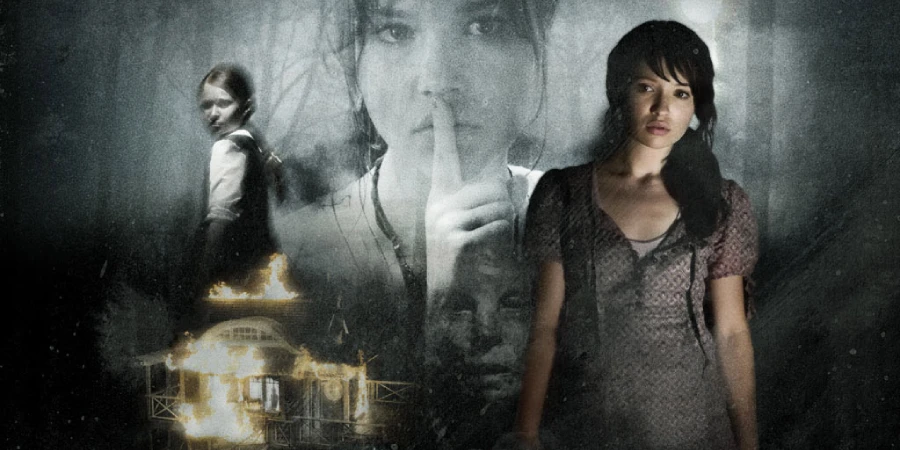

Anna Irons does not remember killing her mother. That is the whole trick, and The Uninvited (2009) bets everything on keeping you from figuring it out before the credits hit. Directed by the Guard brothers, Charles and Thomas, this American remake of the Korean film A Tale of Two Sisters smuggles a genuinely nasty psychological twist inside a polished PG-13 wrapper. It mostly works, and Emily Browning’s performance is a big reason why.
Detailed Summary
Anna’s Return Home
Anna Irons, played by Emily Browning, returns home after ten months in a psychiatric facility. She had been institutionalized following a fire that killed her terminally ill mother in the boathouse on their lakeside property. Her father Steven, played by David Strathairn, welcomes her back warmly.
Almost immediately, Anna clashes with Rachel Summers, played by Elizabeth Banks. Rachel was her mother’s nurse and has since moved into the family home as Steven’s girlfriend. Anna’s sister Alex, played by Arielle Kebbel, shares her suspicion that Rachel is not who she claims to be.
Nightmare Visions and the Ghost of the Mother
Anna begins experiencing vivid nightmares and hallucinations. Her dead mother appears to her, disfigured and rotting, seemingly trying to warn her about something. These visions blur with reality in ways Anna cannot easily untangle.
Alex pushes Anna to dig into Rachel’s past. They find evidence suggesting Rachel previously worked for an elderly man named Mildred’s employer, whose entire family died under suspicious circumstances. Alex insists Rachel killed them and plans to do the same to their family.
Investigating Rachel
Anna tracks down a local woman who confirms that Rachel, under a different name, was present when another family was destroyed. The girls become convinced Rachel poisoned their father’s former patients and intends to kill Steven once she secures her position in the household.
Anna also develops a brief romantic connection with Matt, a boy from town. His presence grounds her in something like ordinary teenage life, but the film yanks him away quickly and brutally, foreshadowing that nothing safe will last.
The Fight at the Boathouse
Tensions erupt when Anna confronts Rachel directly. Alex escalates the conflict and the sisters attempt to expose Rachel’s true identity to their father. Steven refuses to believe them, dismissing their accusations as jealousy and lingering grief.
Anna finds a bag she believes contains evidence of Rachel’s crimes. She takes it to her father, but the contents do not support her story in any clear way. Steven grows alarmed by Anna’s increasingly erratic behavior.
The Truth Beneath Everything
A psychiatrist named Dr. Silberling arrives and speaks with Anna. His conversation plants seeds of doubt about everything she has experienced. Anna begins to crack under the weight of what she cannot reconcile.
Then the film detonates its bomb. Anna goes to confront Rachel one final time, knife in hand. She stops. She sees the truth. Alex is not real. Alex has never been real. Anna has been seeing and speaking with a hallucination of her dead sister throughout the entire film.

Movie Ending
Anna killed Alex. That is what the film has been hiding. On the night of the boathouse fire, Anna discovered that her father and Rachel were having an affair while her mother was still alive and still sick. She snapped. She went to the boathouse carrying a knife to confront Rachel, and in the chaos of that night she accidentally killed her sister, who had come to stop her. She also caused the fire that killed her mother.
Her mind could not survive that guilt intact. So it invented Alex as a living companion, a voice of vengeance and action, letting Anna act out her rage and suspicion through a ghost she believed was her sister. Every scene with Alex was Anna alone, talking to herself, sometimes physically acting out both sides of a confrontation.
Rachel really does have a shady past. That part was not entirely fabricated. But Anna’s obsession with exposing her was driven by guilt and psychosis, not rational investigation. Steven finally understands the full horror of what happened to his family, and Anna is taken back into psychiatric care.
What makes the ending sting is that the film earns it. Go back and recount any scene where another character directly interacts with Alex. You will find almost none. Other characters look past her, speak over her, or are conveniently absent when Alex is most physically active. Browning sells the dissociation so completely that most viewers miss the tells on a first watch. That is the film doing its job well.
Are There Post-Credits Scenes?
The Uninvited has no post-credits scene. Once the story lands its final gut punch, the film is done. You can leave when the credits roll.
Type of Movie
This is a psychological horror film with strong thriller elements and a mystery backbone. Its tone sits closer to slow-burn dread than jump-scare chaos, though it deploys a few well-placed shocks. Younger audiences expecting a slasher will feel the slow pace; audiences who stick with it get a properly disturbing payoff.
Cast
- Emily Browning – Anna Irons
- Elizabeth Banks – Rachel Summers
- Arielle Kebbel – Alex Irons
- David Strathairn – Steven Irons
- Jesse Moss – Matt
Film Music and Composer
Christopher Young composed the score. Young is a veteran of the horror genre, with credits including Hellraiser and Drag Me to Hell. His work here leans on unsettling string arrangements and sparse, creeping piano lines rather than bombastic orchestral swells.
The score suits the film’s psychological orientation. It sounds like memory trying to reassemble itself: fragmented, circular, faintly wrong. That tonal choice is one of the better craft decisions in the film.


Filming Locations
Principal photography took place in British Columbia, Canada, primarily around the coastal and lake regions. Production designers leaned into the Pacific Northwest aesthetic: gray water, dense forest, mist-heavy mornings. The environment does real work in the film.
That lakeside house is not just a setting. Its isolation mirrors Anna’s psychological state. There is nowhere to run, and nobody close enough to hear her. The boathouse, site of the original trauma, looms at the edge of almost every outdoor frame as a constant visual threat.
Awards and Nominations
The Uninvited did not collect significant awards attention. It was a commercially oriented studio release rather than an awards-circuit contender, and critics at the time gave it a mixed reception that kept it off most year-end lists.
Behind the Scenes Insights
- Charles and Thomas Guard, British-born twin brothers, made this their feature directorial debut.
- Elizabeth Banks has spoken about enjoying the ambiguity of Rachel’s character, noting that Rachel is genuinely unpleasant without being a cartoon villain.
- Emily Browning prepared for the role by researching dissociative disorders and trauma responses, particularly how survivors of catastrophic guilt sometimes construct protective alternate realities.
- DreamWorks acquired the rights to A Tale of Two Sisters for the American remake, with producers Neal Moritz and Andrew Rona attached.
- The Guard brothers were reportedly drawn to the project specifically because the Korean source material had a structural logic to its twist that most Western horror films lack.
Inspirations and References
The Uninvited adapts the 2003 South Korean horror film A Tale of Two Sisters, directed by Kim Jee-woon. That film itself draws loosely from a Korean folk tale called Janghwa, Hongryeon jeon, a story about two sisters and a cruel stepmother. The folk tale has been adapted many times in Korean cinema and literature.
Kim’s original film is considerably darker, more ambiguous, and more formally daring than the American remake. Fans of The Uninvited who have not seen it should seek it out immediately. It operates on a different level entirely.
Alternate Endings and Deleted Scenes
No officially released alternate ending exists for The Uninvited. Early test screenings reportedly shaped how explicitly the film presents its final revelation, with some earlier cuts being more ambiguous about the extent of Anna’s guilt. No deleted scenes have received a wide release or been made publicly available in any significant way.
Book Adaptations and Differences
The Uninvited is not based on a book. It is a remake of a film, which itself drew from a folk tale rather than a novel. No novelization of this specific production appears to exist.

Memorable Scenes and Quotes
Key Scenes
- Anna’s first nightmare in the film, where her mother crawls toward her across a dark floor with her face partially burned away. Browning’s physical recoil sells it more than any makeup effect could.
- Alex and Anna confronting Rachel in the kitchen, a scene that gains a completely different meaning once you know Alex is not there. Watch Browning’s eyes; she is looking slightly past Banks for nearly the whole exchange.
- Anna finding the bag she believes contains incriminating evidence. Her hands shake as she opens it, and the camera cuts to her father’s face registering not anger but fear, fear of his daughter, not of Rachel.
- The final revelation sequence, where the film replays fragments of earlier scenes with Alex removed. It is a blunt technique but it works because Browning’s performance retroactively justifies every recontextualized frame.
- Matt’s death, which arrives with a suddenness that shocks partly because the film had let viewers believe he was safe.
Iconic Quotes
- “I remember everything.” Anna’s opening line, which the film eventually reveals to be a lie she tells herself.
- “She’s not who you think she is.” Alex says this to Anna about Rachel, which is bitterly ironic given that Alex herself is the one who is not real.
Easter Eggs and Hidden Details
- In several scenes, other characters visibly fail to acknowledge Alex’s presence. Watch Steven during the dinner table sequences; he directs his attention and dialogue only at Anna.
- Anna’s room is decorated with drawings and sketches that, on close inspection, show two girls but one is always slightly translucent or blurred. This is a background detail most viewers miss on a first watch.
- Rachel’s wardrobe colors shift subtly throughout the film. Early scenes dress her in warmer tones. As Anna’s paranoia grows, Rachel’s clothing becomes cooler and more severe, reflecting Anna’s changing perception rather than any change in Rachel herself.
- The boathouse appears in the background of nearly every outdoor shot near the house. Its visual omnipresence is deliberate: it is the geographic location of Anna’s crime and her subconscious cannot stop pointing at it.
Trivia
- The Uninvited opened in January 2009, a release slot studios often reserve for genre films they believe have commercial but not awards potential.
- Emily Browning was in her early twenties during production and had already completed her work on Lemony Snicket’s A Series of Unfortunate Events years earlier. This role marked a conscious shift toward darker material for her.
- Elizabeth Banks took the role at a point in her career when she was primarily known for comedic work. Her willingness to play genuinely cold and threatening was a deliberate choice to expand her range.
- Arielle Kebbel, who plays the dead sister Alex, had to calibrate her entire performance knowing the audience would eventually understand she was a hallucination. She and Browning reportedly worked closely on their physical chemistry to make the illusion plausible.
- The film grossed significantly more than its production budget at the domestic box office, making it a modest commercial success despite lukewarm critical notices.
Why Watch?
Browning carries this film on her back and never lets it slip. Her performance as a girl unknowingly narrating her own guilt is the most underrated element of the whole production. Watch the kitchen confrontation scene twice: once for the plot, once to study what her eyes are doing while Banks delivers her lines. That is where the film truly lives.
Director’s Other Movies
- The Uninvited (2009) was the Guard brothers’ debut feature. Their subsequent directing work has been primarily in television rather than film.