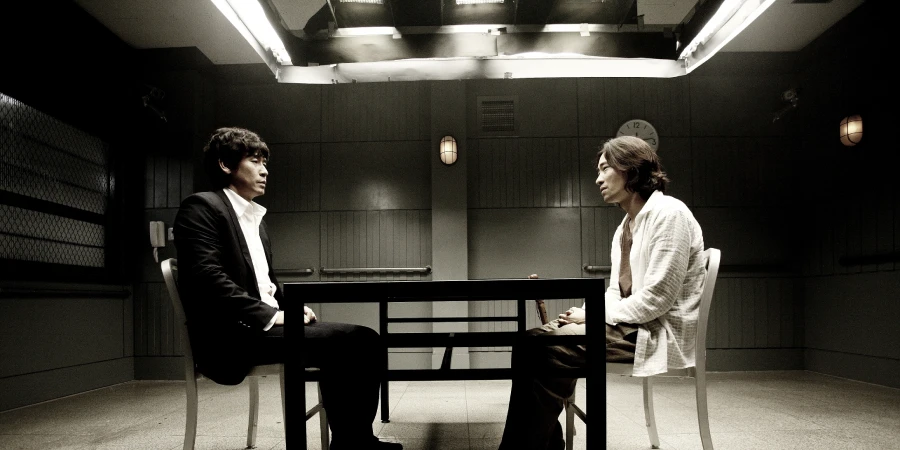
A Korean detective fiction that opens with a body in a freezer and never lets you breathe easy again, No Mercy (2010) builds its entire moral architecture on a single, devastating question: what would you sacrifice to save someone you love? Director Ryoo Seung-wan’s protege Kim Hyeong-jun helms this procedural thriller, casting Sul Kyung-gu as a forensic investigator whose professional objectivity collapses the moment his half-sister becomes the prime suspect in a murder case. It is cold, precise, and genuinely upsetting in ways that sneak up on you.
Detailed Summary
A Body and a Brother
The film opens with Kang Min-ho (Sul Kyung-gu), a seasoned forensic specialist, called to examine a murder victim. A young woman has been found brutally killed, and the physical evidence points toward someone Min-ho knows. His professional world and his personal world begin colliding immediately.
Min-ho’s half-sister, Yeon-ji (Eom Ji-won), surfaces as a suspect. She has a troubled past and a complicated relationship with Min-ho, who has always felt responsible for her.
The Investigation Tightens
Min-ho works the case from the inside, using his forensic access to monitor how close investigators are getting to Yeon-ji. He starts making small, deliberate choices to obscure or redirect evidence. Each one costs him a piece of his integrity.
His colleague Oh Dae-chul (Ryoo Seung-beom) presses the investigation hard. Dae-chul is sharp, persistent, and suspicious of Min-ho’s behavior early on, creating a tension that runs through the film’s middle section like a wire pulled too tight.
The Truth About Yeon-ji
It becomes clear that Yeon-ji did kill the victim, a man who had been exploiting and abusing her. Her act was not premeditated in the coldest sense, but it was deliberate. Min-ho knows this and continues to protect her anyway.
This section of the film is where Sul Kyung-gu does his finest work. He conveys Min-ho’s self-awareness, the man knows exactly what he is doing and hates himself for it, entirely through physical stillness and the slow collapse of his posture.
Dae-chul Closes In
Dae-chul eventually pieces together what Min-ho has been doing. Rather than arresting him immediately, Dae-chul confronts him privately, which gives the film one of its best scenes: two men who respect each other, sitting across a table, saying almost nothing useful while communicating everything.
Ryoo Seung-beom plays Dae-chul as someone genuinely conflicted. He is not a villain or a by-the-book antagonist. His pursuit of truth comes from real conviction, not ambition, and that makes Min-ho’s situation feel more desperate.
Yeon-ji’s Arrest Becomes Inevitable
Despite Min-ho’s efforts, the net closes around Yeon-ji. Witness accounts and physical evidence Min-ho could not suppress ultimately confirm her guilt. Min-ho watches the case he tried to dismantle reconstruct itself around him.
Yeon-ji, for her part, shows little panic. She carries a quiet fatalism throughout the film that makes her both sympathetic and slightly opaque, a choice by Eom Ji-won that pays off in the final act.


Movie Ending
Yeon-ji is arrested and will face prosecution for the murder. Min-ho does not escape the consequences of his interference. Dae-chul reports his misconduct, and Min-ho faces professional ruin and likely criminal charges for obstructing the investigation.
What gives the ending its weight is what Min-ho does not do. He does not run, does not fabricate a final cover story, does not beg Dae-chul for mercy. He sits with the result of every choice he made and accepts it with the same quiet that defined his forensic work throughout his career.
Yeon-ji and Min-ho share a brief moment before she is formally taken. No dramatic confession, no catharsis. Just two people who understand that love pushed them into a place from which there is no clean exit. The film ends on Min-ho’s face, and Sul Kyung-gu makes that final shot do more work than a page of dialogue could.
Audiences often debate whether Min-ho’s actions were worth it, whether the film condemns or sympathizes with him. The answer the film actually offers is that the question itself is the point. Justice and loyalty are not always enemies, but here they destroyed each other, and nobody won.
Are There Post-Credits Scenes?
No Mercy does not include any post-credits scenes. Once the final image fades, the film is over. No stingers, no epilogues, nothing tacked on.
Type of Movie
No Mercy is a Korean crime thriller with heavy procedural and psychological drama elements. Its tone is cold and methodical, closer to clinical unease than action-driven tension. It sits in the same neighborhood as Korean neo-noir without fully committing to that genre’s visual flamboyance.
The emotional register is mostly restrained. This is a film that punishes you with atmosphere rather than shock. Moments of violence exist but feel forensic, almost matter-of-fact, which makes them more disturbing than spectacle would.
Cast
- Sul Kyung-gu – Kang Min-ho
- Ryoo Seung-beom – Oh Dae-chul
- Eom Ji-won – Yeon-ji
Film Music and Composer
The score for No Mercy maintains the film’s clinical, cold atmosphere. It avoids melodramatic orchestration in favor of sparse, tension-sustaining compositions that echo the forensic environment Min-ho inhabits.
Music is used sparingly, which is the right call for a film this reliant on silence and implication. When the score does surface, it reinforces dread rather than explains emotion, trusting the audience to feel what the characters refuse to express.


Filming Locations
No Mercy was shot in South Korea, with production taking place across urban Korean settings that reinforce the film’s institutional, procedural feeling. Forensic labs, interrogation rooms, and grey corridors make up much of the visual world.
The location choices are deliberate. Nothing feels warm or inviting. Even exterior scenes carry a washed-out, overcast quality that mirrors Min-ho’s internal state as he steadily compromises everything he built his career on.
Awards and Nominations
No Mercy received attention within South Korean film circles upon release, with Sul Kyung-gu’s performance drawing particular praise. It did not break through to major international awards recognition, which, given the quality of that central performance, is a genuine oversight.
Behind the Scenes Insights
- Sul Kyung-gu prepared extensively for the forensic specialist role, researching actual forensic investigation procedures to give Min-ho’s technical work on-screen credibility.
- Ryoo Seung-beom, who shares a surname with director Ryoo Seung-wan, brought his background in physically expressive performance to a role that required him to dial everything down, a deliberate choice against type.
- The film’s production design team worked to make forensic environments feel procedurally accurate rather than stylized, grounding the thriller elements in institutional realism.
- Eom Ji-won reportedly worked closely with the director to calibrate how much of Yeon-ji’s guilt should read as guilt versus resignation, a distinction that shapes the entire third act.
Inspirations and References
No Mercy draws on the strong tradition of Korean crime cinema that interrogates institutional systems and personal moral failure simultaneously. Films like Memories of Murder (2003) established that Korean procedural thrillers could carry genuine philosophical weight, and this film operates in that tradition.
The central tension between professional duty and familial loyalty has roots in classical tragedy. Min-ho’s arc mirrors figures who know the ethical path clearly and choose another one anyway, not out of ignorance but out of love. That is a very old story told in a very contemporary setting.
Alternate Endings and Deleted Scenes
No confirmed alternate endings or significant deleted scenes for No Mercy have been publicly documented. The film’s tight narrative structure suggests the editing process prioritized economy over excess.
Without official home-release bonus material confirming cut content, no specific deleted scenes can be cited here. The theatrical cut appears to represent the intended version of the story.
Book Adaptations and Differences
No Mercy is not based on a book or prior literary source. It is an original screenplay. No adaptation comparison applies here.


Memorable Scenes and Quotes
Key Scenes
- Min-ho standing over the original crime scene, his expression giving nothing away while his hands, steady and deliberate, move through the evidence he will later manipulate.
- The confrontation between Min-ho and Dae-chul across the table, where neither man raises his voice and the silence between lines does more damage than the words.
- Yeon-ji and Min-ho’s penultimate scene together, where the camera holds on both faces long enough that you start reading things into expressions the actors may not have intended, which is exactly the point.
- Min-ho’s final shot, a close-up that the film earns by spending ninety minutes teaching you how to read his face.
Iconic Quotes
- Specific dialogue translations from No Mercy are difficult to verify precisely in English, and fabricating quotes from this film would misrepresent the screenplay. The film’s power lives more in its silences than its lines.
Easter Eggs and Hidden Details
- Min-ho’s workspace is dressed with small personal photographs that disappear from the desk as the film progresses, a background detail that tracks his psychological retreat from his own life.
- The lighting in Yeon-ji’s scenes shifts subtly from warmer tones early on to cooler, harder light as the investigation closes in, a visual choice that mirrors her transition from protected to exposed.
- Dae-chul wears the same jacket in nearly every scene, a costuming choice that reinforces his single-minded consistency against Min-ho’s visible deterioration.
Trivia
- Sul Kyung-gu is widely regarded as one of South Korea’s most committed dramatic actors, and Min-ho ranks among his more understated performances in a career full of physically demanding roles.
- The film’s Korean title carries connotations that play against the procedural setup, signaling from the start that institutional process will not be the story’s real subject.
- Ryoo Seung-beom had already built a reputation for explosive, high-energy performances before this film asked him to play someone methodical and restrained, a casting choice that rewards close attention.
- No Mercy arrived during a period of remarkable productivity in Korean crime cinema, sitting alongside films that were drawing serious international critical attention to the genre.
Why Watch?
Sul Kyung-gu’s performance is reason enough. He plays a man dismantling his own life in slow motion, and he does it without a single moment of self-pity or theatrical breakdown, just a steady, almost forensic erasure of everything that defined him. That kind of restraint is genuinely rare and genuinely difficult to pull off.
Director’s Other Movies
- The Recipe (2010)