
Ladj Ly’s Les Misérables has nothing to do with Victor Hugo’s novel beyond borrowing its title and its fury. Set in Montfermeil, the same Paris suburb where Hugo placed his story, this 2019 French film drops you into a single sweltering day with a rookie cop who watches his new colleagues operate like a small criminal empire wearing badges. It is blunt, precise, and politically incendiary in a way that French cinema rarely allows itself to be.
Detailed Summary
A New Arrival in the Brigade
Stéphane Ruiz has just transferred to the Anti-Crime Brigade in Montfermeil. He rides with veterans Chris and Gwada, two officers who patrol their territory less like public servants and more like feudal lords collecting dues. Chris grabs food from vendors without paying, gropes women in the street, and barks orders at residents with total impunity.
Stéphane watches all of this with visible discomfort, but he says nothing. He is the new guy. He keeps his head down.
The Lion Club and the Mayor
Montfermeil operates under a fragile ecosystem of competing power structures. A local Muslim community leader known as the Mayor maintains order through religious authority and negotiation. A Roma circus owner holds his own sway over part of the neighborhood. Street gang leaders carve up territory with their own logic.
Chris knows how to play all of these factions against each other, and he uses that knowledge to keep the streets manageable for himself. This is not policing. It is informal rule.
The Stolen Lion Cub
A young boy named Issa steals a lion cub from the Roma circus. This small act of mischief triggers a cascade. The circus owner is enraged and threatens to unleash his men on the neighborhood unless the cub is returned. Chris and Gwada scramble to locate Issa before the situation explodes.
They find him. The recovery of the cub feels like a minor win, until everything goes wrong in one terrible moment.
The Drone and the Shot
A local teenager, Buzz, flies a drone that captures everything: Gwada firing a rubber bullet at close range directly into Issa’s face, dropping the boy to the ground. The shot is not fired in genuine self-defense. It is panic and aggression combined, and the drone records all of it in crisp footage.
Chris realizes immediately what this footage means. He and Gwada chase Buzz through the streets and apartment buildings of the Bosquets housing projects, desperate to recover the memory card before anyone else sees what happened.
The Cover-Up in Motion
Chris and Gwada catch Buzz and confiscate his drone. They believe the footage is contained. Stéphane is horrified by what he witnessed but remains passive, trapped between his instinct to report and his fear of what Chris will do.
The three officers take Issa to a makeshift clinic to have his wound treated unofficially, avoiding any hospital report that would trigger an investigation. They are now all complicit, including Stéphane, whose silence is its own form of participation.
The Neighborhood Closes In
Word spreads. A local surveillance network run by a young man known as Salah already retrieved a copy of the drone footage before Chris got to Buzz. The neighborhood knows. Tensions that Chris spent years carefully managing begin to crack open.
The Mayor calls a meeting and tries to broker peace, urging the officers to apologize formally and make it right. Chris refuses. His ego cannot absorb any admission of wrongdoing, and that refusal is what sets the film’s final act in motion.

Movie Ending
Night falls over Montfermeil and the neighborhood detonates. A group of young men from the housing projects, many of them teenagers, ambush Chris, Gwada, and Stéphane in a coordinated attack that feels less like a riot and more like a military operation. They have been waiting for exactly this kind of provocation.
Stéphane gets separated from the others and finds himself cornered in a stairwell. Standing above him, holding a Molotov cocktail and a homemade shield, is Issa, the same child Gwada shot earlier that day. The boy stares down at the cop who never stopped his colleagues from hurting him.
Ly holds this image and refuses to resolve it. He freezes the frame on Issa’s face, arm raised, before cutting to black. We do not see what Issa does. We do not see whether Stéphane survives. A title card pulls a line from Victor Hugo: “There are no bad plants or bad men. There are only bad cultivators.”
This ending is the film’s most audacious choice, and it earns every second of its ambiguity. Ly is not interested in giving you a clean verdict. He wants you to sit with the weight of what the system produced: a child radicalized by a single day of police brutality, standing over the one officer who might have been decent enough to matter. The open ending does not let anyone off the hook.
Are There Post-Credits Scenes?
No. Les Misérables ends on its freeze-frame and title card, then cuts to black. There is nothing after the credits. Stay if you want to process what you just watched, but nothing extra is waiting for you.
Type of Movie
Les Misérables is a social thriller and crime drama rooted in political realism. Its tone is urgent and observational in the first two acts, then erupts into something closer to a siege film in the third. Ly shoots with a handheld, documentary-adjacent energy that keeps everything feeling immediate and unmanipulated.
This is not a comfortable film. It does not want to be.
Cast
- Damien Bonnard – Stéphane Ruiz
- Alexis Manenti – Chris
- Djibril Zonga – Gwada
- Issa Perica – Issa
- Al-Hassan Ly – Buzz
- Steve Tientcheu – the Mayor
- Almamy Kanouté – Salah
- Aminata Demba Dramé – Zakia
Film Music and Composer
The score draws on hip-hop, electronic, and ambient textures, reflecting the neighborhood’s youth culture without romanticizing it. Music in this film functions as pressure, not atmosphere. Beats build tension in scenes where dialogue goes quiet and the camera just watches.
Kim Chapiron collaborated with composer Pink Noise on the original score. The decision to ground the soundtrack in sounds that belong to Montfermeil rather than import a generic thriller palette is one of the film’s most underrated choices.
Filming Locations
Les Misérables was shot almost entirely in Montfermeil and the neighboring commune of Clichy-sous-Bois, in the Seine-Saint-Denis department east of Paris. These are the actual banlieues where Ly grew up and where the 2005 French riots ignited. This is not a set dressed to look like a housing project. These are real buildings, real corridors, real faces in the background.
Shooting on location gives the film a texture that no studio recreation could fake. When the boys run through those stairwells in the finale, you feel the geometry of entrapment because those spaces are genuinely labyrinthine.
Awards and Nominations
Les Misérables won the Jury Prize at the Cannes Film Festival in 2019, which immediately signaled that the wider world was paying attention. It also received an Academy Award nomination for Best International Feature Film at the 2020 ceremony.
César nominations followed, and the film swept through international critics’ circles as one of the most discussed French films in years.
Behind the Scenes Insights
- Ladj Ly grew up in Montfermeil and shot an earlier short film of the same name in 2017, which served as a direct proof-of-concept for the feature.
- Many of the young actors, including Issa Perica, were non-professionals discovered locally in the neighborhood where the film was shot.
- Ly was present during the 2005 banlieue riots and filmed footage on his phone at the time, an experience that directly fed into the film’s final act.
- Alexis Manenti, who plays Chris, co-wrote the screenplay with Ly and Giordano Gederlini, which partly explains how fully realized and psychologically specific the character feels.
- The production worked closely with local youth to ensure the film reflected actual dynamics of life in the Bosquets housing projects rather than an outsider’s projection.
Inspirations and References
Victor Hugo’s novel Les Misérables provides the title, the setting of Montfermeil, and the epigraph about bad cultivators. Beyond those structural anchors, Ly draws the film’s DNA from lived experience and from the 2005 French riots, which began in Clichy-sous-Bois after two teenagers died fleeing police.
American cinema about police and community friction, particularly films operating in the tradition of Do the Right Thing, clearly resonates in the film’s construction. Ly has cited Spike Lee as an influence on how political content can coexist with visceral, entertaining filmmaking.
Alternate Endings and Deleted Scenes
No officially confirmed alternate endings or significant deleted scenes have been released or widely documented for this film. Ly’s freeze-frame conclusion appears to have been his intention from early in the writing process, given how precisely the film’s moral architecture points toward that exact unresolved image.
Book Adaptations and Differences
Les Misérables is not an adaptation of Hugo’s novel. It is an original screenplay by Ladj Ly, Alexis Manenti, and Giordano Gederlini. Montfermeil and the Hugo epigraph are deliberate references, but the story, characters, and events are entirely independent of the source novel.
Ly uses Hugo’s name as a provocation: the idea that the same ground that inspired a 19th-century novel about poverty and injustice is still producing the same suffering two centuries later.
Memorable Scenes and Quotes
Key Scenes
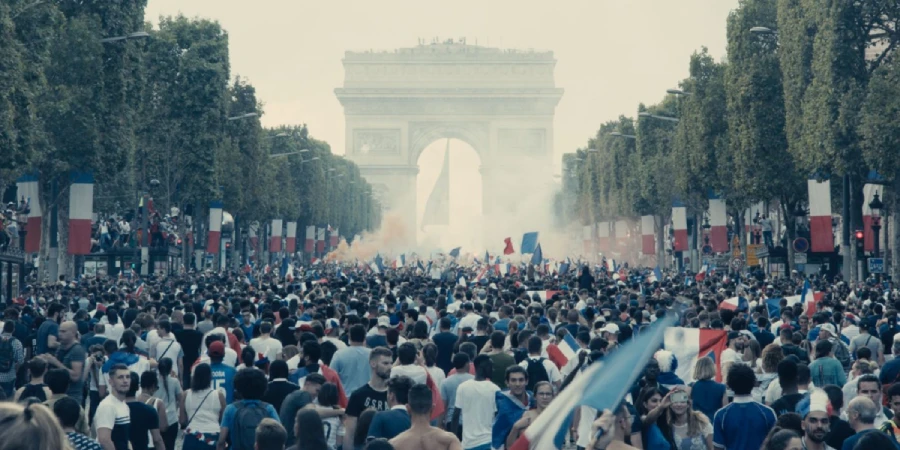
- The opening sequence: Stéphane watching a World Cup crowd celebrate in Paris, flags and joy everywhere, before cutting to the grey silence of Montfermeil. The contrast does not need a single word of dialogue.
- Chris grabbing food from a street vendor without paying, the vendor’s jaw tightening as he says nothing. Manenti plays Chris with a grinning entitlement that makes your skin crawl.
- Gwada firing the rubber bullet at Issa. The shot is sudden, close, and the boy drops instantly. Ly does not slow it down or score it with music. It just happens, the way it actually does.
- The drone chase through the housing project: handheld, breathless, the camera barely keeping pace with the characters, the architecture fragmenting into corridors and rooftops.
- The final stairwell confrontation, Issa above Stéphane, arm raised, the frame freezing before any choice is made.
Iconic Quotes
- “There are no bad plants or bad men. There are only bad cultivators.” (Victor Hugo, closing title card)
- Chris to Stéphane early in the film: “Here, it’s us who make the law.”
Easter Eggs and Hidden Details
- Montfermeil is specifically where Hugo set the Thénardier inn sequences in the original novel, making the location choice a pointed geographic echo.
- Buzz’s drone mirrors the real surveillance footage that Ly himself shot during the 2005 riots on his phone, a piece of personal history embedded in the plot mechanics.
- The World Cup celebration at the film’s opening references France’s 2018 World Cup victory, a moment of national unity that the rest of the film systematically dismantles by showing who that unity excludes.
- Several background performers in the housing project sequences are actual residents of the Bosquets, lending faces and body language that no casting call could replicate.
Trivia
- Ladj Ly’s 2017 short film of the same name screened at major festivals and was seen by producer Toufik Ayadi, who pushed for it to become a feature.
- The film was selected as the French entry for the Academy Award for Best International Feature Film, a significant institutional endorsement for a debut feature from a director outside the traditional French film establishment.
- Alexis Manenti, despite playing the film’s most overtly aggressive character, co-wrote the screenplay and is one of the chief architects of the story’s political precision.
- Issa Perica, who had no prior acting experience, delivers one of the most controlled and affecting child performances in recent French cinema.
- Ladj Ly founded a local cinema school in Montfermeil called Kourtrajmé, which aims to train young people from underrepresented communities in filmmaking.
Why Watch?
Alexis Manenti’s performance as Chris is the reason to push play. He makes institutional cruelty charming and casual in a way that feels far more dangerous than any cartoonish villain. Every scene he occupies crackles with the specific dread of watching someone who believes the rules genuinely do not apply to him, and he is right until the neighborhood decides otherwise.
Director’s Other Movies
- Les Misérables (short, 2017)
- Athena (2022)
Recommended Films for Fans
- Do the Right Thing (1989)
- La Haine (1995)
- Caché (2005)
- Fruitvale Station (2013)
- Banlieue 13 (2004)
- Divines (2016)