
Four men walk into a jewel heist. None of them walk out. Jean-Pierre Melville’s Le Cercle Rouge opens with a quote he attributed to the Buddha: all men who meet will one day share the red circle of fate. He invented that quote himself, which tells you everything about how Melville operated.
Shot in cool blues and grays, plotted with the precision of a Swiss watch, and performed with the silence of men who have long since run out of things to say, this 1970 film is Melville’s most complete statement on crime, brotherhood, and the futility of escape.
Detailed Summary
The Train Transfer and Vogel’s Escape
Commissioner Mattei boards a night train with his prisoner, Vogel, a convicted man being transferred to Paris. Mattei is meticulous, even paternal in his professionalism. He handcuffs Vogel to himself before sleeping, confident in his control.
Vogel slips free from the cuffs while Mattei sleeps and jumps from the moving train near a wooded area. He is immediately cold, soaked, and hunted. Mattei wakes, finds the empty cuff, and the chase begins without a word of shock or panic from either man.
Corey’s Release and the Stolen Goods
Corey, played by Alain Delon, walks out of prison on the same night. His former boss, Santi, has a gift waiting: a tip about a jewelry heist at the Place Vendome. Santi also has Corey’s girlfriend in his pocket, which seals any remaining loyalty between them.
Corey steals a bag of gems from the trunk of Santi’s car before driving away. This is a cold, efficient act with zero theatrical energy, which is exactly right for the character. Delon plays Corey as a man who has already decided everything before the scene begins.
Corey and Vogel Meet by Chance
Vogel, fleeing through the countryside, hides in Corey’s car trunk. Corey discovers him at a roadside check, surrounded by police looking for the escapee. He drives through the checkpoint without betraying Vogel. This moment is the moral center of the film.
No words explain why Corey protects a stranger. Melville simply lets the choice sit there, unexplained and inevitable. When the two men finally speak, their conversation is brief and practical. An alliance forms between them purely on shared instinct.
Recruiting Jansen
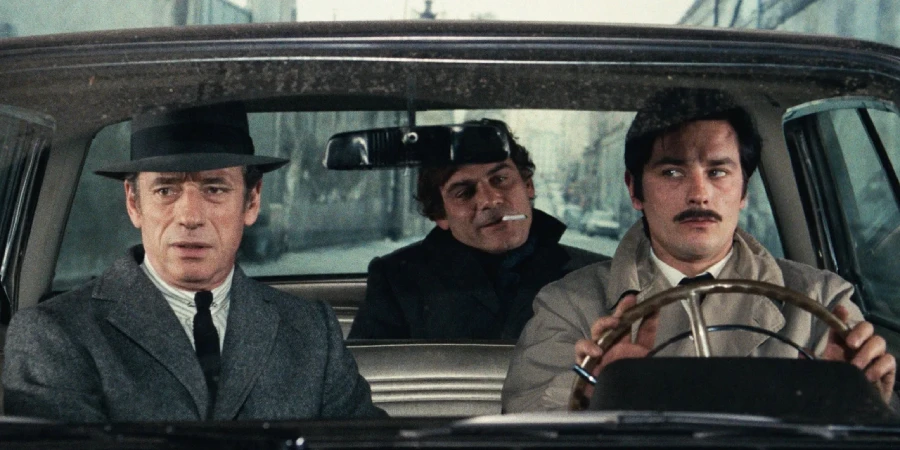
Corey knows he needs a marksman for the Place Vendome job. He seeks out Jansen, a former police sharpshooter played by Yves Montand, now a full-blown alcoholic trembling in his apartment surrounded by hallucinatory visions of crawling animals. Montand is extraordinary here.
Jansen’s detox sequence is one of the film’s most unsettling passages. Melville does not sentimentalize it. He shows us a man gripped by physical horror, then shows us the same man, steadied by bourbon, drawing a bead on a target with absolute surgical calm.
The Place Vendome Heist
This is the sequence people still talk about fifty years later. Running approximately 28 minutes with virtually no dialogue and almost no music, the heist unfolds in real time inside the Ritz jewelry display. Three men move through a laser-alarm grid with practiced, wordless efficiency.
Jansen cuts through the glass case. Corey and Vogel manage the perimeter. Every action is deliberate. Melville’s camera watches without editorializing, no swelling score, no close-ups of sweating faces. It is one of cinema’s great sustained sequences precisely because it refuses to manipulate the audience’s pulse.
The Fence and the Closing Net
After the heist, the three men approach Rico, a fence with connections to both the criminal world and, it turns out, Commissioner Mattei. Selling the stones proves far harder than stealing them. Rico stalls, negotiates, and ultimately traps them.
Mattei has been closing in from his side throughout the film. He runs a network of informants, squeezes them with cold pleasure, and tracks every lead. His professionalism mirrors Corey’s in an uncomfortable way. Both men are simply very good at their jobs, and their jobs are in direct opposition.

Movie Ending
Mattei arranges a sting through Rico. The three men arrive at an isolated warehouse to receive payment for the gems. Police surround the building before the exchange can happen. What follows is a brief, brutal gunfight that kills Vogel, Jansen, and Corey in rapid succession.
There is no heroic last stand. No slow-motion elegy. Each death arrives quickly, matter-of-factly, as if Melville is settling accounts in a ledger. Corey goes last, and Delon plays the final seconds with a face that registers nothing except a faint recognition of how it was always going to end.
Mattei walks through the aftermath. His superiors ask whether the men offered any chance for surrender. He lies and says no. This is the film’s most quietly devastating beat. A man who has spent two hours projecting absolute moral authority chooses to falsify his report, protecting the outcome if not the truth.
Melville refuses any catharsis. Nobody wins. The gems are recovered but the human cost is invisible to the institution. Mattei drives away, and the film ends with that fabricated Buddha quote still hanging in the air. Fate pulled these men into the same circle and closed it around all of them equally.
Are There Post-Credits Scenes?
Le Cercle Rouge has no post-credits scene. Melville was not in the habit of epilogues, ironic winks, or sequel bait. When the film ends, it ends completely.
Type of Movie
Le Cercle Rouge is a French crime thriller, specifically a heist film within the polar tradition of French genre cinema. Its tone is fatalistic, slow-burning, and deeply philosophical without ever announcing its philosophy out loud.
Melville strips away the usual heist-movie adrenaline and replaces it with a kind of mournful inevitability. This is a film about men who are very competent and completely doomed, and Melville never lets you forget that both things are true simultaneously.
Cast
- Alain Delon – Corey
- Bourvil – Commissioner Mattei
- Yves Montand – Jansen
- Gian Maria Volonte – Vogel
- Francois Perier – Rico
- Andre Eyyan – Santi
Film Music and Composer
Eric Demarsan composed the score. His work here is sparse almost to the point of absence, which is a deliberate and correct choice for the material. When music appears, it tends to be cool, jazzy, and unobtrusive.
The Place Vendome heist sequence famously unfolds in near-silence, with only ambient sound. That decision to withhold music is arguably the most important compositional choice in the film. Demarsan’s restraint serves Melville’s vision perfectly.

Filming Locations
Principal photography took place in Paris, including the actual Place Vendome area, which gave the heist sequence its specific architectural texture. Melville used real Parisian geography to anchor the film in a world that feels lived-in and accurate.
Scenes were also shot in the French countryside, particularly for the train escape and the early sequences of Vogel on the run. Those wide, cold, open spaces suit the film’s sense of exposure and vulnerability perfectly. A fugitive in a French field has nowhere to hide, and the landscape makes that fact physical.
Awards and Nominations
Le Cercle Rouge was a major commercial success in France but did not receive significant awards recognition at the major international festivals of its day. Melville’s work was critically respected rather than institutionally celebrated during his lifetime.
Behind the Scenes Insights
- Melville himself invented the opening Buddha quotation and presented it as authentic. He later acknowledged this openly, saying it expressed a truth he believed in regardless of its source.
- Bourvil, best known in France as a comedic actor, was cast against type as the cold Commissioner Mattei. His performance here is among the most controlled and chilling of his career, and it was one of his final roles before his death in 1970.
- Melville was deeply influenced by American film noir and Hollywood crime films. His production company and studio, which he built himself in Paris, was designed to give him complete creative control.
- The heist sequence required meticulous choreography and rehearsal. Melville insisted the three actors move through the set as if they had genuinely practiced the robbery.
- Yves Montand prepared extensively for the detox hallucination sequences, studying the physical symptoms of alcohol withdrawal to achieve the shaking and confusion on screen.
Inspirations and References
Melville drew heavily from American film noir of the 1940s and 1950s. Directors like John Huston and films like The Asphalt Jungle clearly shaped his understanding of the heist genre and its tragic logic.
Japanese samurai cinema also influenced Melville’s approach to male honor, silence, and professional code. His criminals operate by an unspoken bushido of the underworld, where loyalty and competence matter more than survival.
The film also shares thematic DNA with Melville’s earlier work, particularly Le Doulos and Le Samourai, building on his ongoing examination of men trapped between their codes and their fates.
Alternate Endings and Deleted Scenes
No widely documented alternate ending exists for Le Cercle Rouge. Melville was known for tight directorial control over his final cuts, and the film as released reflects his intended vision.
Some cuts of the film circulating outside France were shorter than Melville’s original version. A restored, longer cut has been the preferred version for international release and home video distribution in recent decades.
Book Adaptations and Differences
Le Cercle Rouge is not based on a book or any prior source material. Melville wrote the original screenplay himself. A novelization was published in France to accompany the film’s release, but the film came first.
Memorable Scenes and Quotes
Key Scenes
- The train escape: Vogel slips the handcuff in the dark while Mattei sleeps. No music, minimal cuts. The audience watches a prisoner free himself one careful millimeter at a time.
- Corey at the police checkpoint: He rolls down his window with Vogel hidden in the trunk a few feet behind him. Delon’s face does not move. His stillness is more tense than anything a more expressive actor could have managed.
- Jansen’s hallucinations: Snakes and other creatures crawl across the walls and floor of his apartment. Melville shoots these visions straight, no winking irony, letting them be genuinely frightening.
- The Place Vendome heist: Nearly half an hour of nearly wordless, near-musicless crime choreography. Three men and a laser grid and absolute silence.
- Mattei’s lie: Standing in the aftermath of the shootout, he tells his superiors the men gave no chance for surrender. One flat sentence that reframes everything we thought we understood about him.
Iconic Quotes
- “Siddhartha Gautama, the Buddha, said: ‘All men are guilty. They are born innocent but it doesn’t last.'” (Opening title card, attributed to the Buddha by Melville, fabricated by Melville.)
- Mattei, on his cats: “They always come back.” A line about cats that is clearly also about criminals, informants, and the cycle of the life he oversees.
Easter Eggs and Hidden Details
- Melville named his production company after the American director John Huston‘s production company, a direct nod to the Hollywood crime tradition he was consciously working within and against.
- Corey’s coat and posture deliberately echo Alain Delon‘s character Jeff Costello from Melville’s earlier Le Samourai. Melville was building a visual mythology around Delon’s screen persona across multiple films.
- Commissioner Mattei’s cats appear throughout his scenes at home. They are never explained. Some critics read them as a symbol of his predatory patience; others see them as a rare moment of genuine warmth in a cold man.
- The color red appears sparingly in the production design despite the film’s title. When it does appear, usually in warmly lit interiors, it functions as a quiet visual marker around moments of danger or decision.
Trivia
- Le Cercle Rouge was one of the biggest box office hits in France in 1970, drawing millions of admissions domestically.
- Bourvil died of bone cancer in September 1970, shortly after the film’s release. Commissioner Mattei was his final major film role.
- Melville named himself after the American author Herman Melville; his birth name was Jean-Pierre Grumbach. He adopted the pseudonym as a tribute during World War II and kept it for life.
- The fabricated Buddha quote at the film’s opening has been so widely repeated and attributed that some sources still cite it as genuine Buddhist scripture.
- Melville wore a Stetson hat and aviator sunglasses on set as a deliberate personal uniform, a performance of his own American-influenced mythology.
- The film’s title refers to the concept Melville invented for the opening quote: a circle of fate that draws certain men together regardless of circumstance.
Why Watch?
Watch it for the heist sequence alone: 28 minutes of three men working in near-silence, with no score pushing you toward a feeling you haven’t earned yourself. Melville trusts his audience more than almost any crime director of his era. That trust, combined with Bourvil’s quietly shattering final scene, makes a case for a kind of filmmaking that prizes discipline over sensation.
Director’s Other Movies
- Bob le Flambeur (1956)
- Le Doulos (1962)
- Le Deuxieme Souffle (1966)
- Le Samourai (1967)
- L’Armee des ombres (1969)
- Un Flic (1972)
Recommended Films for Fans
- Le Samourai (1967)
- The Asphalt Jungle (1950)
- Rififi (1955)
- Heat (1995)
- Thief (1981)
- A Prophet (2009)
- L’Armee des ombres (1969)