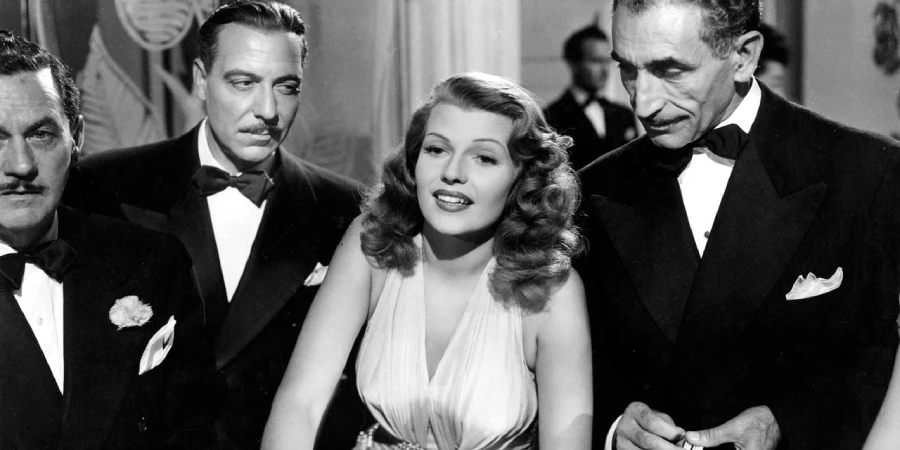

Rita Hayworth takes off one glove in Gilda and somehow makes it feel more dangerous than any gunfight in any Western ever made. Charles Vidor’s 1946 noir is a film about three people who are all lying to each other, and possibly to themselves, in a casino in Buenos Aires where nobody says what they mean. Johnny Farrell narrates his own entrapment with the casual confidence of a man who does not realize he is already caught. What follows is one of the most psychologically tangled love triangles Hollywood ever put on screen.
Detailed Summary
Johnny Farrell Arrives in Buenos Aires
We meet Johnny Farrell, played by Glenn Ford, as a small-time gambler getting rolled on the Buenos Aires docks. A mysterious stranger named Ballin Mundson, played by George Macready, saves him with a cane that conceals a blade. Mundson runs a casino, and he immediately spots Johnny as useful. Johnny gets a job as Mundson’s right-hand man, and the two develop a friendship that the film shoots with a strange, charged intimacy.
Vidor frames Mundson and Johnny in tight two-shots that mirror how the film later frames romantic couples. That choice is not accidental. Critics have spent decades reading their relationship as coded, and the visual evidence supports it.
Gilda Walks In
Mundson disappears briefly and returns with a wife: Gilda, played by Rita Hayworth. Her entrance is one of the most calculated reveals in studio-era cinema. Mundson asks if she is decent; she flips her hair back and says she is. Johnny and Gilda immediately lock eyes, and we understand instantly that they have a history.
Hayworth fills the frame with a physical confidence that makes every other actor in the scene step back slightly. She is not playing a femme fatale in the classic passive sense. Gilda pushes, provokes, and tests every boundary she finds.
The Love Triangle Tightens
Johnny and Gilda’s prior relationship slowly surfaces through clipped, hostile exchanges. They loved each other, it ended badly, and now they are trapped in the same orbit with Mundson between them. Mundson tasks Johnny with keeping Gilda out of trouble, which mostly means keeping other men away from her. Johnny takes the job with a bitter, clenched intensity.
Their scenes together crackle with mutual fury and unresolved desire. Ford plays Johnny as a man perpetually grinding his teeth, which is exactly right. Gilda plays the provocateur, flirting with every man in the casino to punish Johnny for reasons the film eventually makes clear.
Put the Blame on Mame
Mundson hosts a party, and Gilda performs an improvised number, pulling a man from the audience and vamping her way through “Put the Blame on Mame.” She begins peeling off her gloves while the room goes quiet. Johnny watches from the side with a jaw set so tight it looks painful. The sequence ends before she can go further, but the threat of it lingers over every scene that follows.
This is the best scene in the film, full stop. Hayworth does not perform the number as pure seduction. She performs it as an act of controlled warfare, aimed entirely at one man who refuses to admit she has won.
Mundson’s Secret Business
Beneath the casino operation, Mundson runs a cartel that controls tungsten. He is a former Nazi collaborator with powerful enemies, and American and Argentine authorities are quietly circling him. Detective Obregon, played by Joseph Calleia, begins cultivating Johnny as an informant. The geopolitical thriller layer sits somewhat awkwardly against the love story, but it provides the plot mechanism that eventually breaks Mundson’s world apart.
Gilda’s Marriage and Johnny’s Cruelty
When Mundson apparently dies in a plane crash over the ocean, Gilda and Johnny are suddenly free. They marry almost immediately, and then something grim happens: Johnny punishes her for every imagined sin she committed while married to Mundson. He controls her movements, humiliates her publicly, and refuses to let her leave. Gilda drinks, dances, and goads him at every opportunity.
Ford plays this stretch of the film as a man who has confused possession with love, and the film does not let him off the hook for it. Johnny is cruel in a banal, domestic way that feels more disturbing than any villain in the tungsten cartel subplot.
Mundson Returns
Mundson faked his death. He returns to Buenos Aires to reclaim his casino, his wife, and his power. He finds Gilda performing another public number with her hair down and her dignity intact despite everything Johnny put her through. Mundson views Gilda as a possession he left in storage. His return snaps the triangle back into its original shape, tighter than before.

Movie Ending
Mundson returns planning to kill both Gilda and Johnny, framing their betrayal as the reason his business collapsed. He corners Gilda in the casino and makes his intentions clear. Before he can follow through, Uncle Pio, the casino’s bathroom attendant played by Steven Geray, stabs Mundson. It is an abrupt resolution to the film’s most menacing presence, and honestly it feels slightly too convenient, but Macready played Mundson so coldly that any ending for him was always going to feel like a relief.
With Mundson dead and the cartel dismantled, Johnny and Gilda reconcile. Detective Obregon gives Johnny a pass for his cooperation with the authorities. Johnny admits, implicitly, that his cruelty toward Gilda came from his own psychological wreckage rather than anything she actually did.
Gilda forgives him. They walk out of the casino together. It is a Production Code-approved happy ending, and audiences knew what they were getting. But Vidor shoots their final reconciliation with noticeably less heat than every scene of their mutual torment. Whether that is intentional commentary or studio obligation is a question worth sitting with.
What lingers is not the resolution but the preceding ninety minutes of two people weaponizing their love for each other. The ending tidies things up. The film itself does not.
Are There Post-Credits Scenes?
Gilda is a 1946 studio production. Post-credits scenes did not exist as a convention then. There is nothing after the end title card.
Type of Movie
Gilda is a film noir with a strong romantic melodrama current running beneath it. Its genre DNA includes the femme fatale archetype, the morally compromised male protagonist, and the shadowy world of criminal enterprise. The tone shifts between cool, cynical narration and genuinely heated emotional confrontation.
It also functions, unusually for its era, as a film about gendered cruelty within a marriage. That dimension gives it a psychologically darker undercurrent than most studio noirs of the period.
Cast
- Rita Hayworth – Gilda
- Glenn Ford – Johnny Farrell
- George Macready – Ballin Mundson
- Joseph Calleia – Detective Obregon
- Steven Geray – Uncle Pio
- Joe Sawyer – Casey
- Gerald Mohr – Captain Delgado
Film Music and Composer
Morris Stoloff served as the film’s musical director, with Marlin Skiles credited for the score. The music largely functions as atmospheric underscoring, maintaining a smoky, club-adjacent mood throughout.
The real musical centerpiece is “Put the Blame on Mame,” written by Doris Fisher and Allan Roberts. Hayworth’s performance of the song, accompanied by her glove removal, is the moment audiences remember decades later. The song itself is a playful, slightly subversive piece that blames women for every natural disaster in history, which gives Gilda’s performance of it a pointed irony.
Hayworth’s singing voice was dubbed by Anita Ellis, a common studio practice at the time.

Filming Locations
Gilda was shot entirely on soundstages at Columbia Pictures in Hollywood. Buenos Aires exists in the film as a constructed atmosphere rather than a real location. Vidor and cinematographer Rudolph Mate built their Argentina from shadow, lamplight, and production design.
Shooting on controlled studio sets gave the film its characteristic claustrophobia. Every space feels slightly artificial, slightly sealed off from the outside world, which suits a story about characters who cannot escape each other.
Awards and Nominations
Gilda did not receive major Academy Award nominations at the time of its release. Rita Hayworth’s performance generated significant cultural attention, but the awards landscape of the era did not consistently recognize noir performances of this type.
Behind the Scenes Insights
- Rita Hayworth reportedly said that every man she met fell in love with Gilda and woke up disappointed with her. That quote speaks directly to how completely she inhabited the role.
- Glenn Ford and Rita Hayworth made several films together, and their chemistry carried a genuine off-screen tension that Vidor used deliberately.
- George Macready’s real-life facial scar, the result of a car accident, gave Mundson an instantly unsettling physical presence that no makeup department could have manufactured.
- Hayworth performed the “Put the Blame on Mame” number in a strapless black gown that became one of the most referenced costume choices in Hollywood history.
- Rudolph Mate’s cinematography used deep shadows and hard side-lighting to give nearly every frame a sense of something being concealed.
- Director Charles Vidor had a famously contentious relationship with Columbia head Harry Cohn, and the studio environment was tense throughout production.
Inspirations and References
Gilda was based on an original story by E.A. Ellington, adapted for the screen by Marion Parsonnet. It draws from the broader tradition of hardboiled American crime fiction and the noir literary sensibility that writers like James M. Cain and Raymond Chandler had established in the preceding decade.
The film’s Buenos Aires setting reflects a postwar fascination with South America as a place where European villains and American opportunists could operate outside normal legal structures. That geopolitical anxiety feeds directly into the tungsten cartel plot.
Alternate Endings and Deleted Scenes
No documented alternate endings or significant deleted scenes from Gilda have been confirmed in the public record. The film’s ending, with its tidy Code-compliant reconciliation, was almost certainly shaped by studio requirements rather than creative choice, but no alternate version has surfaced to confirm a darker cut existed.
Book Adaptations and Differences
Gilda is not based on a novel or prior literary work beyond Ellington’s original story treatment. No book-to-film comparison applies here.


Memorable Scenes and Quotes
Key Scenes
- Gilda’s entrance: Hayworth flips her hair back in response to Mundson’s question about decency, and the camera catches it in one unbroken movement. Johnny’s face registers recognition and something close to dread.
- “Put the Blame on Mame” performance: Hayworth works the room with deliberate, controlled energy, the gloves coming off one finger at a time while Ford stands rigidly at the edge of the frame.
- Johnny and Gilda’s first private confrontation: Their dialogue cuts back and forth with the rhythm of people who know exactly which words will cause the most damage, and they choose those words on purpose.
- Mundson’s return: Macready appears in the casino with the same cold composure he had before his apparent death, and the film’s atmosphere immediately shifts from melodrama back to genuine menace.
- Johnny’s controlled cruelty during their marriage: A sequence of scenes in which he systematically limits Gilda’s freedom while maintaining a surface of civility. Ford plays these scenes better than the script strictly requires.
Iconic Quotes
- “If I’d been a ranch, they would have named me the Bar Nothing.” Gilda, introducing herself with characteristic deflection.
- “Hate can be a very exciting emotion. Haven’t you noticed that? There’s a heat in it that one can feel.” Mundson, cutting through the pretense of the Johnny-Gilda dynamic with surgical precision.
- “Statistics show that there are more women in the world than anything else. Except insects.” Johnny, narrating with the cheerful misogyny the film is quietly critiquing.
Easter Eggs and Hidden Details
- The cane-sword Mundson carries functions as visual shorthand for his character: elegant on the outside, designed to wound underneath. Vidor keeps it in frame during key conversations to remind you what he is capable of.
- Gilda’s black strapless gown in the performance sequence mirrors the stark black-and-white photography in a way that makes her look simultaneously glamorous and trapped, almost pinned to the screen.
- Johnny’s narration positions him as the controlling intelligence of the story, but nearly every plot development happens to him rather than because of him. The narration is quietly unreliable in a way the film never explicitly flags.
- Uncle Pio watches every confrontation between Johnny and Gilda from a discreet distance throughout the film. His eventual act of violence reads almost as a response to accumulated observation.
- The casino’s geography shifts slightly depending on the emotional register of the scene. Wide shots make it feel public and exposed; close shots make it feel like a private trap. Mate’s framing does this throughout.
Trivia
- A photograph of Rita Hayworth as Gilda was reportedly attached to the atomic bomb dropped on Bikini Atoll during postwar testing in 1946. Hayworth publicly stated she was not pleased about this.
- Glenn Ford reportedly considered this one of his most technically demanding roles because the character’s interior conflict had to register almost entirely through physical restraint rather than expression.
- Rita Hayworth’s real hair was darker than her screen hair; Columbia kept her as a redhead for most of her major films through careful dyeing and lighting choices.
- The film was a major commercial success for Columbia Pictures and cemented Hayworth as the studio’s biggest star of the era.
- George Macready was a classically trained stage actor, and he reportedly researched the vocal rhythms of certain European fascist figures to build Mundson’s cadence.
- Anita Ellis, who dubbed Hayworth’s vocals, remained largely uncredited for many years despite her voice being central to the film’s most famous sequence.
Why Watch?
Watch it specifically for the twenty minutes surrounding the “Put the Blame on Mame” sequence, where Hayworth turns a party performance into a masterclass in doing two things at once: entertaining a room and destroying one specific person in it. Ford’s stone-faced fury across from her is equally precise. No other film from this period captures the violence inside romantic obsession with quite this much economy.
Director’s Other Movies
- Cover Girl (1944)
- A Song to Remember (1945)
- The Love of Carmen (1948)
- Hans Christian Andersen (1952)
- Rhapsody (1954)
Recommended Films for Fans
- Double Indemnity (1944)
- The Big Sleep (1946)
- Out of the Past (1947)
- Laura (1944)
- The Postman Always Rings Twice (1946)
- Notorious (1946)
- Mildred Pierce (1945)