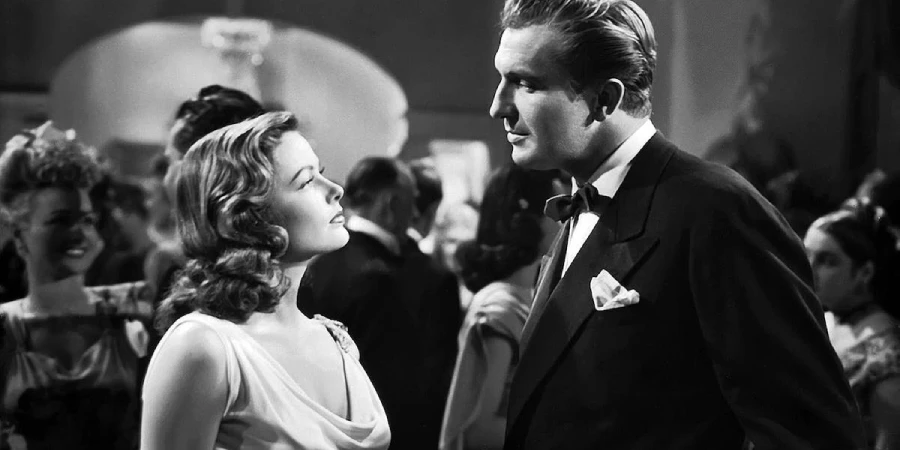

Laura is a film built on one of cinema’s most audacious twists: the murder victim walks back through the front door, alive and confused, halfway through the story. Otto Preminger’s 1944 noir masterpiece plays its audience like a violin, coaxing genuine grief and infatuation out of a detective who falls in love with a dead woman’s portrait. Moreover, it smuggles its real killer in plain sight the entire time. Few films from Hollywood’s golden era feel this sharp, this strange, or this genuinely unsettling.
Detailed Summary
A Detective Obsessed With a Dead Woman
Detective Mark McPherson (Dana Andrews) arrives to investigate the apparent murder of Laura Hunt (Gene Tierney), a successful advertising executive. Her face has been destroyed by a shotgun blast, making identification difficult but not officially disputed.
McPherson begins interviewing the people in Laura’s orbit. He meets Waldo Lydecker (Clifton Webb), a razor-tongued newspaper columnist who was Laura’s mentor, closest companion, and obsessive guardian. Lydecker narrates much of the film’s opening in voiceover, positioning himself as the authority on Laura’s life.
The Portrait and the Obsession
As McPherson investigates Laura’s apartment, he becomes increasingly fixated on a large portrait of her hanging above the fireplace. He reads her diary, handles her belongings, and eventually falls asleep in her chair beneath the painting.
This section of the film does something quietly remarkable. It transfers Lydecker’s obsession with Laura directly onto McPherson, and consequently onto the audience. By the time Laura’s story should feel closed, it feels wide open.
The Suspects Take Shape
Shelby Carpenter (Vincent Price), Laura’s charming but unreliable fiancé, emerges as an early suspect. He is a kept man with wandering eyes, and McPherson quickly notices his relationship with the wealthy Ann Treadwell (Judith Anderson), who finances Shelby’s lifestyle and clearly wants him for herself.
Lydecker, meanwhile, makes no secret of his contempt for Shelby. His possessiveness toward Laura borders on mania. In contrast, Shelby plays everything lightly, which makes him harder to read.
Laura Returns From the Dead
Late one night, while McPherson dozes in Laura’s apartment, the door opens and Laura Hunt walks in, very much alive. She had been at her country cottage and knew nothing of the murder. McPherson’s emotional world collapses and rebuilds itself in a single moment.
So whose body was found in Laura’s apartment? It belonged to Diane Redfern, a model whom Shelby had been seeing secretly. Diane had been using Laura’s apartment, and someone arrived with a shotgun intending to kill Laura, not knowing it was Diane who answered the door.
McPherson Investigates the Living Laura
Now Laura becomes both a witness and a suspect in her own murder case. McPherson interrogates her, and their relationship shifts into something tense and romantically charged. He admits, almost against his will, that he has feelings for her.
Lydecker grows visibly alarmed by this development. His narration, so confident at the film’s start, begins to fracture at the edges. Furthermore, his alibi for the night of the murder is suspiciously airtight in ways that feel rehearsed.

Movie Ending
McPherson pieces it together and confronts Waldo Lydecker as the killer. Lydecker had arrived at Laura’s apartment intending to murder her rather than allow her to marry Shelby Carpenter. His logic was possessive and monstrous: if he could not have Laura entirely to himself, no one else would have her at all.
Lydecker hid the shotgun inside an ornate clock in Laura’s apartment, a clock he himself had given her as a gift. When McPherson works this out, he races back to the apartment. Lydecker has arrived ahead of him.
Laura is alone with Lydecker when he retrieves the weapon and prepares to shoot her. McPherson bursts in and police officers shoot Lydecker on the threshold of Laura’s apartment. He dies calling her name, his obsession fully intact until his last breath.
What makes this ending so effective is its inevitability in hindsight. Lydecker had narrated the entire film from a position of authority, guiding our interpretation of every character. However, his narration was never objective; it was the self-serving account of a man who believed ownership and love were the same thing. His death confirms what the film had been quietly arguing all along: romantic obsession is not romantic at all.
Laura and McPherson are left together, and the film offers no tidy romantic resolution beyond their survival. It is a conclusion built on relief rather than triumph, which feels exactly right for a noir.
Are There Post-Credits Scenes?
Laura was released in 1944, well before the era of post-credits sequences. There are no post-credits scenes of any kind. When the film ends, it ends completely.
Type of Movie
Laura is a film noir and psychological mystery. Its tone balances dark romanticism with genuine menace, threading elegant drawing-room dialogue through a story about murder and obsession.
In contrast to more hard-boiled noirs of its era, Laura spends as much time in glamorous Manhattan apartments as it does in shadowy streets. Its darkness is interior and psychological rather than environmental.
Cast
- Gene Tierney – Laura Hunt
- Dana Andrews – Detective Mark McPherson
- Clifton Webb – Waldo Lydecker
- Vincent Price – Shelby Carpenter
- Judith Anderson – Ann Treadwell
Film Music and Composer
David Raksin composed the score for Laura, and his main theme became one of the most recognized pieces of music in Hollywood history. The “Laura” theme is a haunting, melancholic melody that perfectly mirrors McPherson’s longing for a woman he believes is dead.
Raksin reportedly composed the theme after receiving a Dear John letter from his wife, channeling personal heartbreak directly into the music. Subsequently, lyricist Johnny Mercer added words to the melody, and it became a jazz standard recorded by countless artists over the decades.
The score does not merely accompany the film; it actively shapes the audience’s emotional relationship with Laura as a figure. Hearing the theme, you understand McPherson’s obsession without a single line of dialogue.

Filming Locations
Laura shot primarily on 20th Century Fox studio sets in Los Angeles, California. Laura’s apartment, Lydecker’s penthouse, and the police interrogation spaces were all constructed on soundstages.
This studio-bound approach actually serves the film’s themes well. By confining most of the action to interiors, Preminger creates a world of controlled, suffocating spaces that reflect Lydecker’s desire to keep Laura contained and possessed.
Some exterior shots and establishing footage reflect New York City, grounding the story in a specific social world of Manhattan wealth and media glamour. However, the film’s real geography is psychological rather than physical.
Awards and Nominations
Laura received five Academy Award nominations, including Best Director for Otto Preminger and Best Supporting Actor for Clifton Webb. Joseph LaShelle won the Academy Award for Best Cinematography, Black-and-White, a recognition that acknowledged how vital the film’s visual style was to its success.
Notably, the film’s influence on the noir genre extended well beyond awards season, cementing its status as a canonical work of American cinema.
Behind the Scenes Insights
- Rouben Mamoulian originally directed the film before Otto Preminger replaced him during production. Preminger reshot much of what Mamoulian had filmed, and the two men disputed credit for years afterward.
- Clifton Webb received his first major film role as Lydecker at the age of 52. His theatrical background gave the character a precise, theatrical menace that a more conventional film actor might not have delivered.
- Producer Darryl F. Zanuck initially disliked David Raksin’s theme music and wanted to use Duke Ellington’s Sophisticated Lady instead. Raksin persuaded him otherwise, and the original theme went on to become iconic.
- Dana Andrews reportedly drew on genuine melancholy for McPherson’s scenes of obsession in Laura’s apartment, and Preminger encouraged the actor to play the quieter moments with real emotional stillness rather than dramatic expression.
- Preminger fought studio executives to keep Clifton Webb in the Lydecker role despite resistance from those who considered Webb too theatrical for film audiences.
Inspirations and References
Laura adapts the 1943 novel of the same name by Vera Caspary. Caspary had developed the story first as a stage play before shaping it into the novel that caught Hollywood’s attention.
Caspary’s original conception was notably more focused on Laura’s own perspective, giving her greater interiority and agency than the film ultimately provides. The adaptation shifted the center of gravity toward McPherson and Lydecker, consequently making it more of a male-dominated psychological thriller.
The novel’s structure was also more formally experimental than the film, using multiple first-person narrators to tell the same story from different angles. Preminger and the screenwriters streamlined this into the single Lydecker-dominated voiceover that opens the film.
Alternate Endings and Deleted Scenes
No widely documented alternate endings for Laura exist in the public record. The transition from Mamoulian’s footage to Preminger’s reshoots means that some early material was effectively discarded, though a complete Mamoulian cut does not appear to have survived in any publicly known form.
Preminger’s approach to the material was reportedly tighter and more visually controlled than Mamoulian’s, but specific details about deleted scenes or cut sequences remain undocumented in reliable sources.
Book Adaptations and Differences
Laura is based directly on Vera Caspary’s 1943 novel of the same title. The core mystery and characters carry over faithfully, but the adaptation made significant structural and thematic choices that shifted the story’s focus.
In Caspary’s novel, Laura herself narrates a substantial section, giving readers direct access to her thoughts and desires. The film removes this layer almost entirely, keeping Laura as an object of fascination rather than a subject with full interiority.
Caspary was reportedly dissatisfied with aspects of the adaptation, particularly the degree to which Laura’s perspective was marginalized. On the other hand, she acknowledged that the film reached a far wider audience than the novel alone could have.


Memorable Scenes and Quotes
Key Scenes
- McPherson falls asleep under the portrait: Detective McPherson, alone in Laura’s apartment, drifts into sleep beneath her painted image while her theme plays. It is the film’s most emotionally exposed moment and its most quietly disturbing.
- Laura walks through the door: Midway through the film, the dead woman simply appears. Preminger plays it with no fanfare, and the shock hits precisely because of that restraint.
- Lydecker’s clock revelation: McPherson realizes the shotgun has been hidden inside the ornate clock Lydecker gifted Laura. A decorative object becomes a murder weapon, and a gift becomes a threat.
- Lydecker’s opening monologue: Clifton Webb delivers the film’s first lines while lying in an elaborate bath, establishing Lydecker’s vanity, wit, and unsettling intimacy with the audience immediately.
- Lydecker’s final approach: Lydecker retrieves the rebuilt weapon and advances on Laura in her own apartment, transforming the film’s most familiar space into a trap.
Iconic Quotes
- “I shall never forget the weekend Laura died.” Waldo Lydecker’s opening line, which reframes everything once we learn he was her killer.
- “I don’t use a pen. I write with a goose quill dipped in venom.” Lydecker on his journalistic method, a line that doubles as his character summary.
- “You’d better watch out, McPherson, or you’ll end up in a psychiatric ward. I don’t think they’ve ever had a patient who fell in love with a corpse.” Lydecker diagnosing McPherson’s obsession while projecting his own.
Easter Eggs and Hidden Details
- Lydecker’s ornate clock, prominently displayed throughout the film, hides the murder weapon inside it. Its presence in early scenes rewards attentive rewatchers who notice how often Preminger’s camera acknowledges it.
- Lydecker’s voiceover narration positions him as the storyteller and moral authority of the film, which functions as a sustained piece of misdirection. His authority over the narrative mirrors his desire for authority over Laura’s life.
- Laura’s portrait dominates the visual composition of her apartment scenes, frequently appearing over McPherson’s shoulder. Preminger frames it almost as a second character, sharing screen space with the living actors.
- Shelby Carpenter’s apparent shallowness and obvious guilt-adjacent behavior function as deliberate red herrings. Vincent Price’s natural screen presence made Shelby more suspicious than the script strictly required, which the film exploits cleverly.
- Lydecker’s bath scene at the film’s opening echoes the classical vanity of Roman aristocrats, subtly signaling his belief in his own superiority and his sense that ordinary social rules do not apply to him.
Trivia
- David Raksin composed the “Laura” theme in a single weekend after Darryl Zanuck issued an ultimatum about the music.
- Clifton Webb’s portrayal of Waldo Lydecker effectively launched his film career despite his already extensive background in theater and stage musicals.
- Laura was one of the first films to feature a music theme so strongly associated with a character that the theme itself became the film’s primary marketing hook.
- Gene Tierney appears relatively late in the film despite being its title character, a structural gamble that Preminger executed with considerable confidence.
- Vincent Price, later famous for horror films, plays the comparatively mundane role of the charming but unreliable Shelby Carpenter, which demonstrates his considerable range as a young actor.
- Vera Caspary initially developed the story as a stage play titled Ring Twice for Laura before transforming it into the novel.
- Joseph LaShelle’s cinematography made extensive use of shadow and light contrast to communicate psychological states, a technique that became central to the visual language of noir.
Why Watch?
Laura is essential viewing for anyone serious about film noir, psychological thrillers, or Hollywood craftsmanship at its peak. Its central twist remains genuinely surprising, its performances are exceptional across the board, and Raksin’s score alone justifies the 88-minute investment. Furthermore, it rewards multiple viewings in ways that very few films from any era can claim.
Director’s Other Movies
- Fallen Angel (1945)
- Forever Amber (1947)
- Whirlpool (1949)
- Where the Sidewalk Ends (1950)
- The Moon Is Blue (1953)
- River of No Return (1954)
- Carmen Jones (1954)
- The Man with the Golden Arm (1955)
- Anatomy of a Murder (1959)
- Exodus (1960)
- Advise and Consent (1962)