
Romain Gavras shot an entire riot in one take, and that single fact tells you everything you need to know about what kind of film Athena is. Released on Netflix in 2022, it follows three brothers torn apart by grief, rage, and radically different ideas about justice after their youngest sibling dies.
Director Gavras orchestrates the chaos of a suburban housing project turned warzone with a camera that almost never stops moving. This is one of the most formally daring films to appear on a streaming platform in years, and it earns every second of its ambition.
Detailed Summary
The Opening Raid
Athena opens with a press conference. Abdel (Dali Benssalah), a French soldier recently returned from a combat tour, stands before cameras and speaks about the death of his youngest brother, Idir, a thirteen-year-old boy who died after an apparent police beating.
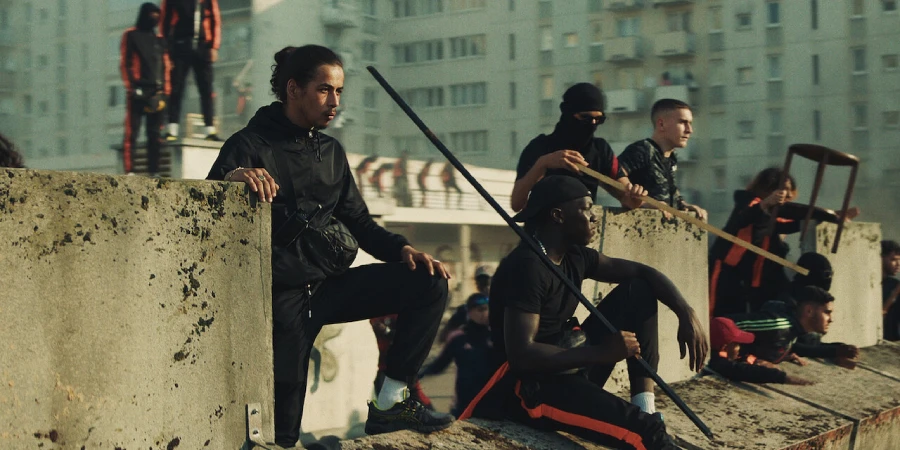
Before Abdel even finishes speaking, his brother Karim (Sami Slimane) leads a masked group of young men in a lightning assault on a police station. They throw molotov cocktails, steal weapons and riot gear, and retreat into the Athena housing project in a single, unbroken shot that lasts several minutes. It is the most arresting opening sequence in recent French cinema.
Athena Under Siege
Karim barricades the entire Athena complex. He and the youth of the project declare that no police will enter until justice is delivered for Idir. Abdel tries to negotiate, desperate to keep the situation from spiraling into bloodshed.
A third brother, Moktar (Ouassini Embarek), operates in the background as a drug dealer. His concern is less about justice and more about his operation, which the chaos is threatening to destroy. Each brother represents a different relationship to the French state: one who serves it, one who rejects it entirely, and one who simply exploits the gaps it leaves behind.
The Video Evidence
A video surfaces appearing to show police officers beating Idir. Karim seizes on it as proof, and it hardens his resolve to hold Athena against the authorities. Abdel, while grieving, urges patience and legal process.
Tension inside the project grows as the police prepare to move in. Gavras shoots the labyrinthine corridors and stairwells of Athena like a fortified castle, and the geography starts to feel genuinely oppressive.
The Far-Right Twist
Here is where the film pivots hard. Abdel uncovers evidence that the police officers visible in the beating video are not actually police. The men who beat Idir were far-right extremists, some with ties to law enforcement, who wanted to provoke exactly this kind of uprising. Their goal was to manufacture a crisis that would discredit the residents of Athena and justify a crackdown.
This revelation reframes everything. Karim’s rage, however understandable, is being weaponized by the very forces he believes he is fighting. Abdel races to get this information to Karim before the situation becomes irreversible.
Moktar’s Betrayal
Moktar, practical to the last, cuts a deal. He negotiates with authorities to end the standoff in exchange for protection of his business interests. His betrayal is not dramatic or theatrical; it is quiet, transactional, and in some ways the most chilling moment in the film because it reflects a very real kind of moral compromise.
The Final Confrontation
Abdel reaches Karim and tries to explain the truth about Idir’s killers. Karim, already too far gone and too deep in his own fury, cannot fully absorb it. The police breach Athena. Violence explodes through the corridors in a series of savage, close-quarters sequences.
Karim dies in the chaos. Abdel survives, left standing in the ruins of the project, surrounded by smoke and broken glass, holding the truth that nobody around him lived long enough to act on.

Movie Ending Explained
Abdel survives the police assault on Athena, but survival here feels like punishment rather than relief. Karim is dead. The project is destroyed. The far-right conspirators who actually killed Idir have, in a brutal irony, achieved exactly what they wanted: the community tore itself apart, the police cracked down, and the narrative in the outside world will almost certainly blame the residents rather than the provocateurs.
Gavras refuses to offer a clean resolution. Abdel knows the truth, but knowledge without power to act on it is almost useless. The film ends in a state of grief and political impotence that feels earned rather than nihilistic, because every story beat has been building toward this particular dead end.
What makes the ending genuinely painful is Dali Benssalah’s physicality in those final minutes. He does not weep or rage. He simply stands there, shoulders dropped, staring at a space that used to be a community. That stillness, after nearly two hours of constant, furious movement, hits harder than any speech could.
The film’s final statement is uncomfortable but clear: systemic violence does not need to fire the first shot when it can engineer someone else into doing it.
Are There Post-Credits Scenes?
Athena has no post-credits scene. Once the film ends, it ends completely. Given the tone, anything tacked on afterward would have felt obscene.
Type of Movie
Athena is a political action thriller with strong elements of Greek tragedy. Its pacing is relentless and its formal ambition is enormous, but beneath the long takes and riot choreography sits a deeply sorrowful story about grief, brotherhood, and systemic manipulation.
Tonally, it is furious and mournful in equal measure. It never lets spectacle become entertainment without consequence.
Cast
- Dali Benssalah – Abdel
- Sami Slimane – Karim
- Ouassini Embarek – Moktar
- Anthony Bajon – Jérémy
- Alexis Manenti – Greg
Film Music and Composer
Surkin (Benoit Heitz) composed the score for Athena. Becker is known for working on sound design and music in unconventional ways, and his work here is less about melodic themes and more about texture and physical pressure.
Much of the score functions almost as an extension of the sound design: industrial noise, percussive drones, and low-frequency rumbles that keep the audience physically unsettled. It is one of the most underrated elements of the film, because it does a huge amount of emotional work without ever drawing attention to itself.

Filming Locations
Production built a large-scale set specifically for the film rather than shooting in an actual housing project. The Athena complex was a purpose-built construction that allowed Gavras and his crew to rig camera rigs, plan complex choreography, and execute the long takes without the logistical chaos of a real residential location.
This decision pays off enormously. Because every corridor and stairwell was designed for the film, the geography is internally consistent in a way that amplifies the sense of a sealed, besieged world. Athena feels like a real place precisely because it was built to serve the story rather than adapted from one.
Awards and Nominations
Athena premiered at the Venice Film Festival in 2022, where it screened out of competition. It generated significant critical discussion around its formal ambition but did not collect major awards.
Behind the Scenes Insights
- The opening sequence, a single unbroken take running several minutes through the police station raid and retreat into Athena, required extensive rehearsal with hundreds of performers and crew.
- Gavras worked closely with stunt coordinators and choreographers to treat the action sequences almost like large-scale dance pieces, mapping every body in the frame.
- Sami Slimane, who plays Karim, was a non-professional actor before this film. Gavras cast him after a long search for someone who could carry that specific quality of righteous, uncontrollable grief.
- Nicolas Becker collaborated with the sound department from very early in production, meaning music and sound design were developed in parallel rather than the score being added in post-production.
- The film was co-written by Gavras and Ladj Ly, director of Les Misérables, which explains some of its political precision about the dynamics of French banlieue life.
Inspirations and References
Gavras and Ly drew directly from the real social tensions surrounding French housing projects, police violence, and the recurring cycle of uprising and crackdown that has marked French politics for decades. Films like Ly’s own Les Misérables (2019) share DNA here.
The film’s title and structure lean heavily on Greek tragedy. Athena is both the name of the project and the goddess of warfare and wisdom, a pairing that underlines the film’s argument that violence without correct knowledge leads to self-destruction. The three brothers map loosely onto competing tragic archetypes: the dutiful son who mediates, the wrathful avenger, and the corrupt opportunist.
Gavras has also cited the influence of action choreographers and long-take filmmakers. The opening sequence draws inevitable comparisons to the opening of Atonement (2007) and the hallway sequence in Oldboy (2003), though Gavras’s execution has its own political fury that distinguishes it from either.
Alternate Endings and Deleted Scenes
No alternate endings or officially confirmed deleted scenes have been made public for Athena. Given how precisely constructed the film feels, it is hard to imagine the ending being substantially different in any earlier draft.
Book Adaptations and Differences
Athena is not based on a book or any prior source material. It is an original screenplay written by Romain Gavras and Ladj Ly.
Memorable Scenes and Quotes
Key Scenes
- The opening raid: A single, continuous shot follows the assault on the police station and the retreat into Athena. Molotov cocktails arc through the air. Masked figures swarm. The camera sprints alongside them. It is an extraordinary piece of filmmaking that functions as a thesis statement for everything that follows.
- Karim’s first address to the project residents: Standing on a rooftop with smoke rising behind him, Karim rallies the youth of Athena. Slimane’s voice cracks with grief and conviction in a way that makes you understand, viscerally, why people follow him.
- Abdel’s discovery of the conspiracy: Shot in tight close-up, Benssalah’s face shifts through shock, despair, and then a terrible kind of clarity as the full picture comes together. It is the film’s quietest sequence and one of its most devastating.
- The breach of Athena: Police flood the corridors in a sequence that mirrors the opening raid structurally, but where the opening felt electric and defiant, this one feels like a funeral.
- The final shot: Abdel standing alone in the wreckage, completely still, the camera slowly pulling back to reveal the scale of destruction around him.
Iconic Quotes
- “They killed Idir. We will not leave until there is justice.” (Karim, rallying the project’s residents)
- “You are doing exactly what they wanted you to do.” (Abdel, to Karim, in the film’s most painful exchange)
Easter Eggs and Hidden Details
- The name “Athena” functions on multiple levels: Greek goddess of warfare and wisdom, the idea that the project is both a battleground and a place of knowledge being deliberately suppressed.
- The architecture of the Athena set references real French banlieue housing project designs from the 1960s and 1970s, built with the best intentions and left to deteriorate by decades of political neglect.
- Karim’s wardrobe shifts across the film: he begins in civilian clothes and gradually acquires more military-looking gear as the siege progresses, a visual arc suggesting his transformation from grieving brother to warlord.
- The far-right provocateurs are introduced with very little screen time early on, blending almost invisibly into background crowd scenes before their significance becomes clear.
- Gavras frames several shots from directly above, a God’s-eye view that places the characters inside a maze they cannot see from their ground-level perspective, a visual argument about the limits of their knowledge.
Trivia
- Romain Gavras is the son of the legendary political filmmaker Costa-Gavras, director of Z (1969). The political DNA runs very clearly through Athena.
- Before Athena, Gavras was primarily known as a music video director, having directed videos for M.I.A., Jay-Z, and Kanye West, among others. His background in visual spectacle and large-crowd choreography is fully on display here.
- Co-writer Ladj Ly grew up in a housing project in Montfermeil, the same suburb that inspired Les Misérables. His firsthand knowledge gave the script a social specificity that comes through in every scene set inside Athena.
- The film was shot on a custom-built set rather than a real location, yet most viewers assume they are watching a real housing project.
- Athena was one of Netflix’s highest-profile original films at the Venice Film Festival in 2022.
- Sami Slimane’s performance as Karim is, by any reasonable measure, one of the best debut performances in a French film in recent years, and he carried scenes opposite experienced professional actors without faltering once.
Why Watch?
Watch Athena because the opening sequence alone, a single unbroken shot of a riot erupting and a community retreating behind its own walls, is a piece of filmmaking that demands to be seen on the largest screen you own. Gavras and Ly combine formal showmanship with genuine political anger in a way that is rare, and Sami Slimane’s debut performance carries the whole film on its back. This is not a comfortable watch, but discomfort is the point.
Director’s Other Movies
- Notre Jour Viendra (2010)
- The World Is Yours (2018)
Recommended Films for Fans
- Les Misérables (2019)
- La Haine (1995)
- Oldboy (2003)
- Children of Men (2006)
- Z (1969)
- Fury Road (2015)