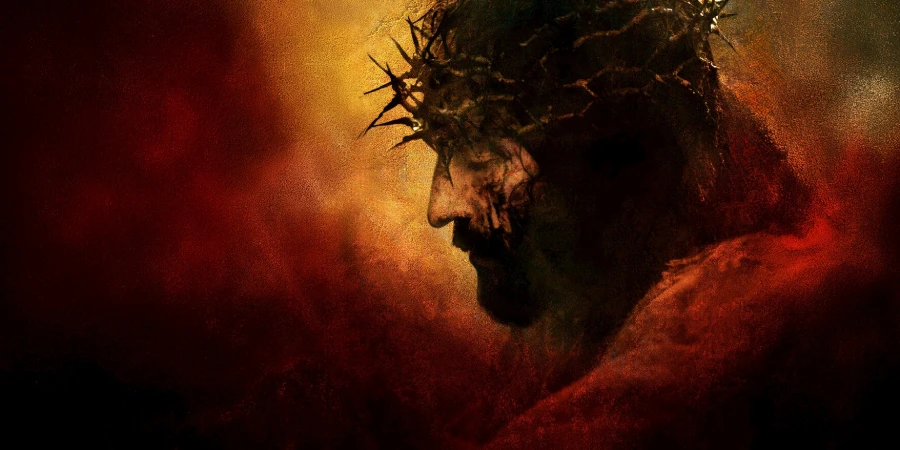

Mel Gibson spent roughly $30 million of his own money to show a man being flogged until his skin hangs in strips, and the result became one of the highest-grossing films ever made. The Passion of the Christ does not ease you in. Within minutes, Jesus is sweating blood in Gethsemane while a pale, androgynous Satan glides through the fog like a bad dream. Gibson wanted discomfort, and he got it, both on screen and off.
Detailed Summary
Gethsemane: The Garden and the Betrayal
Gibson opens in the Garden of Gethsemane, late at night, where Jesus (Jim Caviezel) prays in anguish while his disciples sleep nearby. A serpent slithers out from beneath the robes of Satan, and Jesus crushes it under his heel, a direct visual nod to Genesis 3:15. This small, quiet moment sets the theological thesis for everything that follows.
Judas Iscariot leads a cohort of temple guards into the garden. He identifies Jesus with a kiss. Peter draws a sword and cuts off the ear of Malchus, a servant of the high priest, and Jesus heals it immediately, a detail many adaptations skip but Gibson includes without fanfare.
The Jewish Council and Pilate’s Court
Jesus faces the Sanhedrin, where Caiaphas and the chief priests press charges of blasphemy. The interrogation moves fast, almost procedurally, and Gibson frames it with tight close-ups that keep you inside the suffocating room. Some critics took issue with how the Jewish leadership is portrayed here, and that controversy followed the film for years.
Pilate (Hristo Naumov Shopov) interviews Jesus privately and finds no guilt in him. His wife Claudia Procula brings him a cloth, visibly distressed, after a dream warns her about this man. Pilate tries to pass the problem to Herod Antipas, who mocks Jesus and sends him back. Pilate washes his hands in front of the crowd and releases Barabbas.
The Scourging at the Pillar
This is where the film earns its reputation. Roman soldiers flog Jesus first with rods, then with a flagrum, a multi-thonged whip embedded with metal and bone fragments. Caviezel’s body goes from upright to barely conscious across a sequence that lasts several minutes without relief. Gibson holds on each strike with a commitment that crosses from devotion into something that feels almost punishing to watch.
Satan moves through the crowd carrying a grotesque infant, a disturbing inversion of the Madonna and Child image. It is one of Gibson’s stranger directorial choices, and it lands with genuine unease. Brutality and theological symbol share the same frame throughout this stretch of the film.
The Crown of Thorns and Via Dolorosa
Soldiers weave a crown of thorns and press it onto Jesus’s head with a rod. They dress him in a purple robe and mock him, then strip the robe away, reopening wounds. Caviezel carries genuine physical distress into these scenes; he actually suffered hypothermia, a dislocated shoulder, and was struck by lightning during production.
Jesus carries the cross through Jerusalem’s streets while the crowd jeers. Mary (Maia Morgenstern) pushes through the crowd to reach her son, and Gibson cuts to a flashback of a young Jesus falling as a child, Mary running to him, then back to the present. It is the most emotionally precise editing in the entire film.
Simon of Cyrene is pressed into service to help carry the cross. Veronica wipes Jesus’s face with a cloth. These episodes from tradition play out in quick succession, grounding the procession in human detail rather than pageantry.
Crucifixion on Golgotha
At Golgotha, soldiers nail Jesus to the cross with thick iron spikes driven through his wrists. Gibson shows the hammer blows from below the wood, a tight, visceral angle. Once raised, the cross drops into its hole with a jarring thud that reverberates through the film’s sound design.
Mary Magdalene (Monica Bellucci), Mary, and John stay near the foot of the cross. Jesus speaks several of the traditional “seven last words,” including commending his spirit to the Father and promising paradise to the repentant thief crucified beside him. Darkness gathers. A single enormous teardrop falls from the sky before the temple veil tears in two.
Movie Ending
A Roman soldier drives a spear into Jesus’s side to confirm death. Blood and water pour from the wound. Gibson frames Mary cradling the body in a composition that deliberately mirrors Michelangelo’s Pietà. Morgenstern holds the shot with stillness and grief that needs no dialogue.
Jesus is laid in a tomb. The massive stone rolls shut. Then Gibson cuts to total darkness and silence, held for an unusually long beat, before a shaft of white light breaks in from the side. Jesus stirs. He sits up. The burial cloth collapses flat as his body rises. Gibson shoots the Resurrection with almost no score and no theatrical lighting, just cool morning light and a single, almost casual pan to Caviezel walking out of frame.
That restraint is the most interesting directorial decision in the entire film. After nearly two hours of graphic suffering shot with maximum intensity, Gibson chooses to depict the pivotal theological moment with extreme economy. No choir swells. No slow-motion. He trusts the audience to understand the weight of what just happened without underlining it. It works precisely because he earned the silence.
Are There Post-Credits Scenes?
There are no post-credits scenes. Gibson ends on the Resurrection image and lets the film close quietly. Stay seated if you want, but nothing follows.
Type of Movie
The Passion of the Christ is a religious drama with elements of historical fiction. Its tone is relentlessly solemn, at times approaching the intensity of a horror film during the torture sequences. Gibson made a film built for devotion, not entertainment in the conventional sense.
Cast
- Jim Caviezel – Jesus of Nazareth
- Monica Bellucci – Mary Magdalene
- Maia Morgenstern – Mary, Mother of Jesus
- Hristo Naumov Shopov – Pontius Pilate
- Rosalinda Celentano – Satan
- Luca Lionello – Judas Iscariot
- Mattia Sbragia – Caiphas
- Francesco De Vito – Peter
- Jarreth Merz – Simon of Cyrene
- Sergio Rubini – Dismas, the repentant thief
Film Music and Composer
John Debney composed the score, and it ranks among the more underrated elements of the film. Gibson originally worked with Hans Zimmer, but the collaboration did not continue, and Debney stepped in to deliver something genuinely unusual. He blended ancient Middle Eastern instruments, choral textures, and orchestral writing to build a sound that feels neither Hollywood nor strictly liturgical.
Debney later spoke publicly about experiencing intense personal distress during the composition process, describing a kind of spiritual warfare he felt while working on the music. Whether you read that literally or not, the score carries an atmosphere of dread and sorrow that serves the film well. Tracks accompanying the scourging and the Via Dolorosa are particularly raw in their restraint.
Filming Locations
Principal photography took place in Matera, a city in the Basilicata region of southern Italy. Matera’s ancient cave dwellings and stone streets gave Gibson a location that required minimal set dressing to read as first-century Jerusalem. Local officials cooperated with production, and the city has since become a recognizable destination partly because of this film.
Additional filming occurred at Cinecittà Studios in Rome, where large set pieces and controlled interior scenes were shot. Choosing Italy over the Middle East was partly logistical and partly aesthetic; Gibson wanted ancient stone, specific light, and practical terrain that real desert locations in Israel or Jordan would not easily provide.
Awards and Nominations
The Passion of the Christ received three Academy Award nominations: Best Cinematography (Caleb Deschanel), Best Film Editing, and Best Original Score (John Debney). It did not win in any category. The film’s commercial performance was enormous, but major awards bodies kept their distance, which surprised very few people given the film’s content and the controversy surrounding it.
Behind the Scenes Insights
- Jim Caviezel was struck by lightning while filming the Sermon on the Mount sequence, an incident the crew witnessed in real time.
- Caviezel dislocated his shoulder while carrying the cross during the Via Dolorosa sequences.
- He developed hypothermia during outdoor night shoots and suffered a serious lung infection during filming.
- Gibson financed the film largely out of his own pocket after every major studio passed on the project.
- The film was shot in Aramaic, Latin, and Hebrew, with no English dialogue, requiring subtitles for general audiences; Gibson initially resisted adding subtitles at all.
- Rosalinda Celentano, who plays Satan, had her eyebrows shaved for the role to achieve the unsettling androgynous look Gibson wanted.
- The actor playing Judas was chased by children in Matera who associated him with the character during production.
- Gibson’s own hands appear briefly on screen as the ones driving the nail into Jesus’s wrist, a deliberate personal choice by the director.
Inspirations and References
Gibson drew heavily from the Gospel accounts in Matthew, Mark, Luke, and John. He also cited the visions of Anne Catherine Emmerich, an early nineteenth-century German mystic whose writings were compiled in The Dolorous Passion of Our Lord Jesus Christ. Emmerich’s vivid, physically detailed descriptions of the Passion directly influenced the film’s approach to the scourging and other torture scenes.
Traditional Catholic devotional practices, particularly the Stations of the Cross, shaped the structure of the film’s second half. Gibson grew up in a traditionalist Catholic household and approached the material as an act of personal faith rather than a straightforward adaptation project.
Alternate Endings and Deleted Scenes
Gibson released The Passion of the Christ: The Resurrection cut in 2004, which was a re-edited version that trimmed some of the most extreme violence. This version received an R rating compared to the original, which Gibson released without submitting to the MPAA at all. The core narrative and ending remain identical across both cuts.
No significant alternate ending is known to exist. Gibson has discussed a separate sequel or follow-up film focusing on the Resurrection, though as of this writing no such film has been completed or released. Several scenes establishing backstory for secondary characters were trimmed to keep focus on the central twelve hours.
Book Adaptations and Differences
The Passion of the Christ is not a direct adaptation of a single book. Gibson drew from multiple Gospel sources and from Emmerich’s writings rather than committing to one text. A novelization of the screenplay was published to accompany the film’s release, reversing the usual direction of adaptation.
Memorable Scenes and Quotes
Key Scenes
- Jesus crushing the serpent beneath his heel in Gethsemane while Satan watches from a distance.
- The scourging at the pillar, which runs several unbroken minutes and shifts from disturbing to almost unwatchable by design.
- Mary’s flashback to young Jesus falling, intercut with his collapse on the Via Dolorosa, the most emotionally precise sequence Gibson assembles.
- Satan carrying the grotesque infant through the crowd during the crucifixion, an image that burns into the memory.
- The Resurrection scene, shot with morning light and almost no score, where the burial cloth falls flat and Jesus simply walks out of frame.
- Pilate washing his hands in front of the crowd, Shopov playing the scene with visible self-disgust rather than indifference.
Iconic Quotes
- “Father, forgive them, for they know not what they do.” (Jesus, spoken in Aramaic from the cross)
- “What is truth?” (Pilate to Jesus during the private interrogation)
- “Behold the man.” (Pilate to the crowd, presenting Jesus after the scourging)
- “You have no power over me except what is given to you from above.” (Jesus to Pilate)
Easter Eggs and Hidden Details
- Gibson’s own hands are the ones shown nailing Jesus to the cross, a quiet act of self-implication that most viewers miss entirely.
- Satan’s face is kept slightly out of symmetry throughout the film, an intentional imperfection meant to suggest the corruption beneath the angelic surface.
- The infant Satan carries is shown with an aged, adult face on a baby’s body, a visual inversion of the Christ child meant to represent the Antichrist.
- Caviezel’s initials, J.C., mirror those of Jesus Christ, a coincidence Gibson acknowledged was not lost on him when casting.
- The torn temple veil shot is followed immediately by a brief earthquake sequence, aligning with Matthew 27:51 with unusual fidelity to the text.
- Veronica’s cloth shows a reverse image of Jesus’s face after she wipes it, a reference to the legend of the Veil of Veronica.
Trivia
- Every line of dialogue in the film is spoken in Aramaic, Latin, or Hebrew. No English is spoken at any point.
- Gibson initially wanted to release the film with no subtitles at all, trusting visual storytelling to carry the narrative.
- The film grossed over $600 million worldwide against its approximately $30 million budget, making it one of the most profitable independent productions in film history.
- Caviezel wore a prosthetic chest piece and makeup work that took hours each morning to apply during the crucifixion sequences.
- Gibson’s father, Hutton Gibson, was a known critic of the Second Vatican Council, and Mel’s traditionalist Catholic background directly shaped the film’s theological choices.
- Several prominent Jewish organizations publicly criticized the film before release, fearing it would stoke antisemitism; the controversy generated substantial press coverage that likely increased ticket sales.
- Director Franco Zeffirelli, who made his own landmark television adaptation of Jesus’s life, publicly praised the film.
- Jim Caviezel wore blue contact lenses for the role because Gibson wanted Jesus to have light-colored eyes, a debated and ahistorical choice.
Why Watch?
Caviezel’s physical commitment in the scourging sequences is unlike almost anything else captured on film; he is not acting distress, he is visibly enduring it. Gibson forces viewers to sit with suffering rather than cutting away, which makes the final minute of the film, that quiet Resurrection, hit with a force no conventional climax could match. If you want to understand why this film divided audiences so sharply, you have to see it.
Director’s Other Movies
- Mad Max (1979)
- Mad Max 2: The Road Warrior (1981)
- Braveheart (1995)
- Apocalypto (2006)
- Hacksaw Ridge (2016)
Recommended Films for Fans
- The Last Temptation of Christ (1988)
- Jesus of Nazareth (1977)
- Ben-Hur (1959)
- Risen (2016)
- Apocalypto (2006)
- Son of God (2014)