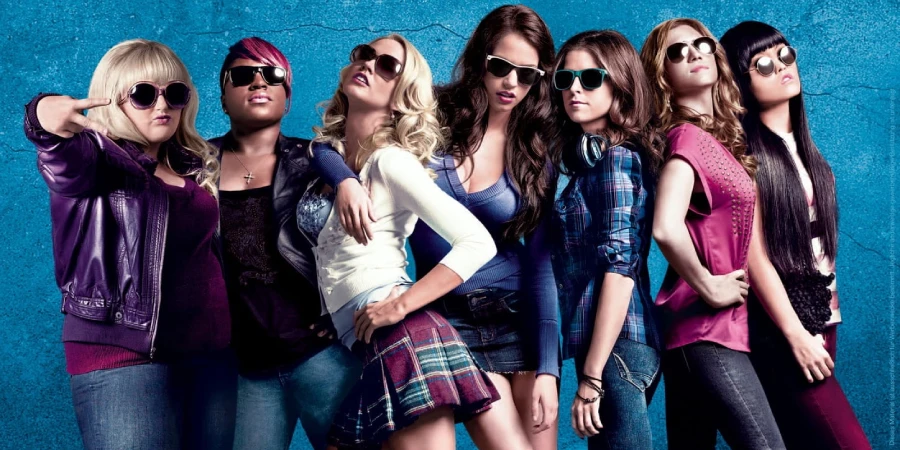

Pitch Perfect walks into a crowded genre, the college comedy-musical, and somehow makes the whole thing feel like a genuine blast rather than a cynical cash-grab. Anna Kendrick spends most of the film with a laptop full of remixed MP3s and a face that says she would rather be anywhere else, and that tension powers every scene she is in.
Writer Kay Cannon and director Jason Moore take a story about an a cappella competition and refuse to let it coast on the premise alone. They give Beca Mitchell real damage, real reluctance, and a final performance that actually earns the crowd’s applause.
Detailed Summary
Beca Arrives at Barden University
Beca Mitchell does not want to be at college. Her father teaches at Barden University and has struck a deal with her: attend one year, give it a genuine shot, and if she still wants to move to Los Angeles to pursue music production, he will pay for it himself.
Beca would rather produce tracks in her dorm room than sit through orientation. She meets her peppy, oversharing roommate Kimmy Jin, who makes it abundantly clear that she wants nothing to do with Beca.
The Activities Fair and the Barden Bellas
Aubrey Posen and Chloe Beale are recruiting for the Barden Bellas, the university’s all-female a cappella group. They catch Beca singing Robyn’s “Silly Boy” in the shower, and Chloe, uninvited, pushes the curtain open and harmonizes right there.
It is one of the film’s most charming moments, completely absurd and completely earned by Brittany Snow’s disarming warmth. Beca is recruited on the spot by Chloe’s enthusiasm rather than Aubrey’s rigid pitch.
The Auditions and the New Lineup
Auditions bring in a wildly mismatched group. Fat Amy introduces herself with that name before anyone can use it against her, delivering the film’s single most quoted line in the first five minutes of her screen time.
Other recruits include Lilly, who speaks exclusively in barely audible whispers, Cynthia Rose, Stacie, and Denise. Aubrey, scarred by the previous year’s catastrophic finale performance, immediately imposes an iron-fisted rehearsal regime built around the same tired set list.
Jesse and the Treblemakers
Jesse Swanson is Beca’s dorm neighbor and a new member of the Treblemakers, the all-male rival group. He is relentlessly friendly in a way that Beca initially reads as annoying.
Jesse bonds with Beca over film scores, dragging her toward the kind of emotional openness she actively resists. Their dynamic is the romantic spine of the film, and Skylar Astin plays Jesse with enough genuine sweetness that you root for him even when Beca keeps pushing back.
Aubrey’s Control and the Group’s Frustration
Aubrey runs rehearsals like a drill sergeant defending a failed battle plan. She insists on performing the same set the Bellas have used for years, centered on “Give Me Everything,” refusing any deviation.
Beca starts quietly pitching ideas for remixing and mashing up songs into something fresh. Aubrey shuts her down every single time, and the tension between their creative philosophies drives the second act.
The Riff-Off
The Bellas and Treblemakers gather with other groups for an underground riff-off in a campus swimming pool. Teams battle by grabbing a song out of their rival’s category and out-performing them.
Beca improvises brilliantly here, pulling out a mashup that wins her group the round. It is the moment where the film fully commits to her as a genuinely talented producer rather than just a quirky protagonist, and it lands with real energy.
Beca Gets Fired and Jesse Finds Out Her Secret
Beca works at the campus radio station and has been secretly submitting her original mixes to a DJ in Atlanta. Jesse discovers this and understands her better than she expected.
She gets fired from the station for scheduling unauthorized music, which strains her situation further. The film starts tightening the screws on her simultaneously in her personal life, her romance, and the Bellas.
The Semi-Finals Disaster
At the semi-finals, Beca convinces Aubrey to let her add a new piece to the set. Aubrey caves slightly, Beca delivers a strong performance, and the crowd responds.
They advance, but the fragile peace inside the group cracks. A confrontation during rehearsal explodes, and nearly every member quits, leaving Aubrey and Chloe standing in an empty rehearsal room.
Beca Rebuilds the Group
Beca steps up and convinces the members to return, taking on a leadership role she never asked for. She designs an entirely new set built around mashups and modern arrangements.
Aubrey, exhausted and finally self-aware, agrees to let Beca lead the performance. It is a small but meaningful surrender from a character who has been defined by control, and Anna Camp plays the moment with just enough vulnerability to make it work.

Movie Ending
At the ICCA Finals, the Bellas take the stage with a completely reimagined set. Beca opens the performance alone, singing a slow, stripped version of “When I’m Gone,” her signature cup routine from earlier in the film.
One by one, the rest of the Bellas join her, and the set builds into a mashup layering tracks across multiple genres. The crowd shifts from polite interest to full engagement, and the judges respond visibly.
Fat Amy gets her own spotlight moment, and the choreography feels loose and joyful rather than rehearsed into stiffness. It is the payoff the whole film has been building toward, and Moore shoots it wide enough that you feel the scale of the room without losing the individual performers.
Beca and Jesse’s relationship resolves in the most deliberately cheesy way possible: he runs to her backstage and she kisses him first, finally abandoning her emotional armor. She also calls her father and tells him she wants to stay at Barden, making the choice herself rather than defaulting into obligation.
The Bellas win the championship. Aubrey cries actual happy tears, which is a small but earned character payoff for someone who spent the entire film holding herself together with white knuckles.
Are There Post-Credits Scenes?
Pitch Perfect does not include a post-credits scene. You can leave when the credits roll without missing anything.
Type of Movie
Pitch Perfect is a comedy-musical with strong romantic subplot elements. Its tone swings freely between broad physical comedy, genuine warmth, and a few moments of real emotional weight.
It is rated PG-13 and plays consistently light, but the screenplay gives enough character motivation to keep it from feeling hollow. Think underdog sports movie with vocal arrangements instead of athletic training montages.
Cast
- Anna Kendrick – Beca Mitchell
- Skylar Astin – Jesse Swanson
- Rebel Wilson – Fat Amy
- Anna Camp – Aubrey Posen
- Brittany Snow – Chloe Beale
- Ester Dean – Cynthia Rose
- Hana Mae Lee – Lilly Onakuramara
- Alexis Knapp – Stacie Conrad
- Ben Platt – Benji Applebaum
- Adam DeVine – Bumper Allen
- John Michael Higgins – John Smith (commentator)
- Elizabeth Banks – Gail Abernathy-McKadden (commentator)
Film Music and Composer
Mark Mothersbaugh, best known as a founding member of the band Devo, composed the score. His background in pop and new wave music made him a smart fit for a film where the needle drops matter as much as anything else.
The music supervision work is arguably more central than the score itself. Arrangements by Deke Sharon, often called the godfather of contemporary a cappella, shaped how the vocal performances sound on screen.
Key musical moments include the shower duet of “Titanium” by David Guetta, the riff-off sequence covering multiple pop and R&B tracks, and the finals mashup anchored by “Just the Way You Are” blended with several other songs. Beca’s cup routine to “When I’m Gone” became genuinely viral after the film’s release.

Filming Locations
Production shot primarily in and around Baton Rouge, Louisiana. Louisiana State University provided many of the campus exteriors, standing in for the fictional Barden University.
Louisiana’s film incentive programs made it a financially practical choice. The result is a campus that feels lived-in and credibly collegiate without being tied to any single recognizable real institution.
Interior competition sequences were shot on purpose-built sets designed to suggest large performance venues. The finals venue looks impressive on screen without the film ever confirming a specific real-world location.
Awards and Nominations
Pitch Perfect was not a major awards circuit contender in categories like acting or direction. It received MTV Movie Award nominations and won strong audience approval reflected in its substantial box office performance relative to its budget.
Behind the Scenes Insights
- Rebel Wilson improvised a significant portion of Fat Amy’s dialogue. Many of her funniest lines were not in Kay Cannon’s original script.
- Anna Kendrick learned the cup routine specifically for the film. The sequence became so popular that a viral challenge version circulated widely after release.
- Deke Sharon worked on set as a music consultant and supervised all the a cappella arrangements to ensure they sounded achievable by real voices rather than studio-polished beyond recognition.
- Director Jason Moore came from a theater background, having directed on Broadway, which informed how he staged the group performance sequences.
- Elizabeth Banks, who played commentator Gail, also served as a producer on the film. She wore both hats throughout production.
- Many of the cast members trained intensively with vocal coaches before shooting began, so the group harmony sequences used the actors’ real voices rather than dubbing.
Inspirations and References
Pitch Perfect is based on Mickey Rapkin’s 2008 non-fiction book Pitch Perfect: The Quest for Collegiate A Cappella Glory. Rapkin embedded himself with competitive collegiate a cappella groups across the country and documented the culture from the inside.
Screenwriter Kay Cannon drew characters and situations from the book but built a largely original narrative around them. The Barden Bellas and their specific story are fictional constructions rather than portraits of any single real group.
Alternate Endings and Deleted Scenes
No widely documented alternate ending exists for Pitch Perfect. The theatrical cut appears to reflect the intended conclusion without a significantly different version in circulation.
Several deleted scenes focused on extended rehearsal sequences and additional Fat Amy material. These were cut largely for pacing, and their absence keeps the second act from sagging.
Book Adaptations and Differences
Mickey Rapkin’s Pitch Perfect is non-fiction journalism, not a novel with characters who map directly onto the film. Beca Mitchell, Jesse, Aubrey, and Fat Amy do not appear in the book.
The book focuses on three real collegiate a cappella groups, including the University of Virginia’s Virginia Gentlemen and groups from other universities. Kay Cannon took the competitive structure, the culture’s obsessions and rivalries, and the general world from Rapkin’s reporting, then built a fictional drama on top of it.
One real element that carried over is the general atmosphere of the ICCA (International Championship of Collegiate A Cappella) circuit, which provides the film’s competitive backbone.


Memorable Scenes and Quotes
Key Scenes
- The shower audition: Chloe slides open Beca’s shower curtain and joins her mid-song. Brittany Snow holds eye contact and beams like it is the most natural thing in the world, making Beca’s flustered reaction ten times funnier.
- The riff-off: Staged in an empty university pool at night with the teams arranged like rival gangs, this sequence has better energy than almost any other scene in the film. Beca’s improvised mashup shifts the room’s entire mood in about thirty seconds.
- The cup routine: Beca sits alone in the Barden radio station, running a paper cup through a percussive rhythm while singing “When I’m Gone.” Anna Kendrick’s hands move through the routine without a single cut, and the camera simply watches her.
- Aubrey’s vomit incident: Flashback to the prior year’s ICCA Finals, where Aubrey projectile vomits onto the audience mid-performance. It is cartoonish and gross and sets up Aubrey’s entire arc in about four seconds.
- The finals performance: The Bellas open quietly, build slowly, and the film earns the audience’s emotional investment by making every performer visible rather than cutting away to crowd reactions every five seconds.
Iconic Quotes
- “I’m gonna finish him like a cheesecake.” – Fat Amy
- “I have a feeling we’re going to be fast friends.” – Chloe, to Beca in the shower
- “I set fires to feel joy.” – Lilly, in one of her barely audible whispers
- “You’re going to miss John Mayer doing ‘Africa’ for forty minutes.” – Jesse to Beca, about a concert
- “That’s a great film.” – Jesse, said with the particular conviction of someone who needs a girl to care about movies as much as he does
Easter Eggs and Hidden Details
- The commentators John and Gail deliver jokes that are deliberately more offensive than any character in the main cast, functioning as a satirical frame around the a cappella world’s self-seriousness.
- Lilly’s whispered lines contain increasingly dark confessions throughout the film. Audiences who lean in to catch them get a running subplot of pure absurdist humor.
- Jesse’s love of film scores and movie endings mirrors the film’s own structure: Pitch Perfect is a movie explicitly about the satisfaction of a perfect finale, and his obsession comments on its own genre.
- Fat Amy’s full name, Patricia, surfaces briefly. It is easy to miss, but it lands as a small, strange payoff to a character whose entire joke is that she names herself.
- The Treblemakers’ arrangements tend to be glossier and more technically intricate than the Bellas’ early sets, visually reinforcing the power imbalance between the groups before Beca shifts it.
Trivia
- Anna Kendrick was not a trained a cappella singer before the film. She worked extensively with vocal coaches to reach the performance level the role required.
- Rebel Wilson’s breakout in American cinema came largely from this film and Bridesmaids (2011), which opened within a year of each other.
- Ben Platt, who plays Benji, would go on to win a Tony Award for his stage work in Dear Evan Hansen. His screen presence here, in a small comedic role, hints at a performer with considerably more range than the part asks for.
- The film grossed well above its production budget, making its two sequels financially inevitable rather than creatively necessary.
- Elizabeth Banks and her producing partner Max Handelman pushed to get the film made for years. The material had been in development before they attached as producers.
- The ICCA is a real competition, and the film’s depiction of the event’s atmosphere tracks closely with accounts from real participants.
- Kay Cannon wrote the screenplay as a spec project after optioning Rapkin’s book. Her instinct to center the story on a reluctant outsider rather than a true believer was the key structural decision that separated it from standard competition-movie templates.
Why Watch?
Anna Kendrick’s cup routine alone justifies the runtime: she performs it in a single unbroken shot with the quiet focus of someone who genuinely does not care whether you are watching. Kay Cannon’s screenplay trusts the audience to find Beca’s emotional arc without spelling it out in monologue, which is rarer in this genre than it should be. Watch it for that creative restraint as much as for the laughs.
Director’s Other Movies
- Sisters (2015)
Recommended Films for Fans
- Bring It On (2000)
- Whiplash (2014)
- Sing Street (2016)
- Camp (2003)
- Bridesmaids (2011)
- The Full Monty (1997)
- Begin Again (2013)