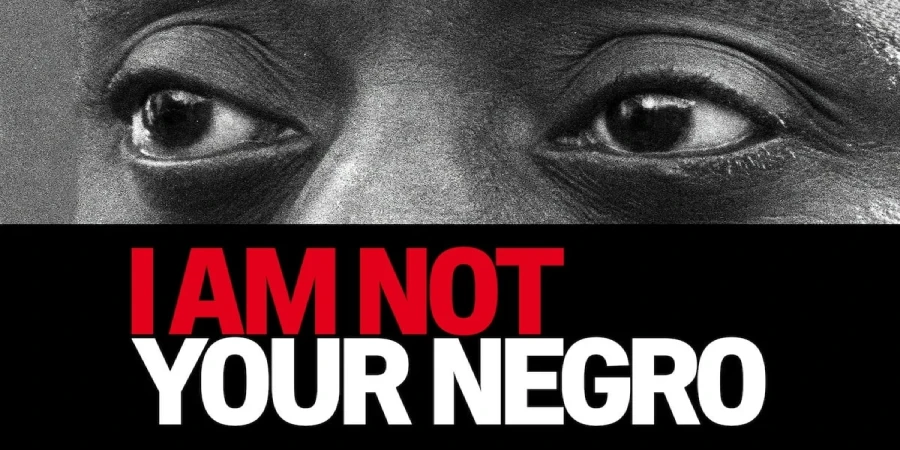

Raoul Peck took an unfinished manuscript, thirty pages of notes James Baldwin left behind at his death, and built something that makes most conventional documentaries look timid. Baldwin had been writing about the murders of Medgar Evers, Malcolm X, and Martin Luther King Jr., three men he personally knew, and his grief sits on every frame of this film. Samuel L. Jackson reads Baldwin’s words in voiceover, and the effect is immediate: you feel like Baldwin is alive in the room, furious and precise.
Detailed Summary
Baldwin’s Unfinished Manuscript
Peck opens by establishing the film’s source material. Baldwin had been working on a book titled Remember This House, a personal account of his friendships with Evers, Malcolm X, and King.
Baldwin never finished it. Peck treats the incompleteness honestly, framing the film not as a biography but as a meditation shaped by thirty pages of notes and a vast archive of Baldwin’s other writing and speeches.
The Three Friends
Peck weaves portraits of all three men through Baldwin’s eyes. What makes this framing so sharp is that Baldwin refuses to flatten them into symbols. He writes about their specific personalities, their humor, their contradictions.
Evers appears first. Baldwin describes his quiet determination and the particular violence of his assassination, shot in his own driveway in 1963, in front of his family.
Malcolm X gets treated with enormous tenderness. Baldwin writes about the transformation Malcolm underwent, and about how American society preferred to demonize him rather than reckon with what he was actually saying.
King arrives as the third figure, and Baldwin connects all three men through a single brutal observation: America killed each of them because America was not ready to face what they represented.
Hollywood and the White American Dream
One of the film’s most pointed sequences uses Hollywood imagery. Peck cuts between classic films, advertisements, and television clips to show how popular culture constructed a version of Black life that served white comfort.
Baldwin’s voiceover dissects specific films with surgical precision. He describes watching movies as a child and slowly realizing that he was supposed to identify with the white hero, not with the people who looked like him.
This section is genuinely uncomfortable viewing. Peck juxtaposes footage of civil rights marches with cheerful advertisements from the same era, and the collision is almost absurd in its cruelty.
The Psychology of White Innocence
Baldwin’s central argument gets its fullest airing here. He insists that the problem of racism in America is not primarily a Black problem; it is a white problem rooted in a refusal to confront history.
Peck pulls archival footage of Baldwin debating and being interviewed, and these clips are some of the most electrically alive moments in the film. Watching Baldwin face interviewers who clearly expect him to reassure them and watching him refuse to do that is something else entirely.
One Cambridge Union debate clip, where Baldwin argues against William F. Buckley Jr., gets particular attention. Baldwin’s controlled fury in that footage could power a city block.
The Dick Cavett Appearance
Peck includes footage of Baldwin on The Dick Cavett Show, and it deserves its own moment of analysis. A Yale professor named Paul Weiss sits on the same panel and speaks about the American Dream with genuine bafflement about why Baldwin finds it insufficient.
Baldwin’s response is patient and devastating. He points out that the dream has always depended on the nightmare of Black American life to sustain itself. You can feel the studio audience shifting in their seats.
Civil Rights Footage and Contemporary Cuts
Peck does something structurally audacious throughout the film. He cuts between historical civil rights footage and contemporary images: Ferguson protests, images of police violence, faces of young Black Americans in 2016.
This editing strategy refuses to let the audience treat the film as history. Baldwin’s fifty-year-old words land against present-day images and the match is exact, which is the film’s most uncomfortable argument.
The Personal Grief
Running beneath all the political argument is personal loss. Baldwin knew these three men. He attended funerals. He fielded the news of each assassination with a grief that never fully resolved.
Peck honors this dimension without sentimentalizing it. Jackson’s voiceover keeps Baldwin’s voice dry and precise even when the content is devastating, and that restraint makes the grief hit harder.


Movie Ending
Peck closes the film on Baldwin’s own words about confronting the truth of American history, delivered over footage of Black Americans across decades, children and elders, marchers and mourners. There is no resolution offered because Baldwin never offered one.
What the film does instead is frame the stakes honestly. Baldwin argued that America could not move forward until white Americans accepted complicity in a system they benefited from, and Peck cuts to contemporary footage to confirm that this argument remains active, not historical.
Jackson’s final voiceover lines carry a particular weight. Baldwin’s prose in these closing moments drops all rhetorical strategy and becomes direct address, almost intimate, speaking to an America he loved and found maddening in equal measure.
Peck refuses a triumphant final note. No musical swell, no archival photograph held for emotional closure. Just Baldwin’s words continuing into silence, and the implication that the reader, now the viewer, is responsible for what comes next. It is the right choice, and it respects the audience enough to not wrap grief in a bow.
Are There Post-Credits Scenes?
No. I Am Not Your Negro has no post-credits sequence. When the film ends, it ends with intention.
Type of Movie
This is a documentary, but calling it only that understates what Peck is doing. It functions simultaneously as an essay film, a literary adaptation, and a political argument.
The tone is urgent and intellectual without being cold. Anger runs through every sequence, but so does grief and, at moments, dark wit.
Cast
- Samuel L. Jackson – Voice of James Baldwin (narrator)
- James Baldwin – Himself (archival footage)
Film Music and Composer
Alexei Aigui served as the film’s music supervisor, and the score draws heavily on existing recordings rather than original composition. Peck and his team use music with the same intentional aggression they bring to archival footage.
A striking choice is the use of Nina Simone’s recordings. Her voice appears at key emotional junctures and does not illustrate the mood so much as deepen it. Simone and Baldwin were contemporaries who shared a political worldview, and placing her voice alongside his words feels historically grounded rather than decorative.

Filming Locations
As a documentary built primarily from archival material, I Am Not Your Negro does not have traditional filming locations in the production sense. The visual texture comes from archival footage spanning decades, shot across the United States.
Key geographical presences include Mississippi, where Evers was killed; Harlem, which Baldwin wrote about with particular intensity; and the American South broadly, which carries the documentary’s historical weight.
Peck also draws on footage from New York television studios, where Baldwin’s most famous interviews and debates were recorded. Those spaces matter because they represent the arena where Baldwin performed his arguments for a white mainstream audience.
Awards and Nominations
I Am Not Your Negro received an Academy Award nomination for Best Documentary Feature. Peck won the César Award for Best Documentary Film in France.
The film also received nominations from BAFTA and numerous critics’ circles, and it was one of the most widely discussed documentaries of 2017 during awards season.
Behind the Scenes Insights
- Raoul Peck spent years pursuing the rights to Baldwin’s estate materials before production could begin.
- Peck himself is Haitian-born, and his outsider perspective on American racial politics sharpens the film’s framing in ways an American director might have softened.
- Samuel L. Jackson was specifically chosen to read Baldwin’s words because Peck wanted a voice with authority and weight, not performance. Jackson reportedly read the text with minimal direction.
- Peck and his team reviewed hundreds of hours of archival footage to find clips that would match Baldwin’s written words precisely rather than generally.
- The film was produced with support from French and Swiss broadcasters, which gave Peck a degree of creative independence that American funding structures might not have permitted.
Inspirations and References
Everything in the film flows from Baldwin’s own writing. The primary source is the unfinished manuscript Remember This House, supplemented by Baldwin’s published essays, particularly those collected in The Fire Next Time and Notes of a Native Son.
Peck also draws on Baldwin’s recorded speeches, television appearances, and interviews spanning roughly two decades. Baldwin’s 1965 Cambridge Union debate with William F. Buckley Jr. is a key reference point both visually and argumentatively.
Thematically, the film sits in conversation with a long tradition of Black American literary and political thought. Baldwin explicitly references and responds to Norman Mailer’s essay The White Negro, and Peck makes sure that particular argument lands clearly.
Alternate Endings and Deleted Scenes
No officially documented alternate ending or deleted scenes have been released for I Am Not Your Negro. Peck has not publicized a director’s cut or extended version.
Book Adaptations and Differences
A companion book titled I Am Not Your Negro was published alongside the film, edited by Peck and featuring Baldwin’s original thirty-page manuscript alongside other selected writings. It is not a novelization but a curated collection of source material.
The film does not adapt any single finished work. It constructs an argument from fragments, which means the “differences” between source and film are really choices about emphasis and sequencing. Peck makes those choices confidently, and the result feels more cohesive than a straight adaptation of incomplete notes should.


Memorable Scenes and Quotes
Key Scenes
- The Cambridge Union debate footage, where Baldwin stands at the podium and argues against William F. Buckley Jr. while the mostly white audience watches with visible unease, is the film’s single most viscerally charged sequence.
- The Dick Cavett panel scene, where Yale professor Paul Weiss talks about the American Dream and Baldwin quietly dismantles every assumption behind the comment without raising his voice.
- Peck’s Hollywood montage, cutting between images of smiling white families in advertisements and simultaneous footage of civil rights marches, produces the film’s most politically blunt moment.
- The sequence where Peck cuts between Ferguson protest footage and 1960s civil rights footage, the visual match so close it takes a second to register which decade you are watching.
- Baldwin’s television interview response when asked why he left America, where he describes the specific experience of Black Americans growing up surrounded by a culture that defines them as inferior.
Iconic Quotes
- “Not everything that is faced can be changed, but nothing can be changed until it is faced.”
- “I am not your Negro.” (The phrase Baldwin used to refuse the role white America assigned him.)
- “The story of the Negro in America is the story of America, and it is not a pretty story.”
- “You were not born to die in the desert. You were born to eat it.” (Baldwin’s address to the next generation.)
Easter Eggs and Hidden Details
- Peck places clips from classic Hollywood westerns at precise moments when Baldwin discusses white American mythology, and the specific films chosen illustrate Baldwin’s argument about heroism and race without Peck spelling it out in narration.
- Several of the contemporary images Peck uses are from Ferguson, Missouri protests in 2014, placed without date labels. Viewers who do not recognize the footage may initially read it as older archival material, which is part of the point.
- A photograph of Baldwin with Nina Simone appears briefly in the film, a visual acknowledgment of their friendship that most viewers miss on a single watch.
- Peck’s editing sometimes places Baldwin’s voiceover over footage Baldwin himself never saw, creating an eerie sense that Baldwin is commenting on a future he predicted but did not live to witness.
Trivia
- Raoul Peck first became interested in making a film about Baldwin in the 1980s, decades before I Am Not Your Negro reached production.
- Samuel L. Jackson initially expressed surprise at being asked to read the text straight, without dramatic interpretation. That restraint is precisely what makes his narration work so well.
- The film’s runtime is approximately 93 minutes, making it lean and relentless by documentary standards.
- Baldwin died in 1987, leaving Remember This House unfinished. Peck was among those who believed the manuscript deserved a public form.
- Footage of the Baldwin-Buckley debate at Cambridge had been largely absent from mainstream American cultural memory before this film brought it to a wide audience again.
- The film screened at Sundance 2016, where it generated significant critical attention before its wider release.
Why Watch?
Watch it specifically for the Cambridge debate footage, where a twenty-two-minute clip of Baldwin in 1965 does more political philosophy than most feature films attempt in two hours. Peck’s editing turns Baldwin’s unfinished notes into a coherent argument about white American self-deception, and Jackson reads it without flinching. At ninety-three minutes, the film makes no wasted moves.
Director’s Other Movies
- Lumumba (2000)
- The Young Karl Marx (2017)
- Exterminate All the Brutes (2021)
Recommended Films for Fans
- 13th (2016)
- Malcolm X (1992)
- Selma (2014)
- The Black Power Mixtape 1967-1975 (2011)
- Eyes on the Prize (1987)
- MLK/FBI (2020)