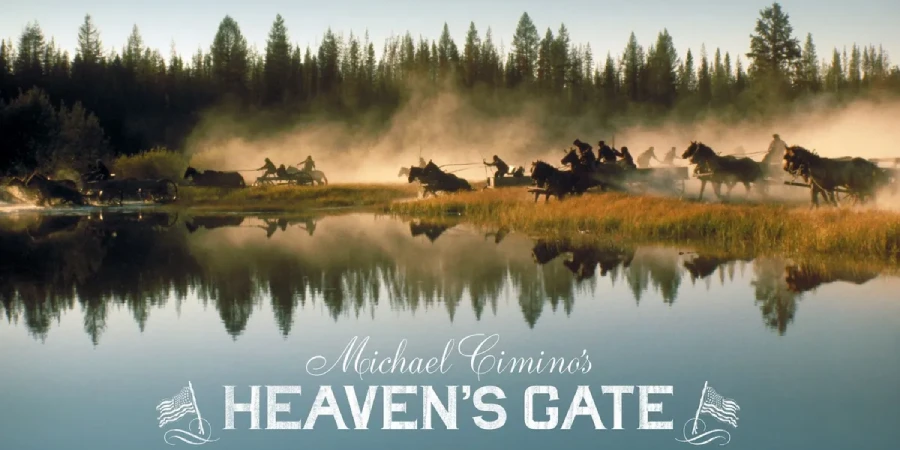

Michael Cimino burned Hollywood down with this one, and the ashes fertilized everything that came after. Heaven’s Gate cost United Artists its independence, ran nearly four hours in its original cut, and arrived to reviews so savage they read more like eulogies. Yet frame by frame, this is a film of genuine visual ambition: the Harvard prologue alone, shot in warm golden light with hundreds of extras waltzing on a campus lawn, announces a filmmaker who wanted to put the entire nineteenth century on screen.
Detailed Summary
The Harvard Prologue: Class of 1870
We open at Harvard in 1870. James Averill, played by Kris Kristofferson, and his friend Billy Irvine, played by John Hurt, celebrate their graduation with an elaborate outdoor dance. Students waltz in circles beneath trees while a brass band plays, and the scene stretches luxuriously, almost defiantly long.
This prologue sets a class divide front and center. Averill comes from privilege. Billy drinks too much and gives a slurring, cynical speech about what the educated class will do to the world. He is right, as it turns out.
Wyoming, Twenty Years Later
We cut to Wyoming, 1890. Averill now works as a sheriff in Johnson County. He has chosen a life far from his Harvard comfort, siding in spirit with the immigrant homesteaders who have settled the land.
A cattle association run by wealthy ranchers, led by Frank Canton, played by Sam Waterston, has drawn up a death list. On that list are 125 names, mostly Eastern European immigrants they accuse of rustling cattle. The association hires mercenary gunmen to execute everyone on it.
Ella and the Love Triangle
Averill loves Ella Watson, played by Isabelle Huppert, a French-born madam who runs a brothel and accepts cattle as payment from the settlers. Nathan Champion, played by Christopher Walken, also loves Ella. He is a hired gun who has not yet fully committed to either side of the conflict.
Cimino gives this triangle real weight. Walken plays Champion with a coiled stillness; he watches Averill and Ella together without ever showing his hand completely. Huppert, working mostly in English as a second language, delivers a performance of quiet, defiant warmth that is honestly the most underrated element of the entire film.
The Mercenaries Arrive
Frank Canton’s hired army rolls into Wyoming on a train. Averill rides out to warn the settlers. He knows the list exists. He has seen it.
Champion initially works for the cattle association but gradually shifts loyalties as he witnesses the brutality being organized against people he knows and loves. His arc mirrors the film’s central argument: that in America, money writes the law, and conscience is a luxury that gets you killed.
The Siege of Champion’s Cabin
A group of mercenaries surrounds Champion’s cabin and pins him inside. He fights alone for hours, holding them off with a rifle while recording his last hours in a diary. Walken carries this sequence almost entirely by himself.
Champion finally makes a run for it. He gets cut down in open ground. It is a brutal, unheroic death, shot in flat daylight that strips away any romantic notion of a last stand. Cimino refuses to let it feel like a Western hero’s exit.
Averill’s Choices and Failures
Averill cannot stop what is happening. He warns people, rides hard and argues with authority figures. Nothing sticks, because the cattle association has federal backing and legal cover.
His failure is structural, not personal. That distinction is what gives the film its political bite. One man’s decency means nothing when an institution decides to commit murder.
The Battle of Johnson County
Hundreds of immigrant settlers, armed and organized, ride out to confront the mercenary army. A massive rolling battle unfolds across the open land, complete with horse-drawn wagons rigged as mobile shields. Cimino shoots it in a swirling, smoke-choked style that makes the geography deliberately confusing.
This is the film’s most ambitious sequence, and it earns every penny of its reported production expense. The settlers actually appear to be winning when the U.S. Army arrives and intervenes on behalf of the cattle association. Federal troops stop the battle and protect the killers.
Ella’s Death
Before the army arrives, the mercenaries capture Ella. They rape and murder her. Cimino does not linger on the act itself, but its aftermath lands hard.
Averill finds her. Kristofferson plays the discovery with an exhausted grief rather than explosive rage, which is the right call. His face goes slack. He does not rage. He just absorbs it, which says more about how thoroughly the film has beaten hope out of him by this point.
Movie Ending
Averill kills Frank Canton in the chaos following the battle. It is a private act of revenge buried inside a larger catastrophe. The settlers lose. The cattle association wins. The federal government backs the powerful, as it always did.
Cimino then cuts to an epilogue that punches harder than any gunfight. We see Averill in 1903, on a yacht off the coast of Rhode Island. He is older, wealthy-looking, clearly returned to his class of origin. A woman who appears to be a society wife sleeps below deck.
He stands alone on the bow, smoking. Wyoming is gone. Ella is gone. Champion is gone. Averill survived by going back to the world he was born into, which is perhaps the most damning thing the film can say about the American ruling class: it always reclaims its own.
The final image holds on his face against gray ocean water. No resolution, no redemption. Just a man who witnessed a massacre, briefly fought it, and then quietly rejoined the class that ordered it. Audiences expecting a conventional Western ending were bewildered. That bewilderment was the point.
Are There Post-Credits Scenes?
No. Heaven’s Gate has no post-credits scenes. Given the film’s somber, deflated ending, a post-credits sequence would have been tonally absurd. Walk out when the screen goes dark.
Type of Movie
Heaven’s Gate is a revisionist Western and a historical epic. Its tone is elegiac and politically furious at the same time, which is an unusual combination even now.
It owes something to the revisionist Westerns of the 1970s but pushes further into period realism than most of its predecessors. It functions partly as a class-war polemic disguised as a frontier adventure.
Cast
- Kris Kristofferson – James Averill
- Isabelle Huppert – Ella Watson
- Christopher Walken – Nathan Champion
- John Hurt – Billy Irvine
- Sam Waterston – Frank Canton
- Brad Dourif – Mr. Eggleston
- Jeff Bridges – John H. Bridges
- Joseph Cotten – the Reverend Doctor
- Roseanne Vela – Beautiful Girl
- Mickey Rourke – Nick Ray
Film Music and Composer
David Mansfield composed the score, and his work is one of the film’s most quietly impressive achievements. Mansfield was a member of Bob Dylan’s Rolling Thunder Revue, and his background in American roots music gives the score an authentically period feel.
He uses fiddles, banjos, and period dance music rather than orchestral bombast. The waltz that recurs throughout the film ties the Harvard prologue to the Wyoming sequences, suggesting that privilege and violence share the same tune. That structural choice is genuinely clever.
Filming Locations
Principal photography took place in Montana, with additional sequences shot in Idaho and in Oxford, England, for the Harvard prologue. Cimino chose Montana specifically for its untouched, expansive landscape: he wanted vistas that had not been domesticated by decades of location filming.
Oxford doubled for 1870s Harvard convincingly. The architectural scale and manicured grounds gave the prologue a sense of Old World institutional authority that American campuses, in 1979, could not easily provide on camera.
Cimino also had his crew build an entire immigrant town from scratch, constructing period-accurate wooden structures that were then partially destroyed during production. That level of commitment to physical reality drove the production over budget and over schedule by a significant margin.
Awards and Nominations
Vilmos Zsigmond received recognition for his cinematography on the film, and the production received some technical praise even as critics and audiences rejected it on release. Given its reputation as a commercial catastrophe, Heaven’s Gate was largely ignored by major awards bodies during its initial run.
Behind the Scenes Insights
- Cimino reportedly demanded retakes of the Harvard waltz sequence over multiple days, with hundreds of extras rehearsing the same choreography repeatedly until he was satisfied.
- The production ran so far over budget that it contributed directly to the financial collapse and eventual sale of United Artists as an independent studio.
- Vilmos Zsigmond, the cinematographer, used a diffusion technique and period-inspired lighting to give the film a painterly, almost amber-tinted quality in many scenes.
- Kris Kristofferson has spoken in interviews about the chaos of the shoot, noting that days would pass without a clear shooting plan, only for Cimino to arrive with elaborate new demands.
- The roller-skating sequence, in which settlers skate together in a large wooden hall, required Isabelle Huppert to learn to skate for the role.
- Cimino had final cut on the film following his Oscar success with The Deer Hunter, and United Artists did not intervene until the damage was done.
- A shorter re-edit was released after the catastrophic initial reception, but it was too late to salvage the film’s commercial prospects or United Artists’ finances.
Inspirations and References
The film draws directly from the Johnson County War of 1892, a real conflict in Wyoming in which the Wyoming Stock Growers Association hired gunmen to kill suspected cattle rustlers, most of whom were immigrant homesteaders. Cimino researched the period extensively and built the film’s political argument around documented historical events.
He was also clearly influenced by the revisionist Westerns that preceded him, particularly the work of Robert Altman and Sam Peckinpah. McCabe and Mrs. Miller (1971) casts a long shadow over this film, from its frontier brothel setting to its insistence that the West was a place of grubby commerce and institutional violence rather than heroic myth.
Alternate Endings and Deleted Scenes
The original cut of the film, screened once at the Cinema 1 theater in New York in November 1980, ran approximately 219 minutes. Critics destroyed it. Cimino then pulled it from release and re-edited it down to roughly 149 minutes for its wider release in 1981.
The re-edited version cut significant character development, particularly for the immigrant community, which weakened the film’s political argument considerably. A longer restored version was later released on home video and given a theatrical re-release, and most serious reassessments of the film are based on the fuller cut. The shorter version is genuinely a lesser work; the extra running time is not excess, it is evidence.
Book Adaptations and Differences
Heaven’s Gate is not based on a novel or any single book. Cimino wrote the screenplay himself, drawing from historical accounts of the Johnson County War rather than a literary source.

Memorable Scenes and Quotes
Key Scenes
- The Harvard waltz sequence, in which students circle a tree-lined lawn in golden afternoon light, establishing the film’s visual grammar of American privilege performing grace while violence waits offstage.
- Champion’s last stand in the cabin, with Walken scribbling in his diary while bullets punch through the walls around him, the camera catching dust motes in shafts of light between shots.
- The roller-skating sequence inside the immigrant community hall, fiddle music echoing off wooden walls, which functions as a rare moment of genuine joy and communal life before everything collapses.
- Averill reading aloud from Canton’s death list, the camera holding on the paper rather than his face, letting the names themselves carry the weight of what is coming.
- The final image of Averill on the yacht, smoke rising from his cigarette against gray Atlantic water, stillness replacing everything the film spent three hours building toward.
Iconic Quotes
- “Life is a lot of things, but it ain’t fair.” (paraphrased from the film’s general dialogue register; attributed to Billy Irvine)
- Billy Irvine’s graduation speech warns his classmates that their education has equipped them to impose their ignorance on those with no recourse. It is cynical, drunk, and entirely accurate.
Easter Eggs and Hidden Details
- The waltz that opens the film reappears as a fiddle tune in the immigrant community sequences, suggesting a deliberate thematic link between the ruling class’s celebration and the settlers’ attempts to build their own version of civilization.
- Averill’s yacht in the epilogue carries visual echoes of the Harvard sequences: white, expensive, and sealed off from the world of work and consequence. The parallel seems intentional.
- Canton’s death list, when shown on screen, uses period-accurate handwriting and paper stock, a level of prop detail that goes unnoticed on first viewing but rewards a closer look.
- The roller-skating rink sequence was reportedly inspired by documented accounts of similar communal halls built by Eastern European immigrants in frontier Wyoming, grounding what looks like a lyrical flight of fancy in actual historical practice.
Trivia
- The production’s financial overrun contributed to United Artists being sold to MGM, effectively ending the studio’s existence as an independent entity.
- Cimino came to this project directly off the success of The Deer Hunter, which won the Academy Award for Best Picture in 1979, giving him near-unlimited creative control.
- Vilmos Zsigmond used anamorphic lenses and specific filtration techniques throughout to give the film the quality of faded period photographs.
- The film was critically reassessed significantly in later decades, particularly in Europe, where it was always received more favorably than in the United States.
- Isabelle Huppert, already a major star in France, took the role of Ella Watson in part because of her interest in American cinema and her admiration for Cimino’s previous work.
- The Criterion Collection released a restored version of the film, cementing its later reputation as a misunderstood work of serious ambition rather than simple Hollywood excess.
- Jeff Bridges appears in a supporting role but is notably underused in the theatrical cut; the longer version restores more of his scenes.
Why Watch?
Watch it for Vilmos Zsigmond’s cinematography, which turns Johnson County into something that looks genuinely handmade from the past. Every wide shot of horsemen crossing pale grass feels like a recovered document rather than a movie set. Isabelle Huppert playing a French madam in the Wyoming Territory should be absurd casting on paper, and it is instead the film’s most human performance.
Director’s Other Movies
- Thunderbolt and Lightfoot (1974)
- The Deer Hunter (1978)
- Year of the Dragon (1985)
- The Sicilian (1987)
- Desperate Hours (1990)
- The Sunchaser (1996)
Recommended Films for Fans
- McCabe and Mrs. Miller (1971)
- The Deer Hunter (1978)
- Pat Garrett and Billy the Kid (1973)
- Reds (1981)
- The Assassination of Jesse James by the Coward Robert Ford (2007)