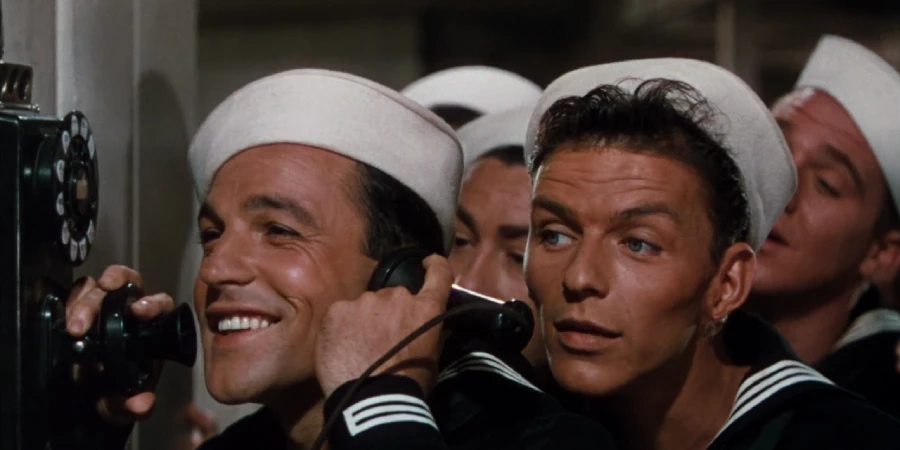

Anchors Aweigh is a film that casually tosses two sailors into Hollywood and expects you not to fall in love with it. Gene Kelly and Frank Sinatra play off each other with effortless chemistry, dancing and singing their way through a romantic comedy that somehow features a live-action and animated sequence with Jerry Mouse. Released in 1945, this MGM technicolor musical remains one of the most charming wartime entertainments ever produced.
Detailed Summary
Two Sailors Hit Los Angeles
The story opens with Navy sailors Joe Brady (Gene Kelly) and clarence Doolittle (Frank Sinatra) arriving in Hollywood on a four-day shore leave. Joe is a decorated, confident ladies’ man. Clarence is shy, awkward, and hopelessly inexperienced with women.
Joe promises to help Clarence find romance during their leave. However, almost immediately, their plans go sideways in the best possible way.
Susie and Donald Enter the Picture
The two sailors encounter a young boy named Donald Martin, who has run away from home to enlist in the Navy. They track him back to his guardian, his aunt Susan Abbott (Kathryn Grayson), an aspiring singer living in a modest house in Los Angeles. Joe is instantly smitten with Susan.
Susan, however, harbors dreams of singing professionally. She wants an audition with the famous conductor Jose Iturbi, who appears in the film as himself. Joe, eager to impress her, rashly promises he can arrange it.
Joe’s Bold (and Fabricated) Promise
Joe has absolutely no connection to Jose Iturbi. His promise is pure bravado. Nonetheless, he commits to it fully, which sets the entire romantic and comedic engine of the film in motion.
Meanwhile, Clarence quietly develops his own romantic feelings, in his case directed toward a girl named Lila Bromley (Pamela Britton), a waitress he meets during their leave. Lila is energetic, direct, and thoroughly charmed by Clarence’s fumbling sincerity.
The Hollywood Hustle
Joe drags Clarence along on a series of schemes to get Susan in front of Iturbi. They bluff their way into studio lots and social circles. Joe’s charm carries them far, but the clock on their shore leave is ticking.
Susan grows increasingly fond of Joe during this time. She believes he is doing all of this out of genuine generosity, which, in fairness, he partly is. His feelings for her are real, even if his connections are not.
The Animated Dream Sequence
In one of cinema history’s most celebrated detours, Joe performs a fantasy dance sequence with Jerry Mouse from MGM’s Tom and Jerry cartoons. Joe plays a Spanish-themed song and dance number alongside the animated character in a fairy-tale kingdom setting. This sequence, combining live-action and animation, stands as one of the film’s most technically ambitious achievements.
For a 1945 audience, the blending of a live performer with a cartoon character was genuinely astonishing. It remains visually striking today.
Clarence Finds His Confidence
Clarence, with encouragement from Lila and Joe, begins to shed his timidity. His growing confidence is both comedic and genuinely touching. Sinatra plays these scenes with a light self-deprecating charm that suits the role perfectly.
Lila, meanwhile, keeps pushing Clarence toward his better self. Their courtship has a scrappy, working-class warmth that contrasts nicely with the grander ambitions swirling around Joe and Susan.
Joe Dances and Deceives
Joe performs several showstopping dance numbers throughout the film, demonstrating why Kelly was redefining what screen dancing could look like. His physicality is extraordinary, every movement precise yet seemingly effortless. In addition, his scenes with Sinatra carry a genuine brotherly camaraderie.
However, Joe’s deception about Iturbi hangs over everything. The longer he lets the lie stand, the more complicated his feelings for Susan become.
The Truth Comes Out
Susan eventually learns that Joe fabricated his connection to Iturbi. She feels betrayed and pulls away from him emotionally. Joe is genuinely crushed, because what started as a scheme has become something he actually cares about deeply.
Clarence, watching his friend suffer, takes it upon himself to help set things right. For once, he steps up rather than hanging back.


Movie Ending
Jose Iturbi, through the persistent efforts of both sailors and some genuine luck, finally hears Susan sing. Her voice impresses him legitimately. He agrees to arrange a proper audition and performance opportunity for her, validating her talent on its own merits rather than through any manufactured favor.
Joe and Susan reconcile. She forgives him not because the deception was trivial, but because she recognizes that his actions, however dishonest in origin, came from real feeling. Their relationship lands on solid ground by the film’s final scenes.
Clarence and Lila reach an understanding of their own. Their romance, simpler and less dramatic than Joe and Susan’s, closes on a warm, satisfying note. Sinatra’s Clarence walks away from the film having gained real confidence and a genuine connection.
Both sailors return to duty when their shore leave ends. The film closes on a note of optimism that was deeply resonant for wartime audiences; young men going back to service, but carrying love and hope with them. It is a tidy, emotionally satisfying resolution that never feels cheap.
Are There Post-Credits Scenes?
No. Anchors Aweigh contains no post-credits scene. Films of this era did not include them, and MGM had no such tradition in 1945. You can leave when the credits roll.
Type of Movie
Anchors Aweigh is a musical romantic comedy with strong elements of wartime patriotism. Its tone is light, bright, and relentlessly optimistic. MGM produced it squarely in their prestige Technicolor musical tradition.
In contrast to grittier wartime dramas being produced simultaneously, this film leans fully into escapism. It wants to make audiences feel good, and it succeeds without apology.
Cast
- Gene Kelly – Joe Brady
- Frank Sinatra – Clarence Doolittle
- Kathryn Grayson – Susan Abbott
- Jose Iturbi – Himself
- Pamela Britton – Lila Bromley
- Dean Stockwell – Donald Martin
- Rags Ragland – Police Sergeant
- Edgar Kennedy – Police Captain
Film Music and Composer
George Stoll served as musical director and received substantial credit for the film’s score. He coordinated the orchestrations and arrangements that gave the film its rich, layered sound. Stoll was a veteran MGM musical supervisor with deep experience in the studio’s signature style.
Notable musical moments include “I Fall in Love Too Easily,” sung by Sinatra, and “The Charm of You,” also performed by Sinatra. Kelly’s showpiece numbers, including the animated sequence set to a Spanish-flavored piece, showcase the film’s musical ambition. Jose Iturbi performing classical piano pieces adds an unexpected highbrow dimension to the proceedings.
Jule Styne and Sammy Cahn wrote several of the original songs for the film. Their contributions gave Sinatra material that suited his emerging romantic balladeer persona perfectly.

Filming Locations
Anchors Aweigh was filmed primarily on the MGM studio lots in Culver City, California. The elaborate sets recreated Hollywood streets, a modest residential neighborhood, and the fantastical animated kingdom sequence. MGM’s production design team built everything needed without leaving the studio.
Some exterior and establishing shots reference real Los Angeles geography, grounding the fantasy in a recognizable wartime American city. For audiences of 1945, Hollywood itself was part of the appeal. Setting the story there gave the film an additional layer of glamour.
Awards and Nominations
Anchors Aweigh received five Academy Award nominations, including Best Picture. It won Best Musical Score for George Stoll at the 18th Academy Awards.
Gene Kelly also received attention for his performance, though his most celebrated Oscar recognition would come later in his career. The Best Picture nomination placed the film among the most prestigious releases of its year, which remains a remarkable achievement for a musical comedy.
Behind the Scenes Insights
- Gene Kelly reportedly spent months developing and rehearsing the animated dance sequence with Jerry Mouse, as the technical coordination between live-action and animation required painstaking frame-by-frame planning.
- Frank Sinatra and Gene Kelly formed a genuine friendship during production, one that would lead to further collaborations including On the Town (1949).
- Director George Sidney pushed for the Technicolor production values that made the film visually distinctive even by MGM’s high standards.
- Kathryn Grayson performed her own vocals throughout, as she was a trained classical soprano with genuine concert-level ability.
- Jose Iturbi, a celebrated concert pianist and conductor in real life, brought authentic musical credibility to his scenes and performed his piano passages without any substitution.
- The production was conceived partly as a morale-boosting entertainment for wartime America, and MGM coordinated some promotional activity with the Navy.
Inspirations and References
Anchors Aweigh was not adapted from a novel or a pre-existing stage musical. The story was an original screenplay developed specifically for MGM as a vehicle for Kelly and Sinatra. However, it draws loosely on a tradition of service-member-on-leave romantic comedies that had become a recognizable wartime genre.
The pairing of a confident, worldly sailor with a shy, inexperienced one echoes classic comic double-act structures. Moreover, the Hollywood setting and the use of real performers playing themselves (as Iturbi does) reflects a self-referential MGM tendency toward glamorous wish fulfillment.
Alternate Endings and Deleted Scenes
No widely documented alternate endings or significant deleted scenes from Anchors Aweigh have entered the public record. MGM did not publicize any major cuts or reshoots for this production. Given the film’s smooth narrative structure, the final cut appears to reflect the intended vision fairly closely.
Some musical numbers may have been trimmed or adjusted during post-production, as was standard MGM practice, but no specific excised sequences have been confirmed by studio records available to the public.
Book Adaptations and Differences
Anchors Aweigh is not based on a book. The screenplay was an original work written for the screen. Consequently, there is no source novel to compare it against, and no adaptation differences to analyze.

Memorable Scenes and Quotes
Key Scenes
- Joe Brady’s live-action dance sequence alongside the animated Jerry Mouse, set in a storybook fantasy kingdom.
- Clarence singing “I Fall in Love Too Easily” at a piano, a quiet and genuinely moving performance from Sinatra.
- Joe and Clarence’s initial arrival in Hollywood, establishing their contrasting personalities with sharp comic efficiency.
- Susan performing for Jose Iturbi, her voice finally getting the serious hearing her ambition deserved.
- Joe’s confession to Susan after his fabricated connections unravel, one of the film’s few emotionally raw moments.
Iconic Quotes
- “I don’t want to be rude, but you’re the most beautiful girl I’ve ever seen.” (Joe to Susan, delivered with Kelly’s characteristic directness)
- Clarence’s repeated anxious declarations about his inability to talk to women, which function as a comic refrain throughout the film.
Easter Eggs and Hidden Details
- The animated kingdom in Jerry Mouse’s sequence features visual design elements consistent with MGM’s Tom and Jerry shorts of the same period, rewarding fans of the cartoon series.
- Jose Iturbi’s piano performances include recognizable classical repertoire pieces, a subtle nod to his real concert career that audiences with classical music knowledge would catch.
- Background extras in several Hollywood studio lot scenes appear to reference actual MGM productions of the era, embedding the film within a larger studio universe.
- Gene Kelly’s costuming in the animated sequence uses a more stylized, exaggerated color palette than the rest of the film, visually signaling the transition into fantasy before the animation even begins.
Trivia
- Anchors Aweigh was one of the highest-grossing films of 1945, reflecting its enormous popularity with wartime audiences.
- Gene Kelly considered the Jerry Mouse sequence one of his proudest technical achievements, not merely a novelty but a genuine artistic experiment.
- Frank Sinatra was still building his film career at this point; his role here helped establish his screen persona as a romantic, slightly bumbling leading man.
- Dean Stockwell, who plays young Donald, went on to a long and distinguished acting career spanning decades, making this an early glimpse of a future star.
- George Sidney directed several major MGM musicals; Anchors Aweigh sits comfortably among his most successful productions.
- Kathryn Grayson’s operatic soprano voice was considered one of MGM’s great musical assets during the 1940s.
Why Watch?
Few films balance pure entertainment with genuine technical ambition as effortlessly as this one. Kelly and Sinatra together are simply irresistible, and the animated sequence alone justifies the entire runtime. Furthermore, the film captures a specific wartime American optimism that feels both historically fascinating and surprisingly moving.
Director’s Other Movies
- Bathing Beauty (1944)
- Holiday in Mexico (1946)
- The Three Musketeers (1948)
- Show Boat (1951)
- Scaramouche (1952)
- Kiss Me Kate (1953)
- Jupiter’s Darling (1955)
- Pal Joey (1957)
- Pepe (1960)
- Bye Bye Birdie (1963)
Recommended Films for Fans
- On the Town (1949)
- Singin’ in the Rain (1952)
- An American in Paris (1951)
- Cover Girl (1944)
- Take Me Out to the Ball Game (1949)
- Meet Me in St. Louis (1944)
- Holiday Inn (1942)