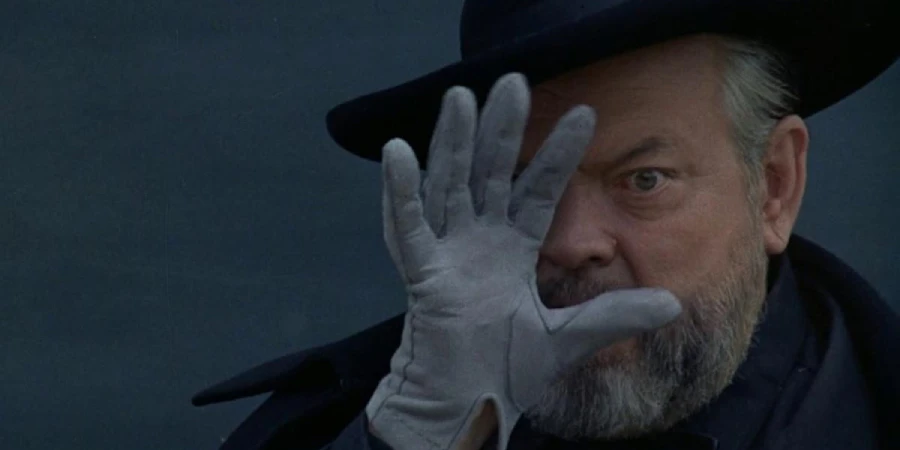

Orson Welles sits in a train station and performs card tricks for children, then turns directly to the camera and promises to tell nothing but the truth for the next hour. That promise is a lie, and he knows you know it, and that is exactly the point. F for Fake is a film about forgery, fraud, and the ego of artistic genius, and Welles built it so that the movie itself is the con. No other documentary has ever weaponized the editing room quite so aggressively against its own audience.
Detailed Summary
The Opening Gambit: Welles as Magician
Welles opens by presenting himself as a conjurer. He performs sleight-of-hand tricks for strangers, then steps into a direct address mode that he sustains across the entire film. He tells us we are about to watch a film about fakers, experts, and fraud.
Right away, the editing crackles. Welles cuts between footage, talking heads, and his own narration at a pace that feels almost aggressive. You are never allowed to settle into passive viewing.
Elmyr de Hory: The World’s Greatest Art Forger
Welles introduces Elmyr de Hory, a Hungarian-born painter living on Ibiza who forged works by Picasso, Matisse, and Modigliani. Footage of Elmyr comes largely from a documentary by François Reichenbach, shot on Ibiza. Elmyr sits in his villa, dashes off a Matisse-style drawing in minutes, and laughs about it.
Welles pushes the central question hard: if experts cannot tell the difference between a fake and an original, does the difference matter? Museums paid fortunes for Elmyr’s work. Critics praised it. No one suspected a thing until journalist Clifford Irving wrote a book about him.
Clifford Irving Enters the Picture
Here is where the film twists its own knife. Irving, who wrote Fake! about Elmyr, turns out to be a faker himself. While Welles was assembling this film, Irving perpetrated one of the great literary hoaxes of the twentieth century: a fabricated autobiography of Howard Hughes, which he sold to a publisher for a substantial advance.
Welles relishes the layering. The man who wrote the book on forgery was himself a forger. Irving appears on screen, charming and unguarded, filmed before the Hughes scandal fully broke. Watching him here, knowing what he did, is genuinely unsettling.
Howard Hughes: The Shadow Figure
Hughes drifts through the film as an absence. Welles never shows him, because there is nothing to show. Hughes lived in total seclusion, which made him the perfect target for Irving’s con. A man no one could verify became a man anyone could invent.
Welles treats Hughes with fascination and a hint of kinship. Both men understood the value of mystique. Both built elaborate public personas. Welles never quite says this out loud, but the parallel sits in every frame that mentions Hughes.
The Picasso Sequence: Welles Invents a Story
After roughly an hour, Welles announces he will now tell a story about Oja Kodar, his companion, and Picasso. Kodar walks through Spanish streets while Picasso reportedly watches obsessively from a window. He allegedly paints twenty-two portraits of her. Her grandfather, revealed to be a forger himself, then copies all twenty-two and sells them.
Welles presents this as fact. He uses real footage of Picasso intercut with recreated scenes involving Kodar. Only at the end does he admit he made the entire Picasso story up. He reminds us that he promised only one hour of truth, and that hour has passed.
The Chartres Cathedral Coda
Welles ends with a meditation on Chartres Cathedral. He stands outside and speaks about the anonymous craftsmen who built it. Nobody knows their names. Their art survives them by centuries. He frames this against the ego-driven world of galleries, forgeries, and famous signatures.
His voice drops into something unusually sincere here. After ninety minutes of tricks, the emotion lands differently because you have earned it through the deception that preceded it.
Movie Ending
Welles confesses to the Picasso fabrication with visible delight. He has just spent twenty minutes presenting invented footage as documentary truth, and he wants you to feel the rug being pulled. It is not a hostile move; it is a pedagogical one. He is showing you exactly how easily a compelling narrator can shape belief.
The Chartres monologue follows immediately. Welles argues that anonymous art, built without the promise of credit, may be the only honest art. Everything with a famous name attached carries the weight of the market, the ego, and the forger’s opportunity.
His final image is himself walking away, still in his magician’s cape. He does not resolve the central question about authenticity. He leaves you with it. That refusal to conclude is the most honest thing in the film.
Are There Post-Credits Scenes?
No post-credits scene exists. F for Fake predates that convention entirely, and Welles was not interested in offering comfort or closure at any point in the running time.
Type of Movie
F for Fake is a documentary essay film, though both words require asterisks. Welles actively subverts the truth-telling contract that documentary implies. Call it a cinematic essay, a magic act, or a meditation on authorship.
Tonally, it swings between playful and philosophical. Welles is funny, then suddenly serious, then clearly mischievous again. It never fully commits to a single mood, which is entirely intentional.
Cast
- Orson Welles – Himself (narrator, host, trickster)
- Oja Kodar – Herself
- Elmyr de Hory – Himself
- Clifford Irving – Himself
- François Reichenbach – Himself
Film Music and Composer
Michel Legrand composed the score. His contribution gives the film a jazz-inflected, playfully European texture. Legrand was one of the great French film composers of his era, having scored films for Jean-Luc Godard and Jacques Demy, among others.
The music never underscores emotion in a conventional way. It accompanies Welles’s tricks with a lightness that keeps the film from feeling heavy-handed, even when the ideas are dense.
Filming Locations
Much of the film takes place on Ibiza, Spain, where Elmyr de Hory actually lived. The island’s sun-drenched whitewashed architecture gives those sequences a relaxed, almost holiday-postcard quality that sits in ironic contrast to the criminal subject matter.
Paris appears in sequences involving art world figures and gallery culture. Welles shot some of his own footage there and incorporated Reichenbach’s pre-existing material.
Chartres, France, provides the cathedral setting for the film’s closing meditation. Welles chose it deliberately. The cathedral is one of the great anonymous achievements in Western art, and its physical presence lends real weight to his argument about ego and authorship.
Awards and Nominations
F for Fake did not receive major awards recognition upon release. It performed modestly at the box office and took years to accumulate the critical reputation it now holds.
Behind the Scenes Insights
- Welles originally started with Reichenbach’s footage of Elmyr and restructured the entire project after the Clifford Irving scandal broke, recognizing that Irving’s fraud added a perfect second layer to his story.
- Oja Kodar co-wrote the screenplay and was instrumental in shaping the Picasso segment, which she and Welles crafted together as an explicit fiction embedded in the documentary.
- Welles edited the film himself and considered the editing process central to the work’s argument. He saw rapid montage not as a stylistic flourish but as an active form of deception that illustrated his themes.
- The film was assembled from footage shot across multiple years by multiple people. Welles wove Reichenbach’s Ibiza material, his own new footage, and archival clips into a single seamless-seeming fabric.
- Welles reportedly regarded F for Fake as a return to creative freedom after years of struggling to get conventional film projects financed.
Inspirations and References
Clifford Irving’s book Fake!, his biography of Elmyr de Hory, provided the documentary foundation. Welles repurposed the subject and then cannibalized the author himself once Irving’s Hughes hoax became public.
Welles drew on his own history as a fabulist. His 1938 radio broadcast of The War of the Worlds caused widespread panic by presenting fiction as live news. That history shadows every frame of this film.
The essay film tradition, associated with figures like Chris Marker, clearly informed the structure. But Welles pushed further by making the form itself the argument rather than merely the vessel.
Alternate Endings and Deleted Scenes
No officially documented alternate endings or significant deleted scenes have been confirmed for public discussion. Welles worked fluidly across multiple cuts of the material, but no alternate version has been released or described in sufficient detail to report here with confidence.
Book Adaptations and Differences
F for Fake is not adapted from a single source book. It draws on Clifford Irving’s Fake! as raw material but departs from it radically, using Irving’s own life as a second subject. Welles was not adapting; he was hijacking.

Memorable Scenes and Quotes
Key Scenes
- Welles performing card tricks at the train station in the opening minutes, establishing himself as the film’s chief illusionist before a single fact appears on screen.
- Elmyr de Hory sketching a Matisse-style drawing in real time, his hand moving with casual speed. Watching him do it so effortlessly is more disquieting than any amount of narration could be.
- Welles standing before the Chartres Cathedral at dusk, speaking quietly about anonymous craftsmen while the camera holds on the stone. His voice carries genuine feeling here, which hits harder precisely because you have spent the rest of the film not trusting him.
- The Picasso sequence, where Oja Kodar walks through the streets and Welles narrates with complete authority, presenting invented material as documented fact until he pulls back the curtain.
- Welles reminding the audience, with a slight smile, that his promised hour of truth has now elapsed. The camera catches the exact moment the contract expires.
Iconic Quotes
- “I’m a charlatan. But I’m also a genuinely great magician.” (Welles on himself, paraphrased from his narration)
- “Our works in stone, in paint, in print are spared, some of them for a few decades, or a millennium or two, but everything must finally fall in war or wear away into the ultimate and universal ash.” (Welles, Chartres monologue)
- “Who is the expert? Who is to tell?” (Welles, on the impossibility of authenticating art)
Easter Eggs and Hidden Details
- Welles splices in footage of himself from earlier in his career without signaling the temporal jump. He is quietly demonstrating how seamlessly the editor can lie about time.
- Some of the footage Welles presents as candid is clearly staged or recreated. He never flags this. The point is that you probably cannot tell which parts those are.
- The film’s title appears on screen in a context that frames the letter F as a grade: an F for fake, but also a failing grade. Welles is grading the entire art world.
- Reichenbach appears on camera not just as a filmmaker but as a character subject to Welles’s editorial control. His presence undercuts his own authorial claim on the Elmyr footage.
- Welles’s magician costume in the opening is not incidental. He is wearing it throughout much of the film’s wraparound segments, a constant visual reminder of his role as performer rather than journalist.
Trivia
- Welles described the film as his first essay film and reportedly felt it was among his most personally expressive works.
- Clifford Irving’s Howard Hughes hoax broke publicly in early 1972, and Welles incorporated it into a film he was already editing. The timing was extraordinarily fortunate for his thesis.
- Elmyr de Hory died in 1976 on Ibiza, reportedly by suicide, facing extradition proceedings. His death came just a few years after the film appeared.
- Welles shot new footage specifically for this project but wove it so tightly into Reichenbach’s material that distinguishing the two streams requires careful attention.
- The film runs approximately 88 minutes, which means Welles’s “one hour of truth” pledge leaves a substantial portion of the runtime operating under no contract whatsoever.
- Oja Kodar is present in the film both as subject and co-architect. Her dual role mirrors the film’s blurring of observer and participant.
Why Watch?
No other film makes deception feel this educational. Welles’s rapid-cut editing in the Picasso sequence is a clinic in how a confident narrator can make fabrication indistinguishable from fact, and recognizing that trick as it happens is genuinely useful for anyone who consumes media. Watch it as a manual for skepticism, not as a documentary about art fraud.
Director’s Other Movies
- Citizen Kane (1941)
- The Magnificent Ambersons (1942)
- The Stranger (1946)
- The Lady from Shanghai (1947)
- Macbeth (1948)
- Othello (1951)
- Mr. Arkadin (1955)
- Touch of Evil (1958)
- The Trial (1962)
- Chimes at Midnight (1965)
Recommended Films for Fans
- Sans Soleil (1983)
- I, Pierre Riviere (1976)
- Symbiopsychotaxiplasm: Take One (1968)
- The Act of Killing (2012)
- Capturing the Friedmans (2003)
- Stories We Tell (2012)
- My Best Fiend (1999)