
Robert Zemeckis made a Hitchcock movie in 2000, and most people either forgot about it or wrote it off as a glossy thriller knockoff. That is a mistake. What Lies Beneath gives Harrison Ford one of his most genuinely unsettling performances, asks Michelle Pfeiffer to carry nearly every scene on her own, and builds its dread through slow, suffocating domestic detail rather than cheap jump scares.
Detailed Summary
Claire and Norman’s Picture-Perfect Life Begins to Crack
Claire Spencer (Michelle Pfeiffer) and her husband Norman (Harrison Ford) settle into their Vermont lakeside home after their daughter Caitlin leaves for college. Claire, a former cellist, has given up her career for the marriage. With the house suddenly quiet, she starts noticing things she cannot explain.
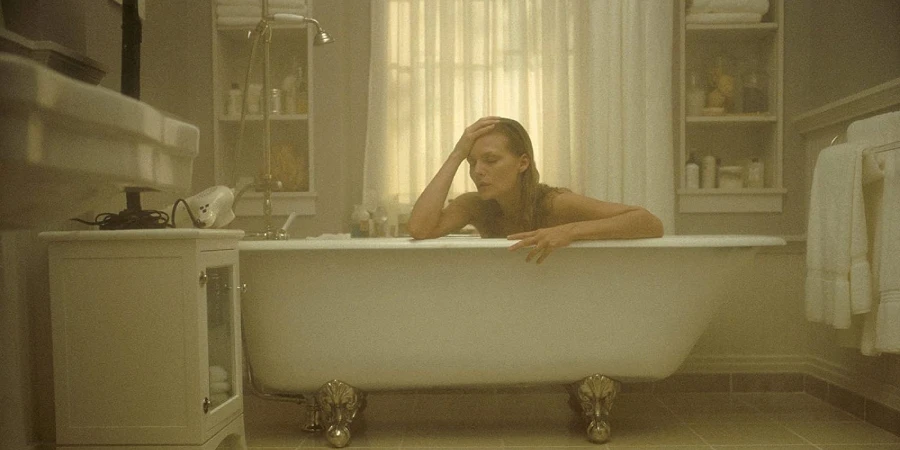
She hears voices. She sees a face beneath the water in the bathtub. Picture frames fall without reason. Claire becomes convinced the house is haunted, and her attention fixes on the neighbors, Warren and Mary Feur, after she witnesses what looks like a violent confrontation next door.
The Neighbor Obsession and the Red Herring
Claire grows so fixated on the Feurs that she breaks into their home, convinced Mary has been murdered. She tells Norman, who humors her at first but grows quietly dismissive. Her friend Jody encourages her to pursue the mystery, even helping her attempt an Ouija board session in the house.
Zemeckis plays the neighbor subplot long enough to make you genuinely believe it is the story. It is not. Mary Feur turns up alive. The entire thread exists purely to establish Claire as an unreliable, anxious figure in Norman’s eyes and, crucially, in the audience’s eyes too. It is a well-constructed misdirect.
Madison Elizabeth Frank Appears
Strange phenomena keep intensifying. A name begins to surface: Madison Elizabeth Frank. During a Ouija session, the spirit communicating with Claire spells it out. Claire digs into the name and discovers Madison was a young student at the university where Norman works as a research scientist.
Madison Frank disappeared roughly a year earlier. Nobody seems to know what happened to her. Claire finds a photograph that links Madison directly to Norman. His reaction when confronted is evasive, tightly controlled, and chilling in Ford’s understated delivery.
Norman’s Confession
Norman eventually admits he had an affair with Madison. He claims she became obsessed, that she ended her own life, and that the guilt nearly destroyed him. He frames himself as a man haunted by a tragic mistake, not a perpetrator. Claire, desperate to hold her marriage together, wants to believe him.
Pfeiffer plays Claire’s decision to accept this story with heartbreaking precision. You see the deliberate emotional shutting-down, the jaw set just slightly too firm. Claire tells herself the haunting will stop now that the truth is out. It does not stop.
The Truth About Madison
Claire discovers a lock of hair and a small vial hidden inside a picture frame in Norman’s study. She also finds evidence that Madison did not simply disappear: Norman killed her. He drowned her in the lake behind the house after she threatened to expose their affair and go public about their relationship.
Madison’s ghost has been reaching out specifically to Claire, not because they share some mystical bond, but because Claire is the closest person to her killer. The haunting is purposeful. Madison wants exposure.

Movie Ending
Norman drugs Claire with a paralytic agent he has access to through his research lab. He puts her in the bathtub, intending to stage her death as an accidental drowning, just as he did with Madison. Claire is fully conscious but completely unable to move or speak. She watches him prepare the scene from behind her own frozen eyes, which is genuinely one of the most disturbing sequences in any mainstream thriller from this era.
Norman loses his nerve at the last second. He pulls Claire out of the water and tries to make it look like she simply had an accident. His plan is to drive her somewhere and finish the job, or so the film implies. He puts her in his truck.
The paralytic begins to wear off slowly. Claire regains just enough motor control to grab the steering wheel. She causes the truck to crash off a bridge and into the lake below, the same lake where Norman drowned Madison.
Norman survives the crash initially and tries to drown Claire underwater. Madison’s ghost intervenes, pulling Norman down to the lake floor while Claire swims to safety. Norman drowns in the same body of water where he murdered Madison Frank. It is blunt poetic justice, and Zemeckis commits to it fully rather than hedging into ambiguity.
Claire surfaces. She survives. In the final shot, Madison’s ghost rises briefly before dissolving, at peace now that her killer is dead and her story is known. Claire is left on the bank, shattered but alive.
Audiences sometimes question whether the ghost is real within the film’s logic or a projection of Claire’s unraveling mind. Zemeckis answers this clearly: the ghost is real. Madison physically drags Norman under. There is no psychological reading that accounts for that action. The film commits to the supernatural.
Are There Post-Credits Scenes?
What Lies Beneath has no post-credits scene. Once the credits roll, the film is done. You can leave.
Type of Movie
This is a supernatural psychological thriller with strong horror elements, particularly in its second and third acts. The tone starts closer to domestic drama and slides steadily toward outright horror. Zemeckis leans into Hitchcock’s grammar: long silences, slow zooms, a score that tells you something is wrong before the image does.
It is not a slasher film, and it is not purely a ghost story. The scariest thing in it is a man sitting calmly at a dinner table while his wife slowly realizes what he is capable of.
Cast
- Michelle Pfeiffer – Claire Spencer
- Harrison Ford – Dr. Norman Spencer
- Diana Scarwid – Jody
- Miranda Otto – Mary Feur
- James Remar – Warren Feur
- Katharine Towne – Caitlin Spencer
- Victoria Bidewell – Madison Elizabeth Frank (as a ghost)
Film Music and Composer
Alan Silvestri composed the score. Silvestri and Zemeckis had worked together since Romancing the Stone in 1984, and their collaboration here produces something darker and more restrained than either man is usually associated with. String arrangements dominate, with an undercurrent of low brass that rarely resolves into comfort.
The bathtub scenes use near-silence punctuated by a single sustained note, which does more work than a full orchestral swell would. Silvestri resists the obvious. That restraint is the most underrated element of the film’s audio design.
Filming Locations
Production filmed primarily in Vermont, with much of the principal photography taking place at a purpose-built lakeside house. The house itself was constructed specifically for the film on a soundstage at Raleigh Studios in Los Angeles and was designed to be fully functional from every angle, including underwater.
Vermont’s overcast autumn palette does real work for the story. The bare trees, grey water, and perpetual threat of rain keep the film visually cold even in its quieter moments. Warm domesticity never quite lands because the environment refuses to cooperate with it.
Awards and Nominations
What Lies Beneath received limited awards attention despite its commercial success. Pfeiffer’s performance earned some critical praise, but the film did not factor significantly into major awards season conversations that year.
Behind the Scenes Insights
- Zemeckis filmed What Lies Beneath back-to-back with Cast Away on the same lot. While Tom Hanks lost weight for his role in that film, Zemeckis kept two productions running simultaneously.
- Michelle Pfeiffer performed many of her own takes in the bathtub scenes, including sequences requiring her to remain submerged. She has spoken about how physically demanding those days were.
- Harrison Ford deliberately underplayed Norman’s menace throughout production, wanting audiences to read him as genuinely grieving rather than guilty for as long as possible.
- The production built a custom gimbal-mounted set to simulate the truck sinking into the lake, allowing cameras to capture Pfeiffer’s perspective from inside a vehicle filling with water.
- Zemeckis studied Hitchcock’s shot construction extensively during pre-production, specifically Rear Window and Vertigo, and incorporated deliberate visual references throughout.
Inspirations and References
Zemeckis and screenwriter Clark Gregg drew heavily from Hitchcock’s thriller playbook, particularly Rear Window (the neighbor-watching subplot) and Vertigo (the obsession with a dead woman, the lake imagery, a husband who cannot let a past relationship stay buried).
The film also owes something to Rebecca (1940), Hitchcock’s adaptation of Daphne du Maurier’s novel. A second wife slowly uncovers the truth about a dead woman her husband refuses to discuss honestly: the structural echo is hard to miss.
Sarah Kernochan developed the original story, and Clark Gregg shaped it into screenplay form. No single source novel exists; the story was conceived directly for the screen.
Alternate Endings and Deleted Scenes
An alternate ending circulated in discussions around the film’s release in which Norman survives the lake sequence. Test audiences rejected it strongly, finding it unsatisfying. Zemeckis returned to the version where Madison drags him down for good.
Several scenes establishing Claire’s pre-film life as a cellist were reportedly trimmed significantly in editing. These scenes would have fleshed out her sense of lost identity, which is present in the final cut but somewhat undercooked given how much Pfeiffer could have done with more material there.
Book Adaptations and Differences
What Lies Beneath is not based on a book. The story originated as an original screenplay, developed from a story by Sarah Kernochan and written by Clark Gregg. No source novel exists to compare it against.
Memorable Scenes and Quotes
Key Scenes
- The Bathtub Paralysis Scene: Norman injects Claire with the paralytic and lowers her into the bathtub. Claire’s eye moves, tracking him around the room, while her body stays completely still. Her perspective is shown through a slight fisheye distortion, cold and close. It is the film’s most effective horror sequence.
- The Ouija Session: Claire and Jody attempt to contact the spirit. The planchette moves to spell out “MEF,” then later “Norman.” Pfeiffer plays Claire’s dawning horror not with screaming but with a very slow backing away from the board, like her body understands before her mind catches up.
- Norman’s Confession: Ford sits across from Pfeiffer at their kitchen table and admits the affair. His posture stays controlled. His voice stays low. The camera barely moves. It is scarier than any ghost sequence in the film because everything he says sounds exactly right.
- The Lake Finale: Madison’s ghost appears underwater, hair fanning out, and wraps her hands around Norman’s ankle. He thrashes. She holds. He sinks. Zemeckis shoots it from above water and below alternately, cutting between Claire’s desperate swim and Norman’s final moments.
Iconic Quotes
- “I was with her. I just wasn’t careful.” (Norman, confessing the affair with devastating casualness)
- “She’s not after you. She’s after me.” (Claire, realizing the ghost’s true target)
Easter Eggs and Hidden Details
- The name Madison appears written in condensation on a bathroom mirror early in the film before Claire consciously knows who Madison is. It is easy to miss on a first viewing because it forms slowly and partially.
- Norman’s study contains a framed photo that, in a briefly visible background shot, shows him with a younger woman. Claire walks past it twice before the film draws her attention to it properly.
- The lake is visible from nearly every exterior window in the house. Zemeckis frames Norman near windows overlooking the water repeatedly, long before the audience understands why the lake matters to him.
- Claire’s cello case appears in the background of the opening scenes, then gradually disappears from the house’s visible spaces as her sense of self erodes. It reappears in the final act near her car.
Trivia
- The film opened at number one at the US box office and earned substantial returns on its production investment, making it one of the bigger live-action successes of Zemeckis’s career outside his effects-driven blockbusters.
- Clark Gregg, who wrote the screenplay, later became widely known as an actor for his role as Agent Coulson in the Marvel Cinematic Universe.
- Zemeckis reportedly kept the full script from Harrison Ford and Michelle Pfeiffer during early table reads, revealing Norman’s true nature in stages to preserve the actors’ natural responses.
- Michelle Pfeiffer was in her early forties during production and has cited this film as one of the more physically grueling shoots of her career, specifically because of the water work.
- The film was marketed almost entirely around the ghost premise, deliberately hiding Ford’s villain turn in all promotional materials. Contemporary audiences went in expecting a haunted-house movie and got something considerably darker.
Why Watch?
Pfeiffer carries this film almost entirely on physical performance alone: the way she holds her breath, the micro-expressions she deploys in scenes where Claire cannot speak aloud, the exact moment her face shifts from suspicion to terror in the bathtub. Ford playing against his heroic image is genuinely unsettling. See it for those two actors working at full intensity inside a Hitchcock puzzle box Zemeckis clearly built with real care.
Director’s Other Movies
- Romancing the Stone (1984)
- Back to the Future (1985)
- Who Framed Roger Rabbit (1988)
- Back to the Future Part II (1989)
- Back to the Future Part III (1990)
- Death Becomes Her (1992)
- Forrest Gump (1994)
- Contact (1997)
- Cast Away (2000)
- The Polar Express (2004)
- Beowulf (2007)
- A Christmas Carol (2009)
- Flight (2012)
- The Walk (2015)
- Allied (2016)
- Welcome to Marwen (2018)
- Pinocchio (2022)
Recommended Films for Fans
- Rear Window (1954)
- Vertigo (1958)
- Rebecca (1940)
- Sleeping with the Enemy (1991)
- The Others (2001)
- Stir of Echoes (1999)
- Gothika (2003)
- The Gift (2000)