A broken leg, a heat wave, and a pair of binoculars: that is all Alfred Hitchcock needed to turn one Greenwich Village courtyard into the most suspenseful neighborhood in cinema. Rear Window (1954) traps its hero in a wheelchair and dares us to share his bad habit. Every window across the way tells a story. One of them, as it turns out, hides a murder.
Detailed Summary
A Photographer Stuck in a Wheelchair
L.B. “Jeff” Jefferies (James Stewart) earns his living as a globetrotting magazine photographer. A racetrack accident has left him with a cast from toe to hip, and he has spent six long weeks confined to his small apartment. One more week remains before the plaster comes off.
Boredom drives him to the window. Through it, he watches a cast of neighbors going about their lives in the sweltering summer heat. Among them are a lonely woman he calls Miss Lonelyhearts, a dancer he dubs Miss Torso, a struggling songwriter, a childless couple who dote on their little dog, a pair of newlyweds, and a salesman named Lars Thorwald (Raymond Burr) with a bedridden, nagging wife.
Stella and Lisa Enter the Picture
Stella (Thelma Ritter), a sharp-tongued nurse sent by Jeff’s insurance company, warns him about his new hobby. She delivers one of the film’s great lines about a “race of Peeping Toms” and predicts trouble. Jeff waves her off; however, the warning will prove prophetic.
His girlfriend Lisa Carol Fremont (Grace Kelly) arrives that evening in a stunning gown, complete with a catered dinner from the 21 Club. Lisa wants marriage. Jeff insists that a Park Avenue fashion icon could never survive his rough, nomadic lifestyle, and the two quarrel.
Three Trips in the Rain
Later that night, during a thunderstorm, Jeff notices something odd. Thorwald leaves his apartment three separate times carrying a metal sample case, each time returning after a short absence. By morning, Mrs. Thorwald’s bed sits empty, and the blinds stay drawn.
Jeff grows suspicious. Over the following day, he watches Thorwald wrap a large knife and a saw in newspaper. Thorwald also makes a long-distance phone call and ties up a large trunk with heavy rope. Lisa initially scoffs, but when she sees Thorwald handling his wife’s handbag and jewelry, she changes her mind completely.
The Skeptical Detective
Jeff calls in a favor from an old wartime buddy, Detective Lieutenant Thomas Doyle (Wendell Corey). Doyle investigates and comes back with deflating news. Witnesses saw Mrs. Thorwald leave the building with her husband early that morning, and the trunk went by rail to a town called Merritsville, where Mrs. Thorwald apparently signed for it herself.
Doyle lectures Jeff about privacy and the law. Jeff and Lisa feel embarrassed, even a little ashamed, as they realize how deeply they have invaded the lives of strangers. For a moment, the mystery seems to evaporate.
The Dog and the Flower Bed
Then the little dog turns up dead in the courtyard. Its owner wails from her fire escape, asking which of the neighbors could have done such a thing. Every window fills with faces, except one. Thorwald sits alone in the dark, the glow of his cigar the only sign of life.
Jeff recalls that the dog had been digging in Thorwald’s flower bed. Comparing a recent photo to the current view, he notices that the zinnias are now shorter than before. Something has been buried there and then disturbed. Lisa, now fully committed, reasons that a wedding ring would be the key: no woman leaves on a trip without hers.
Lisa Climbs the Fire Escape
Jeff writes a note reading “What have you done with her?” and Lisa slips it under Thorwald’s door. Rattled, Thorwald begins packing. Jeff then phones him, pretending to be a blackmailer, and lures him to the Albert Hotel to clear the apartment.
Stella and Lisa dig up the flower bed but find nothing. Lisa, acting on impulse, climbs the fire escape and slips into Thorwald’s apartment through an open window. Inside, she finds Mrs. Thorwald’s handbag and, crucially, the wedding ring. Meanwhile, Thorwald returns early. Jeff can only watch in horror as the killer corners her.
Movie Ending
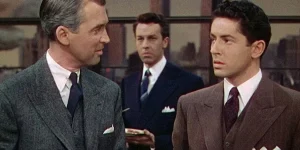
Thorwald grabs Lisa and starts to rough her up while Jeff, frantic and helpless, calls the police. Officers arrive just in time. Lisa cleverly presents herself as a burglar, and as the police lead her away, she slides the wedding ring onto her finger and wiggles her hand behind her back for Jeff to see. Thorwald sees it too. He follows her gaze straight across the courtyard to Jeff’s window.
Stella rushes off to the police station with bail money, leaving Jeff alone. His phone rings, and he assumes it is Doyle. Silence answers him, and then heavy footsteps sound in the hallway. Thorwald enters and asks, quietly, “What do you want from me?”
Jeff has only one weapon: his camera flashbulbs. He fires them one after another, blinding Thorwald for a few precious seconds each time. Hitchcock renders these moments from Thorwald’s point of view, the screen bleaching to red and fading back as the killer staggers forward.
Thorwald reaches him anyway. In the struggle, he shoves Jeff out the window. Jeff clings to the ledge, calling for help, as the neighbors rush out and Doyle’s men finally burst in. Officers in the courtyard break his fall, but not before Jeff hits the ground. Thorwald confesses on the spot, and Doyle reports that he is willing to take the police on a tour of the East River, where the body was disposed of.
Why does it matter? Jeff spent the entire film arguing that Lisa was too fragile for his world. In the end, she proved braver than him, risking her life while he sat trapped in a chair. The final scene seals the point. Jeff now sleeps with two broken legs, and Lisa lounges beside him in jeans and a casual shirt, reading a book about the Himalayas. Once she is sure he is asleep, she swaps it for Harper’s Bazaar. She will meet him halfway, but on her own terms.
Around the courtyard, the other stories resolve too. Miss Lonelyhearts has found companionship with the songwriter, whose finished song pulled her back from despair. Miss Torso welcomes home her boyfriend, a short soldier who heads straight for the refrigerator. The couple on the fire escape have a new puppy. Even the newlyweds have begun to bicker. Life goes on, and the blinds roll down.
Are There Post-Credits Scenes?
No. Rear Window is a 1954 production, and the post-credits scene did not exist as a convention at that time. The film ends with the blinds coming down on Jeff’s window and a simple end title. Once the screen fades, you can safely leave.
Type of Movie
Rear Window is a suspense thriller with strong elements of mystery and romantic comedy. Hitchcock blends them so seamlessly that the tone shifts within single scenes, from flirtation to dread and back again.
The film also functions as a sly piece of self-reflection about voyeurism and cinema itself. Jeff’s window is a movie screen, the neighbors are his cast, and we are complicit in every glance. Consequently, the thrills land with a slight sting of guilt.
Cast
- James Stewart – L.B. “Jeff” Jefferies
- Grace Kelly – Lisa Carol Fremont
- Wendell Corey – Detective Lieutenant Thomas J. Doyle
- Thelma Ritter – Stella
- Raymond Burr – Lars Thorwald
- Judith Evelyn – Miss Lonelyhearts
- Ross Bagdasarian – The Songwriter
- Georgine Darcy – Miss Torso
- Irene Winston – Anna Thorwald
- Sara Berner – Woman on the Fire Escape
- Frank Cady – Man on the Fire Escape
- Jesslyn Fax – Sculptress Neighbor
Film Music and Composer
Franz Waxman composed the score, though Rear Window uses less traditional underscore than most Hitchcock films. Waxman provides a jazzy, percussive main title that sets the urban summer mood. After that, most of the music arrives from inside the courtyard itself.
Radios, record players, and a piano supply the soundtrack. The songwriter neighbor works throughout the film on a tune called “Lisa,” which Waxman wrote, and the song reaches completion just as Miss Lonelyhearts prepares to take her own life. Hearing it, she stops. In addition, popular recordings such as Dean Martin’s “That’s Amore” drift through the air at key moments.
Waxman was one of Hollywood’s most decorated composers. He won back-to-back Academy Awards for Sunset Boulevard (1950) and A Place in the Sun (1951), and he had earlier scored Hitchcock’s Rebecca (1940).

Filming Locations
Hitchcock shot the entire film on a single soundstage at Paramount Studios in Hollywood. The production built a complete Greenwich Village courtyard on Stage 18, including the surrounding apartment buildings, a street glimpsed through an alley, and functioning fire escapes. Dozens of apartments stood on the set, many of them fully furnished and wired with their own electricity and plumbing.
The design was based on a real courtyard at 125 Christopher Street in Manhattan, though the film gives Jeff’s address as 125 West 9th Street. Hitchcock directed almost exclusively from Jeff’s apartment. Actors across the courtyard wore earpieces so he could give them instructions by radio.
Why does it matter? The entire story depends on Jeff’s fixed point of view. By shooting nearly every frame from his window, Hitchcock ensures that we know only what Jeff knows. The single enormous set made that discipline possible.
Awards and Nominations
Rear Window earned four Academy Award nominations: Best Director for Hitchcock, Best Screenplay for John Michael Hayes, Best Color Cinematography for Robert Burks, and Best Sound Recording. It did not win in any category.
Time has been kinder. In 1997, the Library of Congress selected the film for preservation in the National Film Registry, and it routinely appears on lists of the greatest films ever made.
Behind the Scenes Insights
- Hitchcock makes his customary cameo in the songwriter’s apartment, where he can be seen winding a clock while the composer works at the piano.
- James Stewart spent most of the shoot in a wheelchair and cast, delivering an almost entirely reactive performance built from close-ups and glances.
- Legendary costume designer Edith Head created Grace Kelly’s wardrobe, and the elegant dresses became a subtle part of the story, signaling Lisa’s transformation.
- Raymond Burr’s look, with the silver hair and glasses, has long been said to echo producer David O. Selznick, with whom Hitchcock had a difficult working relationship.
- The courtyard set was so large that the stage floor had to be excavated so Jeff’s apartment could sit at the proper height above the courtyard.
- Georgine Darcy, who played Miss Torso, was a real dancer and performed her own routines without a double.
- A decades-long rights dispute involving the original short story kept the film out of circulation for years, eventually reaching the United States Supreme Court.
Inspirations and References
The film adapts Cornell Woolrich‘s 1942 short story It Had to Be Murder, which Woolrich published under the pen name William Irish. Woolrich was one of the most adapted writers of the noir era, and his pulp sensibility shaped the film’s central premise.
Screenwriter John Michael Hayes expanded the slim story into a full feature. He drew on his own experiences with a fashion-model wife to create Lisa, who has no counterpart in the original. The film also reflects Hitchcock’s longstanding interest in voyeurism and guilt, themes he would explore again in Vertigo and Psycho.
Alternate Endings and Deleted Scenes
No alternate endings have surfaced for Rear Window. Hitchcock planned his films with such precision that very little footage ended up unused, and the finished film closely matches the shooting script.
Interestingly, the biggest “alternate version” lives in the source material rather than on the cutting room floor. Woolrich’s story resolves the Thorwald mystery through very different means, as the next section explains.
Book Adaptations and Differences
Yes, the film is based on a book, or more precisely a short story. Woolrich’s It Had to Be Murder is a lean piece of pulp fiction, and the film changes it considerably.
In the story, the narrator is named Hal Jeffries, and the text never explains why he cannot leave his chair. He has no girlfriend and no visiting nurse; instead, a houseman named Sam runs his errands. The Lisa and Stella characters, and with them the romance and much of the humor, are entirely the invention of the screenplay.
The resolution differs as well. Woolrich’s Thorwald hides his wife’s body beneath a freshly laid cement floor in the building, and the climax plays out as a grim action sequence rather than the flashbulb standoff. Hayes and Hitchcock kept the premise and the villain’s name but built a far richer world around them.
Memorable Scenes and Quotes
Key Scenes
- The opening crane shot that glides out the window, across the courtyard, and back to Jeff’s sweating face, telling us everything about his situation without a word of dialogue.
- Lisa’s first entrance, as she leans in to kiss Jeff in slow motion and switches on three lamps while introducing herself, name by name.
- The thunderstorm night, with Thorwald’s repeated departures seen in fragments as Jeff drifts in and out of sleep.
- The dog’s death and the owner’s anguished speech to the courtyard, which breaks the film’s playful mood for good.
- Lisa’s climb into Thorwald’s apartment, perhaps the most unbearable stretch of suspense Hitchcock ever filmed.
- The flashbulb confrontation, shot in near silence, with the screen flaring red each time Thorwald is blinded.
- The final shot of Lisa swapping her adventure book for a fashion magazine.
Iconic Quotes
- “We’ve become a race of Peeping Toms. What people ought to do is get outside their own house and look in for a change.” (Stella)
- “Tell me everything you saw, and what you think it means.” (Lisa)
- “I’m not much on rear window ethics.” (Lisa)
- “Intelligence. Nothing has caused the human race so much trouble as intelligence.” (Stella)
- “Why would a man leave his apartment three times on a rainy night with a suitcase and come back three times?” (Jeff)
- “What do you want from me?” (Thorwald)
Easter Eggs and Hidden Details
- Jeff’s apartment is lined with clues about his past: a smashed camera and a framed photo of a racetrack crash explain his broken leg within the first minute.
- Each neighbor’s story mirrors a possible future for Jeff and Lisa, from the bickering newlyweds to the lonely woman to the couple whose dog substitutes for a child.
- Lisa’s name becomes the title of the songwriter’s tune, quietly linking the two romances across the courtyard.
- When Jeff finally looks at Thorwald with his telephoto lens, Hitchcock cuts to the enlarged image, reminding us that Jeff’s instrument of work has become an instrument of spying.
- The thermometer on Jeff’s wall tracks the heat wave, and the weather breaks, with rain, just as the murder occurs.
- Thorwald’s apartment is the only one in the courtyard where the lights are consistently off after the murder, a visual cue that pays off during the dog scene.
Trivia
- Ross Bagdasarian, the songwriter at the piano, later created Alvin and the Chipmunks under the name David Seville.
- Thelma Ritter received six Academy Award nominations in her career, though not for this film.
- Grace Kelly made three films with Hitchcock in rapid succession: Dial M for Murder, Rear Window, and To Catch a Thief.
- The courtyard set required so much lighting that the heat on stage reportedly matched the heat wave in the story.
- Hitchcock’s name appears in his own cameo scene at the same moment the audience hears the songwriter struggling with his melody.
- James Stewart and Hitchcock collaborated four times in total, including Rope, The Man Who Knew Too Much, and Vertigo.
Why Watch?
Rear Window remains the ultimate masterclass in suspense built from pure point of view. It is funny, romantic, and quietly unsettling all at once. Few films have ever made the audience so aware of its own habit of watching, and fewer still have done it with this much style.
Director’s Other Movies
- The 39 Steps (1935)
- The Lady Vanishes (1938)
- Rebecca (1940)
- Shadow of a Doubt (1943)
- Notorious (1946)
- Rope (1948)
- Strangers on a Train (1951)
- Dial M for Murder (1954)
- To Catch a Thief (1955)
- The Man Who Knew Too Much (1956)
- Vertigo (1958)
- North by Northwest (1959)
- Psycho (1960)
- The Birds (1963)
- Marnie (1964)
- Frenzy (1972)
Recommended Films for Fans
- Blow-Up (1966)
- The Conversation (1974)
- Body Double (1984)
- Disturbia (2007)
- The Lives of Others (2006)
- Peeping Tom (1960)
- Caché (2005)
- The Girl on the Train (2016)
- Wait Until Dark (1967)