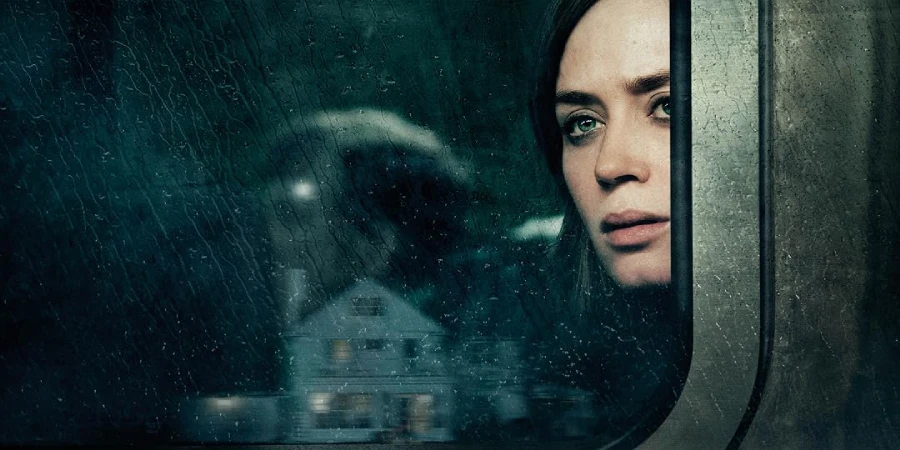

Rachel Watson watches the same house every morning from a commuter train, fixated on a couple she has never met, building a fantasy life for them in her head. When the woman she watches goes missing, Rachel inserts herself into the investigation with all the reliability of someone who blacks out regularly from alcohol. Tate Taylor’s 2016 adaptation of Paula Hawkins’ best-selling novel commits fully to its unreliable-narrator premise, and Emily Blunt makes Rachel’s self-destruction feel genuinely painful rather than merely convenient. This is a film where almost everyone is lying, and the pleasure comes from figuring out in what order.
Detailed Summary
Rachel’s Daily Routine and Obsession
Rachel Watson rides the commuter train between Ardsley-on-Hudson and New York City every day, even though she no longer has a job to commute to. She drinks from a flask, watches the passing houses, and focuses especially on one where Megan and Scott Hipwell live.
Rachel has named them Jason and Jess in her head. She projects a perfect marriage onto them, partly because she lived nearby with her own ex-husband, Tom Watson, just a few houses down on the same street.
Tom, Anna, and the Collapse of Rachel’s Marriage
Tom left Rachel for Anna Boyd, who is now his wife and the mother of his infant daughter. Rachel’s drinking intensified during and after the divorce. She experiences regular blackouts, waking up with injuries she cannot explain and no memory of her actions.
Rachel still calls Tom. She shows up near the old house. Anna considers her a stalker and a threat, and she is not entirely wrong.
Megan’s Secrets
Megan Hipwell is not the happy wife Rachel imagines. She sees a therapist, Dr. Abdic (Kamal), and their sessions reveal a deeply troubled past. Megan lost a baby years ago, an infant daughter she accidentally drowned in a bathtub.
Megan is also having an affair with Tom Watson. She becomes pregnant and is not certain who the father is. She tells Tom about the pregnancy.
The Night Megan Disappears
One morning from the train, Rachel sees Megan kissing a man on the terrace who is clearly not Scott. Rachel blacks out that night after drinking heavily. She wakes up with blood on her face, a wound on her head, and no memory of what happened.
Megan is reported missing. Rachel saw her on the night she vanished. Police consider Rachel a potential witness, and later a suspect.
Rachel Inserts Herself Into the Investigation
Rachel contacts Scott Hipwell, presenting herself as a friend of Megan’s. Scott is grief-stricken and suspicious of Dr. Abdic, who he believes was Megan’s lover. Rachel feeds that suspicion while also developing her own complicated feelings for Scott.
Detective Riley interviews Rachel repeatedly. Rachel’s blackouts make her testimony nearly useless, and her history of harassment toward Tom and Anna works against her credibility at every turn.
Recovering the Memory
Fragments of Rachel’s blackout night begin returning. Memory places her near the underpass, caught in a sharp confrontation. Flashes of a man’s face breach the haze, though the details remain too blurred to act on yet.
Driven by equal parts suspicion and genuine distress, Rachel books a session with Dr. Abdic. He maintains a cautious distance. Throughout their time together, nothing he says or does definitively clears or implicates him.
The Truth About Tom
Rachel’s memory finally solidifies. On the night Megan disappeared, Tom was there. He was the man Megan was with. When Rachel stumbled onto the scene in a blackout state, Tom beat her to prevent her from seeing or remembering what happened.
Tom had killed Megan. She had told him about the pregnancy, and he panicked. He is not the steady, responsible man who simply moved on from a troubled marriage; he is a manipulative abuser who has been gaslighting Rachel for years, convincing her that her blackout behavior was violent and erratic when he was actually the one hurting her.

Movie Ending
Rachel confronts Tom at the house. Anna, crucially, has also begun piecing things together. She finds a phone Tom hid, and it contains messages that confirm he was having an affair with Megan and that he knew about the pregnancy.
Anna finally believes Rachel. The two women, who spent the entire film as adversaries, arrive at the same horrifying understanding at the same time. Tom drops the charming facade entirely. He attacks Rachel.
Anna stabs Tom with a corkscrew during the struggle. Rachel then drives it deeper. Tom dies. Both women are covered in blood in the kitchen of a house that was once Rachel’s home.
Police rule the killing as self-defense. Rachel boards a train again in the final scene, but this time she is sober. She stares out the window without the obsessive fantasy. She passes the house without flinching. It is a quiet, deliberately undramatic ending, and that restraint is the right call; a triumphant score and a wide smile would have betrayed everything the film worked to establish about how slowly and incompletely people recover.
Are There Post-Credits Scenes?
No. The Girl on the Train contains no post-credits scene of any kind. Once the final sequence ends and the credits begin, the film is done. You can leave the theater.
Type of Movie
The Girl on the Train is a psychological thriller with strong elements of domestic noir. Its tone is heavy and deliberately oppressive, leaning into dread rather than suspense.
This is not a whodunit designed to be fun. It is closer in mood to a trauma procedural, a film more interested in how women survive gaslighting than in the mechanics of a murder mystery.
Cast
- Emily Blunt – Rachel Watson
- Haley Bennett – Megan Hipwell
- Rebecca Ferguson – Anna Watson
- Justin Theroux – Tom Watson
- Luke Evans – Scott Hipwell
- Édgar Ramírez – Dr. Kamal Abdic
- Allison Janney – Detective Riley
- Lisa Kudrow – Martha
- Laura Prepon – Cathy
Film Music and Composer
Danny Elfman composed the score. His work here is deliberately restrained by his own standards, trading the gothic playfulness of his earlier work for something colder and more clinical.
Strings dominate. Elfman uses dissonance sparingly but effectively, especially during Rachel’s blackout sequences where the score fragments alongside her memory. It is one of the quieter corners of his catalog, and it suits the film’s suffocating domestic atmosphere well.

Filming Locations
Despite being set in New York’s commuter suburbs, significant portions of the film were shot on location in Westchester County, New York, which gives the story an authentic sense of that particular kind of upper-middle-class American sprawl.
Actual Metro-North Railroad commuter trains were used for the train sequences. Shooting on real trains and real platforms gives Rachel’s daily ritual a documentary texture that a studio set would have flattened.
The original novel by Paula Hawkins is set in London and uses the real London to Northampton rail line. Relocating the story to New York was a deliberate production decision, and it works better than skeptics initially expected, partly because Westchester’s quiet, manicured neighborhoods carry their own specific kind of concealed suburban rot.
Awards and Nominations
Emily Blunt received a Golden Globe nomination for Best Actress in a Motion Picture Drama for her performance as Rachel. The Girl on the Train did not collect major awards wins, which is a mild collective failure of recognition given how physically and emotionally demanding Blunt’s work is here.
Behind the Scenes Insights
- Emily Blunt wore prosthetic bruising and gained weight for the role to physically embody Rachel’s deterioration.
- Director Tate Taylor initially had reservations about relocating the story from England to the United States, but ultimately supported the change.
- Haley Bennett and Emily Blunt were styled to look similar, partly to reinforce the film’s thematic interest in how Rachel projects herself onto Megan.
- The non-linear structure required the cast to shoot scenes out of chronological order, which Blunt noted made tracking Rachel’s emotional and physical state especially demanding.
- Lisa Kudrow’s role as Martha is small but pointed; casting a performer so associated with warmth and likability adds an ironic texture to scenes that are quietly devastating.
Inspirations and References
The Girl on the Train is a direct adaptation of Paula Hawkins’ 2015 debut novel of the same name. Hawkins has cited Alfred Hitchcock’s Rear Window as a clear structural ancestor, with its premise of a passive observer becoming entangled in a crime they witnessed partially and imperfectly.
The novel and the film also participate in a broader cultural moment of domestic noir led by Gillian Flynn’s Gone Girl. Both works feature unreliable female narrators and marriages that are elaborate performances of normality concealing serious violence.
Alternate Endings and Deleted Scenes
No officially released alternate ending or substantial deleted scene package has been made widely available for this film. The home release includes some minor additional footage, but nothing that substantially changes the story or its resolution.
Book Adaptations and Differences
Paula Hawkins’ novel serves as the source material. The most significant change is the geographic relocation from suburban London to suburban New York, which required adjusting specific cultural references and character backgrounds throughout.
Megan’s backstory involving her dead child remains essentially intact. Rachel’s blackout structure and the three-woman narrative perspective carry over faithfully. Dr. Abdic’s ambiguity is preserved. Tom’s reveal as the killer lands in roughly the same way in both versions.
One notable tonal difference: Hawkins’ novel spends more time inside each narrator’s interiority. The film compresses this by leaning harder on visual disorientation during Rachel’s blackout sequences rather than internal monologue.

Memorable Scenes and Quotes
Key Scenes
- Rachel spotting Megan kissing a stranger from the train window, a moment where the camera places us directly in Rachel’s eyeline and holds the shot just long enough for her expression to shift from fantasy to fracture.
- Tom’s full reveal, where his voice drops, his posture changes, and Justin Theroux stops performing affability entirely; it is a clean, unnerving pivot.
- Rachel waking up on the floor of her apartment, bloody, with her phone buzzing, and slowly assembling the damage of another lost night while the camera stays in close on Blunt’s face.
- Anna and Rachel’s kitchen confrontation with Tom, where domestic space becomes explicitly threatening and the corkscrew sitting on the counter feels like a loaded weapon from the moment it enters the frame.
- Megan’s therapy sessions with Dr. Abdic, particularly the scene where she confesses the death of her infant daughter; Bennett plays the confession with a flatness that reads as dissociation rather than indifference.
Iconic Quotes
- “I am not the girl I used to be.” (Rachel)
- “Everybody thinks I’m a mess. And they’re not wrong.” (Rachel)
- “You were never the woman I thought you were.” (Scott to Megan)
Easter Eggs and Hidden Details
- Haley Bennett and Emily Blunt’s physical resemblance is not accidental; costume and hair choices amplify it deliberately, reinforcing the film’s suggestion that Rachel sees in Megan a version of herself she wishes she still was.
- The color red appears repeatedly in Megan’s scenes, in her clothing and in the production design of her home, functioning as a visual thread connecting her to danger before the audience consciously registers it.
- Tom’s house, once Rachel’s house, is staged with an almost aggressive normality: clean lines, neutral tones, fresh flowers. That visual cleanliness is its own kind of horror once you understand what Tom is.
- Rachel’s flask is present in nearly every scene set on the train, but there is one late-film train scene where it is conspicuously absent, a small visual signal that something has shifted before the dialogue confirms it.
Trivia
- Paula Hawkins’ novel spent over a year on the New York Times bestseller list before the film adaptation entered production.
- Emily Blunt was cast before a director was attached, which is an unusual sequence for a studio production at this budget level.
- Tate Taylor is best known for directing The Help (2011), making The Girl on the Train a significant tonal departure for him.
- The film was released in October 2016, roughly two years after Gone Girl (2014) had established strong audience appetite for this exact genre of domestic thriller.
- Allison Janney plays Detective Riley with a dry skepticism that the script does not fully earn; she makes the role larger than it is written.
Why Watch?
Emily Blunt’s performance is reason enough. She makes Rachel’s unreliability physical: the way Blunt holds her jaw, avoids eye contact, and visibly tries to reconstruct her own recent past is more convincing than any voiceover could be. Watching Blunt do the quiet work of a woman gaslighted into doubting her own memory is worth the two hours on its own.
Director’s Other Movies
- The Help (2011)
- Get on Up (2014)
- Ma (2019)
Recommended Films for Fans
- Gone Girl (2014)
- Rear Window (1954)
- Big Little Lies (2017)
- Nocturnal Animals (2016)
- Sharp Objects (2018)
- The Woman in the Window (2021)
- Stoker (2013)