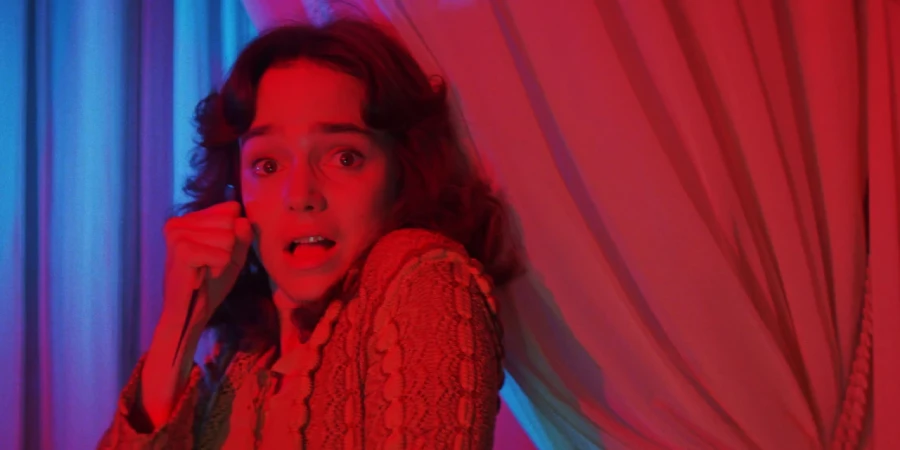

Dario Argento opens Suspiria with a young American woman pressing her face against a rain-soaked airport window, and within ten minutes she witnesses a murder so elaborately staged it feels less like a slasher kill and more like a baroque painting come to life.
Color is the real weapon here: Argento and cinematographer Luciano Tovoli drenched every frame in saturated primary reds and greens that no horror film before or since has quite replicated. This is a witch movie that barely bothers explaining its witches, and that restraint is exactly what makes it work.
Detailed Summary
Suzy Arrives in Freiburg
American ballet student Suzy Bannion lands in Frankfurt and takes a taxi to the Tanz Dance Academy in Freiburg. A storm batters the car the entire drive. When she reaches the academy’s front door, another student rushes out in a panic, muttering something Suzy cannot catch.
Suzy is turned away for the night and checks into a hotel. She catches a glimpse of the fleeing student, Pat Hingle, whose expression is pure terror.
Pat’s Murder
Pat takes shelter at a friend’s apartment. She begins behaving strangely, pacing and staring out the window before suddenly screaming that she can see a set of eyes in the trees below.
A pair of hands smashes through the window, grabs Pat by the hair, and drags her face-first into the glass. What follows is one of the most elaborately violent kills in horror history: she gets stabbed repeatedly through a skylight floor, then hanged by a cord through a hole punched in the ornate ceiling. Her friend falls through the shattered skylight and is impaled on a spiked decorative arch below.
Argento shoots the entire sequence in blazing reds and yellows. The color work here is not atmosphere for its own sake; it communicates something genuinely wrong with the physical world these characters inhabit.
Life Inside the Academy
Suzy returns the next day and is accepted. She meets fellow student Sara, who becomes her closest ally. She also notices that the school’s directress, Miss Tanner, runs the place with an iron fist, and the gentler assistant directress Madame Blanc seems to be hiding something behind her composure.
Strange things accumulate quickly. Suzy faints during a rehearsal and is moved into the academy’s dormitory against her wishes. After that, she starts feeling weak and drowsy every evening, which Sara suspects is linked to the wine the students are served at dinner.
The Maggot Infestation
One night, maggots rain down from the ceiling onto the sleeping students. Everyone scrambles downstairs. The school blames a batch of spoiled food stored in the attic, but the explanation feels hollow.
Forced to sleep in the main hall, the students hear snoring from behind a curtain. Whatever is sleeping there, the staff refuses to acknowledge it directly. Sara tells Suzy she has been tracking the footsteps and believes a man lives hidden inside the school.
Daniel’s Death
Daniel, the academy’s blind piano accompanist, gets fired after his guide dog bites the nephew of one of the school’s directors. That night, walking through a plaza, Daniel’s dog suddenly turns on him and tears out his throat.
It is a shocking scene precisely because the violence comes from the one companion Daniel trusted completely. Argento frames the attack from low angles, the open plaza lit in cold blue, making the space feel vast and inescapable.
Sara’s Fate
Sara grows increasingly frightened. She tells Suzy about the original directress of the academy, a woman named Helena Markos, and her belief that the school is a front for a coven of witches. Sara has also found a pattern in the floorboards by counting the staff members’ footsteps.
That night, Sara tries to escape through a window and drops into what she thinks is an empty room. It turns out to be a chamber packed floor to ceiling with razor wire. She struggles through it, bleeding badly, and makes it into a corridor, only to be stabbed to death by an unseen assailant.
Sara’s death hits hard because her friendship with Suzy is the film’s only genuine warmth. Losing her strips away Suzy’s last anchor inside the school.
Suzy Investigates
Desperate for answers, Suzy visits Dr. Frank Mandel, a psychiatrist who knew Sara. He connects her to a colleague, Professor Milius, who specializes in the occult.
Milius explains that covens operate through their leader’s will. If that leader dies, every spell and every servant under their control collapses. He also tells Suzy that Helena Markos, the so-called Black Queen, supposedly died years ago but may still be present in some form inside the school.


Movie Ending
Suzy slips back into the academy while the other students are away at a performance. She follows the sound of voices to a hidden room and peers through a gap in a curtain. The entire coven is assembled, chanting, with Madame Blanc and Miss Tanner both present. They are gathered around Helena Markos, still alive, ancient and barely visible in the dim red light.
Markos commands her coven to kill Suzy, and the body of Sara, now animated, lunges at her. Suzy grabs a peacock-feather ornament with a metal spike hidden inside it and drives it through Markos’s throat. The moment Markos dies, the entire academy begins to collapse. Fires erupt. Miss Tanner screams and disintegrates. The animated corpses drop. Suzy runs through the crumbling, burning hallways and escapes into the rain outside.
What matters about this ending is what it refuses to do. Argento gives Suzy no mentor, no magical gift, and no grand revelation. She wins by being present, by paying attention, and by grabbing the nearest sharp object. After a film drenched in helplessness, that simplicity feels genuinely earned.
The final shot shows Suzy walking away through the rain, smiling faintly. No explanation follows. The academy burns behind her. Argento does not linger on grief or trauma; he lets her leave, and the film ends.
Are There Post-Credits Scenes?
Suspiria has no post-credits scene. Argento cuts to black after Suzy walks away, and that is the end.
Type of Movie
Suspiria is a supernatural horror film, sitting firmly in the Italian giallo tradition while pushing well beyond its genre roots into something closer to a nightmare fairy tale. Its tone is relentless, dreamlike, and occasionally surreal rather than grounded or psychological.
Think less haunted house, more Brothers Grimm retold by someone with a very large lighting budget and no interest in reassuring the audience.
Cast
- Jessica Harper – Suzy Bannion
- Stefania Casini – Sara
- Flavio Bucci – Daniel
- Miguel Bose – Mark
- Barbara Magnolfi – Olga
- Susanna Javicoli – Sonia
- Eva Axen – Pat Hingle
- Rudolf Schundler – Professor Milius
- Udo Kier – Dr. Frank Mandel
- Alida Valli – Miss Tanner
- Joan Bennett – Madame Blanc
Film Music and Composer
The score for Suspiria was composed and performed by the Italian rock band Goblin, with additional compositional input from Argento himself. It is, without exaggeration, one of the most aggressive and disorienting horror scores ever recorded. Goblin used electric guitars, harpsichord, tuned percussion, and heavily processed vocals that sound less like singing and more like something trying to speak from inside a wall.
The main Suspiria theme opens with a lullaby-like chime figure before the full band crashes in underneath it. Argento reportedly played rough cuts of the music on set at high volume during filming so that actors reacted to the actual score rather than ambient noise. Whether or not that detail is apocryphal, it explains why the performances feel genuinely rattled.
Goblin had already worked with Argento on Profondo Rosso in 1975, but their work on Suspiria pushed into stranger, more experimental territory. The score and the film are genuinely inseparable; watching the film on mute is a fundamentally different experience.
Filming Locations
Principal photography took place in Munich, Germany, with additional interiors shot at studios in Rome. The exterior of the dance academy was the Palais Neuhaus-Preysing in Munich. The building’s ornate, almost theatrical facade suited Argento’s vision of a space that presents beauty while concealing rot.
Argento and Tovoli made a deliberate choice to shoot on Technicolor film stock using older three-strip processing techniques to achieve colors far more saturated than standard 1970s film could produce. That decision accounts for why the film’s reds look almost physically painful on screen.
Choosing Germany as a setting was not incidental. Fairy tale imagery, dark forests, and Gothic architecture carry genuine cultural weight in that context, and Argento knew exactly what he was borrowing.
Awards and Nominations
Suspiria did not collect major awards upon its original release, largely because Italian horror existed outside the circuits that academic film bodies recognized. Its reputation built slowly through cult screenings and home video over subsequent decades.
Behind the Scenes Insights
- Argento has said he conceived the film partly as a horror story told from the perspective of a child, which is why the door handles and light switches in the academy are placed unrealistically high, making Suzy appear small and powerless in every room.
- Jessica Harper was cast partly because Argento wanted a wide-eyed quality that could convey vulnerability without helplessness. He reportedly had a specific image in mind of a young woman “with the face of Snow White.”
- Goblin composed and recorded the main theme before filming began. Argento played the finished music loudly on set to keep the cast and crew in an unsettled state.
- The film was shot on Eastmancolor stock but processed to mimic the vivid palette of early three-strip Technicolor. Cinematographer Luciano Tovoli researched the older process specifically for this project.
- Many of the actors dubbed their own lines in post-production, which was standard Italian film practice at the time.
- Joan Bennett, cast as Madame Blanc, was a veteran of Hollywood’s golden studio era. Argento cast her partly for the contrast between her old-world elegance and the film’s violent content.
- Alida Valli, who plays Miss Tanner, also appeared in Carol Reed’s The Third Man. Her stern physicality made her one of the most genuinely intimidating presences in the film.
Inspirations and References
Argento drew heavily on Thomas De Quincey’s essay collection Suspiria de Profundis from 1845, which introduced the concept of the Three Mothers: ancient supernatural forces named Mater Suspiriorum, Mater Tenebrarum, and Mater Lachrymarum. Helena Markos is identified with Mater Suspiriorum, the Mother of Sighs.
This film became the first entry in Argento’s loose Three Mothers trilogy, followed by Inferno and La terza madre.
Argento has also cited the visual world of Walt Disney animation, particularly Snow White and the Seven Dwarfs, as an influence on the film’s fairy tale color palette and its use of extreme, almost cartoonish lighting to signal danger.
Alternate Endings and Deleted Scenes
No widely documented alternate ending exists for Suspiria. Argento has not publicly confirmed any major alternate cut of the finale.
Some scenes featuring Pat Hingle’s subplot were reportedly trimmed for pacing before release. Restoration efforts over the years have focused primarily on color correction and audio quality rather than restoring cut footage.
Book Adaptations and Differences
Suspiria is not based on a novel. The screenplay was written by Dario Argento and Daria Nicolodi, with Nicolodi drawing on personal stories her grandmother had told her about attending a music school in Europe where the teachers secretly practiced magic.
De Quincey’s Suspiria de Profundis provided the mythology and the title, but it is a source of inspiration rather than a source text being adapted.


Memorable Scenes and Quotes
Key Scenes
- Pat’s double murder: Pat gets stabbed through the skylight floor and then hanged through the ceiling, while her friend falls onto the ornamental arch below. The staging is so precise it resembles choreography more than carnage.
- The maggot rain: White larvae drop from ceiling tiles onto sleeping students in the blue-lit dormitory. It is disgusting and funny and genuinely surreal, all at once.
- Sara in the razor wire: Sara drops into a room packed with wire and tries to crawl through it, arms and legs shredding, lit in deep red. It is the film’s most physically painful sequence to watch.
- Suzy spies on the coven: Through a gap in a curtain, Suzy watches the witches chanting around the barely visible figure of Markos. Argento keeps Markos almost completely obscured, which makes her far more frightening than any clear reveal would.
- The academy burns: After Suzy kills Markos, the building tears itself apart in fire. Argento shoots it like a stage set collapsing, which is absolutely the right choice given how theatrical the whole film has been.
Iconic Quotes
- “Suzy, do you know anything about witches?” Sara asks Suzy this quietly, and it is the moment the film finally names what it has been circling around.
- “Bad luck isn’t brought by broken mirrors, but by broken minds.” Professor Milius delivers this line as a kind of thesis statement for what Argento is up to thematically.
Easter Eggs and Hidden Details
- All the door handles, light switches, and countertops in the academy are set at an adult height that would be comfortably out of reach for a child, a deliberate design choice by Argento to make the space feel physically wrong for the protagonist.
- The name Marcos appears written on a wall near Pat’s apartment building during the opening murder sequence, possibly a reference to Helena Markos.
- The pattern of colored floor tiles in the academy contains a subtle iris shape, which several frame-by-frame analysts have linked to the eye motif that recurs throughout Argento’s work.
- Goblin’s score includes passages where the vocal track whispers the word “witch” repeatedly just below a comfortable listening volume, audible mainly with headphones.
- The peacock feather ornament Suzy uses to kill Markos is visible in the background of at least two earlier scenes, planted long before it becomes relevant.
Trivia
- Jessica Harper had previously appeared in Brian De Palma’s Phantom of the Paradise before taking the role of Suzy.
- Daria Nicolodi was originally intended to play the lead role of Suzy, but an American distributor pushed for an American actress in the part. Nicolodi co-wrote the screenplay and remained a major creative force on the project.
- Argento reportedly wrote the screenplay with a protagonist who was originally meant to be much younger, around eleven or twelve years old, before the production shifted toward a college-age character.
- The film’s title translates loosely from Latin as “sighs.”
- A scene where Suzy walks through the academy and notices a door shaped like a mouth is frequently cited by production designers as an influence on subsequent horror set design.
- Luca Guadagnino remade the film in 2018 with Dakota Johnson and Tilda Swinton.
Why Watch?
No horror film before or since has weaponized color quite like this one. Argento and Tovoli’s decision to push reds and greens past any naturalistic limit means every single frame functions as a visual threat. Watch it for that reason alone, because the craft on display in any random ten-second clip puts most modern horror to shame.
Director’s Other Movies
- L’uccello dalle piume di cristallo (1970)
- Il gatto a nove code (1971)
- 4 mosche di velluto grigio (1971)
- Profondo Rosso (1975)
- Inferno (1980)
- Tenebre (1982)
- Phenomena (1985)
- Opera (1987)
Recommended Films for Fans
- Inferno (1980)
- Profondo Rosso (1975)
- Don’t Look Now (1973)
- The Wicker Man (1973)
- Phenomena (1985)
- Bay of Blood (1971)
- Carnival of Souls (1962)